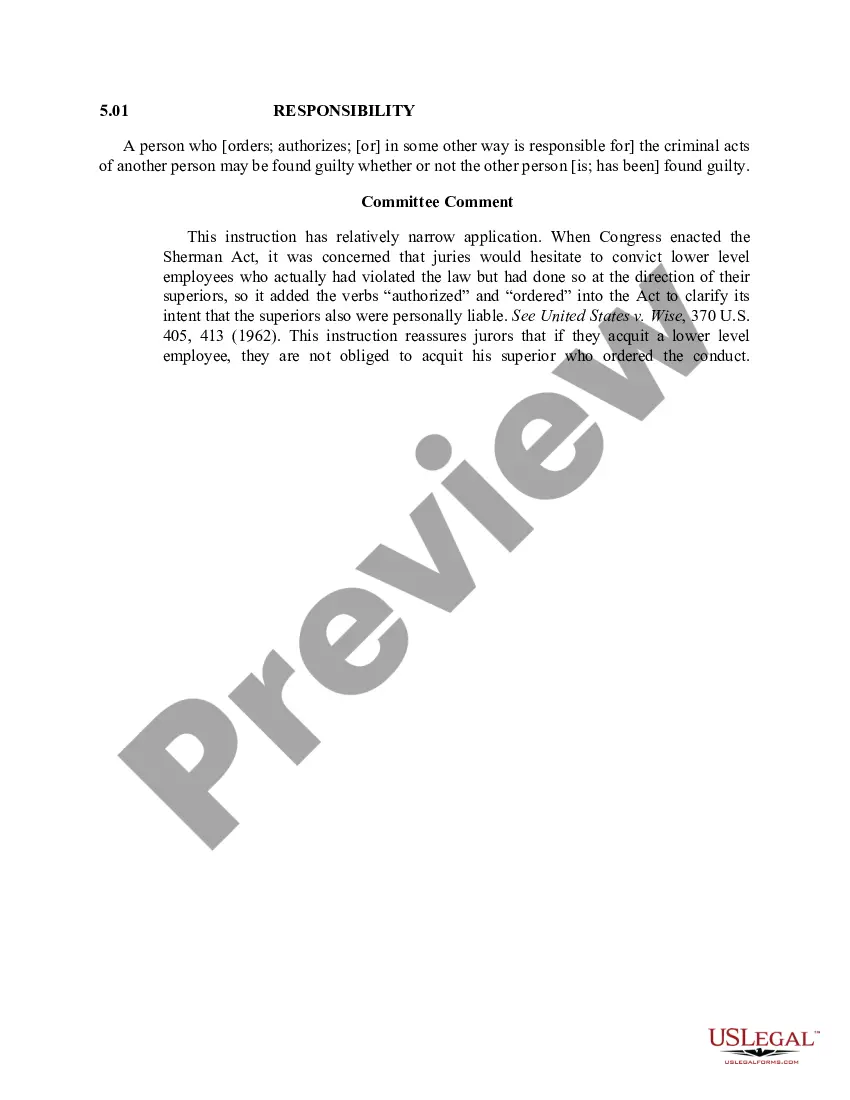
5.06 Job Titles
What this document covers
The 5.06 Job Titles form provides guidance on determining whether two jobs are "substantially equal." It differentiates between actual job requirements and job titles, emphasizing that job classifications and descriptions should not dictate equality. This form is essential for understanding equitable job evaluations in compliance with legal standards.
Main sections of this form
- Definition of "substantially equal" jobs
- Consideration of actual job requirements
- Emphasis on job titles not being controlling
- Relevant legal citations and committee comments



When to use this document
This form should be utilized during job evaluations or disputes concerning job classifications. It is particularly relevant in cases where job titles are questioned, or discrepancies in job duties exist. Employers can reference this form when assessing compliance with fair labor standards.
Intended users of this form
- Employers conducting job evaluations
- Human resources professionals
- Employees questioning job classifications
- Legal professionals assisting clients with employment law matters
Steps to complete this form
- Review the job descriptions of the positions in question.
- Assess the actual duties and responsibilities associated with each job.
- Compare the requirements based on skills, effort, and working conditions.
- Document any discrepancies in job classifications.
- Refer to the cited legal guidelines to support your evaluation.
Notarization requirements for this form
Notarization is not commonly needed for this form. However, certain documents or local rules may make it necessary. Our notarization service, powered by Notarize, allows you to finalize it securely online anytime, day or night.
Get your form ready online
Our built-in tools help you complete, sign, share, and store your documents in one place.
Make edits, fill in missing information, and update formatting in US Legal Forms—just like you would in MS Word.
Download a copy, print it, send it by email, or mail it via USPS—whatever works best for your next step.
Sign and collect signatures with our SignNow integration. Send to multiple recipients, set reminders, and more. Go Premium to unlock E-Sign.
If this form requires notarization, complete it online through a secure video call—no need to meet a notary in person or wait for an appointment.
We protect your documents and personal data by following strict security and privacy standards.

Make edits, fill in missing information, and update formatting in US Legal Forms—just like you would in MS Word.

Download a copy, print it, send it by email, or mail it via USPS—whatever works best for your next step.

Sign and collect signatures with our SignNow integration. Send to multiple recipients, set reminders, and more. Go Premium to unlock E-Sign.

If this form requires notarization, complete it online through a secure video call—no need to meet a notary in person or wait for an appointment.

We protect your documents and personal data by following strict security and privacy standards.
Common mistakes
- Relying solely on job titles without considering actual job duties.
- Ignoring relevant legal guidelines and case law.
- Failing to document comparisons between job responsibilities adequately.
Advantages of online completion
- Convenient access to essential legal guidelines at any time.
- Editability allows users to customize the evaluation process.
- Reliability of instructions drafted by licensed attorneys.
Looking for another form?
Form popularity
FAQ
The different job experience levels Entry-level. Intermediate. Mid-level. Senior or executive-level.
The hierarchy of corporate titles is: Chief Executive Officer (CEO) Chief Operating Officer (CEO)/Chief Technology Officer (CTO)/Chief Financial Officer (CFO) President.
A job code is a numeric number assigned to a job title and also indicates the type of employee classification it represents. The job description represents the minimal duties required of the position.
Inflated job title examples Director of first impressions: Receptionist. Loss prevention officer: Store security officer. Meat distribution engineer: Deli-counter staff. Waste removal engineer: Trash collector. Customer happiness hero: Customer service representative. Vision clearance engineer: Window washer.
A hierarchical structure is the chain of command within a company that begins with senior management and executives and extends to general employees. This organization of authority ensures management levels understand their relationships with each other and helps companies make efficient decisions.
For a job title structure, market and organisational-specific requirements are taken into account. Ideally, a job title should be structured as below: Rank + Title + Expertise. Senior + Specialist + Finance.
A: Currently, prefix designations (associate, no prefix, senior, etc.) are used to indicate an employee's level of experience in a job. A newly hired employee may have an associate prefix, whereas a seasoned employee doing the same job may have a senior prefix.
Hierarchy of executive titles Chief executive officer. Chief operating officer. Chief financial officer. Chief information officer. Chief innovation officer. Chief strategy officer. Chief compliance officer. Chief marketing officer.