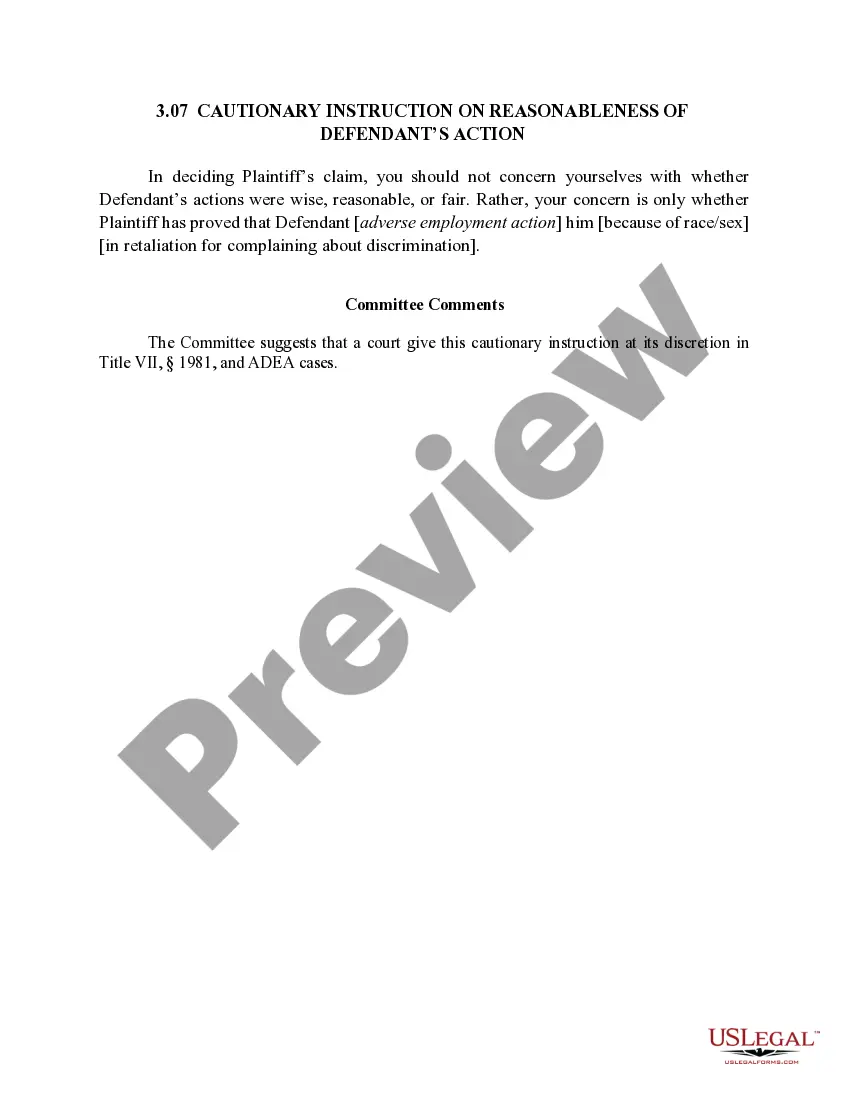
3.07 Cautionary Instruction on Reasonableness of Defendant's Action.
Overview of this form
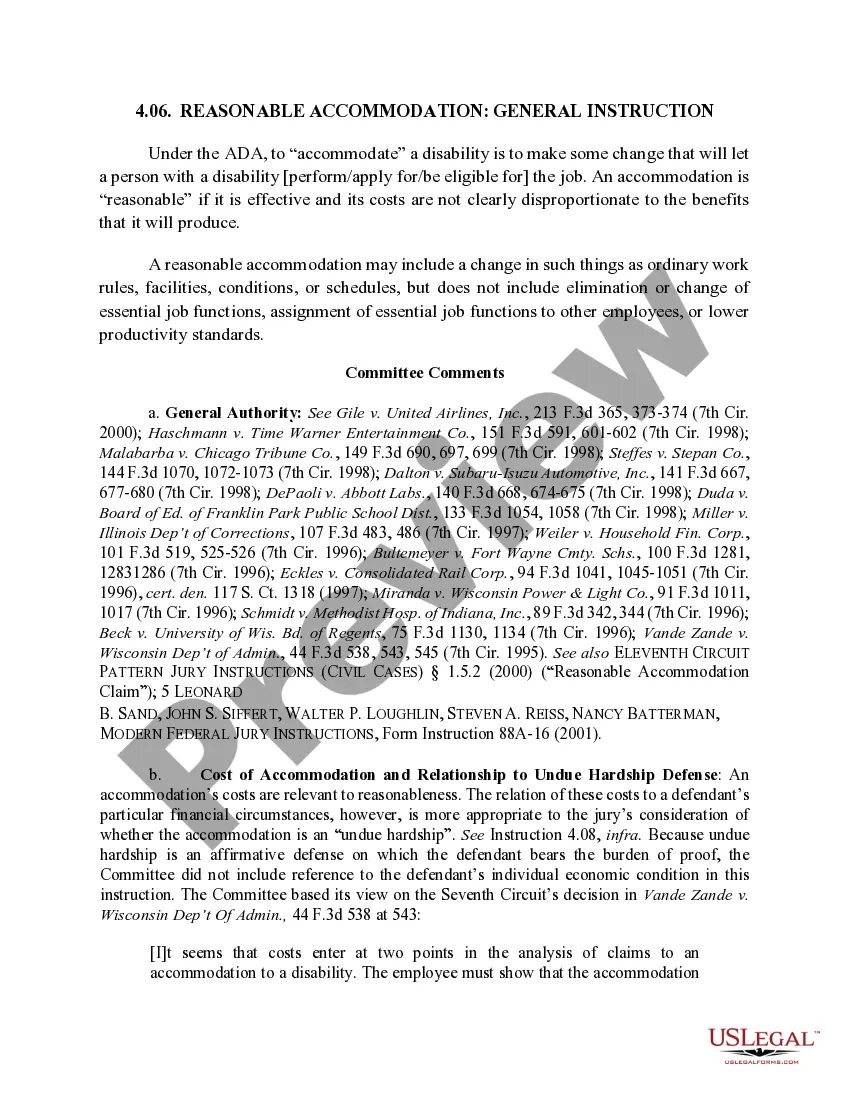
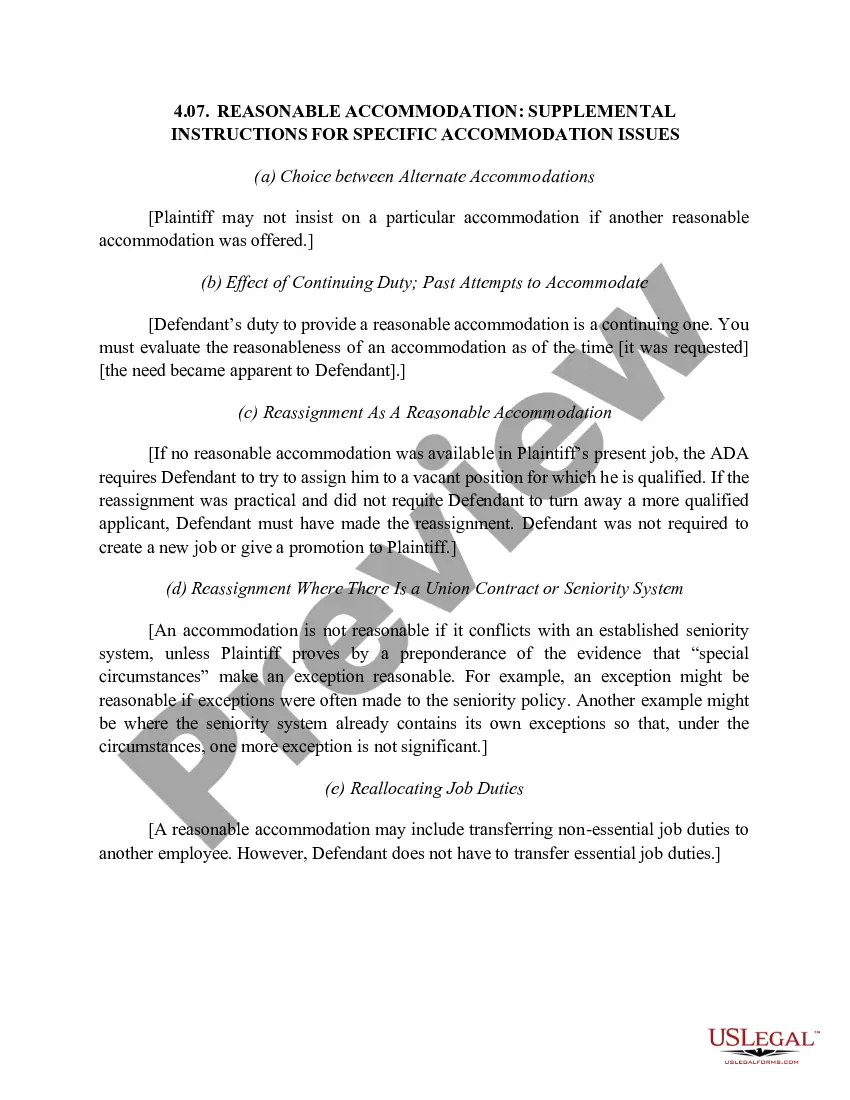
The 3.07 cautionary instruction on reasonableness of defendant's action is an official legal instruction adopted by the Federal 7th Circuit Court. Its purpose is to guide juries in evaluating claims of employment discrimination, clarifying that their decision should focus on whether the plaintiff proved adverse actions were taken against them due to race, sex, or retaliation, rather than whether the defendant's actions were wise or fair. This instruction is distinct from other legal forms in that it specifically addresses the jury's responsibility in Title VII, Section 1981, and ADEA cases.
Form components explained
- This instruction emphasizes the jurors' focus on evidence regarding the defendant's actions.
- It clarifies that the evaluation of the defendant's actions should not include a judgment of their reasonableness.
- It addresses specific grounds such as race, sex, and retaliation relevant to discrimination cases.
- The instruction is applicable at the discretion of the court in certain employment discrimination cases.

When to use this document
This cautionary instruction should be used during jury trials involving claims of employment discrimination. It is particularly relevant when the jury needs to make decisions based on whether a defendant's actions constituted adverse employment actions against the plaintiff, rather than assessing the wisdom or fairness of those actions. Situations may include cases where an employee alleges discrimination or retaliation due to their race or gender after complaining about workplace issues.
Who can use this document
- Attorneys representing plaintiffs or defendants in employment discrimination cases.
- Judges presiding over trials involving discrimination claims.
- Legal practitioners needing clear instructions for jury deliberation on discrimination-related lawsuits.
How to complete this form
- Review the specific allegations made by the plaintiff regarding adverse employment actions.
- Ensure the form is tailored to address the relevant grounds, such as race, sex, or retaliation.
- Select the appropriate case context, referencing Title VII, Section 1981, or ADEA as necessary.
- Include any additional jury instructions pertinent to the trial.
- Present this instruction clearly during jury deliberation to facilitate comprehension.
Does this document require notarization?
Notarization is generally not required for this form. However, certain states or situations might demand it. You can complete notarization online through US Legal Forms, powered by Notarize, using a verified video call available anytime.
Get your form ready online
Our built-in tools help you complete, sign, share, and store your documents in one place.
Make edits, fill in missing information, and update formatting in US Legal Forms—just like you would in MS Word.
Download a copy, print it, send it by email, or mail it via USPS—whatever works best for your next step.
Sign and collect signatures with our SignNow integration. Send to multiple recipients, set reminders, and more. Go Premium to unlock E-Sign.
If this form requires notarization, complete it online through a secure video call—no need to meet a notary in person or wait for an appointment.
We protect your documents and personal data by following strict security and privacy standards.

Make edits, fill in missing information, and update formatting in US Legal Forms—just like you would in MS Word.

Download a copy, print it, send it by email, or mail it via USPS—whatever works best for your next step.

Sign and collect signatures with our SignNow integration. Send to multiple recipients, set reminders, and more. Go Premium to unlock E-Sign.

If this form requires notarization, complete it online through a secure video call—no need to meet a notary in person or wait for an appointment.

We protect your documents and personal data by following strict security and privacy standards.
Common mistakes to avoid
- Failing to clarify the focus on evidence rather than the reasonableness of actions.
- Omitting relevant details regarding the specific adverse actions taken against the plaintiff.
- Not adapting the instruction to the specific laws applicable in the particular case.
Why complete this form online
- Convenience of accessing and downloading legal forms anytime.
- Editability to customize the form as needed for specific cases.
- Reliability, with forms drafted by licensed attorneys ensuring accuracy and compliance with legal standards.
Legal use & context
- This instruction is intended for use in federal discrimination lawsuits, reinforcing jury focus on factual elements of a case.
- It supports legal proceedings under federal laws like Title VII, Section 1981, and ADEA.
- Proper use of the instruction may influence outcomes in jury verdicts regarding discriminatory practices.
Looking for another form?
Form popularity
FAQ
Proof beyond a reasonable doubt is proof that leaves you firmly convinced the defendant is guilty. It is not required that the government prove guilt beyond all possible doubt. A reasonable doubt is a doubt based upon reason and common sense and is not based purely on speculation.
To be ?undue,? the influence exerted upon the settlor must be of such a degree that it overpowered the settlor's free choice and caused him/her to act against his/ her own free will and to act in ance with the will of the person/persons who influenced him/her.
Before you can return a verdict of guilty, the evidence must satisfy you beyond a reasonable doubt that the defendant is guilty. If you can reconcile the evidence upon any reasonable hypothesis consistent with the defendant's innocence,2 you should do so and return a verdict of not guilty.
Verbiage in particular for North Carolina is as follows: ?A reasonable doubt is a doubt based on reason and common sense, arising out of some or all of the evidence that has been presented, or lack or insufficiency of the evidence, as the case may be.
An example of this would be a trial for manslaughter in which the prosecution was only able to convince the jury panel that you had a 75% chance of committing the crime. Because the jury is 25% uncertain, the prosecution was not successful in proving beyond a reasonable doubt that you are guilty.
Presumption of Innocence; Proof Beyond a Reasonable Doubt. It is a cardinal principle of our system of justice that every person accused of a crime is presumed to be innocent unless and until his or her guilt is established beyond a reasonable doubt.
"The unclean hands doctrine demands that a plaintiff act fairly in the matter for which he seeks a remedy. He must come into court with clean hands, and keep them clean, or he will be denied relief, regardless of the merits of his claim." (Kendall-Jackson Winery, Ltd.
Reasonable doubt is defined in the California Jury Instructions (CALCRIM) and the Penal Code. The trial judge will inform the jury that: The fact that a criminal charge has been filed against the defendant is not evidence that the charge is true.