2.09 Use of Interrogatories .
Overview of this form
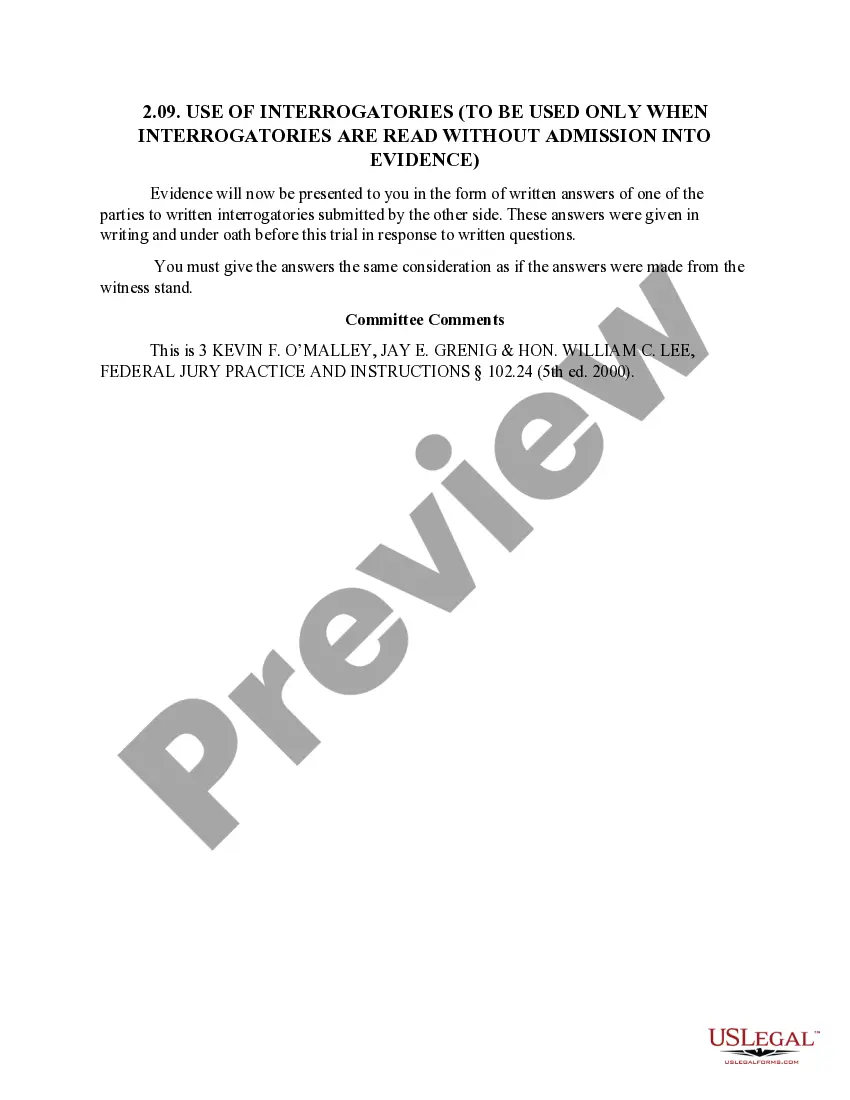
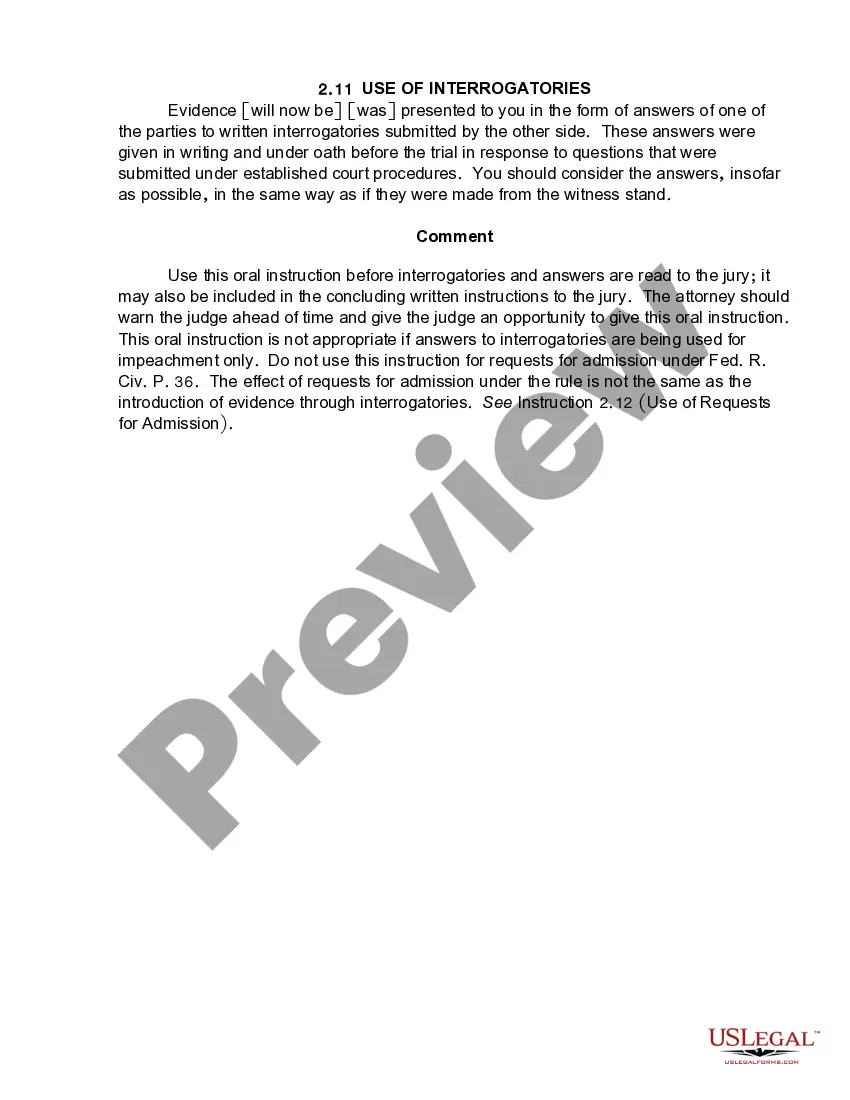
The 2.09 Use of Interrogatories form is an official pattern jury instruction adopted by the Federal 7th Circuit Court. This form allows evidence to be presented in the form of written answers from one party to interrogatories submitted by the opposing side. These answers, given under oath before the trial, are treated with the same weight as if provided by a witness on the stand. This form is specifically intended for use when presenting interrogatories without them being admitted as evidence, distinguishing it from forms used solely for evidence presentation.
What’s included in this form
- Introduction to the use of written answers to interrogatories.
- Specification that answers were given under oath prior to the trial.
- Instruction to the jury on how to evaluate the written responses.
- Emphasis that these answers are treated as serious as oral testimony.

Situations where this form applies
This form should be used in legal proceedings where one party has submitted written interrogatories to another party. It is particularly relevant in civil lawsuits, where written responses are indispensable for establishing facts in the case. If you are expecting to present these responses without them being formally admitted into evidence, this form is appropriate.
Who this form is for
- Attorneys handling civil cases in federal court.
- Litigants needing to present written evidence via interrogatories.
- Parties involved in legal disputes who require structured guidelines on using interrogatories as evidence.
Steps to complete this form
- Identify the parties involved in the case.
- Collect the written interrogatories that were submitted.
- Ensure all written answers are signed and dated under oath.
- Present the responses in the courtroom as instructed.
- Follow any additional instructions provided by the judge regarding the submission of this evidence.
Does this form need to be notarized?
This form usually doesn’t need to be notarized. However, local laws or specific transactions may require it. Our online notarization service, powered by Notarize, lets you complete it remotely through a secure video session, available 24/7.
Get your form ready online
Our built-in tools help you complete, sign, share, and store your documents in one place.
Make edits, fill in missing information, and update formatting in US Legal Forms—just like you would in MS Word.
Download a copy, print it, send it by email, or mail it via USPS—whatever works best for your next step.
Sign and collect signatures with our SignNow integration. Send to multiple recipients, set reminders, and more. Go Premium to unlock E-Sign.
If this form requires notarization, complete it online through a secure video call—no need to meet a notary in person or wait for an appointment.
We protect your documents and personal data by following strict security and privacy standards.

Make edits, fill in missing information, and update formatting in US Legal Forms—just like you would in MS Word.

Download a copy, print it, send it by email, or mail it via USPS—whatever works best for your next step.

Sign and collect signatures with our SignNow integration. Send to multiple recipients, set reminders, and more. Go Premium to unlock E-Sign.

If this form requires notarization, complete it online through a secure video call—no need to meet a notary in person or wait for an appointment.

We protect your documents and personal data by following strict security and privacy standards.
Mistakes to watch out for
- Submitting answers without verification that they are signed under oath.
- Failing to present the interrogatories in an organized manner.
- Not properly instructing the jury on how to evaluate the answers.
Why complete this form online
- Convenient access to the form at any time.
- Editability to customize responses according to your needs.
- Reliable format compliant with federal guidelines.
Looking for another form?


Form popularity
FAQ
' Much of the conflict has centered on Rule 33(a), which provides that "any party may serve upon any other party written interrogatories, not ex- ceeding 25 in numberto be answered by the party served." The Rule's language indicates that each party of a civil suit may serve up to twenty-five interrogatories upon
Interrogatories are lists of questions sent to the other party that s/he must respond to in writing. You can use interrogatories to find out facts about a case but they cannot be used for questions that draw a legal conclusion.
What are Interrogatories? Texas Rules of Civil Procedure 197 governs Interrogatories. Interrogatories are written questions sent by one party to another to gather specific information about details of specific events, occurrences, and more.
Where a solicitor or his partner acts as solicitor for any party to any proceeding, or is a party to any proceeding, that solicitor shall not, without the leave of the Court, act for any other party to the proceedings not in the same interest.
Civ. P. 33(c) allows a responding party to substitute access to documents or electronically stored information for an answer only if the burden of deriving the answer will be substantially the same for either party.
Rule 33(d) states that a party electing to respond to an interrogatory by providing electronically stored information must ensure that the interrogating party can locate and identify it ?as readily as can the party served,? and that the responding party must give the interrogating party a ?reasonable opportunity to
The rule provides that a request for inspection shall set forth the items to be inspected either by item or category, describing each with reasonable particularity, and shall specify a reasonable time, place, and manner of making the inspection.
An interrogatory is a written question on a relevant issue, submitted by one of the parties in a civil proceeding to the other before the trial, requiring a written response, usually on oath. Interrogatories are part of the discovery process, and may be tendered as evidence to support the case of the inquirer.