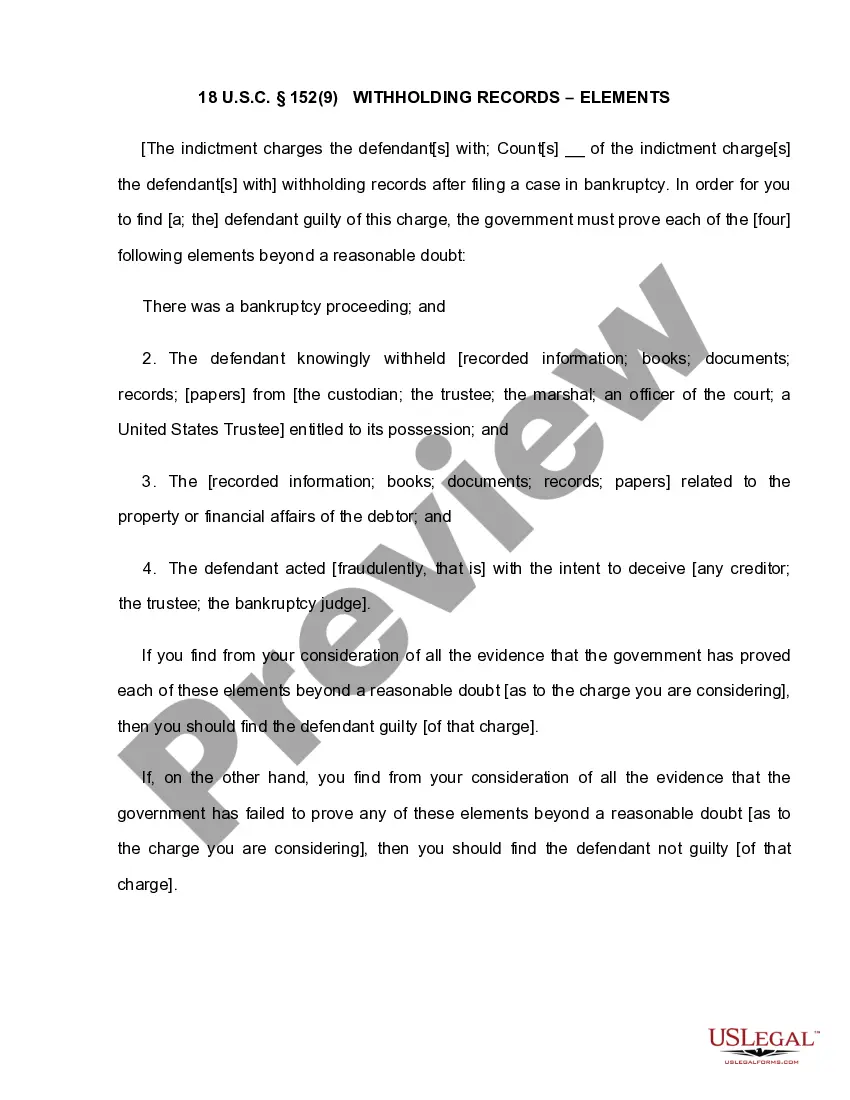
18 U.S.C. Sec. 152(9) WITHHOLDING RECORDS - ELEMENTS
Notarization requirements for this form
This form does not typically require notarization to be legally valid. However, some jurisdictions or document types may still require it. US Legal Forms provides secure online notarization powered by Notarize, available 24/7 for added convenience.
Get your form ready online
Our built-in tools help you complete, sign, share, and store your documents in one place.
Make edits, fill in missing information, and update formatting in US Legal Forms—just like you would in MS Word.
Download a copy, print it, send it by email, or mail it via USPS—whatever works best for your next step.
Sign and collect signatures with our SignNow integration. Send to multiple recipients, set reminders, and more. Go Premium to unlock E-Sign.
If this form requires notarization, complete it online through a secure video call—no need to meet a notary in person or wait for an appointment.
We protect your documents and personal data by following strict security and privacy standards.

Make edits, fill in missing information, and update formatting in US Legal Forms—just like you would in MS Word.

Download a copy, print it, send it by email, or mail it via USPS—whatever works best for your next step.

Sign and collect signatures with our SignNow integration. Send to multiple recipients, set reminders, and more. Go Premium to unlock E-Sign.

If this form requires notarization, complete it online through a secure video call—no need to meet a notary in person or wait for an appointment.

We protect your documents and personal data by following strict security and privacy standards.
Looking for another form?
Form popularity
FAQ
18 U.S.C. § 152 "attempts to cover all the possible methods by which a bankrupt or any other person may attempt to defeat the Bankruptcy Act through an effort to keep assets from being equitably distributed among creditors." Stegeman v.
18 U.S. Code § 152 - Concealment of assets; false oaths and claims; bribery.
§ 157 prohibits devising or intending to devise a scheme or artifice to defraud and, for purposes of executing or concealing the scheme either (1) filing a bankruptcy petition; (2) filing a document in a bankruptcy proceeding; or (3) making a false statement, claim, or promise (a) in relationship to a bankruptcy
A qualifying relative. If an individual is a dependent of a taxpayer for any taxable year of such taxpayer beginning in a calendar year, such individual shall be treated as having no dependents for any taxable year of such individual beginning in such calendar year.
§ 152(4) Subsection (4) of Section 152 sets out the offense of filing a false bankruptcy claim. A "claim" is a document filed in a bankruptcy proceeding by a creditor of the debtor.