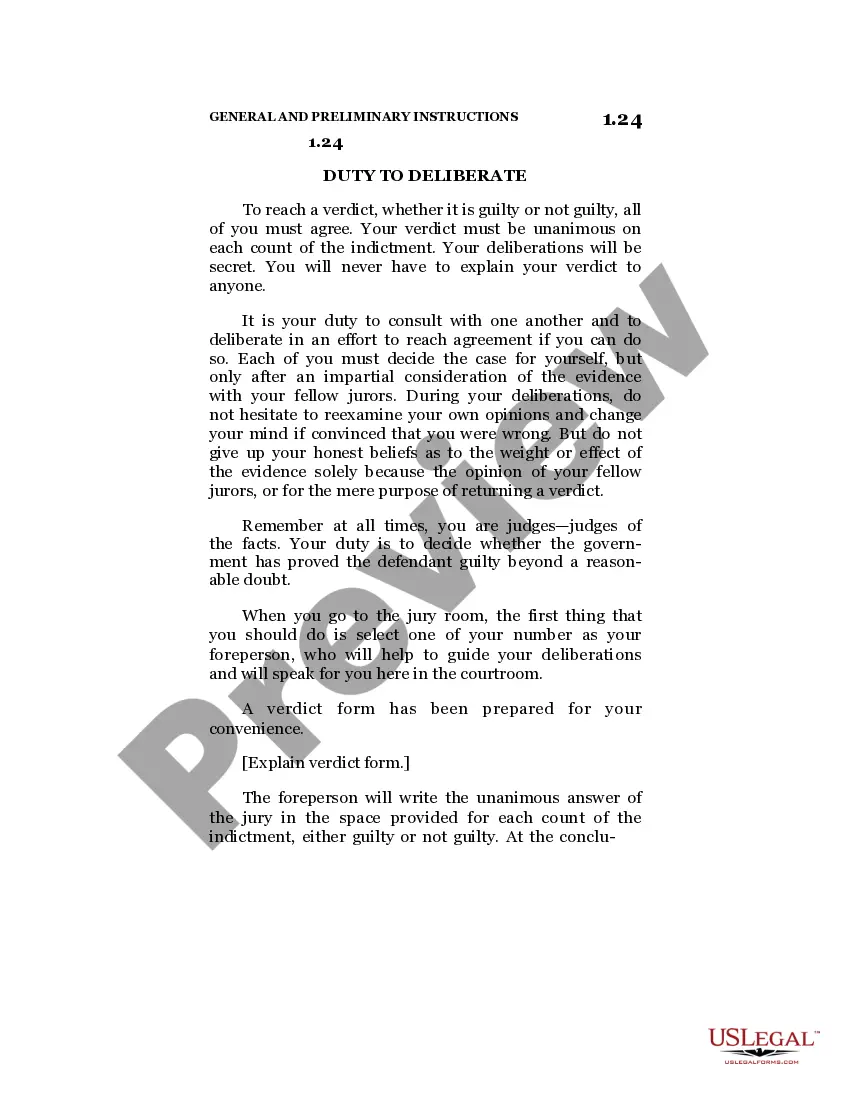
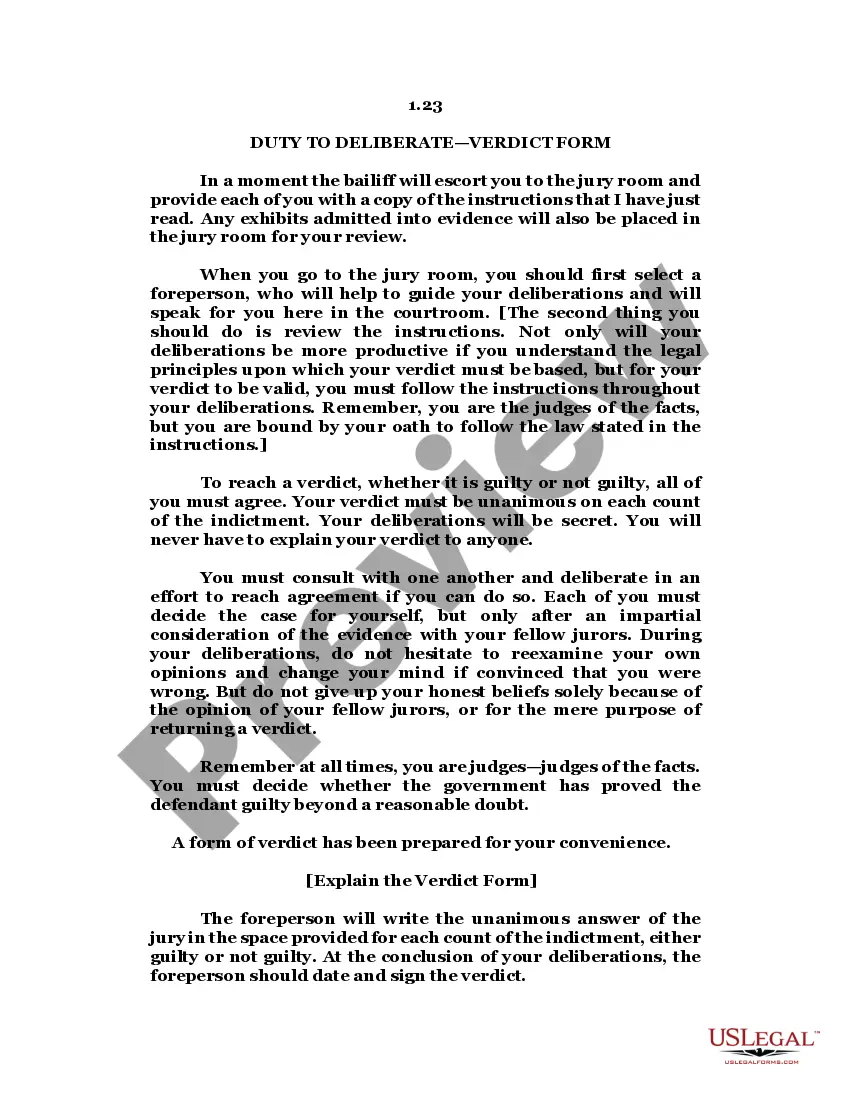
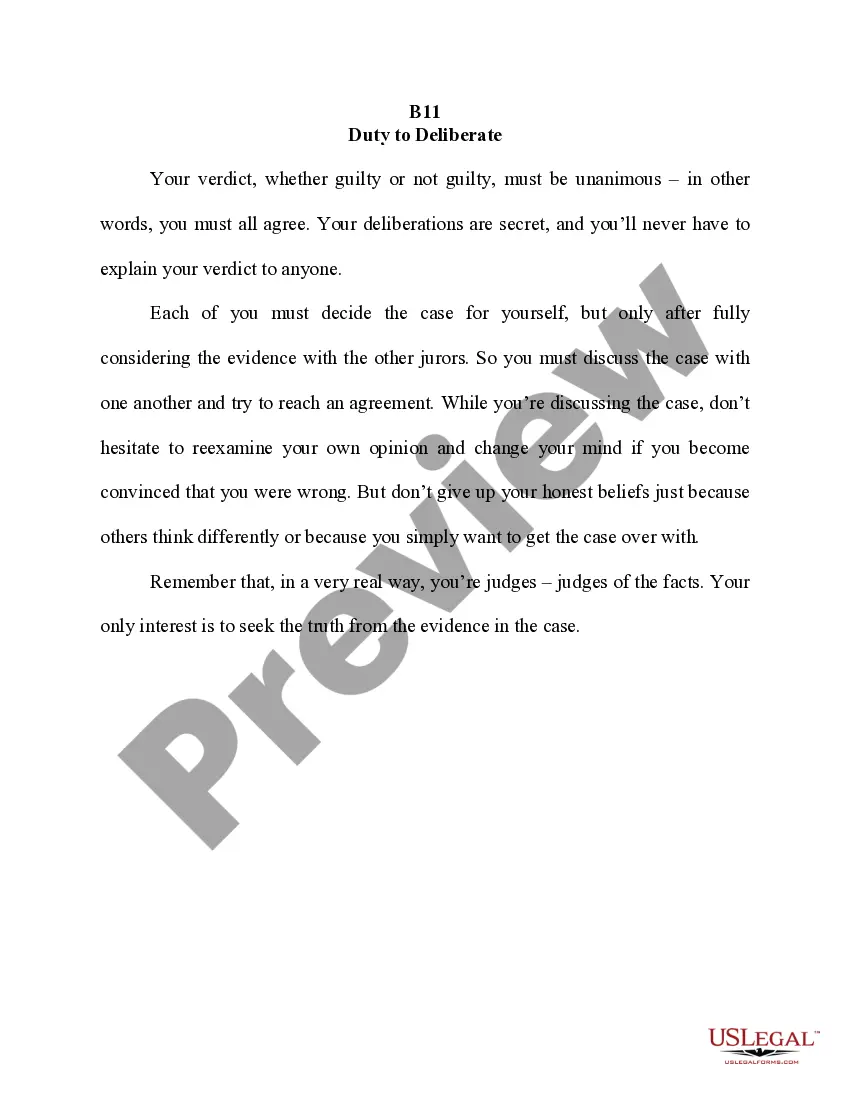
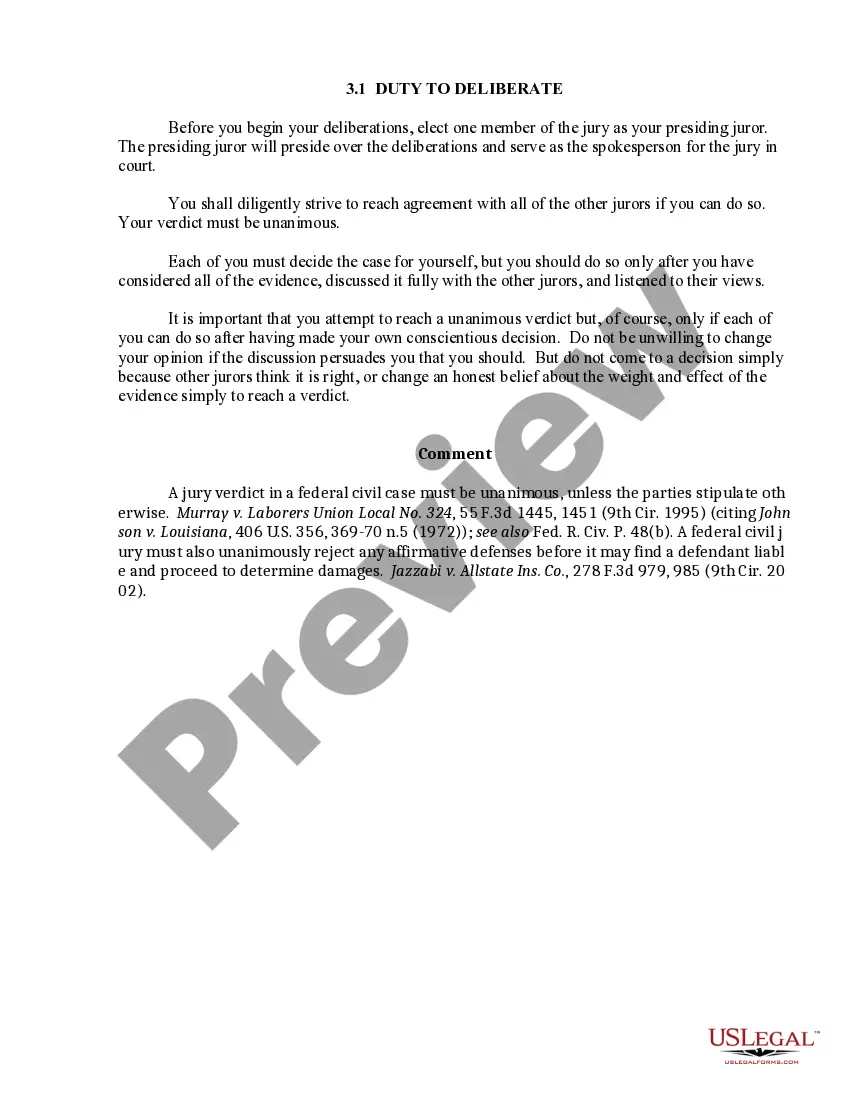
DUTY TO DELIBERATE
Overview of this form
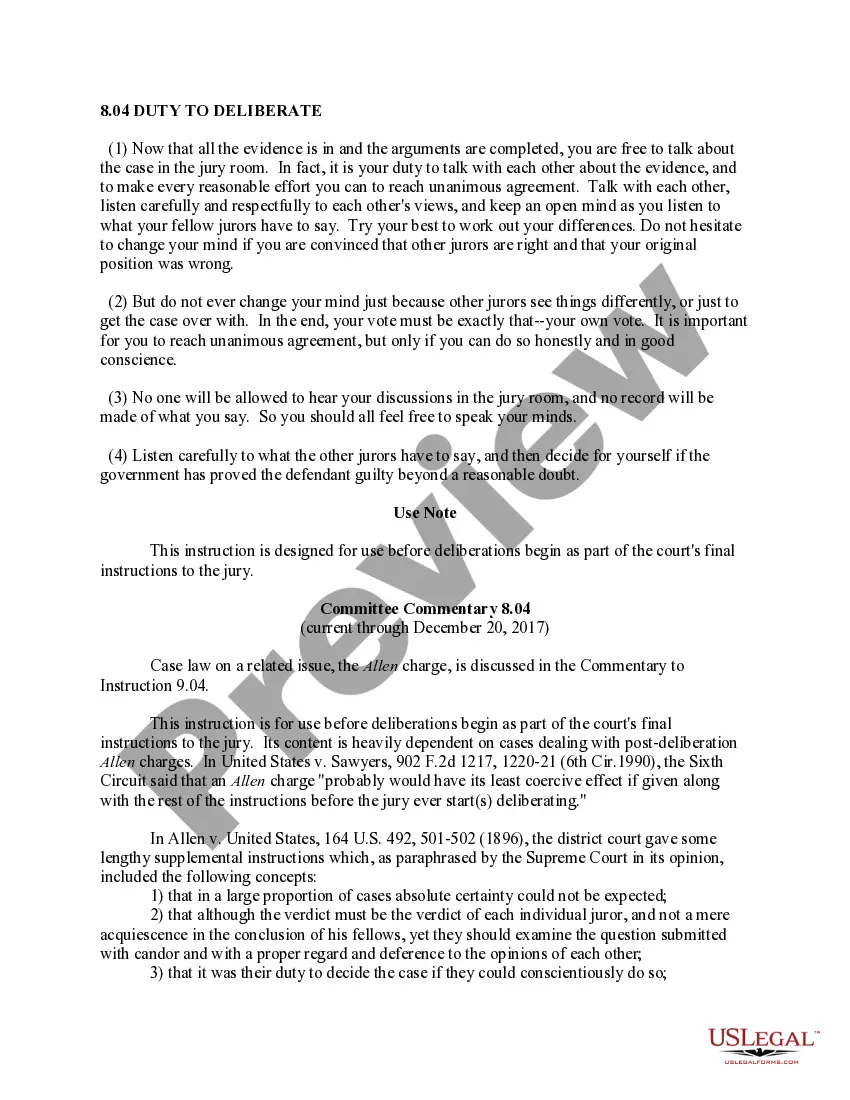
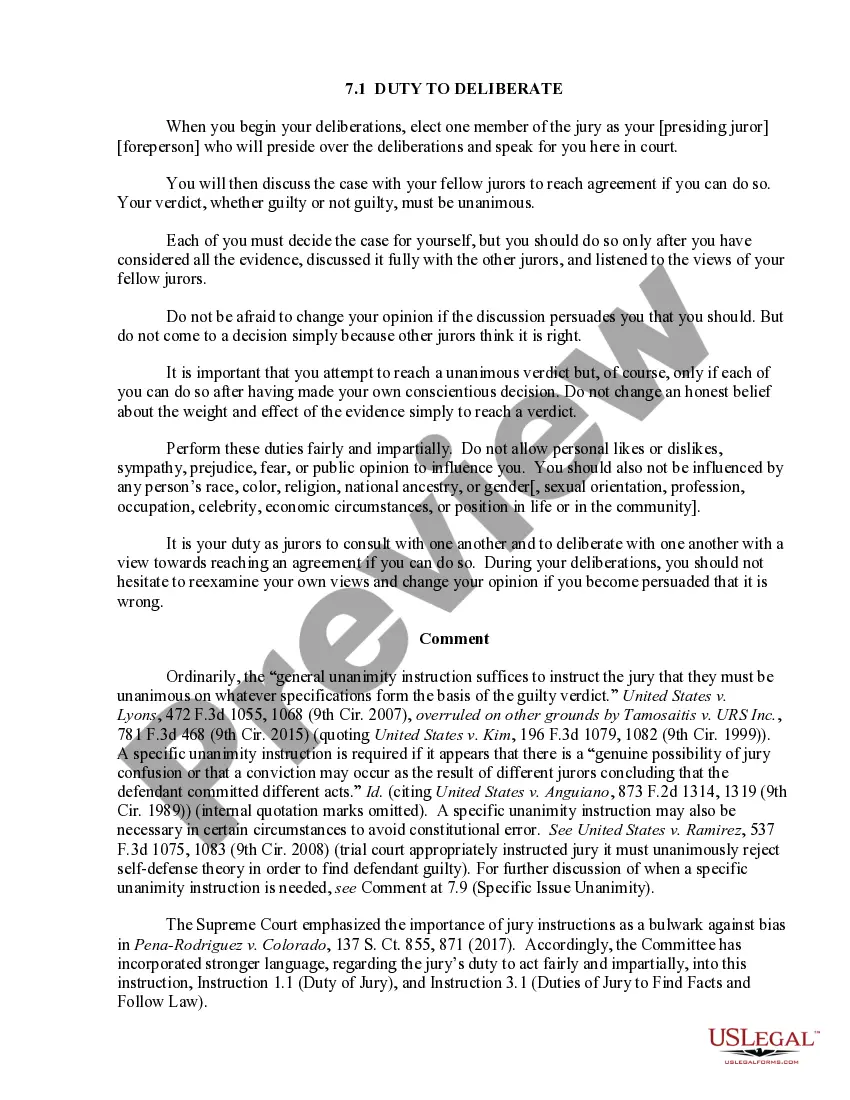
The Duty to Deliberate form is a critical document used in jury trials to guide jurors in their decision-making process. This form outlines the responsibilities of jurors to discuss evidence openly and reach a unanimous verdict while ensuring that each jurorâs individual judgment is respected. Unlike other jury instructions, this form emphasizes the importance of reaching a consensus based on honest deliberation, making it essential for maintaining the integrity of the trial process.
Main sections of this form
- Communication mandate: Jurors are required to discuss the evidence and share their views in the jury room.
- Unanimous verdict requirement: The form stresses the need for jurors to work towards a unanimous decision while respecting individual opinions.
- Confidentiality assurance: Jurors can freely express their thoughts without fear of outside influence as discussions are private.
- Governmentâs burden of proof: Jurors must determine guilt based on whether the evidence proves the defendantâs guilt beyond a reasonable doubt.
- Openness to persuasion: Jurors are encouraged to maintain an open mind and consider each other's viewpoints during deliberations.
When this form is needed
This form should be used in criminal trials before jury deliberations begin. It provides jurors with essential guidelines on how to approach their discussions and make decisions based on the evidence presented. It is particularly relevant when jurors may face challenges in reaching a unanimous verdict, ensuring that the deliberation process is fair, thorough, and respectful of each jurorâs beliefs.
Who this form is for
The Duty to Deliberate form is intended for:
- Jurors participating in criminal trials.
- Court administrators responsible for jury instructions.
- Legal professionals involved in trial procedures.
- Judges providing final instructions to juries.
How to prepare this document
To properly utilize the Duty to Deliberate form, follow these steps:
- Gather all jurors in the designated jury room to begin discussions.
- Encourage open dialogue about the evidence presented during the trial.
- Emphasize the importance of reaching a unanimous verdict.
- Monitor discussions to ensure that all jurors feel free to express their opinions without judgment.
- Focus discussions on the burden of proof, assessing whether the evidence establishes guilt beyond a reasonable doubt.
Is notarization required?
In most cases, this form does not require notarization. However, some jurisdictions or signing circumstances might. US Legal Forms offers online notarization powered by Notarize, accessible 24/7 for a quick, remote process.
Get your form ready online
Our built-in tools help you complete, sign, share, and store your documents in one place.
Make edits, fill in missing information, and update formatting in US Legal Forms—just like you would in MS Word.
Download a copy, print it, send it by email, or mail it via USPS—whatever works best for your next step.
Sign and collect signatures with our SignNow integration. Send to multiple recipients, set reminders, and more. Go Premium to unlock E-Sign.
If this form requires notarization, complete it online through a secure video call—no need to meet a notary in person or wait for an appointment.
We protect your documents and personal data by following strict security and privacy standards.

Make edits, fill in missing information, and update formatting in US Legal Forms—just like you would in MS Word.

Download a copy, print it, send it by email, or mail it via USPS—whatever works best for your next step.

Sign and collect signatures with our SignNow integration. Send to multiple recipients, set reminders, and more. Go Premium to unlock E-Sign.

If this form requires notarization, complete it online through a secure video call—no need to meet a notary in person or wait for an appointment.

We protect your documents and personal data by following strict security and privacy standards.
Mistakes to watch out for
- Failing to engage all jurors in discussions can lead to incomplete consensus.
- Allowing personal biases to overshadow evidence can skew the deliberation process.
- Not respecting differing opinions may lead to coercion and mistrust among jurors.
Benefits of using this form online
- Convenience of having a structured guide for juror discussions.
- Ensures that all jurors understand their responsibilities and rights during deliberations.
- Enhances the likelihood of reaching a fair and just verdict through organized deliberation.
- The Duty to Deliberate form is legally recognized and ensures compliance with jury deliberation standards.
- Using this form supports the fundamental legal principle that each jurorâs voice matters in the decision-making process.
- It protects the rights of defendants by fostering a fair deliberation environment.
Quick recap
- The Duty to Deliberate form guides jurors on their responsibilities during deliberations.
- Open discussion, respect for differing opinions, and unanimous agreement are emphasized.
- This form should be utilized in all jury trials before deliberation begins.
Looking for another form?

Form popularity
FAQ
Follow the judge's instructions about the law. Respect each other's opinions, and value the different viewpoints you each bring to the case. Know that it is okay to change your mind. Listen to one another, do not let yourself be bullied into changing your opinion, and do not bully anyone else.
2.6. If even one member of the jury panel disagrees with the rest, the jury is hung, and the defendant retains the presumption of innocence. A ?hung jury? results in either: a mistrial (which means there may be a retrial with a new jury), a plea bargain to a reduced charge that carries a lesser sentence, or.
In the end, a long deliberation really just means the jurors are taking their time to go through the evidence and discuss their positions. This can end in either a guilty or not guilty verdict. A long jury deliberation could mean the jurors are at an impasse or a deadlock.
The goal of jury deliberation is agreement on a verdict, but no juror should try to force another to adopt his/her position. Courteous and reasonable discussion will usually make it possible to reach agreement.
If used as a verb, it refers to the action of analyzing or carefully considering the evidence, facts, the law, or other matters. For example, a jury that deliberates on a verdict in a criminal case.
There is no set time limit for jury deliberations. Once testimony has concluded and the jury has been given the charge ? the judge's written instructions on the law ? the ball is in the jury's court.
Excuse from Service You have no means of transportation. You would have to travel an excessive distance to the courthouse. You have a physical or mental impairment. You provide care for a dependent and cannot afford to have someone cover for you. Serving would be an extreme financial burden.
Question 1: What was the shortest time taken by a jury to make its decision? Unbelievably, one minute! ing to Guinness World Records, on 22 July 2004 Nicholas McAllister was acquitted in New Zealand's Greymouth District Court of growing cannabis plants.