Duty to Deliberate
What this document covers
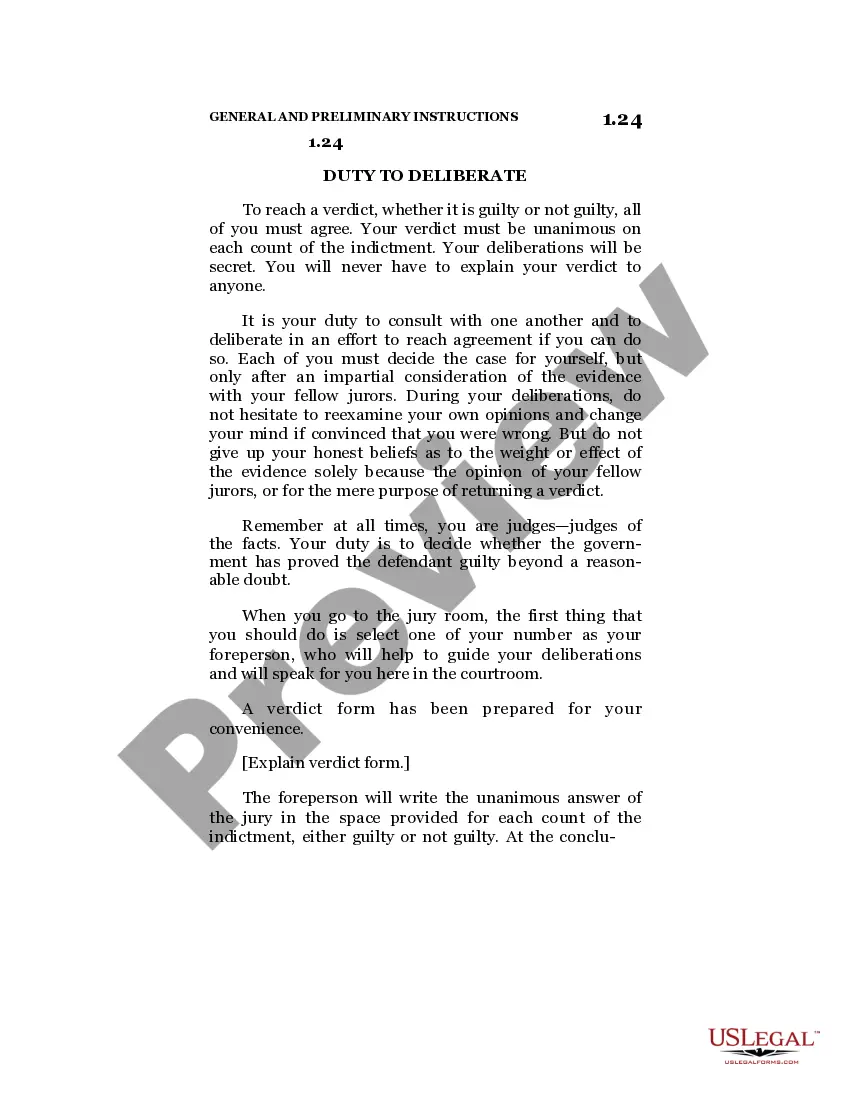
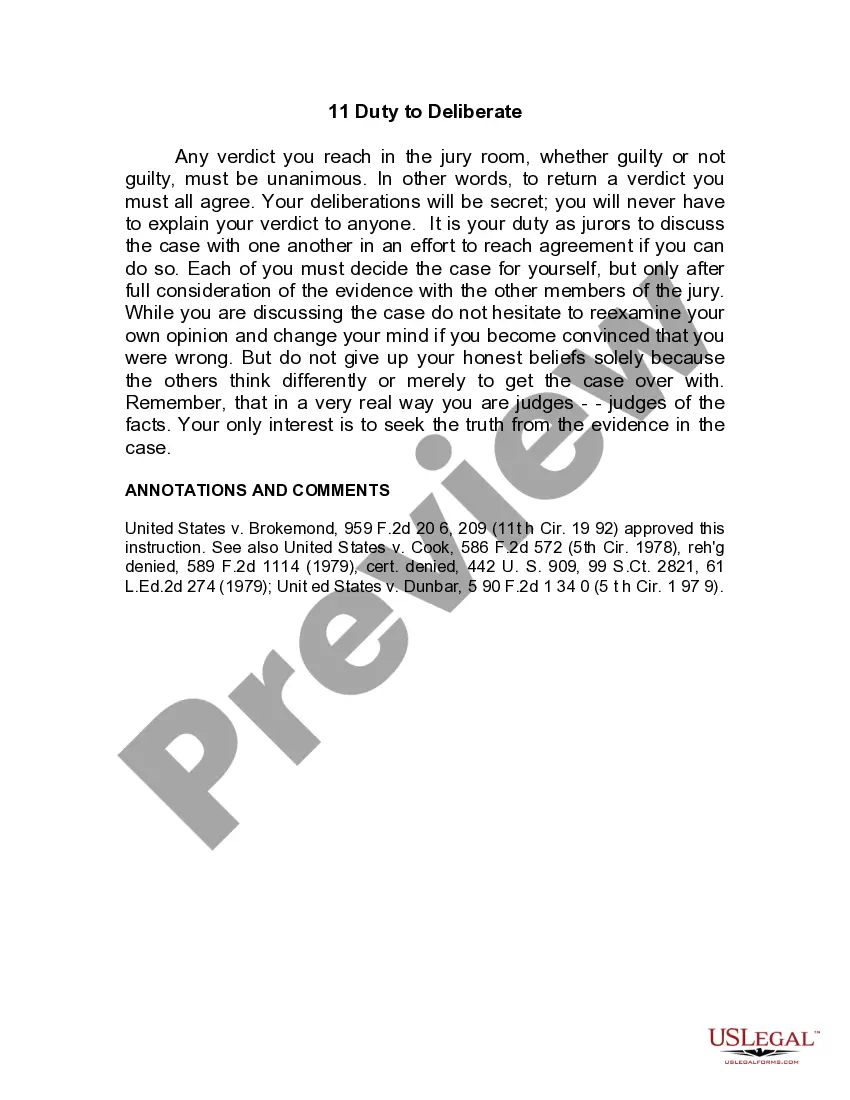
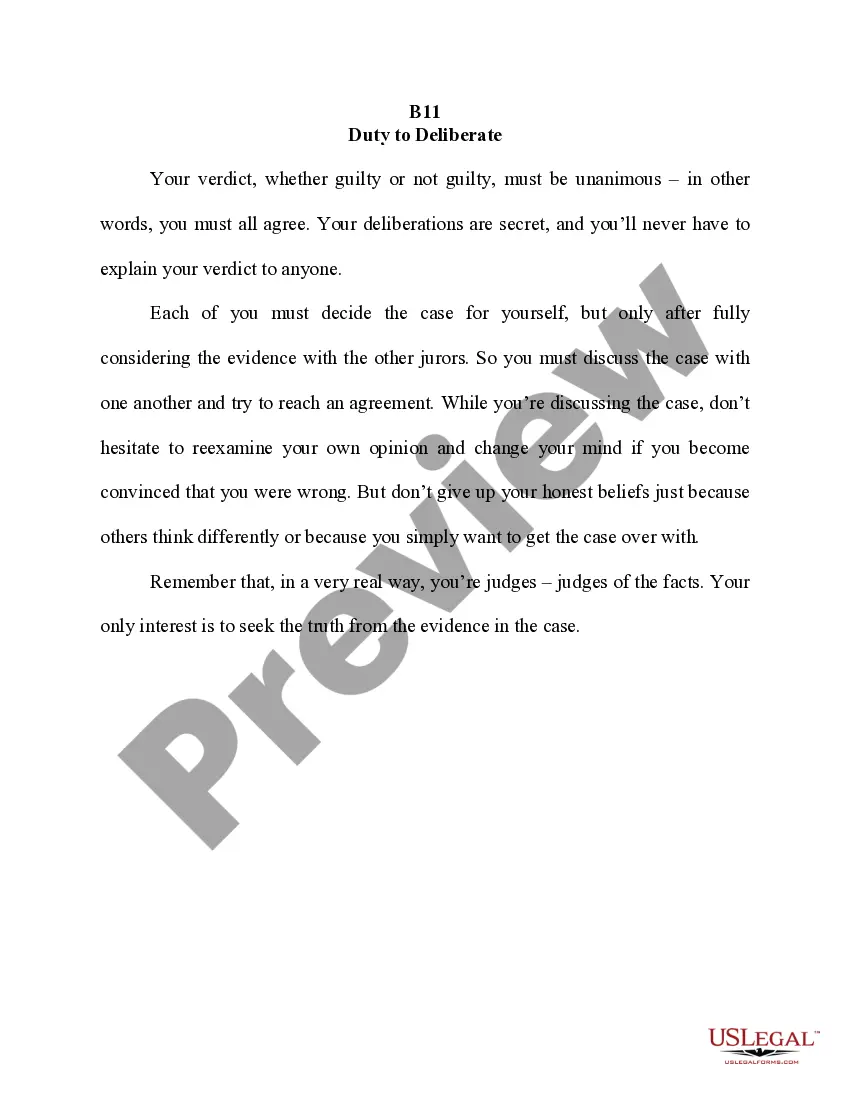
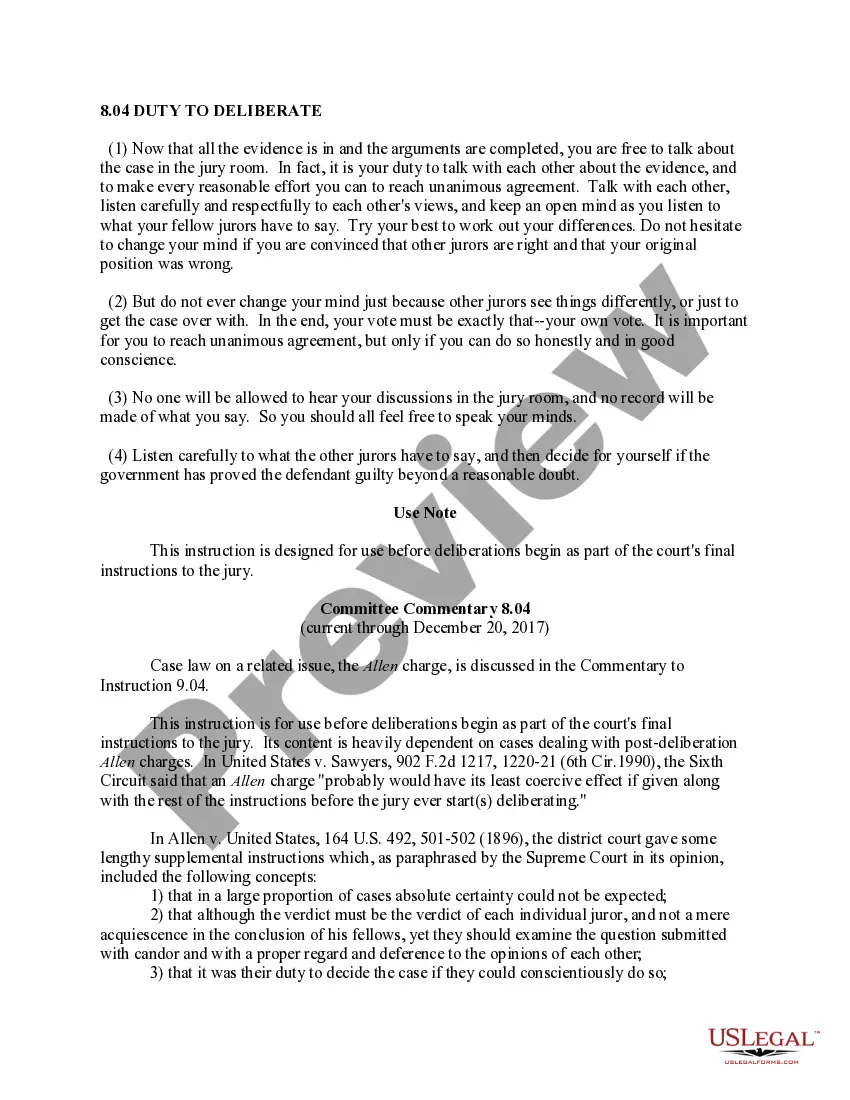
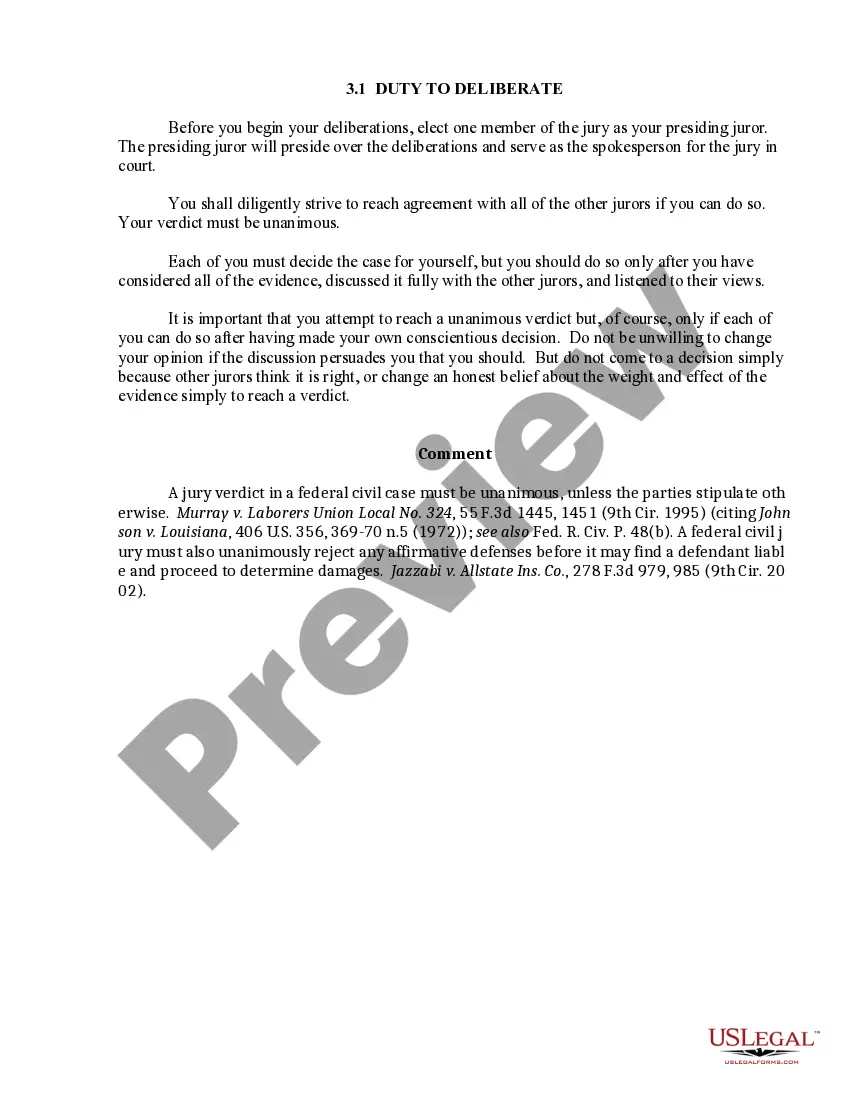
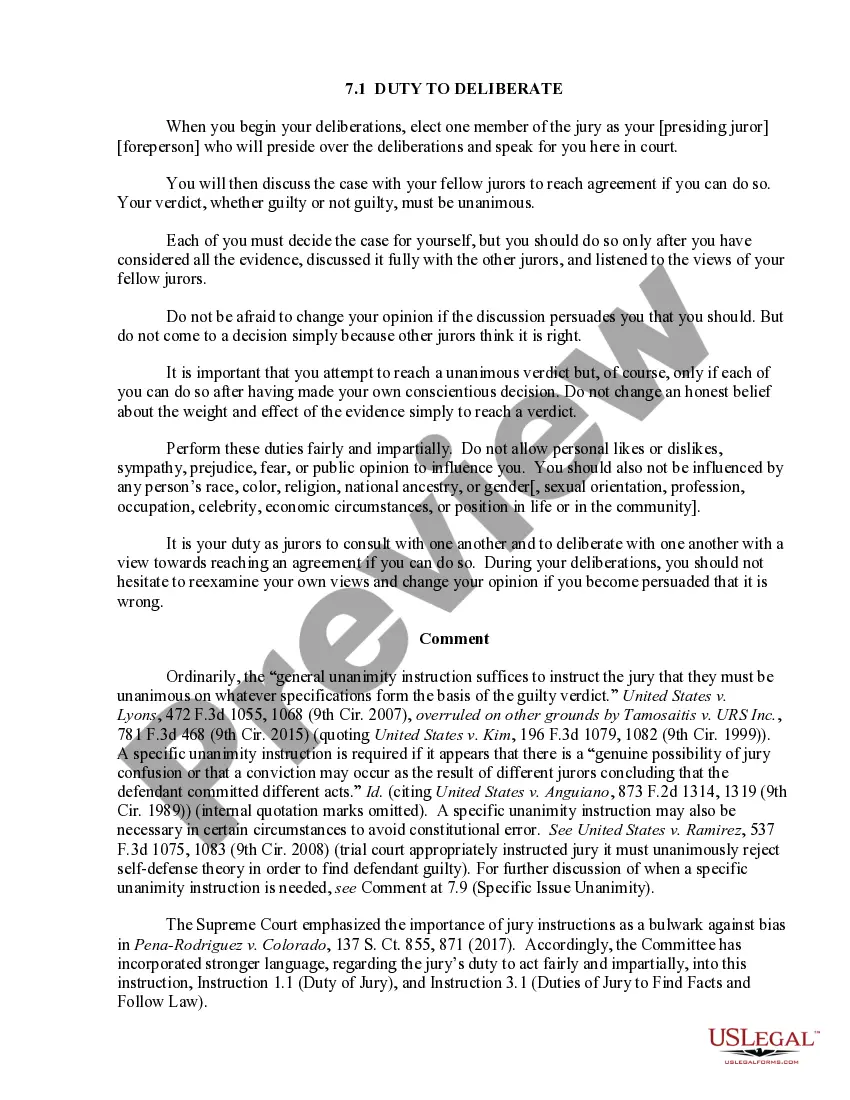
The Duty to Deliberate form outlines the essential responsibilities of jurors during their deliberation process. This form emphasizes the requirement for jurors to reach a unanimous verdict, whether guilty or not guilty, based on collaborative discussions. Unlike other legal forms, this document specifically addresses the procedures that juries must follow in determining the outcome of a trial, ensuring fairness and justice within the legal system.
Key parts of this document
- Instructions for reaching a unanimous verdict on each count of the indictment.
- Guidelines for jurors on consulting and deliberating with fellow jurors.
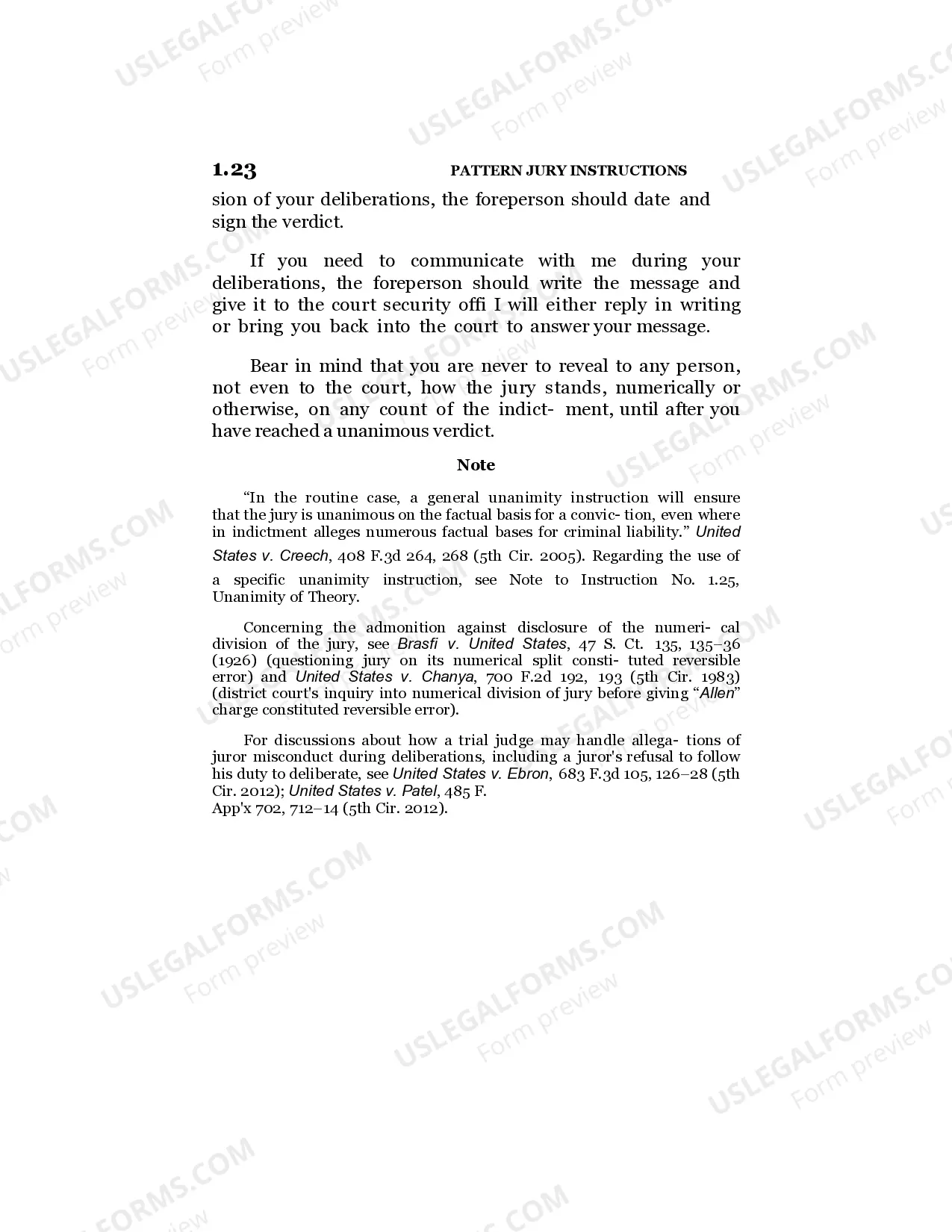
- An explanation of the role of the foreperson in guiding discussions and recording the verdict.
- Directions for maintaining the confidentiality of jury deliberations.
- Instructions for notifying the court if communication is needed during deliberations.
When to use this document
This form is used during jury trials to educate jurors about their responsibilities in the deliberation process. It should be utilized whenever jurors are instructed to reach a decision based on the evidence presented during the trial, ensuring they understand the importance of a unanimous verdict.
Intended users of this form
This form is intended for:
- Jurors selected to serve on a jury during a criminal trial.
- Court officials who instruct juries on the legal requirements of deliberation.
- Legal practitioners seeking to understand jury functions in trials.
How to prepare this document
- Read the instructions thoroughly to understand your responsibilities as a juror.
- Select a foreperson among your group who will facilitate discussions.
- Engage in discussions with fellow jurors, sharing thoughts and considerations regarding the case.
- Reevaluate your perspectives and be open to changing your opinion based on the deliberations.
- After reaching a unanimous decision, ensure the foreperson records the verdict on the provided form.
- Sign and date the verdict form before presenting it to the court.
Does this form need to be notarized?
This form does not typically require notarization to be legally valid. However, some jurisdictions or document types may still require it. US Legal Forms provides secure online notarization powered by Notarize, available 24/7 for added convenience.
Get your form ready online
Our built-in tools help you complete, sign, share, and store your documents in one place.
Make edits, fill in missing information, and update formatting in US Legal Forms—just like you would in MS Word.
Download a copy, print it, send it by email, or mail it via USPS—whatever works best for your next step.
Sign and collect signatures with our SignNow integration. Send to multiple recipients, set reminders, and more. Go Premium to unlock E-Sign.
If this form requires notarization, complete it online through a secure video call—no need to meet a notary in person or wait for an appointment.
We protect your documents and personal data by following strict security and privacy standards.

Make edits, fill in missing information, and update formatting in US Legal Forms—just like you would in MS Word.

Download a copy, print it, send it by email, or mail it via USPS—whatever works best for your next step.

Sign and collect signatures with our SignNow integration. Send to multiple recipients, set reminders, and more. Go Premium to unlock E-Sign.

If this form requires notarization, complete it online through a secure video call—no need to meet a notary in person or wait for an appointment.

We protect your documents and personal data by following strict security and privacy standards.
Common mistakes
- Not understanding the requirement for a unanimous verdict can lead to confusion.
- Miscommunication among jurors may hinder effective deliberation.
- Failing to maintain confidentiality during discussions can violate court rules.
Why complete this form online
- Convenient access to legal instructions anytime and anywhere.
- Easy to download and print for use during jury deliberations.
- Provided templates ensure clarity and compliance with legal standards.
Legal use & context
This form is critical in maintaining the integrity of the jury process. Jurors are legally bound to follow the instructions provided, and a misuse or misunderstanding of their duties can lead to significant legal consequences, including mistrials. Therefore, proper use of this form is essential in upholding justice and the rule of law.
Looking for another form?
Form popularity
FAQ
If used as a verb, it refers to the action of analyzing or carefully considering the evidence, facts, the law, or other matters. For example, a jury that deliberates on a verdict in a criminal case.
The goal of jury deliberation is agreement on a verdict, but no juror should try to force another to adopt his/her position. Courteous and reasonable discussion will usually make it possible to reach agreement.
When the jury decides a case they reach what is called a verdict. Verdict is a Latin word which means "to speak the truth." In order to reach a verdict in a case, all 12 jurors must agree; there is no majority rule.
In the event of a mistrial, the defendant is not convicted, but neither is the defendant acquitted. An acquittal results from a not guilty verdict and cannot be appealed by the prosecution, overturned by the judge, or retried. When there is a mistrial, however, the case may be retried.
2.6. If even one member of the jury panel disagrees with the rest, the jury is hung, and the defendant retains the presumption of innocence. A ?hung jury? results in either: a mistrial (which means there may be a retrial with a new jury), a plea bargain to a reduced charge that carries a lesser sentence, or.
Follow the judge's instructions about the law. Respect each other's opinions, and value the different viewpoints you each bring to the case. Know that it is okay to change your mind. Listen to one another, do not let yourself be bullied into changing your opinion, and do not bully anyone else.
In any trial the judge is the ultimate decision maker and has the power to overturn a jury verdict if there is insufficient evidence to support that verdict or if the decision granted inadequate compensatory damages.
What Happens If a Jury Is Hung Twice? Generally, it is rare for a hung jury to occur, let alone occur twice for the same proceeding. Often, juries will report that they are deadlocked after only deliberating for a short period of time. If there is a hung jury, the judge may order the jurors to deliberate further.