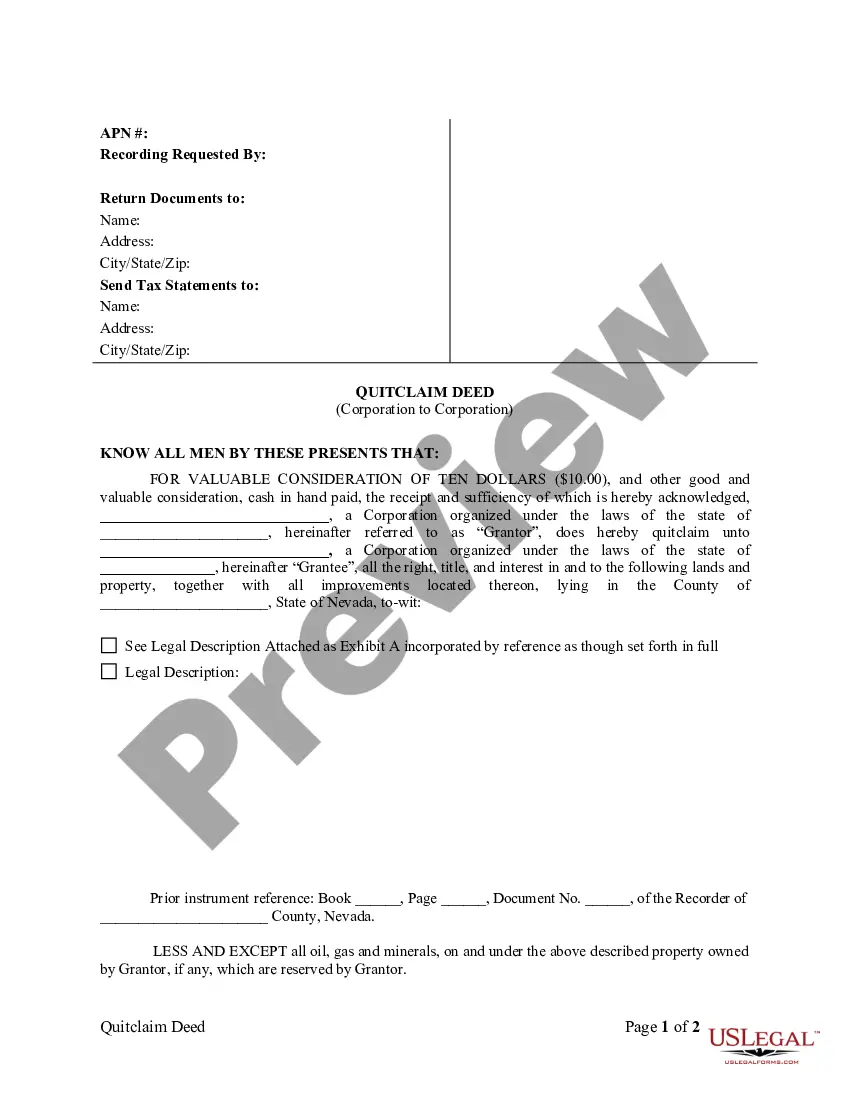
MONEY LAUNDERING B Engaging in Monetary Transactions in Property Derived from Specified Unlawful Activity
What is this form?
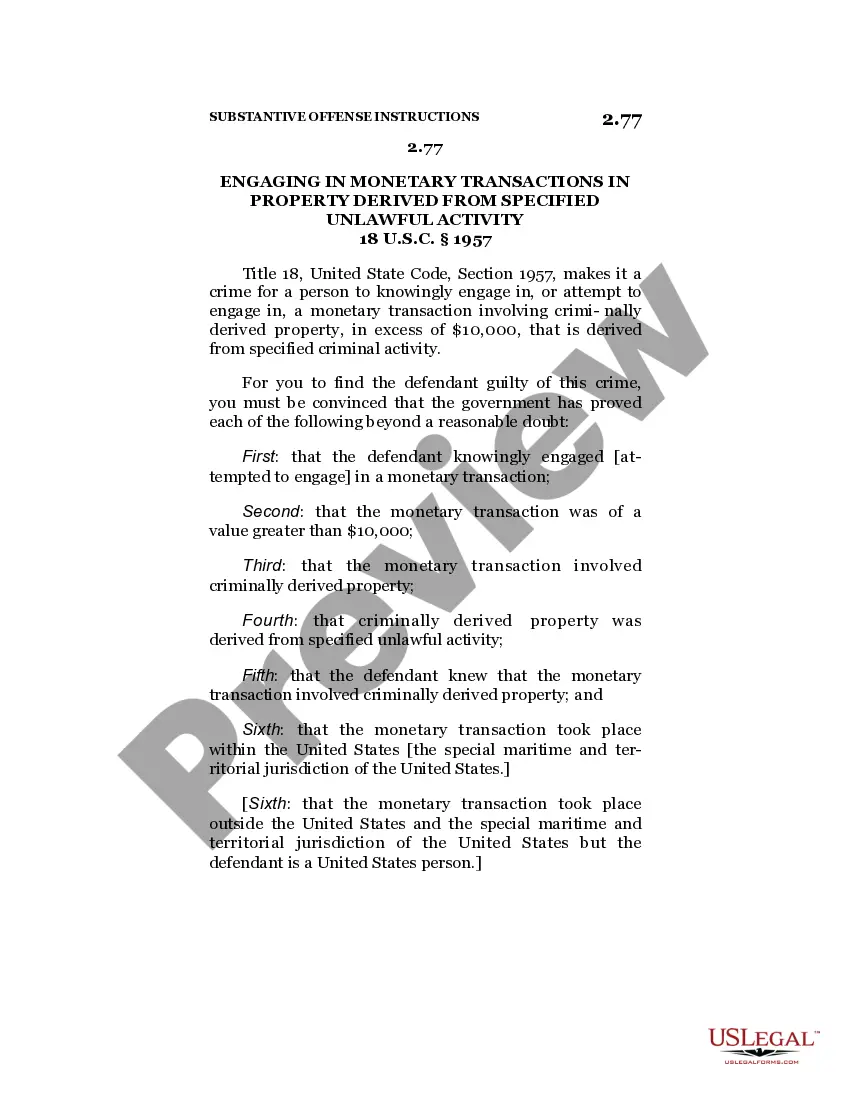
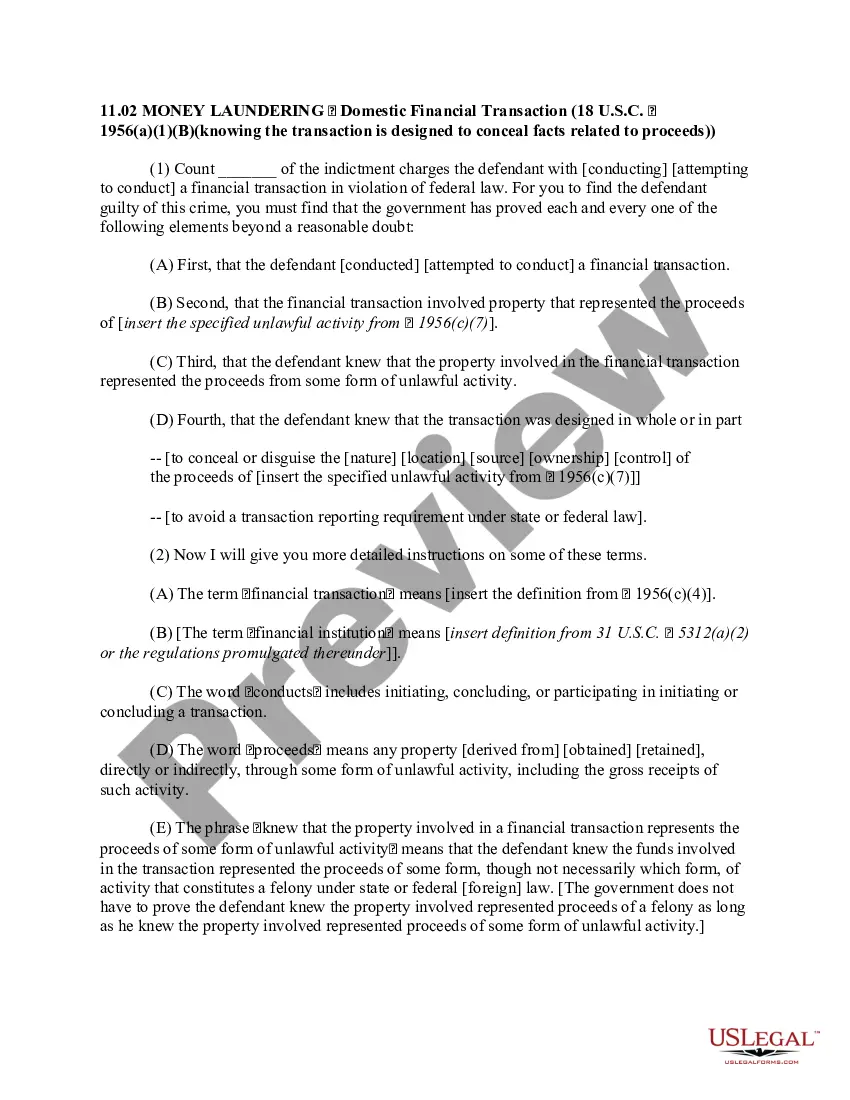
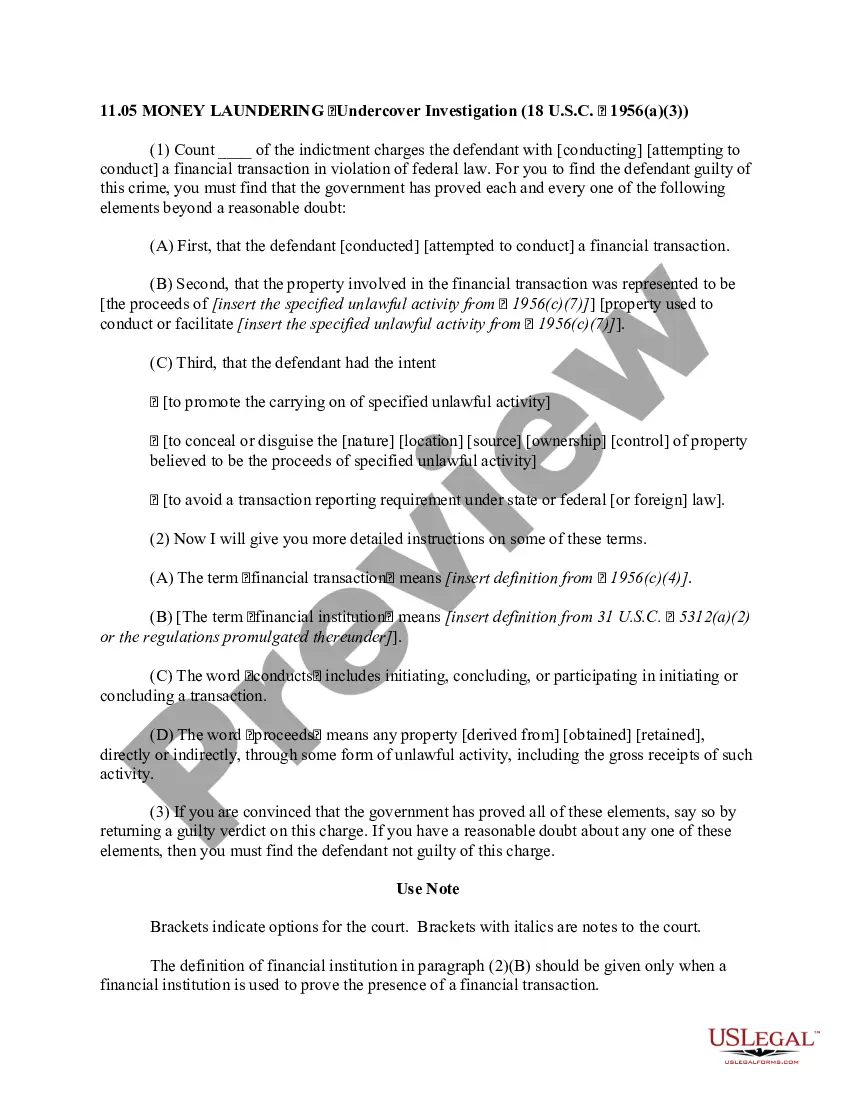
The form titled "Money Laundering B Engaging in Monetary Transactions in Property Derived from Specified Unlawful Activity" is a legal document that outlines the federal offense of engaging in financial transactions involving property illegally obtained through criminal activity. It specifies the criteria that must be met for a defendant to be found guilty under federal law, distinguishing it from other financial crime forms by focusing on the nature of the property involved and the necessary knowledge of the defendant regarding its origin.
Form components explained
- Definition of key terms such as "monetary transaction" and "criminally derived property."
- Elements that the prosecution must prove for a conviction, including the value of the property involved and the defendant's knowledge.
- Instructions on how the jury should approach their decision-making process regarding guilt or innocence.
- Provisions for jurisdictional considerations within the United States.
- Clarification of the definition of a "United States person" in the context of the law.
Situations where this form applies
This form is used in legal proceedings when an individual is charged with the crime of engaging in monetary transactions involving proceeds derived from unlawful activity. It is relevant in cases where the prosecution must demonstrate that the defendant knowingly engaged in transactions with property exceeding a value of $10,000 that was criminally obtained.
Who should use this form
- Prosecutors needing to outline charges for financial crimes involving money laundering.
- Judges presiding over cases related to violations of 18 U.S.C. 1957.
- Defense attorneys preparing for cases involving financial transactions related to alleged unlawful activities.
Instructions for completing this form
- Identify the defendant and specify the count being charged.
- Outline the nature of the monetary transaction in question.
- Confirm the value of the property involved exceeds $10,000.
- Indicate the defendant's knowledge of the property being criminally derived.
- Determine the jurisdiction where the transaction took place.
Does this document require notarization?
This form does not typically require notarization to be legally valid. However, some jurisdictions or document types may still require it. US Legal Forms provides secure online notarization powered by Notarize, available 24/7 for added convenience.
Get your form ready online
Our built-in tools help you complete, sign, share, and store your documents in one place.
Make edits, fill in missing information, and update formatting in US Legal Forms—just like you would in MS Word.
Download a copy, print it, send it by email, or mail it via USPS—whatever works best for your next step.
Sign and collect signatures with our SignNow integration. Send to multiple recipients, set reminders, and more. Go Premium to unlock E-Sign.
If this form requires notarization, complete it online through a secure video call—no need to meet a notary in person or wait for an appointment.
We protect your documents and personal data by following strict security and privacy standards.

Make edits, fill in missing information, and update formatting in US Legal Forms—just like you would in MS Word.

Download a copy, print it, send it by email, or mail it via USPS—whatever works best for your next step.

Sign and collect signatures with our SignNow integration. Send to multiple recipients, set reminders, and more. Go Premium to unlock E-Sign.

If this form requires notarization, complete it online through a secure video call—no need to meet a notary in person or wait for an appointment.

We protect your documents and personal data by following strict security and privacy standards.
Common mistakes
- Failing to establish that the property was derived from specified unlawful activity.
- Not correctly assessing the value of the property involved in the transaction.
- Overlooking the importance of the defendant's knowledge regarding the criminal nature of the property.
Benefits of using this form online
- Easy access to the form can lead to prompt legal actions and decision-making.
- Downloadable formats allow for easy editing and customization as per individual case needs.
- Reliability of using forms drafted by licensed attorneys ensures legal accuracy.
Legal use & context
- The form is enforceable in federal court under 18 U.S.C. 1957.
- It is important that the prosecution proves each element beyond a reasonable doubt for a guilty verdict.
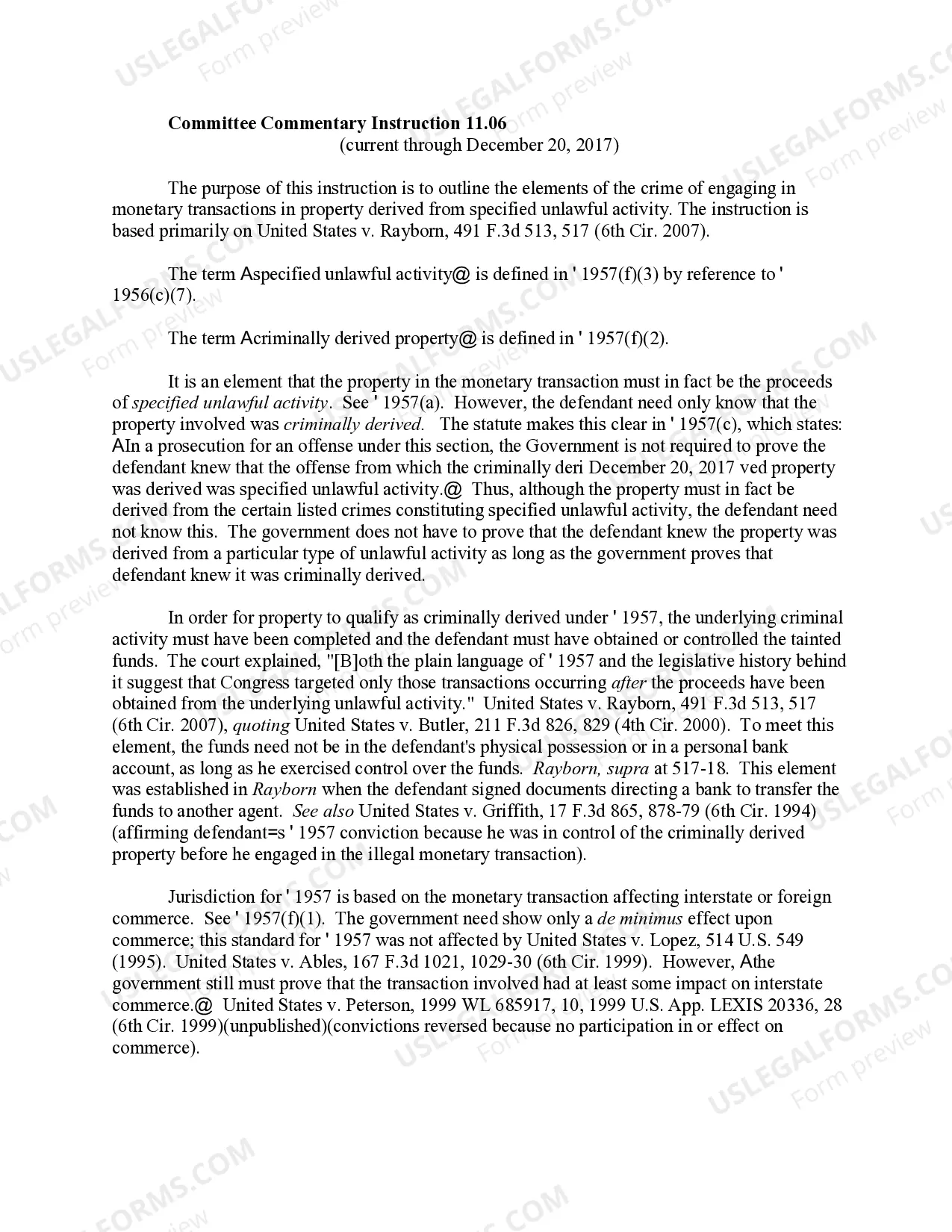
- Recent interpretations of the law clarify that the government does not need to prove knowledge of the specific unlawful activity, only that the property was criminally derived.
Key takeaways
- The form is essential for understanding the charges related to money laundering in federal law.
- It outlines crucial elements that must be proven for a conviction.
- Using this form correctly helps ensure all relevant legal standards are addressed during proceedings.
Looking for another form?
Form popularity
FAQ
Specified unlawful activities include over 250 crimes in six categories: (1) most RICO predicate offenses; (2) certain offenses against foreign nations; (3) acts constituting a criminal enterprise under the Controlled Substances Act; (4) miscellaneous offenses against persons and property; (5) federal health care
Specified unlawful activities include over 250 crimes in six categories: (1) most RICO predicate offenses; (2) certain offenses against foreign nations; (3) acts constituting a criminal enterprise under the Controlled Substances Act; (4) miscellaneous offenses against persons and property; (5) federal health care
§ 1957 arise when the defendant knowingly conducts a monetary transaction in criminally derived property in an amount greater than $10,000, which is in fact proceeds of a specified unlawful activity.
See §§ 1956(c)(7)(A), 1957(f)(3), and 1961(1)(B) ("Specified unlawful activity" is defined as any act or activity constituting an offense listed in section 1961(1), which includes both mail and wire fraud statutes.).
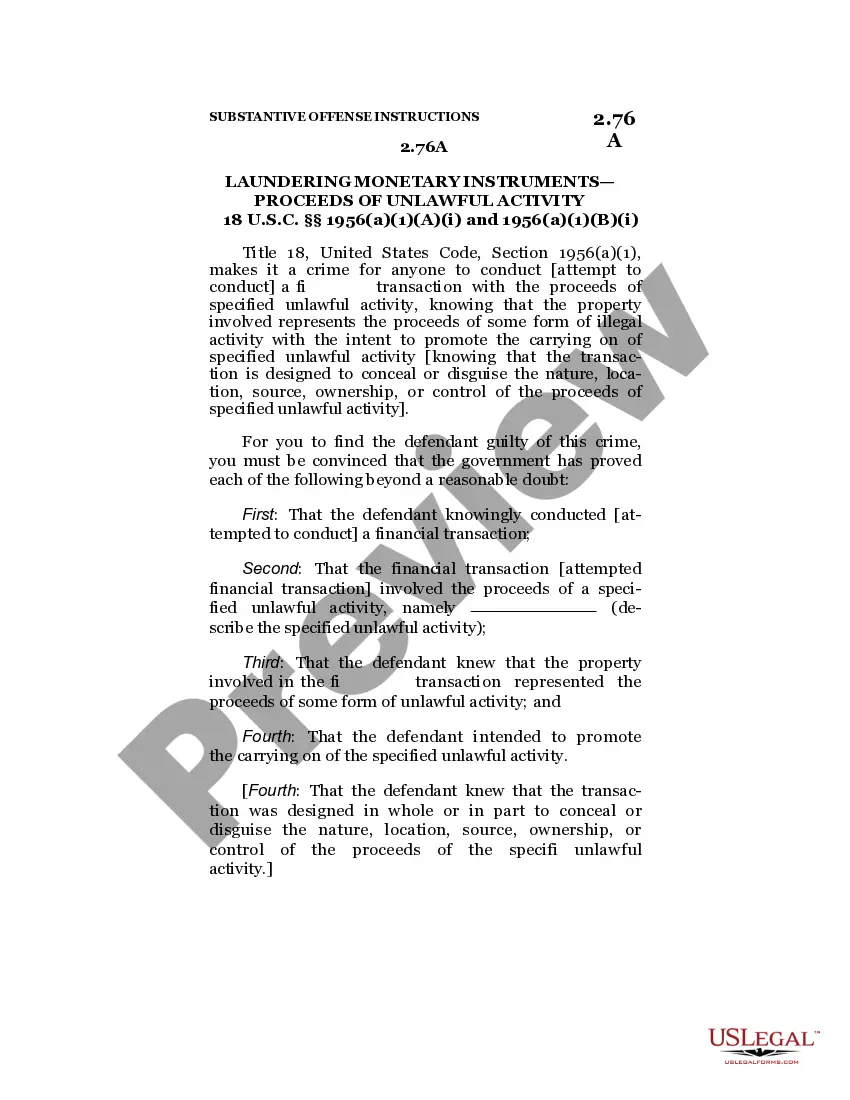
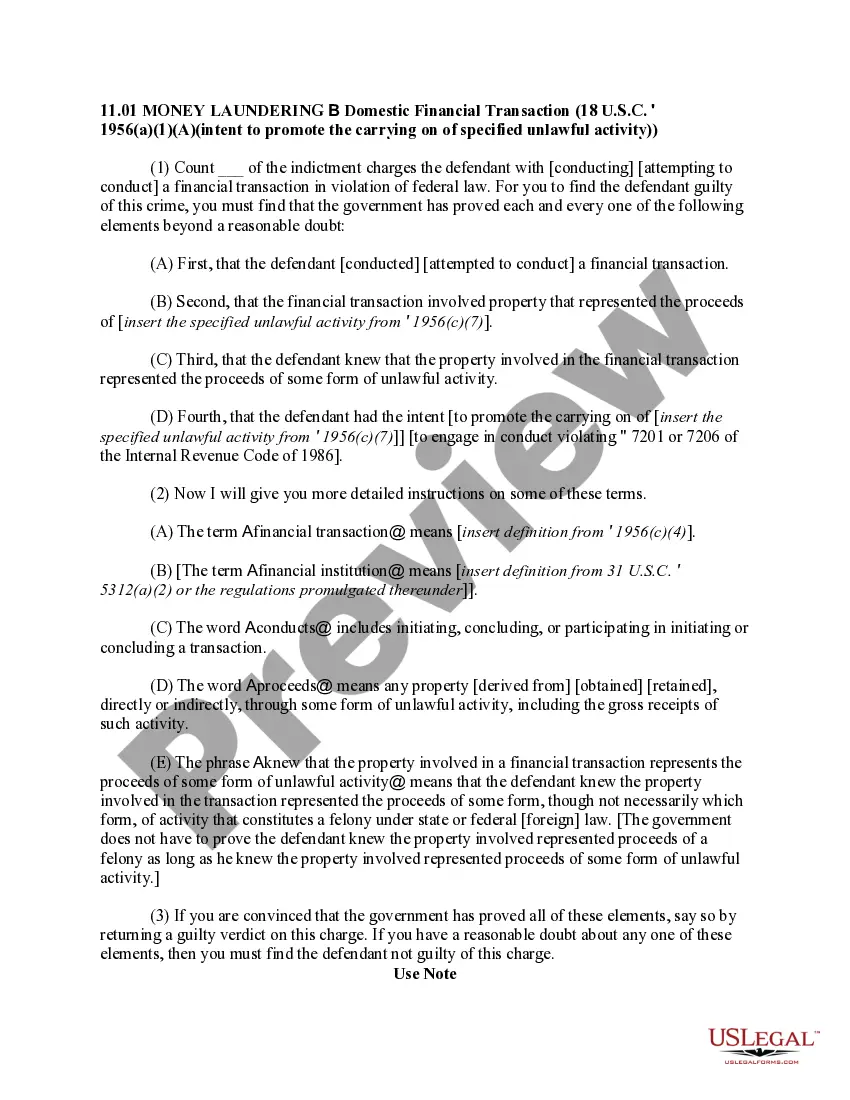
Money Laundering - Engaging in Monetary Transactions in Property Derived From Specified Unlawful Activity.
More precisely, Section 1956(a)(1)15 outlaws financial transactions involving the proceeds of other certain crimes?predicate offenses referred to as "specified unlawful activities" (sometimes known as SUA)?committed or attempted (1) with the intent to promote further predicate offenses; (2) with the intent to evade
§1956. Laundering of monetary instruments. (ii) to avoid a transaction reporting requirement under State or Federal law, shall be sentenced to a fine of not more than $500,000 or twice the value of the property involved in the transaction, whichever is greater, or imprisonment for not more than twenty years, or both.