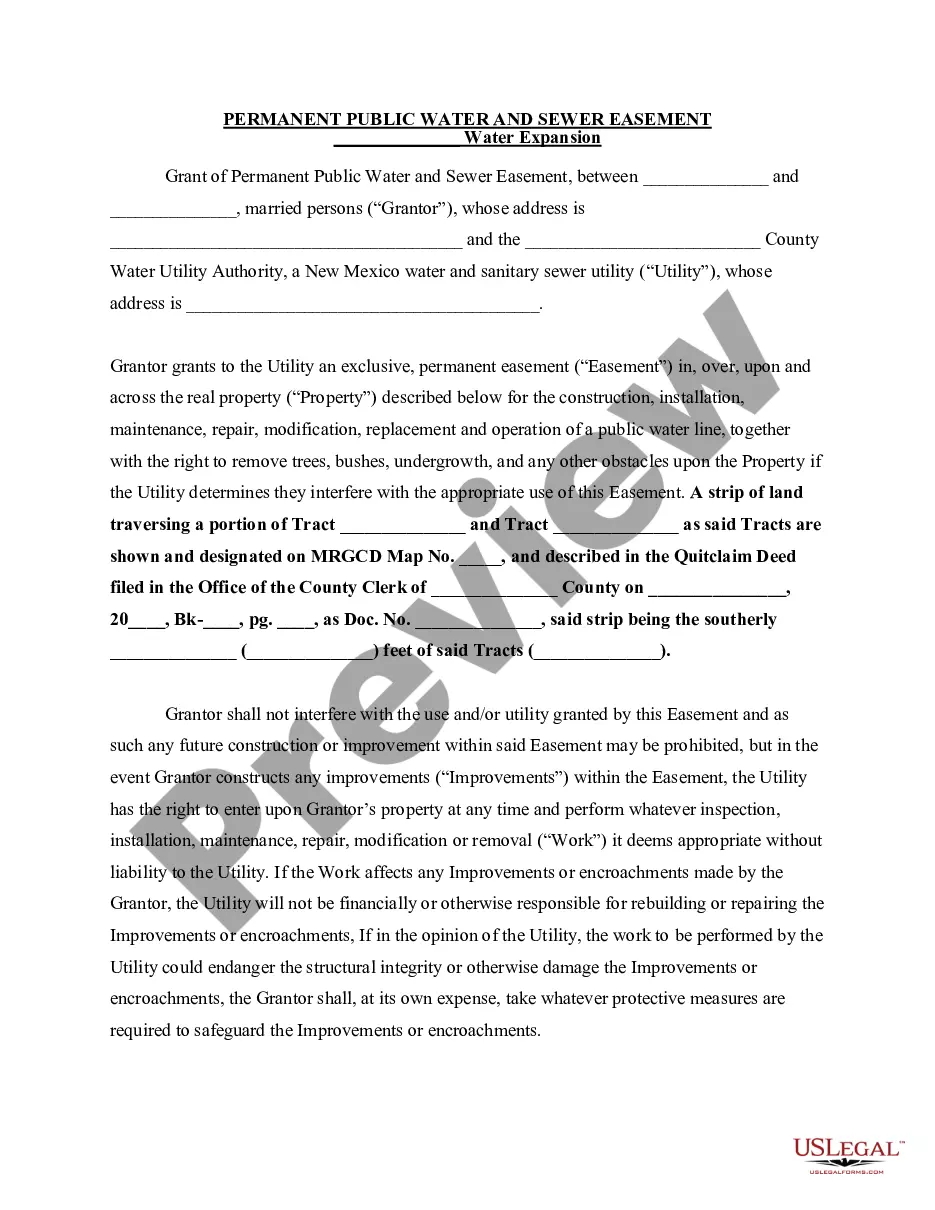
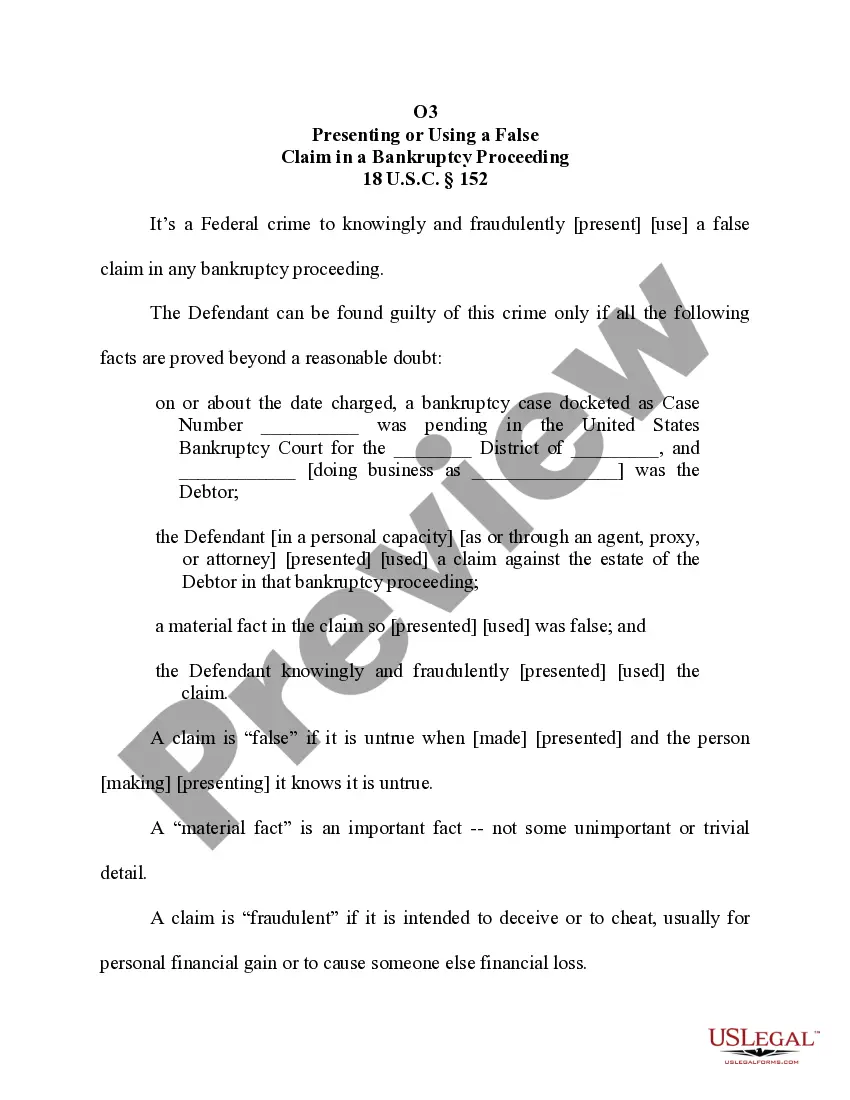
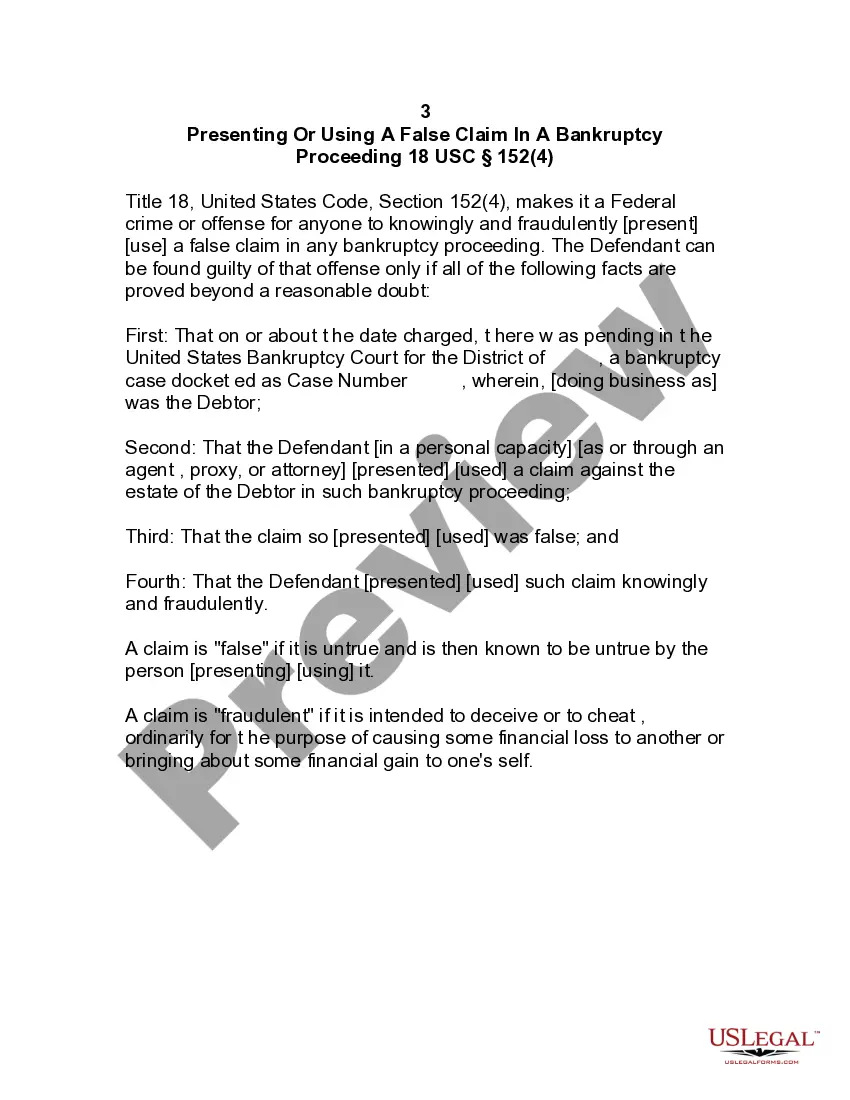
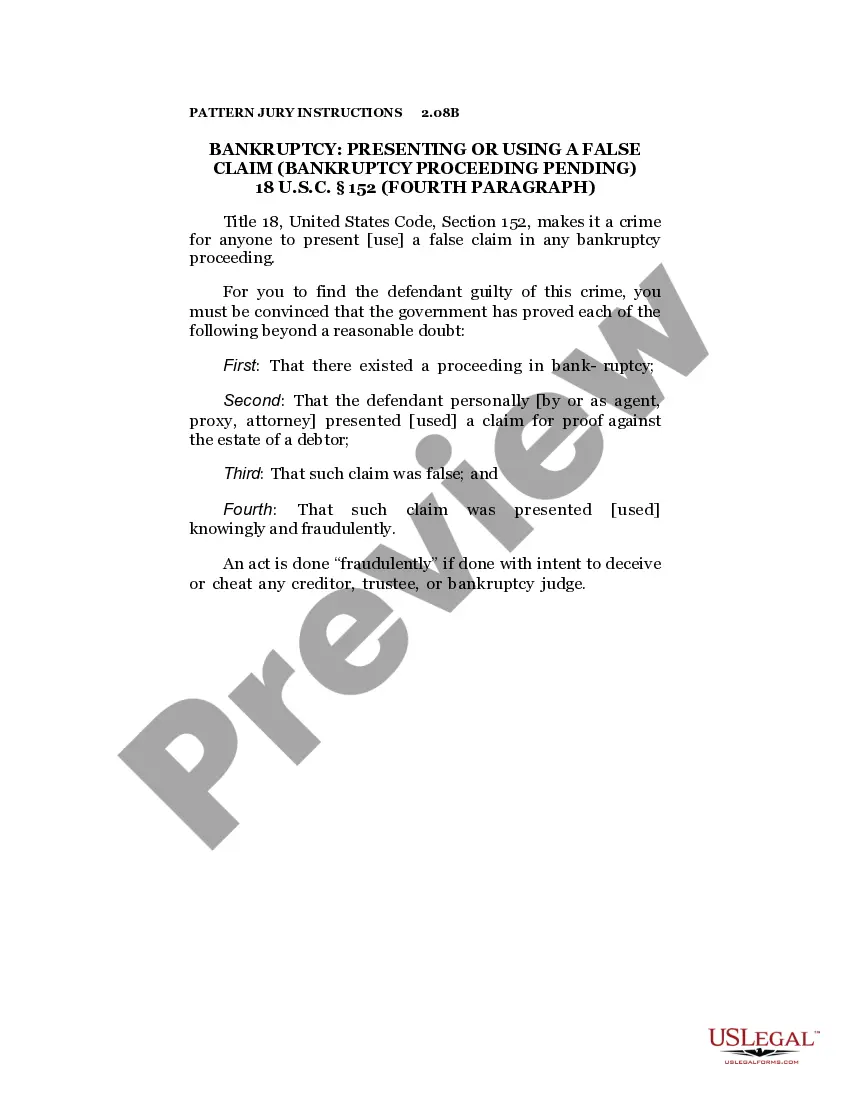
Presenting or Using a False Claim in a Bankruptcy Proceeding
Overview of this form
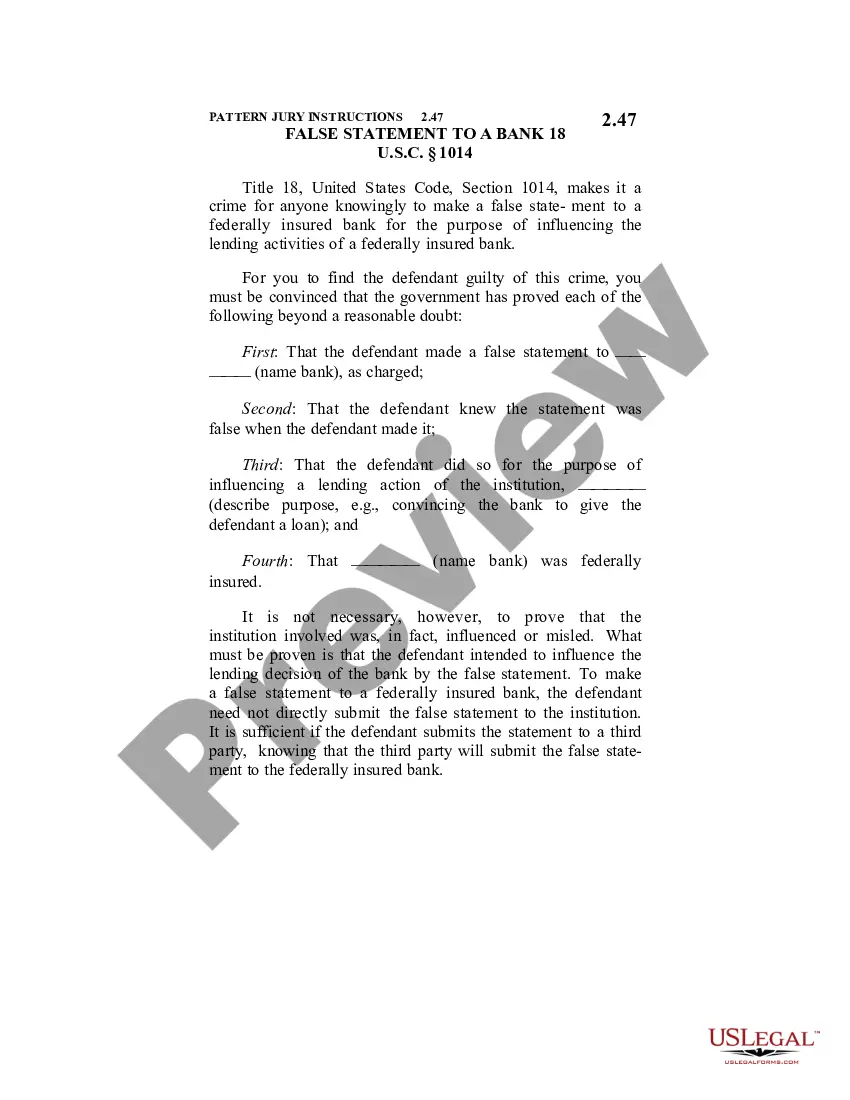
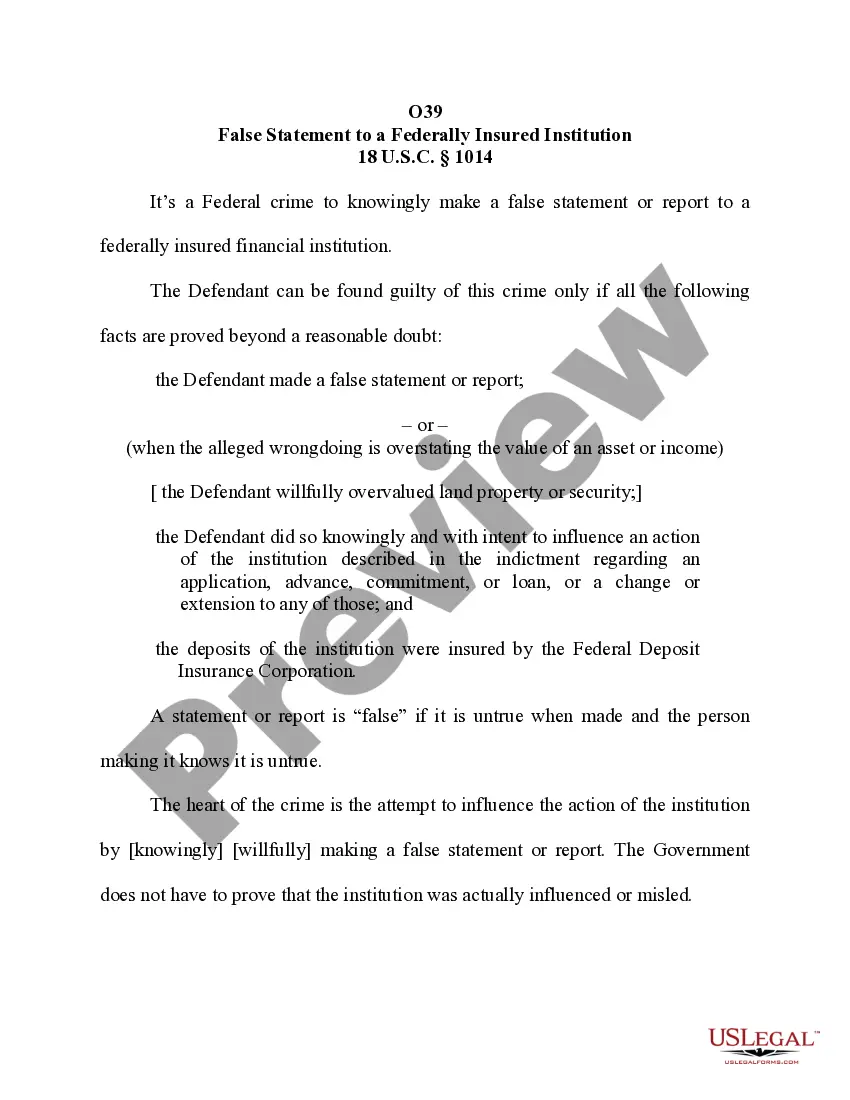
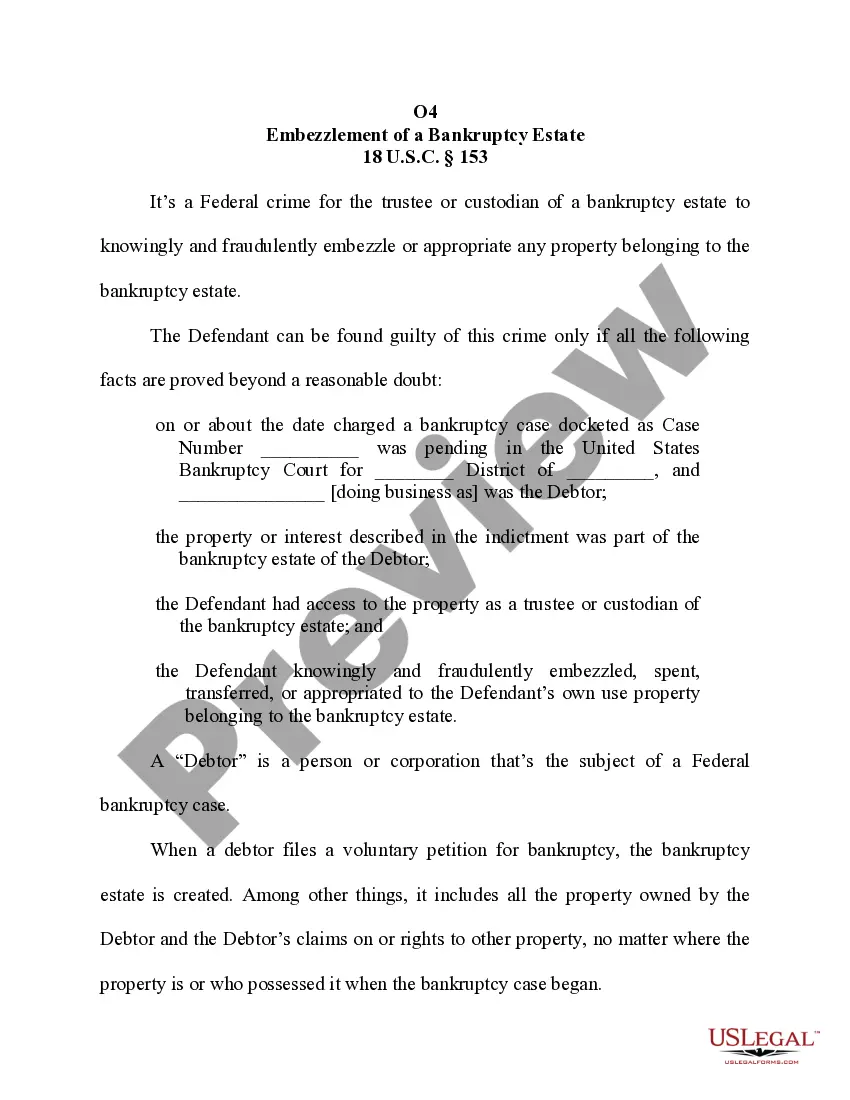
This document addresses the crime of presenting or using a false claim in a bankruptcy proceeding. It outlines the elements required to establish that a defendant knowingly submitted false information within a bankruptcy context. By using this form, you can better understand the legalities surrounding fraudulent claims in bankruptcy, which is vital for ensuring compliance with federal law and protecting yourself from potential liability.
Key components of this form
- Identification of the bankrupt entity and the bankruptcy case number.
- Specification of how the defendant presented or used the claim in question.
- Details about any false material fact included in the claim.
- Explanation of the defendant's knowledge and intent regarding the fraudulent nature of the claim.
When this form is needed
This form is essential when you believe there has been a fraudulent claim made in a bankruptcy case. It is relevant in situations where you are involved in a bankruptcy proceeding and suspect that another party is attempting to deceive the court by submitting false information to gain an unfair advantage or financial benefit.
Who should use this form
- Individuals involved in a bankruptcy case as either debtors or creditors.
- Legal professionals representing clients in bankruptcy proceedings.
- Anyone needing to report fraudulent claims related to bankruptcy.
Instructions for completing this form
- Identify the bankruptcy case by providing the case number and the debtorâs name.
- Specify the party responsible for presenting or using the false claim.
- Include details regarding the false material fact that was included in the claim.
- State the defendant's knowledge and intent regarding the fraudulent claim.
Is notarization required?
This form does not typically require notarization unless specified by local law. However, it is advisable to check with your local jurisdiction to ensure compliance with all legal requirements.
Get your form ready online
Our built-in tools help you complete, sign, share, and store your documents in one place.
Make edits, fill in missing information, and update formatting in US Legal Forms—just like you would in MS Word.
Download a copy, print it, send it by email, or mail it via USPS—whatever works best for your next step.
Sign and collect signatures with our SignNow integration. Send to multiple recipients, set reminders, and more. Go Premium to unlock E-Sign.
If this form requires notarization, complete it online through a secure video call—no need to meet a notary in person or wait for an appointment.
We protect your documents and personal data by following strict security and privacy standards.

Make edits, fill in missing information, and update formatting in US Legal Forms—just like you would in MS Word.

Download a copy, print it, send it by email, or mail it via USPS—whatever works best for your next step.

Sign and collect signatures with our SignNow integration. Send to multiple recipients, set reminders, and more. Go Premium to unlock E-Sign.

If this form requires notarization, complete it online through a secure video call—no need to meet a notary in person or wait for an appointment.

We protect your documents and personal data by following strict security and privacy standards.
Common mistakes to avoid
- Failing to include the correct bankruptcy case number.
- Not specifying the nature of the false claim adequately.
- Omitting details about the defendant's intent.
- Neglecting to verify the facts before submission.
Advantages of online completion
- Immediate access to a comprehensive form without the need for in-person consultation.
- Easy to edit and customize to fit your specific situation.
- Drafted by licensed attorneys to ensure legal accuracy and relevance.
- Available for download, allowing for convenient printing and filing.
Legal use & context
- This form serves as a tool for documenting allegations of fraud in bankruptcy proceedings.
- Understanding the legal implications of submitting false claims is crucial for all parties involved in bankruptcy.
- Failure to comply with these regulations can result in significant legal penalties.
What to keep in mind
- The form is essential for addressing false claims in bankruptcy legally.
- Proper completion is crucial to prevent legal repercussions.
- Seek local legal guidance to navigate specific jurisdiction requirements.
- Using this form online provides convenience and accuracy.
Looking for another form?
Form popularity
FAQ
A bankruptcy debtor is required to sign his/her petition under penalty of perjury, which can result in a fine or even prison time up to 8 years.
Often your secured debts can be discharged in Chapter 7 bankruptcy, which means you could get your home and auto loans discharged. However, if you want to keep your house and your car, you will need to continue making payments.
Dismissal of a Bankruptcy Case ? Dismissal ordinarily means that the court stopped all proceedings in the main bankruptcy case AND in all adversary proceedings, and a discharge order was not entered. Dismissal can occur because a debtor requested the dismissal and qualifies for voluntary dismissal.
The court may deny a chapter 7 discharge for any of the reasons described in section 727(a) of the Bankruptcy Code, including failure to provide requested tax documents; failure to complete a course on personal financial management; transfer or concealment of property with intent to hinder, delay, or defraud creditors;
A proof of claim is a form used by the creditor to indicate the amount of the debt owed by the debtor on the date of the bankruptcy filing. The creditor must file the form with the clerk of the same bankruptcy court in which the bankruptcy case was filed. Secured Claim Under 11 U.S.C. § 506 (a)