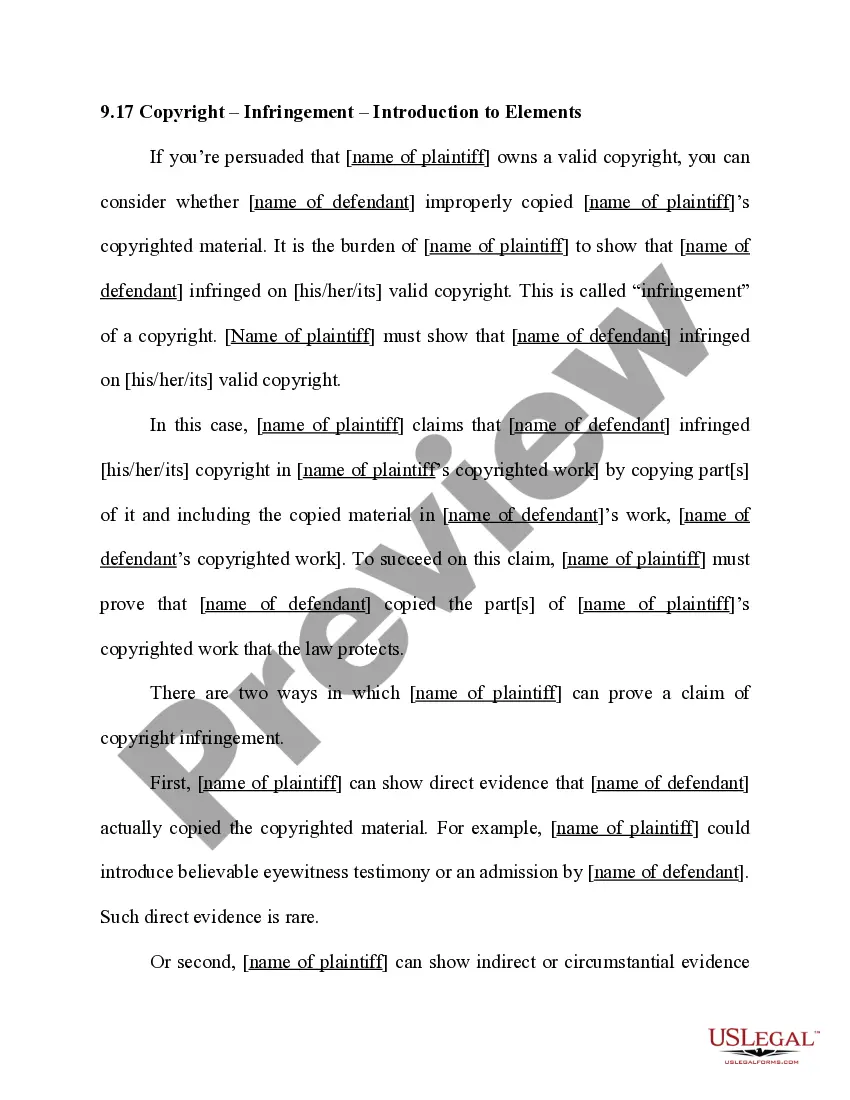
Copyright - Infringement - Introduction to Elements
About this form
The Copyright - Infringement - Introduction to Elements form is a legal template that outlines the essential components involved in a copyright infringement claim. It is designed to clarify the process for determining whether a valid copyright has been infringed upon, differentiating itself from other legal forms relating to copyright in terms of its focus on the elements needed to establish a case. This form serves as a foundational guide for plaintiffs and defendants in copyright disputes, ensuring that all necessary elements are considered in the legal proceedings.
Key parts of this document
- Ownership of a valid copyright by the plaintiff.
- Improper copying of the plaintiff's copyrighted material by the defendant.
- Burden of proof lying on the plaintiff to show infringement.
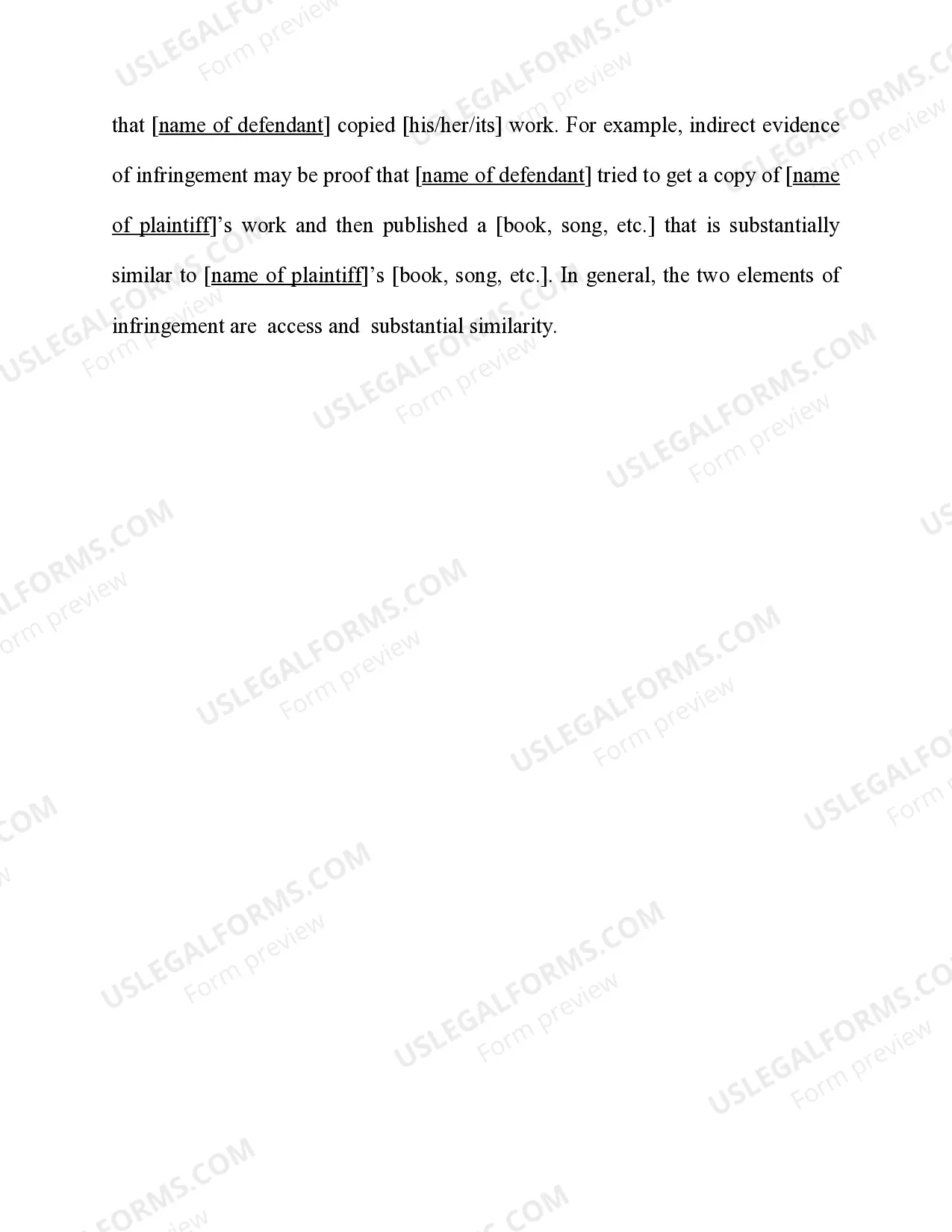
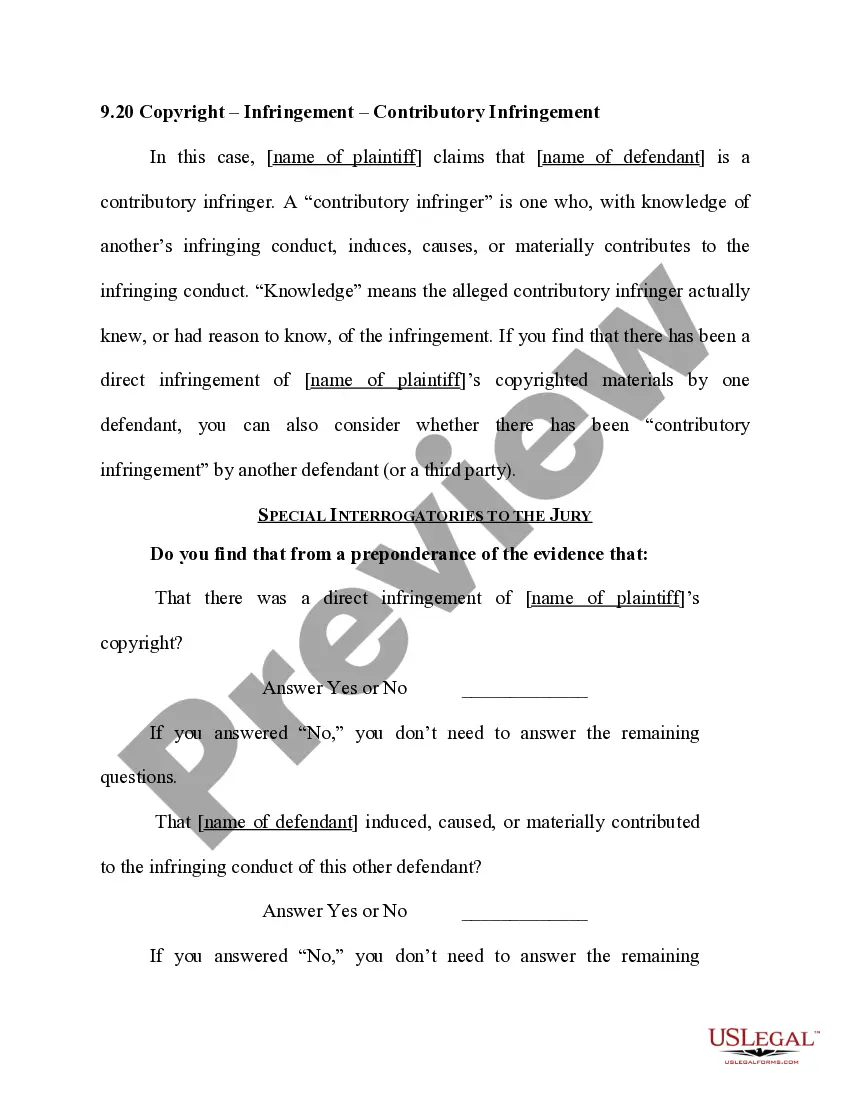
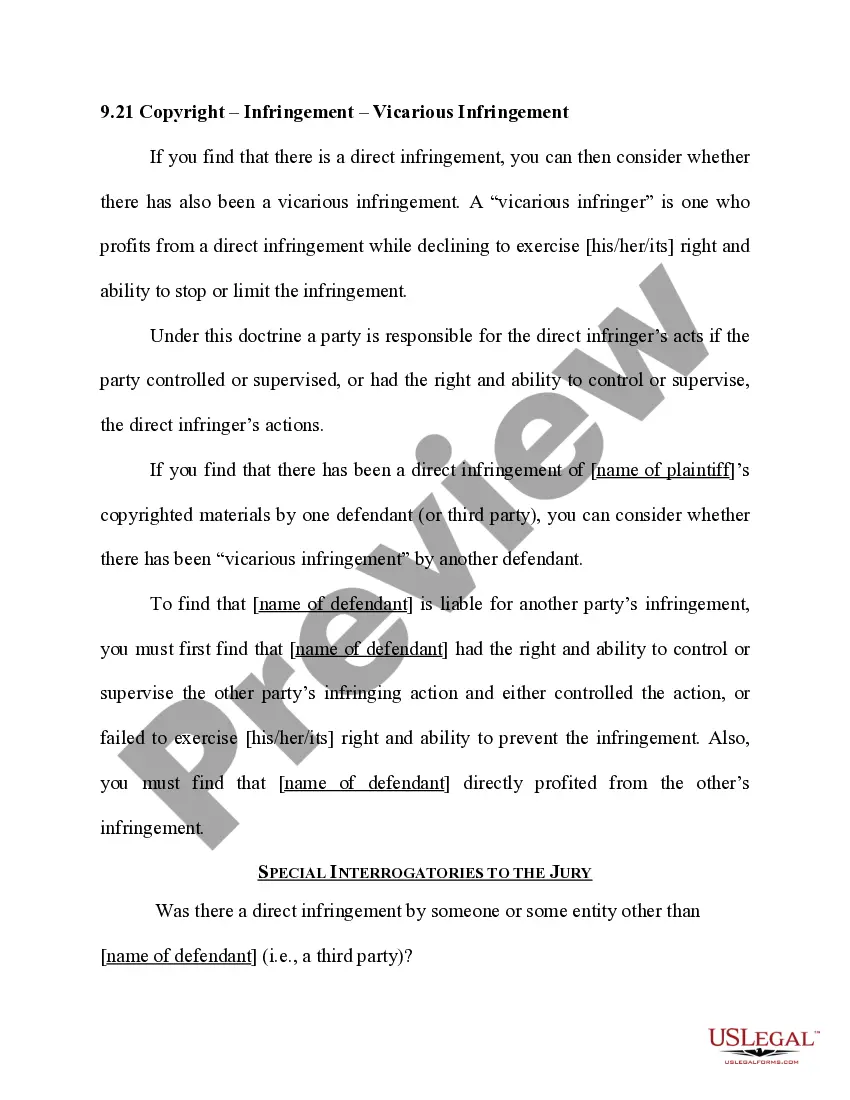
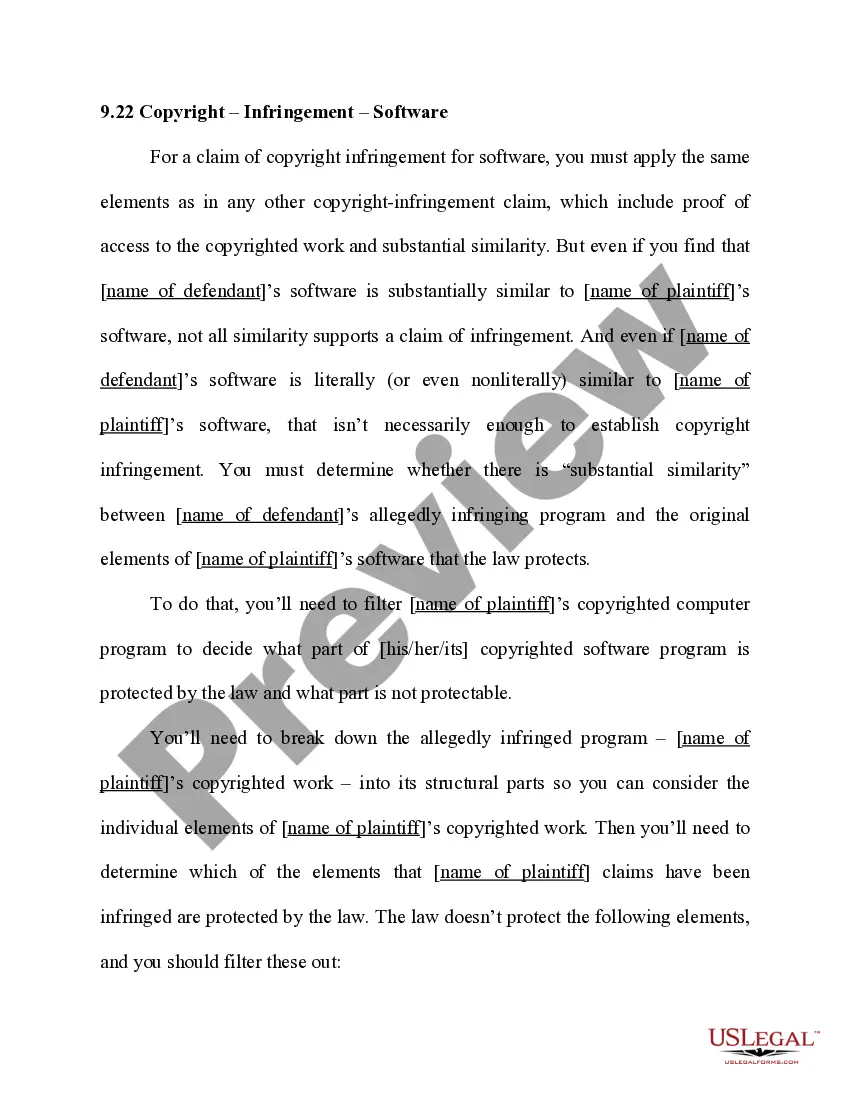
- Two methods of proving infringement: direct and circumstantial evidence.
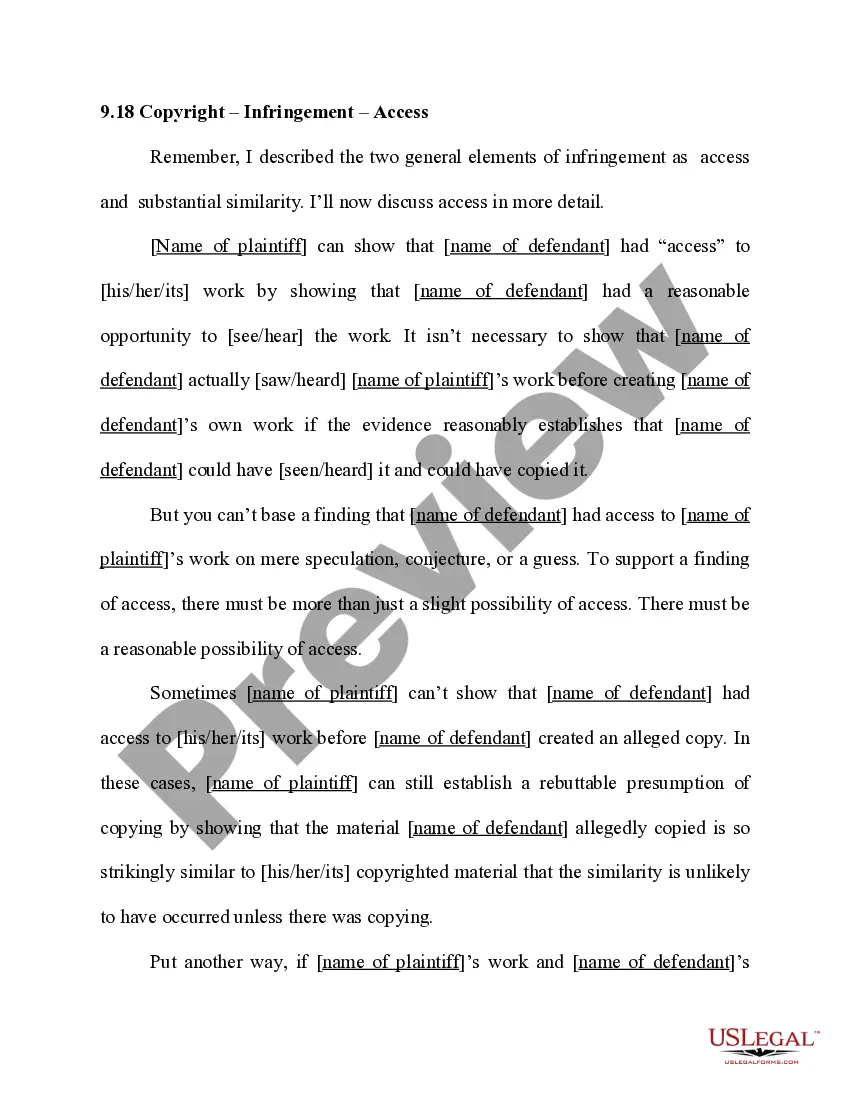
- Requirement to demonstrate access and substantial similarity in copied works.
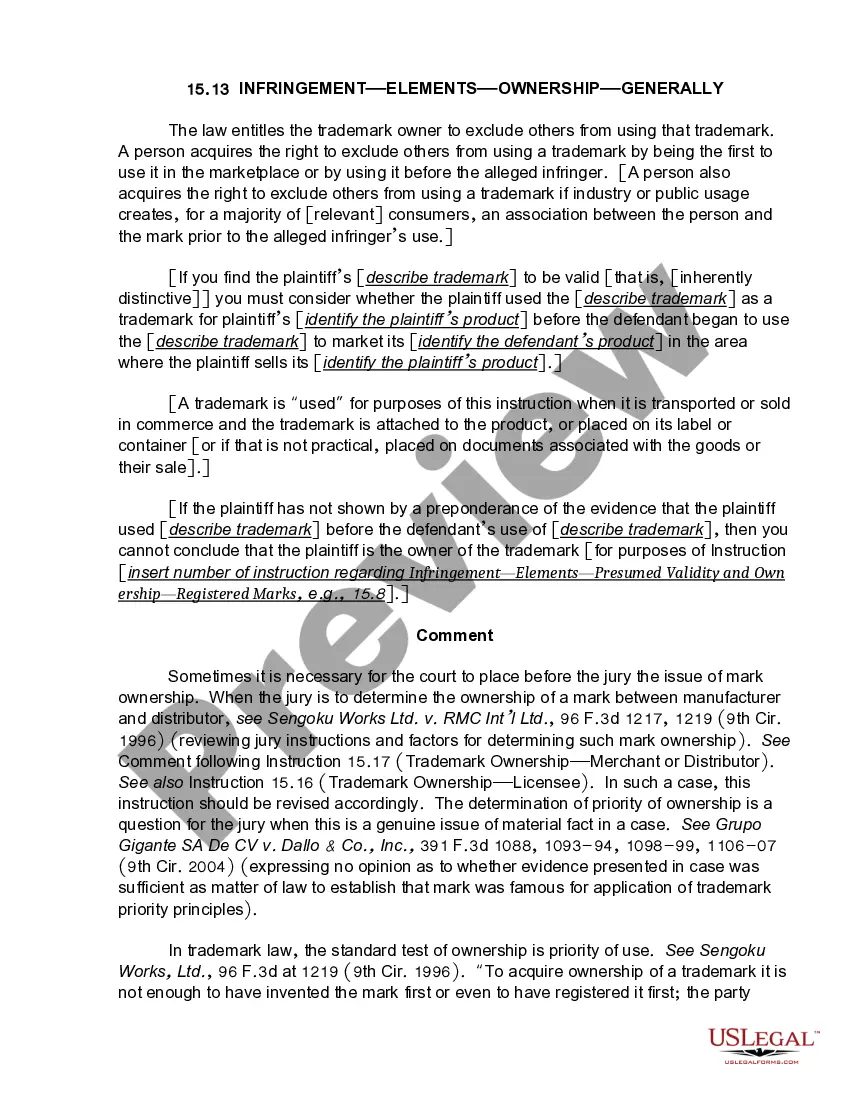
When to use this document
This form should be used in cases where a copyright holder believes that their original work has been copied without permission by another party. It is pertinent during the initial stages of a legal claim for copyright infringement, particularly when preparing for litigation or negotiations. Utilization of this form can help clarify the fundamental aspects required to assert a copyright infringement claim, paving the way for a potential lawsuit or settlement discussions.
Who needs this form
- Copyright owners who suspect infringement of their original works.
- Legal representatives or attorneys preparing a case for copyright infringement.
- Individuals or organizations involved in a dispute over copyright claims.
- Defendants in a copyright case who need to understand the elements of infringement.
Instructions for completing this form
- Identify the name and details of the plaintiff claiming the copyright.
- Outline the specific copyrighted work that is claimed to have been infringed.
- Provide the name and details of the defendant accused of infringement.
- Gather and present evidence supporting the claim of copyright ownership.
- Document any direct or indirect evidence of infringement, including instances of access and similarity.
Notarization requirements for this form
In most cases, this form does not require notarization. However, some jurisdictions or signing circumstances might. US Legal Forms offers online notarization powered by Notarize, accessible 24/7 for a quick, remote process.
Get your form ready online
Our built-in tools help you complete, sign, share, and store your documents in one place.
Make edits, fill in missing information, and update formatting in US Legal Forms—just like you would in MS Word.
Download a copy, print it, send it by email, or mail it via USPS—whatever works best for your next step.
Sign and collect signatures with our SignNow integration. Send to multiple recipients, set reminders, and more. Go Premium to unlock E-Sign.
If this form requires notarization, complete it online through a secure video call—no need to meet a notary in person or wait for an appointment.
We protect your documents and personal data by following strict security and privacy standards.

Make edits, fill in missing information, and update formatting in US Legal Forms—just like you would in MS Word.

Download a copy, print it, send it by email, or mail it via USPS—whatever works best for your next step.

Sign and collect signatures with our SignNow integration. Send to multiple recipients, set reminders, and more. Go Premium to unlock E-Sign.

If this form requires notarization, complete it online through a secure video call—no need to meet a notary in person or wait for an appointment.

We protect your documents and personal data by following strict security and privacy standards.
Avoid these common issues
- Failing to adequately prove ownership of the copyright.
- Insufficient evidence of access or substantial similarity between works.
- Neglecting to define the infringing material clearly.
- Confusing direct evidence with circumstantial evidence.
Benefits of using this form online
- Immediate access to a legally vetted template that saves time.
- Easy editing capabilities allow you to customize the form as needed.
- Enhanced reliability with templates drafted by licensed attorneys.
- Ability to download and use the form at your convenience without delays.
Legal use & context
- Understanding copyright infringement is crucial for both claimants and defendants in legal disputes.
- This form is established based on federal copyright laws as interpreted by the 11th Circuit Federal Court of Appeals.
- Parties must gather adequate proof to substantiate their claims or defenses.
Looking for another form?
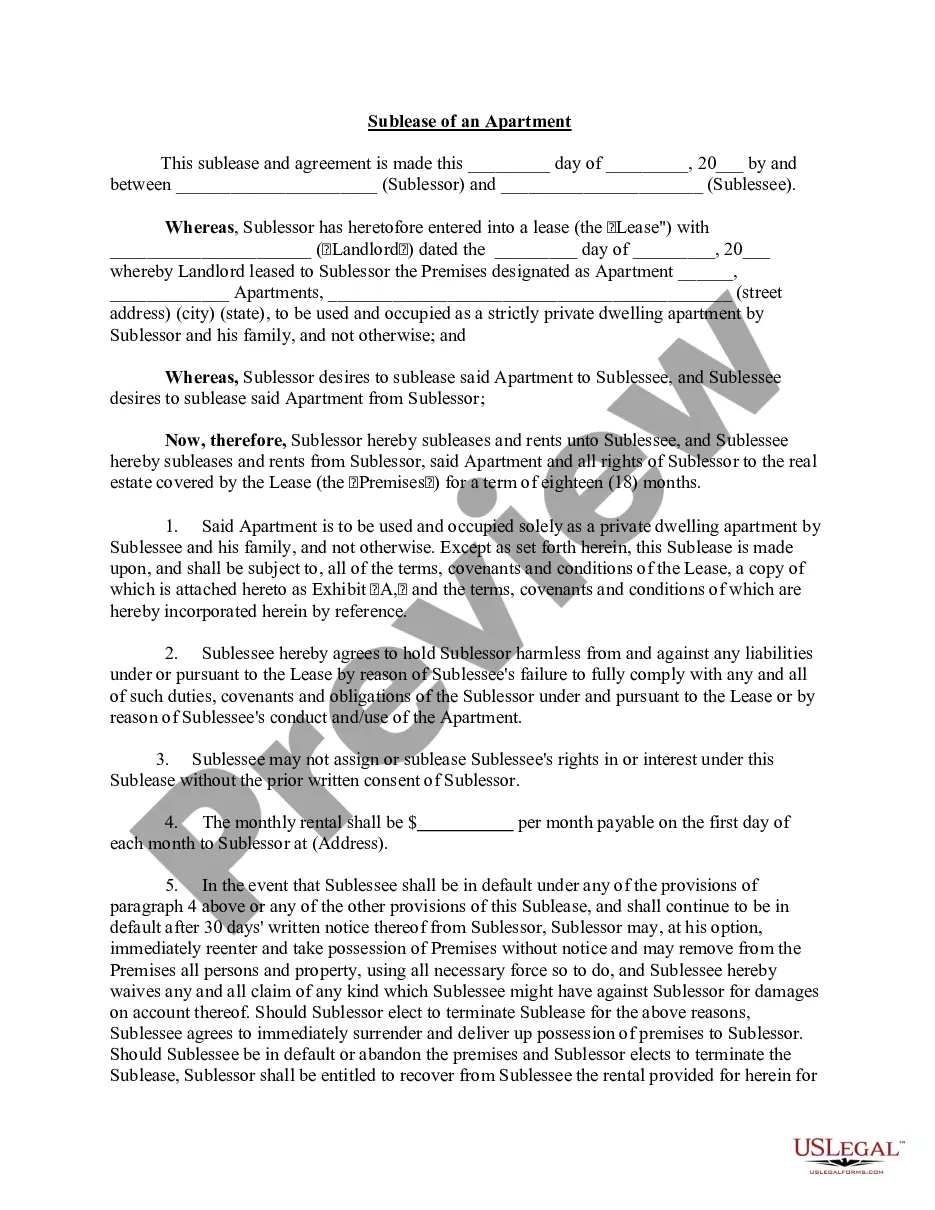
Form popularity
FAQ
To prove copyright infringement, the plaintiff must prove (1) ownership of a valid copyright (usually through the showing of a certificate of registration); (2) the defendant has copied the worN; and (3) such copying constitutes unlawful appropriation.
There are three elements that must be in place in order for the infringement to occur. The copyright holder must have a valid copyright. The person who is allegedly infringing must have access to the copyrighted work. The duplication of the copyrighted work must be outside the exceptions.
Examples of Copyright Infringement Illegally downloading music files. Uploading someone else's copyrighted material to an accessible web page. Downloading licensed software from an unauthorized site. Modifying and reproducing someone else's creative work without making significant changes. Recording a movie in a theater.
What is copyright infringement? Recording a film in a movie theater. Posting a video on your company's website which features copyrighted words or songs. Using copyrighted images on your company's website. Using a musical group's copyrighted songs on your company's website.
Copyright infringement penalties can be civil and criminal and include: Statutory damages between $750 and $30,000 per piece of work infringed upon. Civil penalties of up to $150,000 per piece if willful infringement is found. Actual copyright infringement damages and profits obtained due to infringing activity.
At 361 (?To establish infringement, two elements must be proven: (1) ownership of a valid copyright, and (2) copying of constituent elements of the work that are original.?); see also Seven Arts Filmed Entm't Ltd. v.
As a general matter, copyright infringement occurs when a copyrighted work is reproduced, distributed, performed, publicly displayed, or made into a derivative work without the permission of the copyright owner.