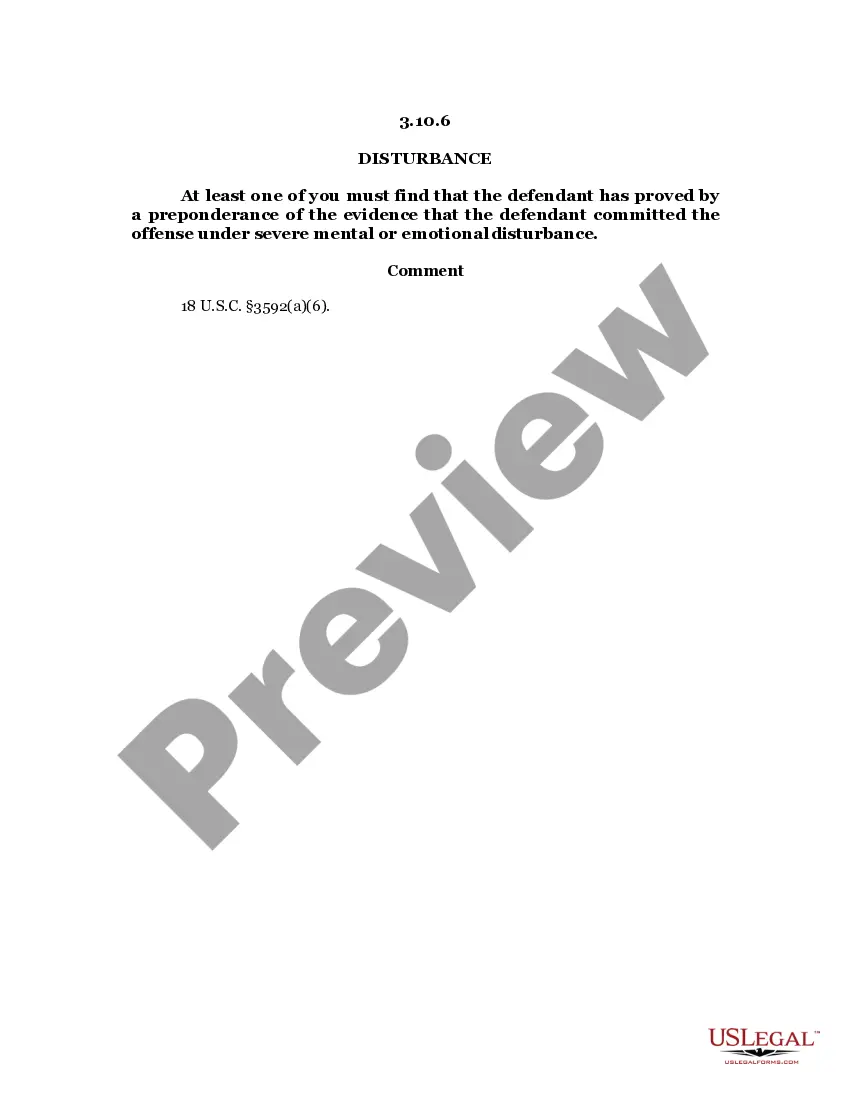
DISTURBANCE
Overview of this form
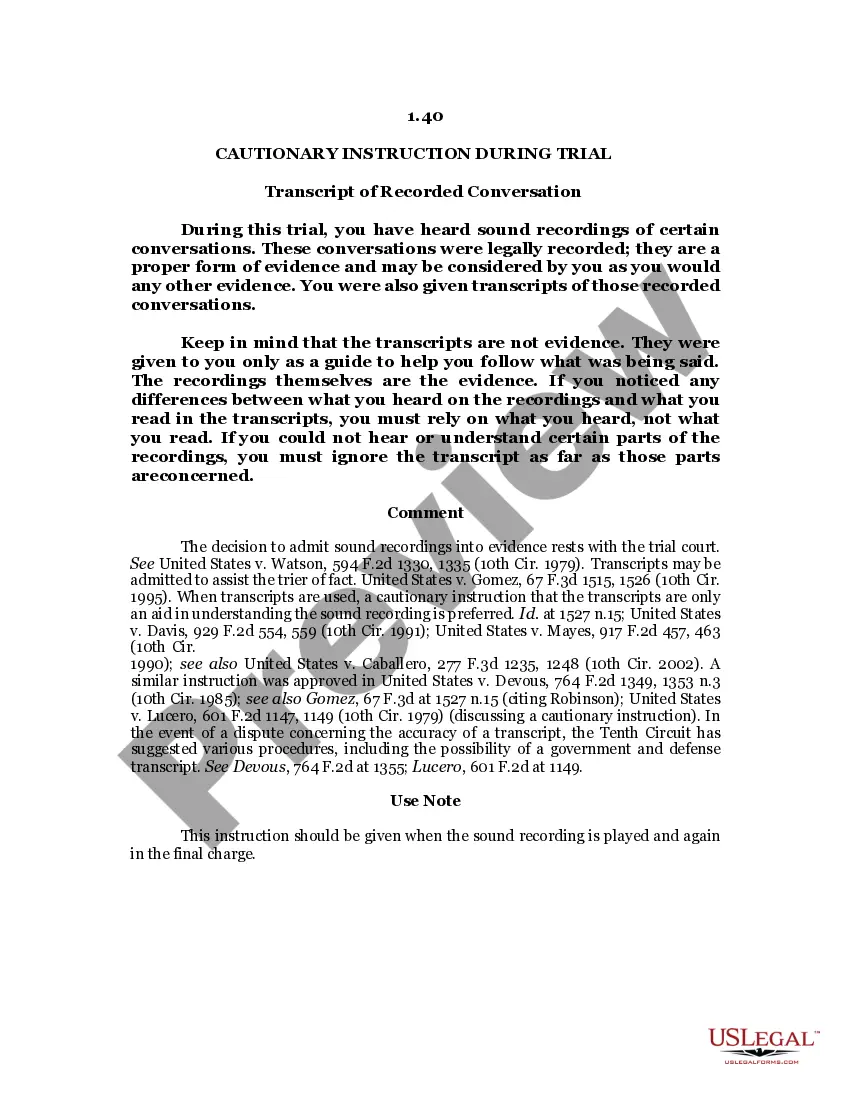
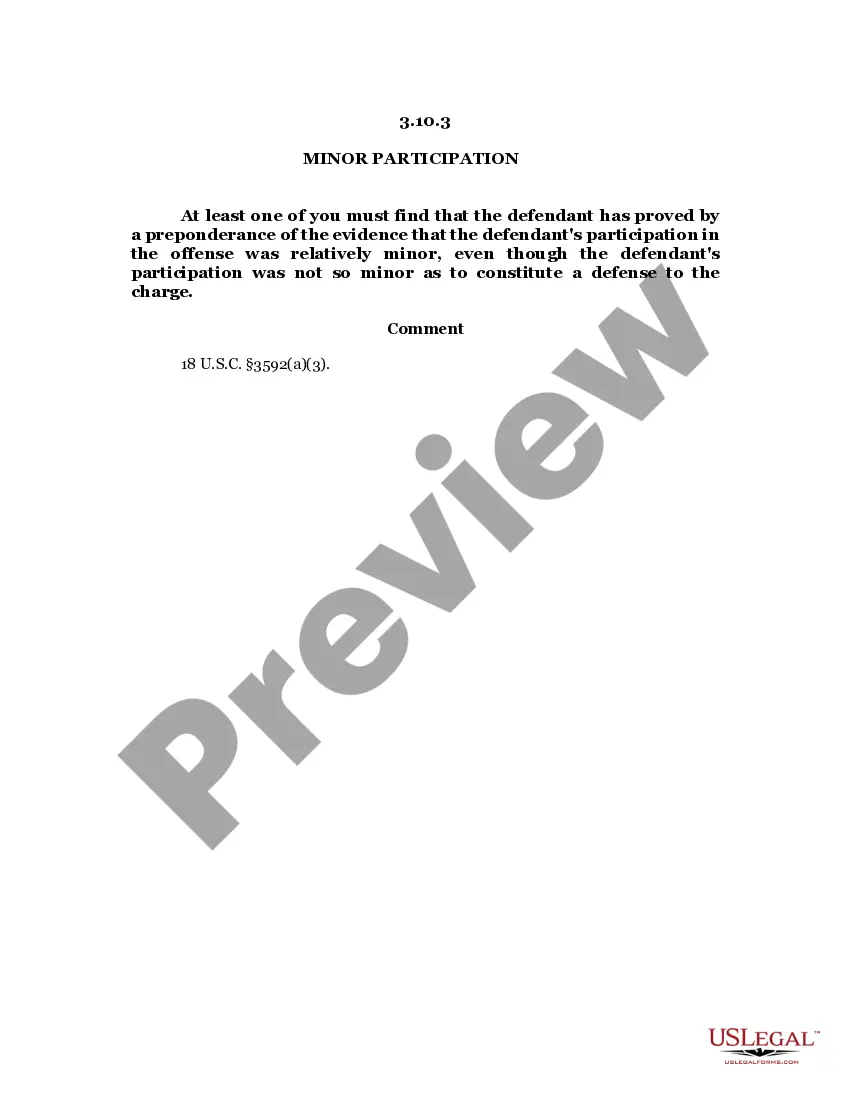
The Disturbance form is a legal document used in situations where a defendant claims that their actions were influenced significantly by a severe mental or emotional disturbance. This form emphasizes the need for the defendant to prove this condition by a preponderance of the evidence, making it distinct from other defense strategies that do not consider mental health factors. It plays a crucial role in legal contexts where mitigating circumstances can alter the perception of culpability.
Form components explained
- The requirement for the defendant to demonstrate they acted under severe mental or emotional disturbance.
- The legal standard of proof set as "preponderance of the evidence."
- Reference to relevant legal statutes, including 18 U.S.C. §3592(a)(6).
When to use this form
This form is necessary in criminal cases where a defendant seeks to present a mental health defense. It can be relevant during trials where the defendant's state of mind is a critical aspect of the case, such as in cases involving charges of violence or harm where diminished capacity may be asserted.
Intended users of this form
This form is intended for:
- Defendants in criminal proceedings who wish to argue their mental state as a mitigating factor.
- Defense attorneys representing clients in cases involving claims of emotional or mental disturbances.
- Individuals looking to understand the implications of mental health on legal accountability.
Instructions for completing this form
- Identify the parties involved, including the defendant and the legal representation.
- Clearly state the nature of the offense and the circumstances surrounding it.
- Document evidence supporting the claim of severe mental or emotional disturbance.
- Complete any required fields pertaining to legal statutes invoked.
- Ensure all parties sign and date the form where indicated.
Notarization requirements for this form
This form does not typically require notarization unless specified by local law. However, it is advisable to check state-specific regulations to ensure compliance and validity of the document.
Get your form ready online
Our built-in tools help you complete, sign, share, and store your documents in one place.
Make edits, fill in missing information, and update formatting in US Legal Forms—just like you would in MS Word.
Download a copy, print it, send it by email, or mail it via USPS—whatever works best for your next step.
Sign and collect signatures with our SignNow integration. Send to multiple recipients, set reminders, and more. Go Premium to unlock E-Sign.
If this form requires notarization, complete it online through a secure video call—no need to meet a notary in person or wait for an appointment.
We protect your documents and personal data by following strict security and privacy standards.

Make edits, fill in missing information, and update formatting in US Legal Forms—just like you would in MS Word.

Download a copy, print it, send it by email, or mail it via USPS—whatever works best for your next step.

Sign and collect signatures with our SignNow integration. Send to multiple recipients, set reminders, and more. Go Premium to unlock E-Sign.

If this form requires notarization, complete it online through a secure video call—no need to meet a notary in person or wait for an appointment.

We protect your documents and personal data by following strict security and privacy standards.
Typical mistakes to avoid
- Failing to provide adequate evidence of mental or emotional disturbance.
- Ignoring jurisdiction-specific requirements that may affect the formâs validity.
- Not signing the form in the presence of required witnesses or notaries, if applicable.
Benefits of completing this form online
- Convenience of accessing the form anytime and anywhere with an internet connection.
- Ability to easily edit and customize the form to fit specific legal needs.
- Reliability and legality through forms drafted by licensed attorneys.
Legal use & context
- The form is used in criminal court to assert a defense based on mental health.
- It must adhere to applicable mental illness statutes for it to be successfully argued in court.
- Utilization of this form may affect sentencing and juror perceptions of the defendantâs actions.
What to keep in mind
- The Disturbance form is vital for defendants asserting mental health as a defense.
- Understanding legal standards and requirements is crucial for successful use.
- Consulting with legal professionals can enhance the effectiveness of the defense strategy.
Looking for another form?
Form popularity
FAQ
Natural disturbances include fires, insect outbreaks, disease epidemics, droughts, floods, hurricanes, windstorms, landslides, avalanches, and volcanic eruptions.
Examples of ecological disturbances include fires, landslides, flooding, windstorms and insect and pest outbreaks. Disturbances often come in the form of short-term or temporary changes to the landscape but can have very significant ecosystem impacts.
Disturbing the peace, also referred to as breach of the peace, is when a person disturbs peace and tranquility in a public space. Every state has a different law defining what constitutes disturbing the peace and the penalties the offender will face.
Earthquakes, various types of volcanic eruptions, tsunami, firestorms, impact events, climate change, and the devastating effects of human impact on the environment (anthropogenic disturbances) such as clearcutting, forest clearing and the introduction of invasive species can be considered major disturbances.
The word disturbance is used in ecology to refer to a great variety of phenomena. Examples of disturbance include fires, storms, diseases, volcanic eruptions, earthquakes, contaminant spills, land clearing and dredging among many others (see Dornelas et al.
Synonyms for disturbance brawl. confusion. disorder. disruption. eruption. explosion. fracas. interruption.
Natural disturbance can be in many forms. Examples of natural disturbances are: droughts, floods, fires, hurricanes, volcanic eruptions, earthquakes, etc. Human disturbances \textbf{Human disturbances} Human disturbances are disturbances caused by human activities.
: the act of disturbing someone or something : the state of being disturbed: such as. : an interruption of a state of peace, quiet, or calm.