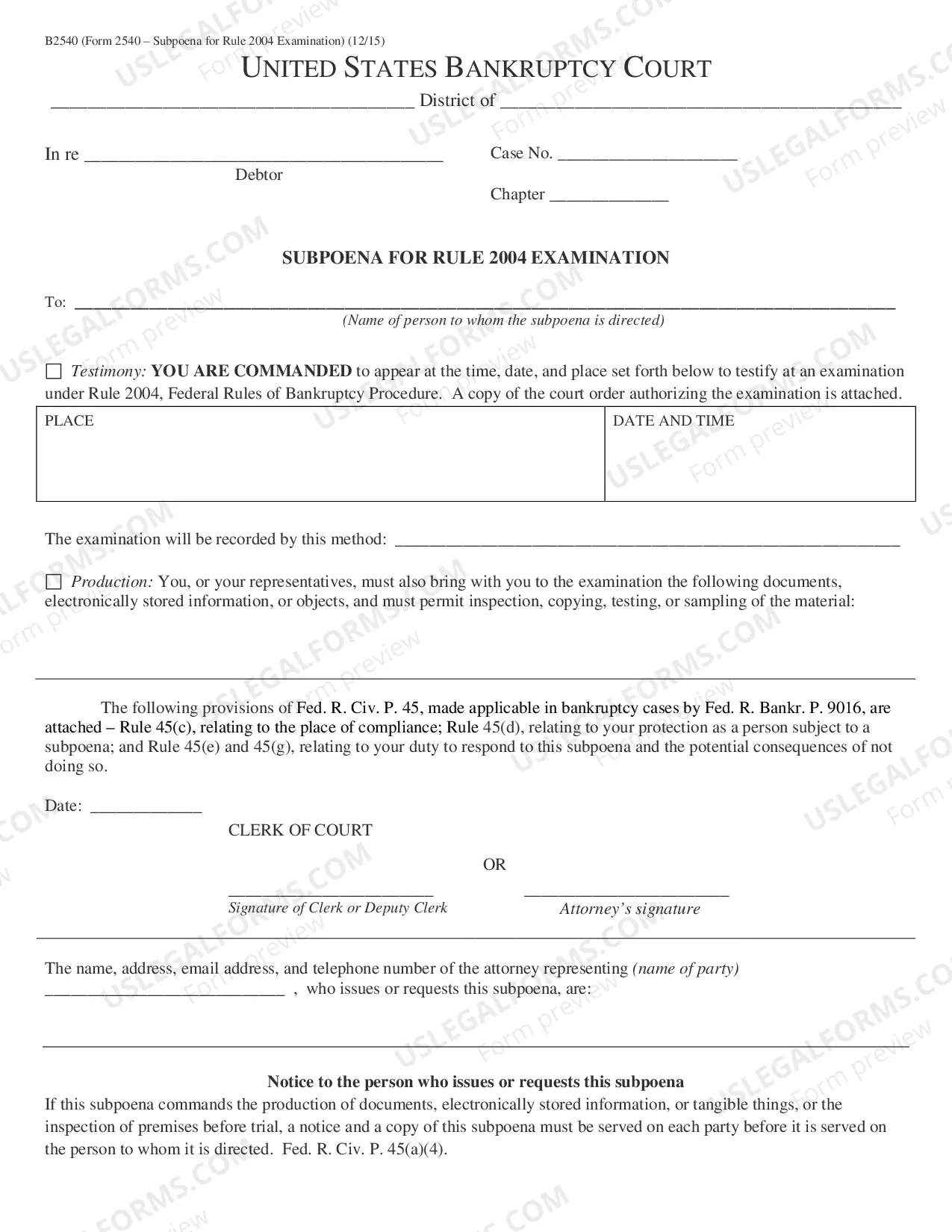
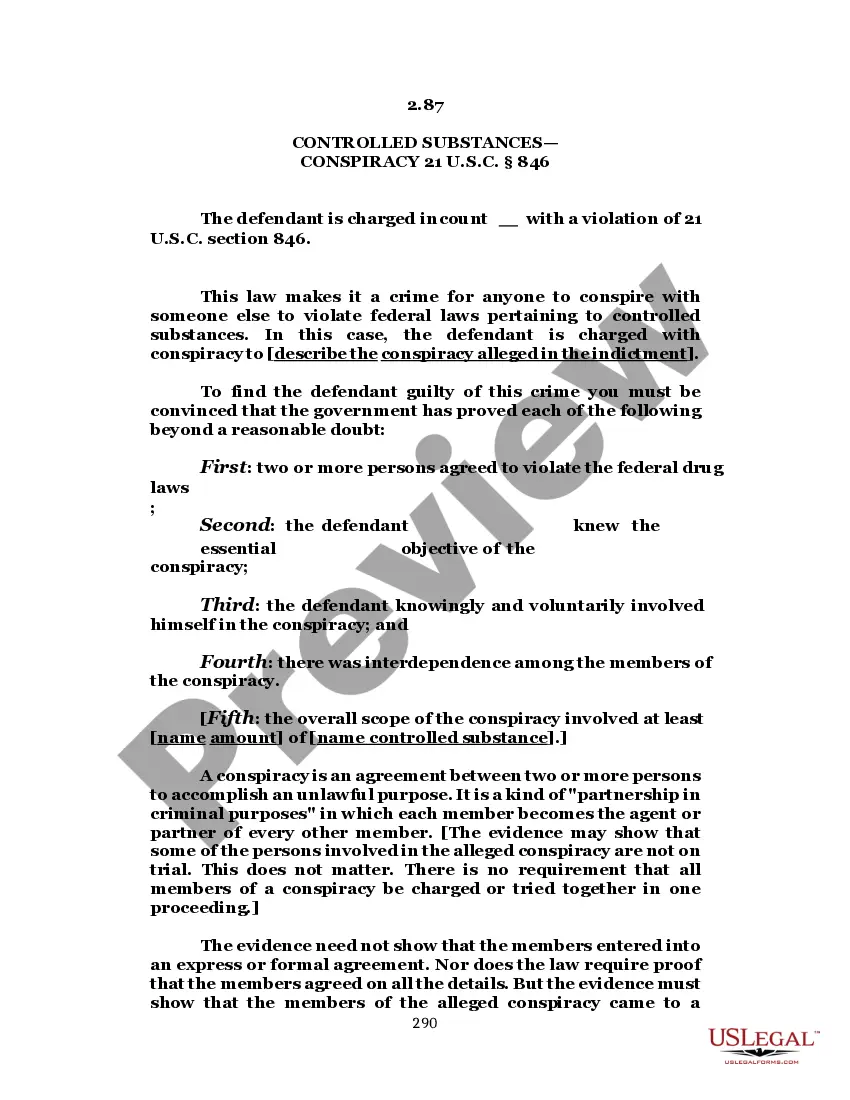
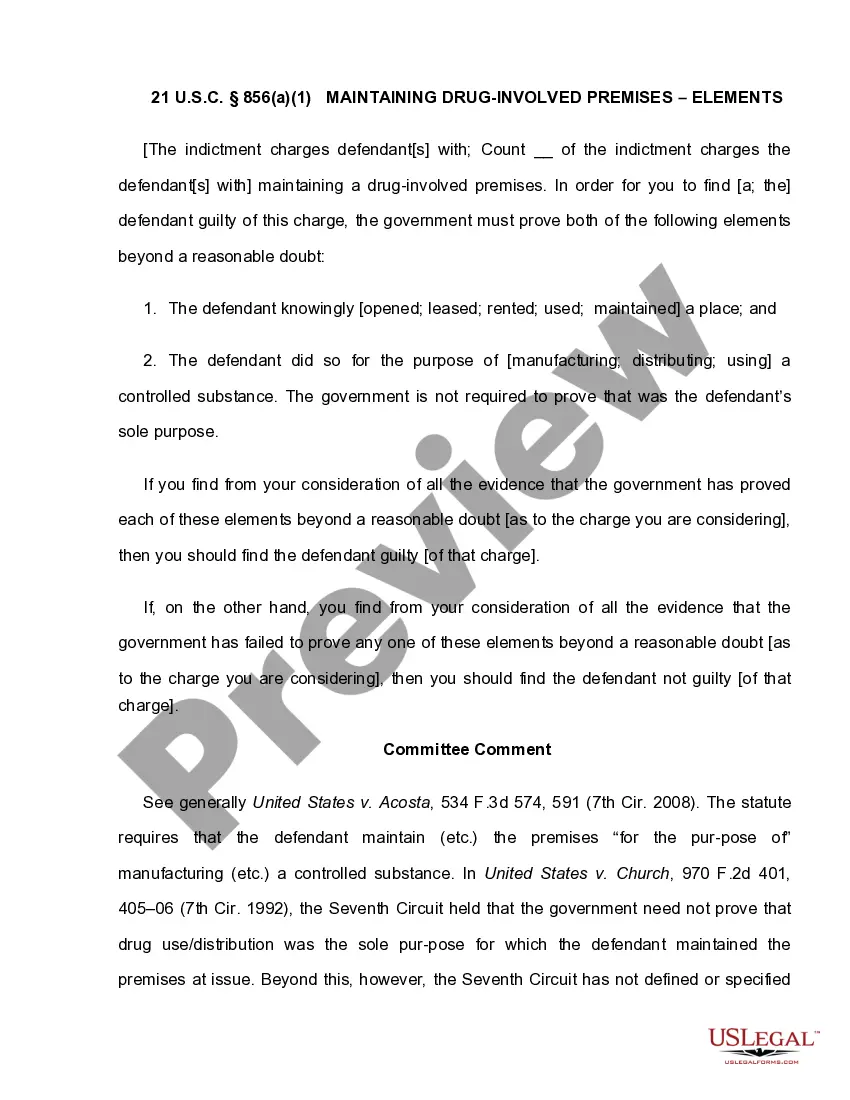
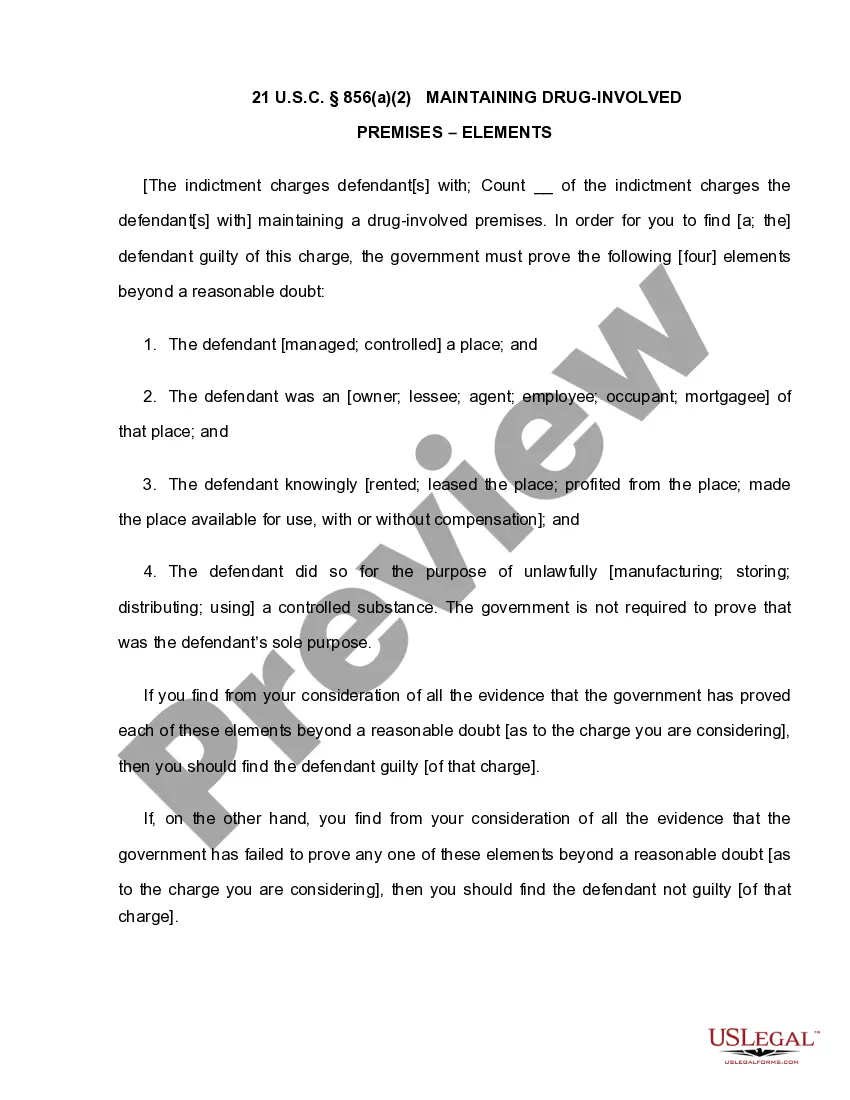
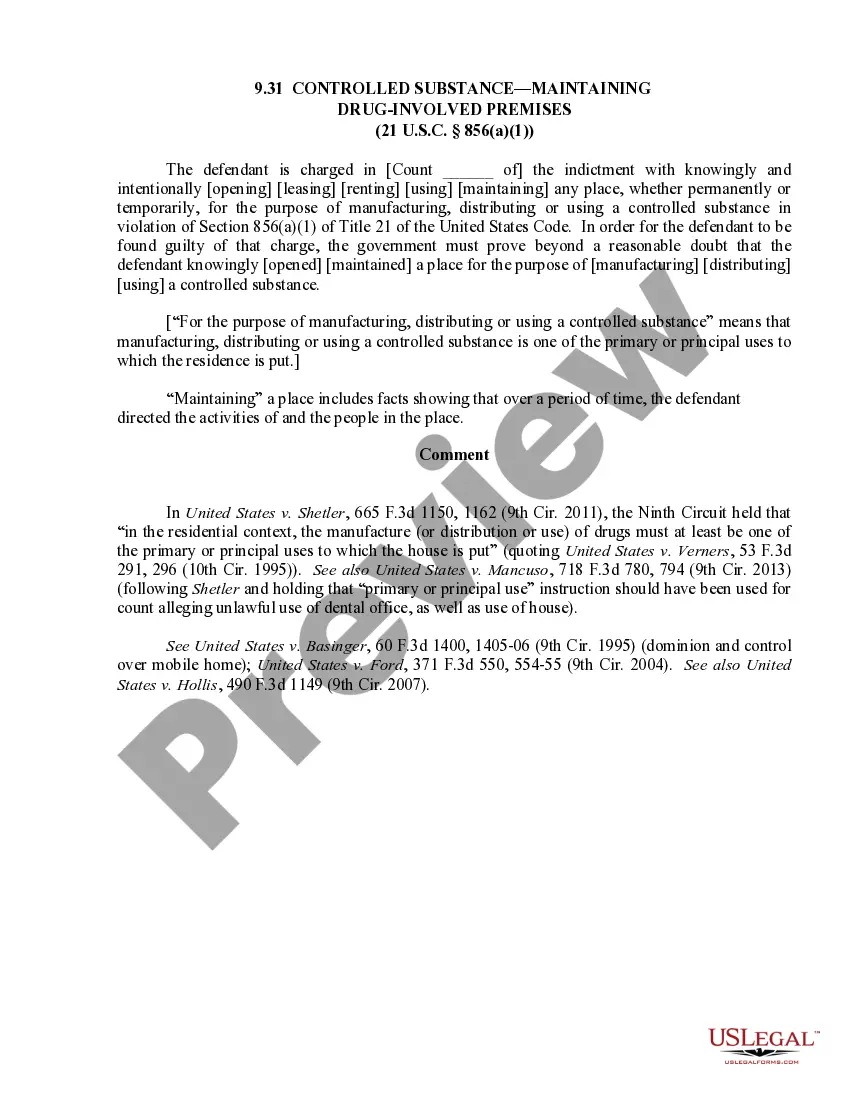
2.89 CONTROLLED SUBSTANCES-MAINTAINING DRUG INVOLVED PREMISES / 21 U.S.C. Sec. 856(a)(1)
Understanding this form
The 2.89 Controlled Substances - Maintaining Drug Involved Premises form is a legal document used to address violations under 21 U.S.C. § 856(a)(1). This law makes it a crime to knowingly open or maintain a property for the purpose of manufacturing, distributing, or using controlled substances. This form is essential for understanding legal proceedings related to drug-involved premises, differentiating it from other criminal liability forms focused on personal drug offenses or possession.
Key parts of this document
- Charges laid against the defendant under 21 U.S.C. § 856(a)(1).
- Definition of âopenâ and âmaintainâ in relation to drug-involved premises.
- Provisions requiring proof that the defendant knew the premises were used for illegal purposes.
- Specifications on the type of controlled substances involved.
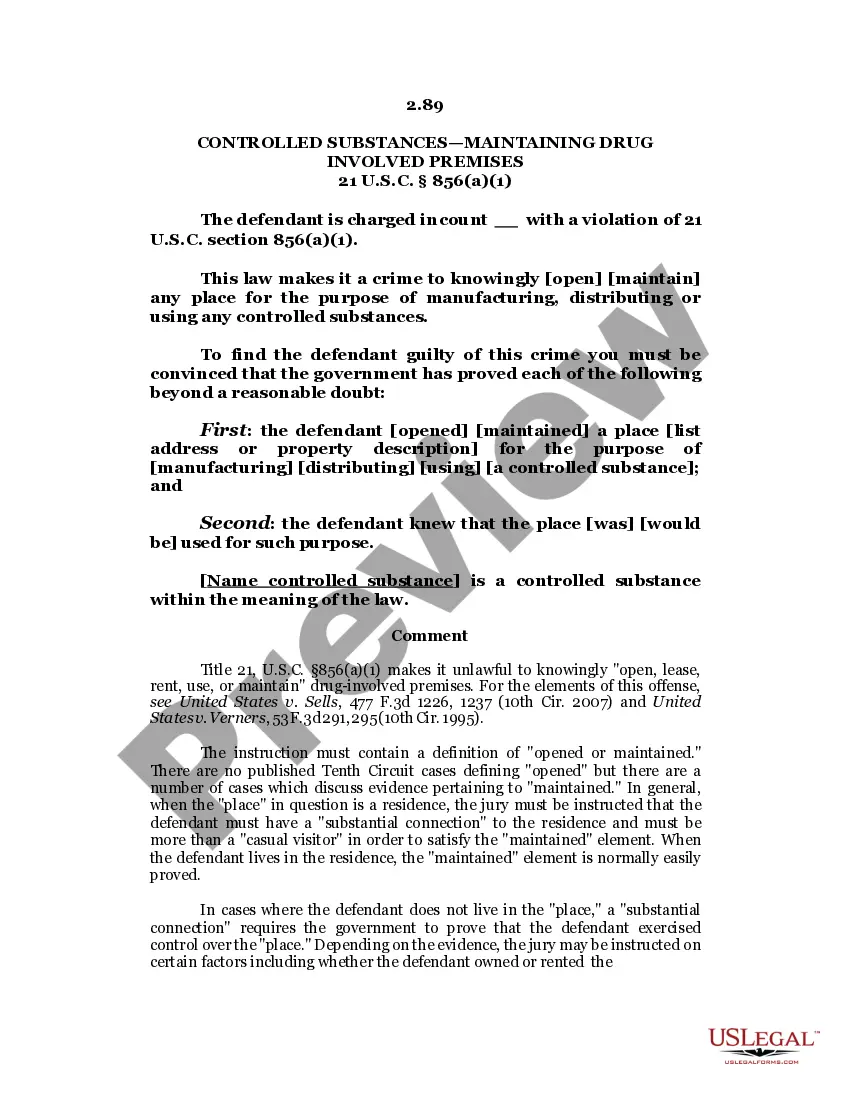
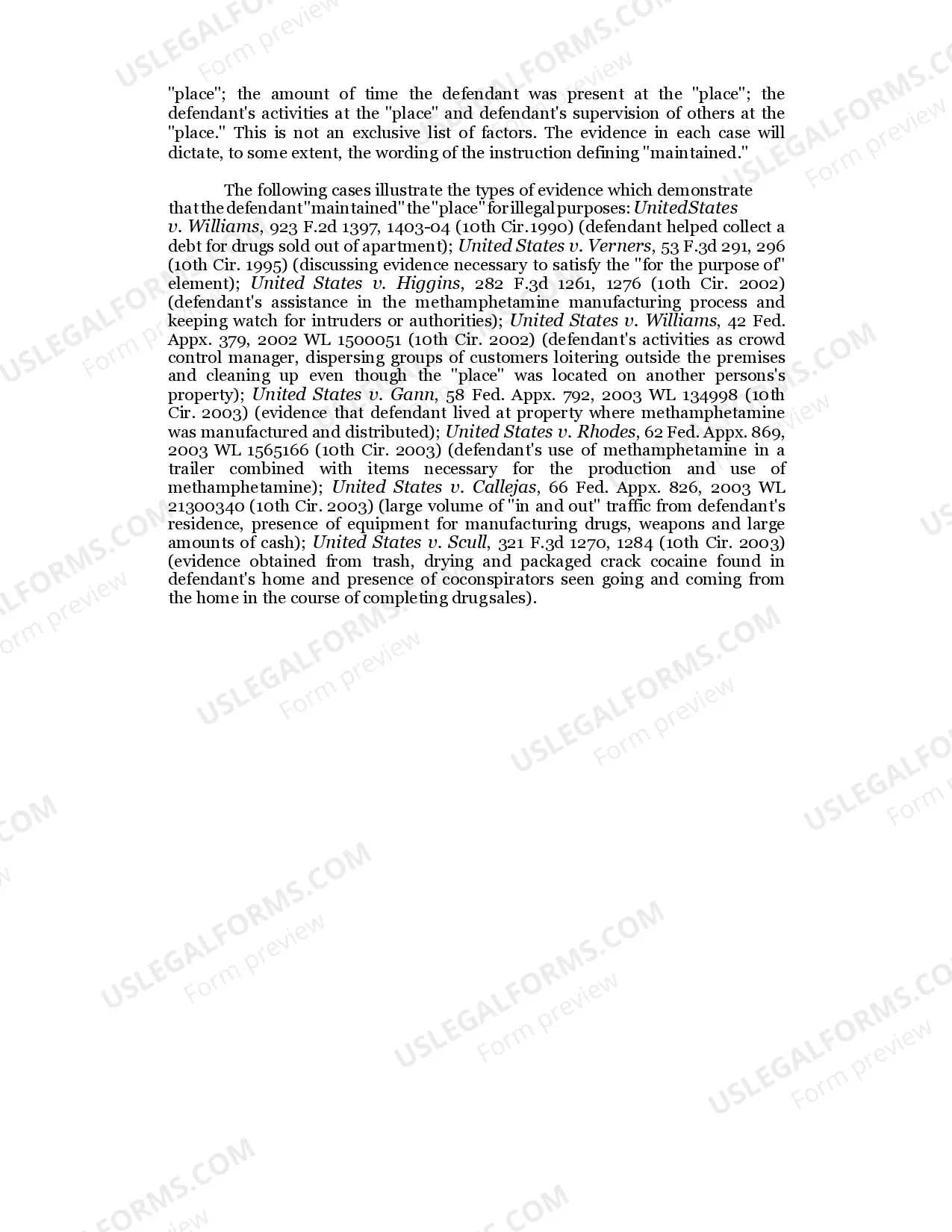
- Guidelines for jury instructions based on case precedents related to maintaining premises.
Situations where this form applies
This form is used in situations where an individual is facing charges for maintaining a property involved with drug-related activities. If you are involved in a legal case concerning the use, distribution, or manufacturing of controlled substances at a specific location, this form will help outline the necessary legal framework and responsibilities under U.S. law.
Who this form is for
- Individuals charged with maintaining drug-involved premises.
- Legal representatives defending clients against such charges.
- Property owners or landlords potentially implicated in drug-related activities occurring in their properties.
- Anyone needing to understand the implications of drug laws pertaining to real estate.
Completing this form step by step
- Identify the defendant's details and the specific charges being laid.
- Provide the address or property description related to the charges.
- Specify the controlled substances involved in the alleged activities.
- Document any evidence that indicates the defendant knew about the illegal use of the premises.
- Prepare jury instructions based on the legal precedents relevant to maintaining drug-involved premises.
Is notarization required?
This form does not typically require notarization to be legally valid. However, some jurisdictions or document types may still require it. US Legal Forms provides secure online notarization powered by Notarize, available 24/7 for added convenience.
Get your form ready online
Our built-in tools help you complete, sign, share, and store your documents in one place.
Make edits, fill in missing information, and update formatting in US Legal Forms—just like you would in MS Word.
Download a copy, print it, send it by email, or mail it via USPS—whatever works best for your next step.
Sign and collect signatures with our SignNow integration. Send to multiple recipients, set reminders, and more. Go Premium to unlock E-Sign.
If this form requires notarization, complete it online through a secure video call—no need to meet a notary in person or wait for an appointment.
We protect your documents and personal data by following strict security and privacy standards.

Make edits, fill in missing information, and update formatting in US Legal Forms—just like you would in MS Word.

Download a copy, print it, send it by email, or mail it via USPS—whatever works best for your next step.

Sign and collect signatures with our SignNow integration. Send to multiple recipients, set reminders, and more. Go Premium to unlock E-Sign.

If this form requires notarization, complete it online through a secure video call—no need to meet a notary in person or wait for an appointment.

We protect your documents and personal data by following strict security and privacy standards.
Common mistakes to avoid
- Failing to clearly identify the premises involved in the offenses.
- Neglecting to provide sufficient evidence of the defendant's awareness of the drug-related activities.
- Misinterpreting the definitions of âopenâ and âmaintainâ as they relate to the law.
- Overlooking relevant case law that supports the charges or the defense.
Benefits of using this form online
- Convenient access to accurate and up-to-date legal language.
- Editability to meet specific case requirements quickly.
- Reliable documents drafted by licensed attorneys to ensure compliance with legal standards.
- Streamlined process for obtaining legal documentation without extensive delays.
Legal use & context
- This form is legally significant in establishing the context of drug charges related to properties.
- It clarifies the responsibilities and potential liabilities for those associated with drug-involved premises.
- Understanding this form is crucial as it shapes criminal defenses and strategies in court.
What to keep in mind
- The form is essential for defining legal responsibilities under drug involvement laws.
- It provides a structured approach for understanding how to defend against charges relating to drug-involved premises.
- Consulting with a legal expert can enhance comprehension and ensure accurate completion of the form.
Looking for another form?

Form popularity
FAQ
Schedule 1: marijuana, heroin, LSD, ecstasy, and magic mushrooms. Schedule 2: cocaine, meth, oxycodone, Adderall, Ritalin, and Vicodin. Schedule 3: Tylenol with codeine, ketamine, anabolic steroids, and testosterone.
A drug or other substance that has a high chance of being abused or causing addiction and has no FDA-approved medical use in the United States. Schedule I drugs are tightly regulated by the federal government. Examples of Schedule I drugs are heroin, LSD, and ecstasy.
Schedule I ? drugs with a high abuse risk. These drugs have NO safe, accepted medical use in the United States. Some examples are heroin, marijuana, LSD, PCP, and crack cocaine. Schedule II ? drugs with a high abuse risk, but also have safe and accepted medical uses in the United States.
Any person who violates subsection (a) of this section shall be sentenced to a term of imprisonment of not more than 20 years or a fine of not more than $500,000, or both, or a fine of $2,000,000 for a person other than an individual.
Examples of Schedule II narcotics include: hydromorphone (Dilaudid®), methadone (Dolophine®), meperidine (Demerol®), oxycodone (OxyContin®, Percocet®), and fentanyl (Sublimaze®, Duragesic®). Other Schedule II narcotics include: morphine, opium, codeine, and hydrocodone.
Under 21 U.S.C. Section 856, a person is guilty of Maintaining Drug Involved Premises, when s/he: Knowingly opens, leases, rents, uses or maintains any place (whether permanently or temporarily) for the purpose of manufacturing, distributing or using any controlled substance, OR.
Schedule I: Drugs with no current medical use with high potential for abuse and/or addiction. Schedule II: Drugs with some medically acceptable uses, but with high potential for abuse and/or addiction.
Schedule II drugs, substances, or chemicals are defined as drugs with a high potential for abuse, with use potentially leading to severe psychological or physical dependence. These drugs are also considered dangerous.