Marketing and Distribution Agreement between Publishers Group West, Inc. and Total Sports, Inc.
Overview of this form
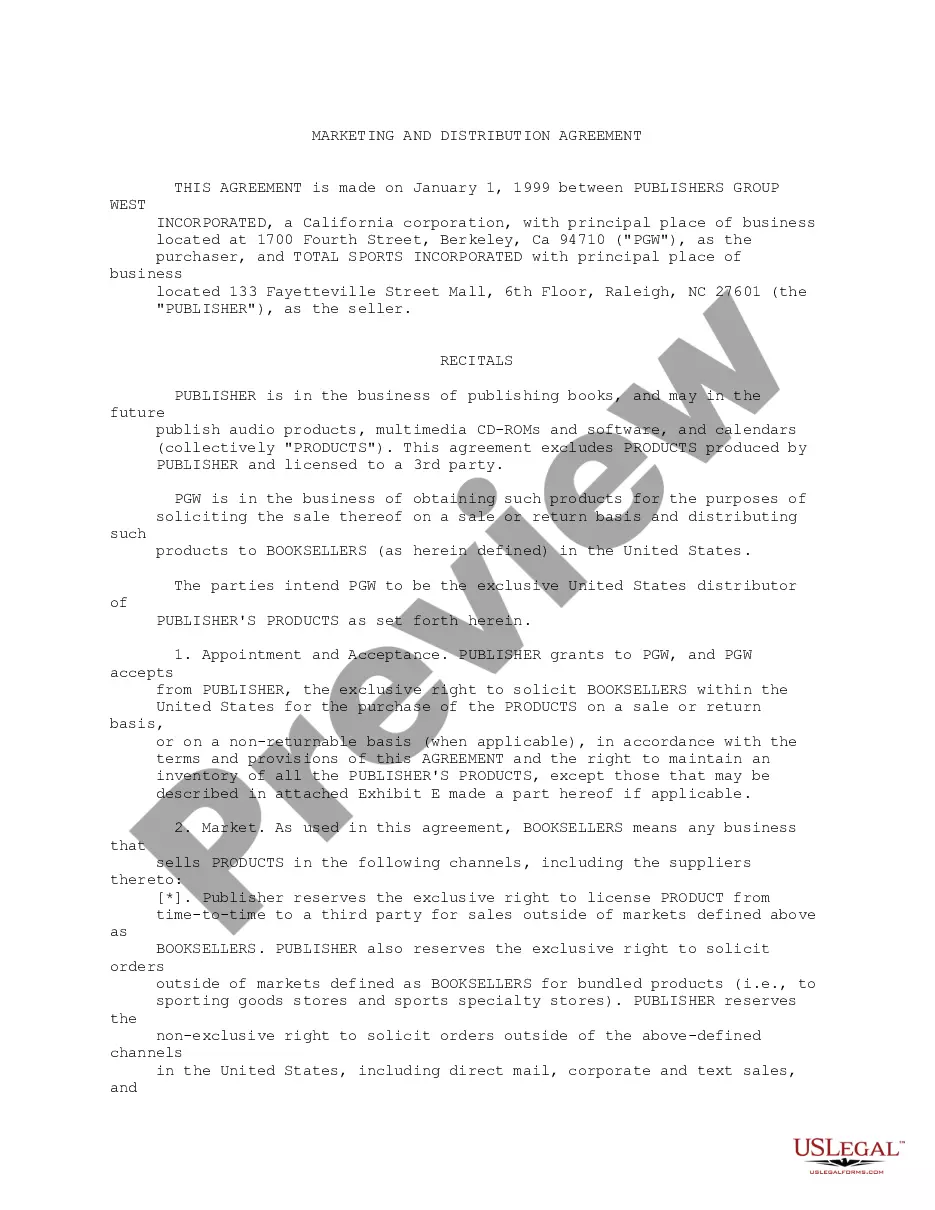
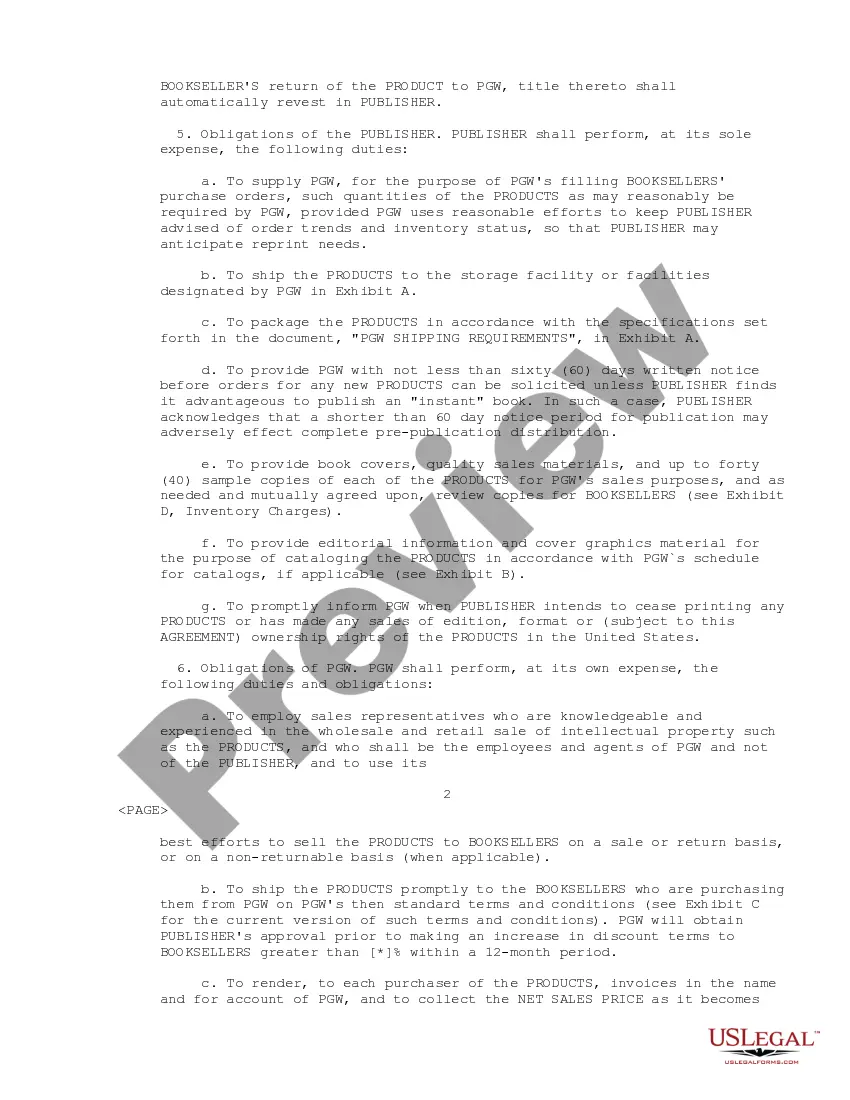
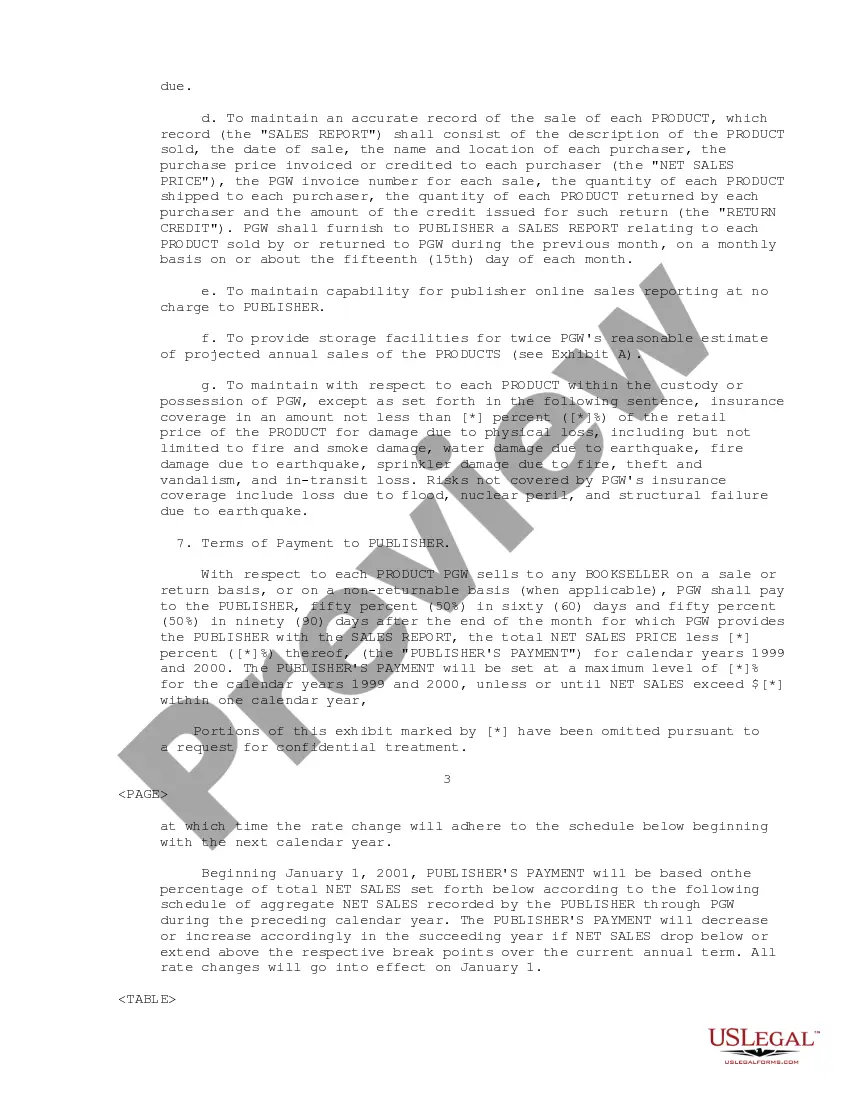
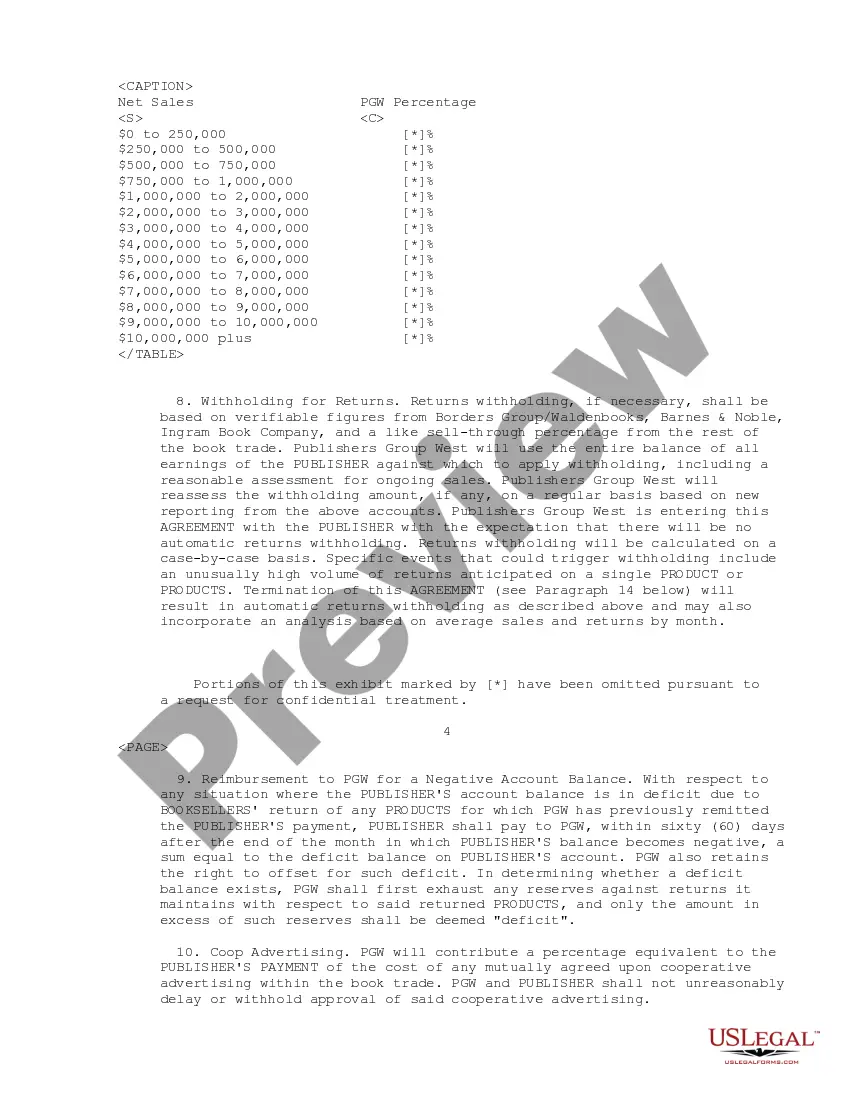
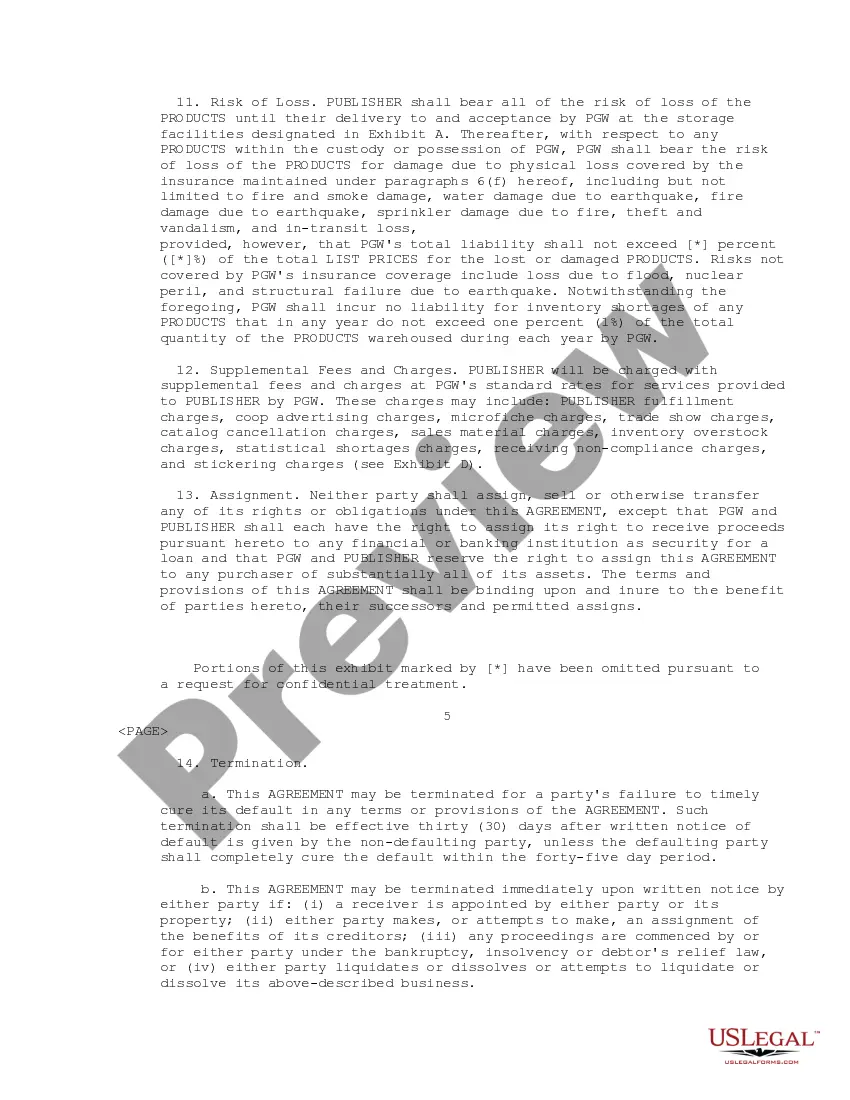
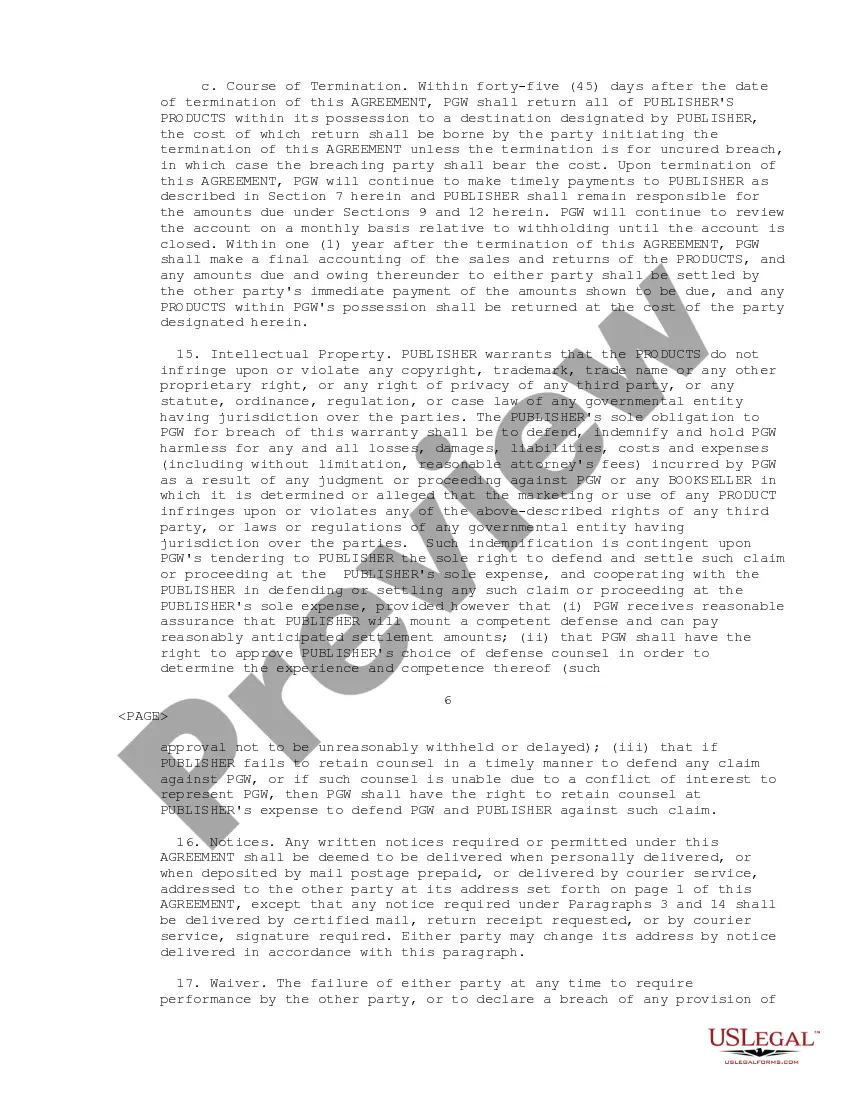
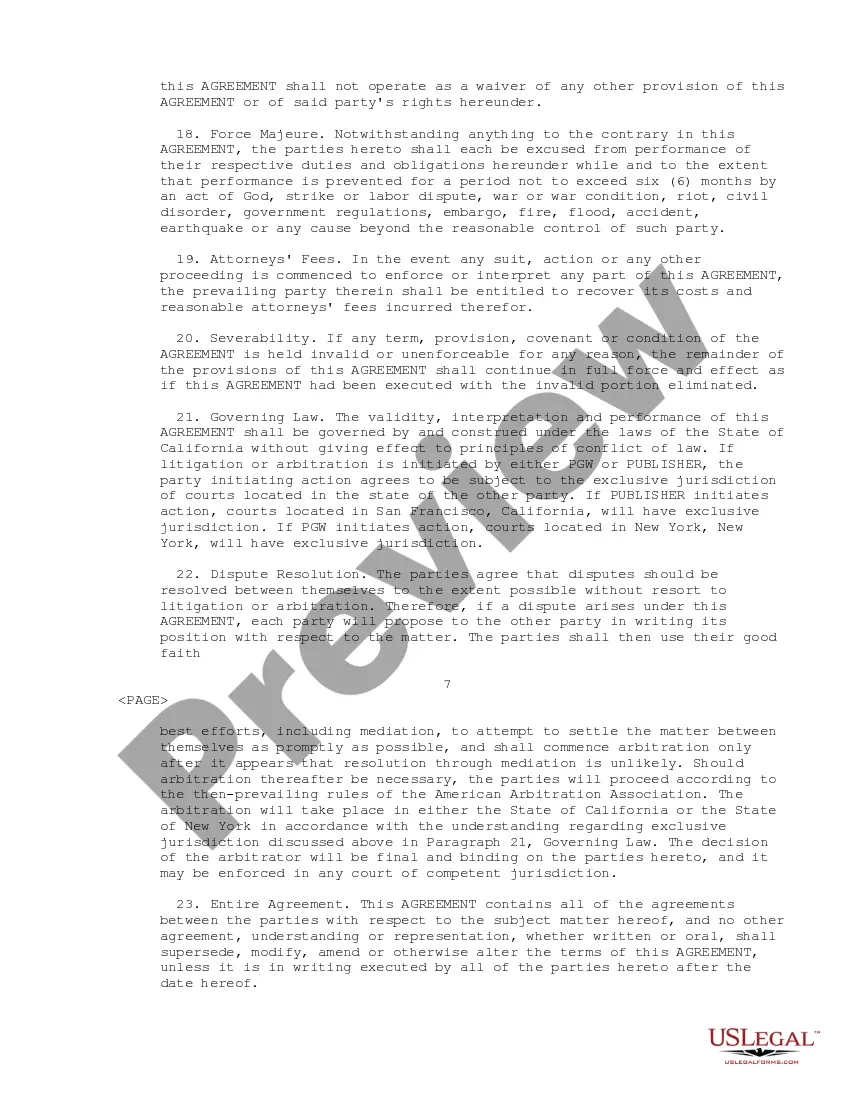
This Marketing and Distribution Agreement is a legal document that defines the exclusive distributorship arrangement between Publishers Group West, Inc. and Total Sports, Inc. This form outlines the responsibilities and rights of both parties in the marketing and distribution of specific products in the United States. It establishes how products will be solicited, sold, and returned, setting clear guidelines to avoid disputes during the partnership. Unlike general distribution contracts, this agreement is tailored to the specific collaboration between the two publishers, ensuring all mutually beneficial terms are included.
Key parts of this document
- Appointment of exclusive distributor rights for PGW.
- Duties and obligations of both the publisher and the distributor.
- Terms of payment and sales reporting requirements.
- Handling of product returns and account balance regulation.
- Provisions for advertising and promotional support.
- Conditions for termination and dispute resolution methods.

When this form is needed
This form should be used when a publisher intends to grant exclusive distribution rights to a distributor for their products, particularly when establishing a clear framework for marketing efforts, inventory management, and sales obligations. It is beneficial when two companies want to formalize their business relationship, ensuring both understand their roles and responsibilities in the distribution process.
Who can use this document
- Publishers looking to establish a distribution partnership.
- Distributors seeking exclusive rights to market a publisher's products.
- Companies planning to manage inventory and sales for book-related products.
- Business entities involved in the publishing or distribution of multimedia products.
Steps to complete this form
- Identify and enter the full names and addresses of both parties involved (Publishers Group West, Inc. and Total Sports, Inc.).
- Specify the products covered in the agreement and any exclusions.
- Outline the payment terms, including percentages and timing relevant to sales reporting.
- Detail the obligations and responsibilities of both parties regarding marketing, inventory, and returns.
- Include the duration of the agreement and conditions for termination.
Does this document require notarization?
This form does not typically require notarization unless specified by local law. However, parties may choose to have the agreement notarized for added verification and legal assurance.
Get your form ready online
Our built-in tools help you complete, sign, share, and store your documents in one place.
Make edits, fill in missing information, and update formatting in US Legal Forms—just like you would in MS Word.
Download a copy, print it, send it by email, or mail it via USPS—whatever works best for your next step.
Sign and collect signatures with our SignNow integration. Send to multiple recipients, set reminders, and more. Go Premium to unlock E-Sign.
If this form requires notarization, complete it online through a secure video call—no need to meet a notary in person or wait for an appointment.
We protect your documents and personal data by following strict security and privacy standards.

Make edits, fill in missing information, and update formatting in US Legal Forms—just like you would in MS Word.

Download a copy, print it, send it by email, or mail it via USPS—whatever works best for your next step.

Sign and collect signatures with our SignNow integration. Send to multiple recipients, set reminders, and more. Go Premium to unlock E-Sign.

If this form requires notarization, complete it online through a secure video call—no need to meet a notary in person or wait for an appointment.

We protect your documents and personal data by following strict security and privacy standards.
Mistakes to watch out for
- Failing to specify all products and any exclusions, leading to potential misunderstandings.
- Not clearly defining roles and responsibilities, which can result in disputes.
- Neglecting to outline payment terms accurately, leading to financial complications.
- Forgetting to document the agreement duration or renewal conditions.
Advantages of online completion
- Easy access and immediate download, allowing for quick implementation.
- Edit and customize the agreement to fit specific business needs without the need for legal counsel.
- Reliable templates drafted by licensed attorneys ensure compliance with legal standards.
Legal use & context
- This agreement is legally binding and enforceable under California law.
- Both parties should keep copies of the signed agreement for their records.
- Changes or modifications to the agreement should be documented in writing and signed by both parties.
What to keep in mind
- The Marketing and Distribution Agreement formalizes the relationship between a publisher and a distributor.
- Clearly defined roles and responsibilities help prevent disputes.
- Compliance with local laws, particularly in California, is crucial for the document's enforceability.
Looking for another form?
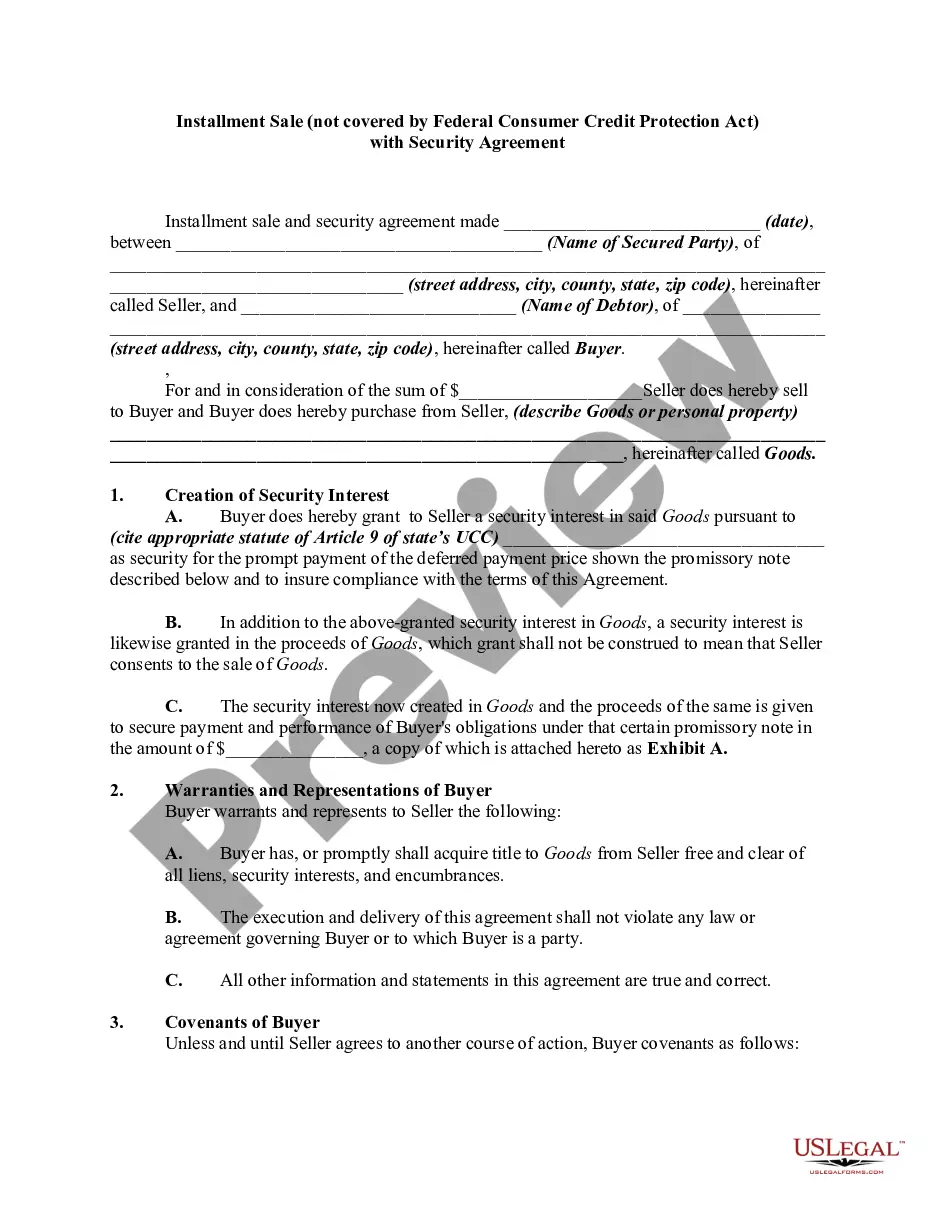





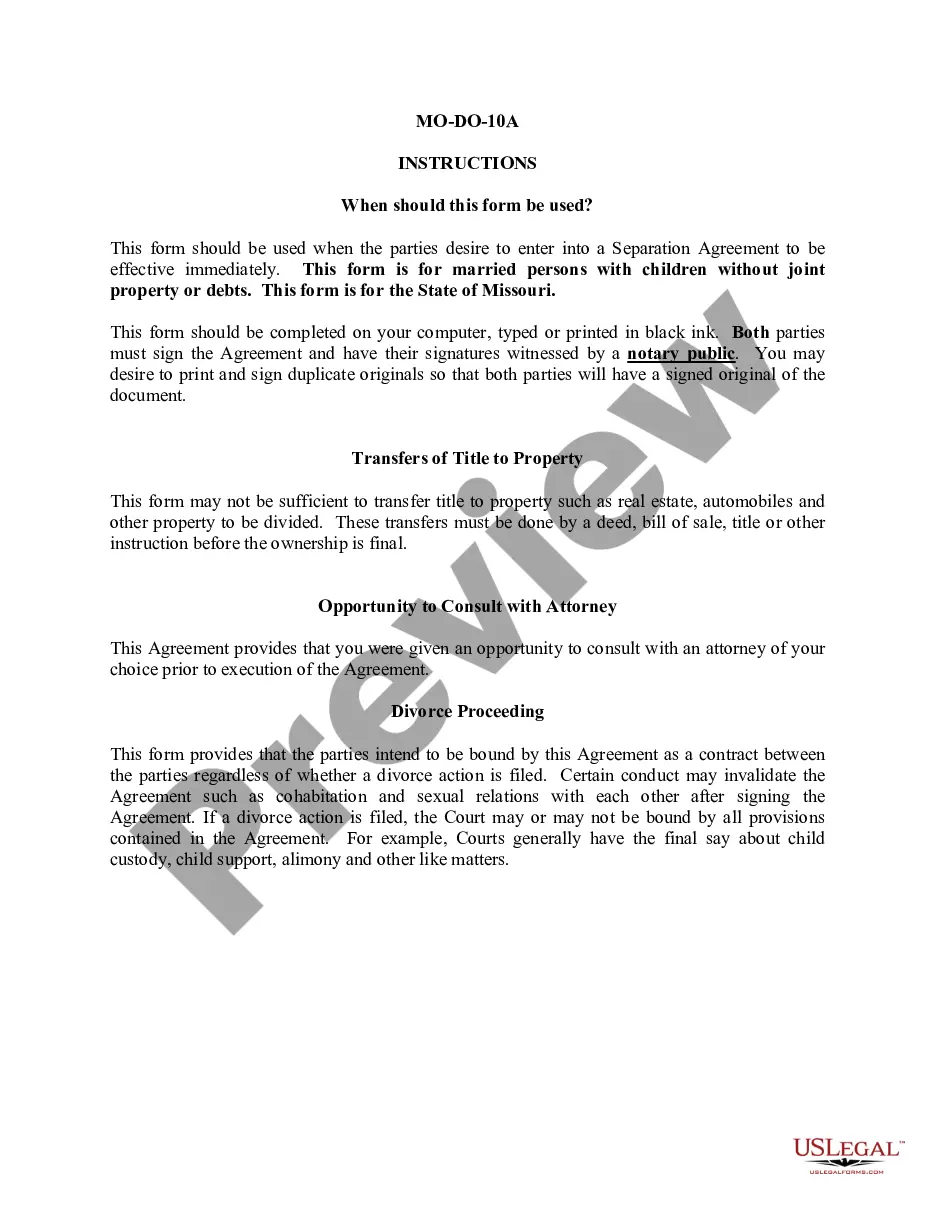


Form popularity
FAQ
Under standard royalties, an author gets roughly 20 to 30% of the publisher's revenue for a hardcover, 15% for a trade paperback, and 25% for an eBook. So, very roughly, every hardcover release that earns out brings the author something like 25% of all revenue earned by the publisher.
Penguin/Random House. Hachette Book Group. Harper Collins. Simon and Schuster. Macmillan.
A book contract is a written agreement that encompasses every facet of an author's work with a publisher. When a book publisher offers to publish a book, and the author accepts, there are deal points that must be discussed and agreed to. Typically, these points are hashed out between the author's agent and publisher.
Go to writers conferences where agents appear, search their websites, find their names in the acknowledgment pages of books you like, find a friend who has a good agent, and subscribe to Publisher's Marketplace for the latest book deals between agents and editors.
Typically, an author can expect to receive the following royalties: Hardback edition: 10% of the retail price on the first 5,000 copies; 12.5% for the next 5,000 copies sold, then 15% for all further copies sold. Paperback: 8% of retail price on the first 150,000 copies sold, then 10% thereafter.
The average author with a first-time book deal can expect to receive an advance of $5,000 to $15,000. Once your book is released, you won't see another dime until you have earned back that advance$1.25 at a timeuntil the advance is paid back in full.
Self-published authors can make between 40% 60% royalties on a single book sale while traditionally published authors usually make between 10%-12% royalties. First-time authors who want to traditionally publish can get an advance, which is usually $10,000 (usually not that much more for a first-timer).
The path to publication generally requires authors to sign a publishing contract that covers such topics as: manuscript delivery and acceptance, copyright ownership and grants; royalty advances, rates and payment; author warranties and indemnities; contract duration and rights reversion (out-of-print); options on new