Five Percent Shareholder Checklist
About this form
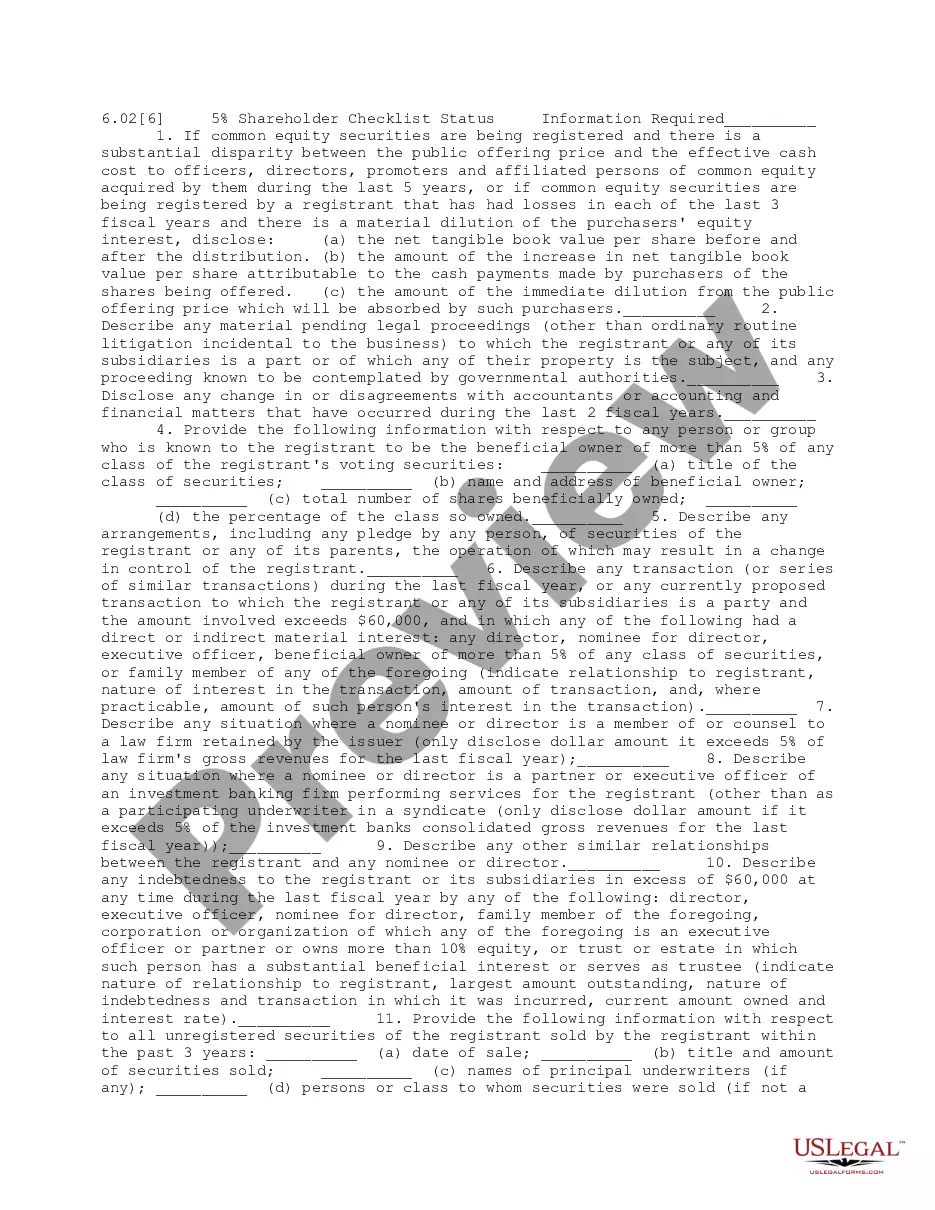
The Five Percent Shareholder Checklist is a due diligence document designed to gather information relevant to five percent shareholders in a business transaction. This form helps businesses disclose crucial financial and legal details pertaining to significant shareholders, ensuring transparency and compliance in transactions, distinguishing it from other shareholder-related forms.
Main sections of this form
- Disclosure of any substantial disparity in public offering price and cash costs to key stakeholders
- Information on material pending legal proceedings
- Details regarding any disagreements with accountants in the last two fiscal years
- Information about beneficial owners of voting securities
- Disclosure of significant transactions with directors or executive officers
- Details regarding unregistered securities sold in the past three years



Situations where this form applies
You should use the Five Percent Shareholder Checklist when preparing for a business transaction that involves shareholders owning five percent or more of the company's equity. This includes initial public offerings, mergers, acquisitions, or any situation where significant financial transparency is required for compliance or due diligence purposes.
Who this form is for
This form is intended for:
- Business owners and executives looking to prepare for a transaction
- Shareholders with five percent or more ownership in a business
- Legal and financial advisors conducting due diligence
- Investors assessing the financial health and structure of a business
Instructions for completing this form
- Review each category of information required to ensure all pertinent details are included.
- Gather financial and legal documents that provide clarity on pending transactions and shareholder details.
- Complete each section systematically, ensuring accuracy in disclosures related to ownership and financial dealings.
- Sign and date the checklist upon completion, confirming the provided information is correct.
- Provide the completed checklist to legal or financial advisors for review before final submission.
Notarization guidance
Notarization is generally not required for this form. However, certain states or situations might demand it. You can complete notarization online through US Legal Forms, powered by Notarize, using a verified video call available anytime.
Get your form ready online
Our built-in tools help you complete, sign, share, and store your documents in one place.
Make edits, fill in missing information, and update formatting in US Legal Forms—just like you would in MS Word.
Download a copy, print it, send it by email, or mail it via USPS—whatever works best for your next step.
Sign and collect signatures with our SignNow integration. Send to multiple recipients, set reminders, and more. Go Premium to unlock E-Sign.
If this form requires notarization, complete it online through a secure video call—no need to meet a notary in person or wait for an appointment.
We protect your documents and personal data by following strict security and privacy standards.

Make edits, fill in missing information, and update formatting in US Legal Forms—just like you would in MS Word.

Download a copy, print it, send it by email, or mail it via USPS—whatever works best for your next step.

Sign and collect signatures with our SignNow integration. Send to multiple recipients, set reminders, and more. Go Premium to unlock E-Sign.

If this form requires notarization, complete it online through a secure video call—no need to meet a notary in person or wait for an appointment.

We protect your documents and personal data by following strict security and privacy standards.
Common mistakes
- Failing to disclose significant financial or legal interests
- Inaccurate or incomplete information regarding shareholder identities and ownership percentages
- Missing deadlines for submission in relation to transaction timelines
Why use this form online
- Convenient access to the form from any device, allowing for flexibility in completion
- Editability of the document ensures information can be updated easily as needed
- Reliable access to attorney-drafted templates, reducing the likelihood of errors
Legal use & context
- This form serves as a key tool for ensuring compliance with securities regulations regarding shareholder disclosures.
- Failure to provide accurate information can lead to legal liabilities and issues with regulatory bodies.
Key takeaways
- The Five Percent Shareholder Checklist is vital for transparency in significant shareholder transactions.
- Accurate disclosures are crucial to avoid legal issues and ensure compliance.
- The checklist can be easily adapted for various state regulations, making it a flexible option for businesses.
Glossary of terms
- Beneficial owner: A person who enjoys the benefits of ownership even though the title to the asset is in another name.
- Equity interest: The ownership interest that shareholders have in a company.
- Control: The power to influence or direct the management and policies of a company.
Looking for another form?

Form popularity
FAQ
5% Owner means an individual who owns (or is considered as owning, within the meaning of Code Section 318) more than 5% of the outstanding stock of the Company or stock possessing more than 5% of the total combined voting power of all stock of the Company.
Introduction. Why have a Shareholders' Agreement? Identify the interests of the Shareholders. Identify Shareholder Value. Identify who will make decisions - Shareholders or Directors? Decide how the voting power of Shareholders should add up. Decide on the issues that the Shareholders' Agreement should cover.
5% Owner means any Person that owns 5% or more of the Company's Ordinary Shares on a fully-diluted basis. Sample 2.
A shareholders' agreement is an agreement entered into between all or some of the shareholders in a company. It regulates the relationship between the shareholders, the management of the company, ownership of the shares and the protection of the shareholders. They also govern the way in which the company is run.
Protection against dilution. The right to appoint a director. Rights to access information. Tag along and buy out rights. Pre-emptive rights. Limits on the Board's control. Protections against breach.
Introduction. Step 1: Decide on the issues the agreement should cover. Step 2: Identify the interests of shareholders. Step 3: Identify shareholder value. Step 4: Identify who will make decisions - shareholders or directors. Step 5: Decide how voting power of shareholders should add up. Further information and documents.
Common problem areas include the following: Directors -v- members. Transfer of shares. Approving a change in business direction. Managing changes in the roles shareholders play. Injection of debt. Competition. Exit.
There is another simple way to view the list of shareholders of the company in the MCA website, which is as follows: Visit the site : www.mca.gov.in and click on the icon 'MCA 21' Login by clicking the login option on right side of the page.
Any shareholder has a percentage ownership in the company, determined by dividing the number of shares they own by the number of outstanding shares.