Industrial Revenue Development Bond Workform
What is this form?
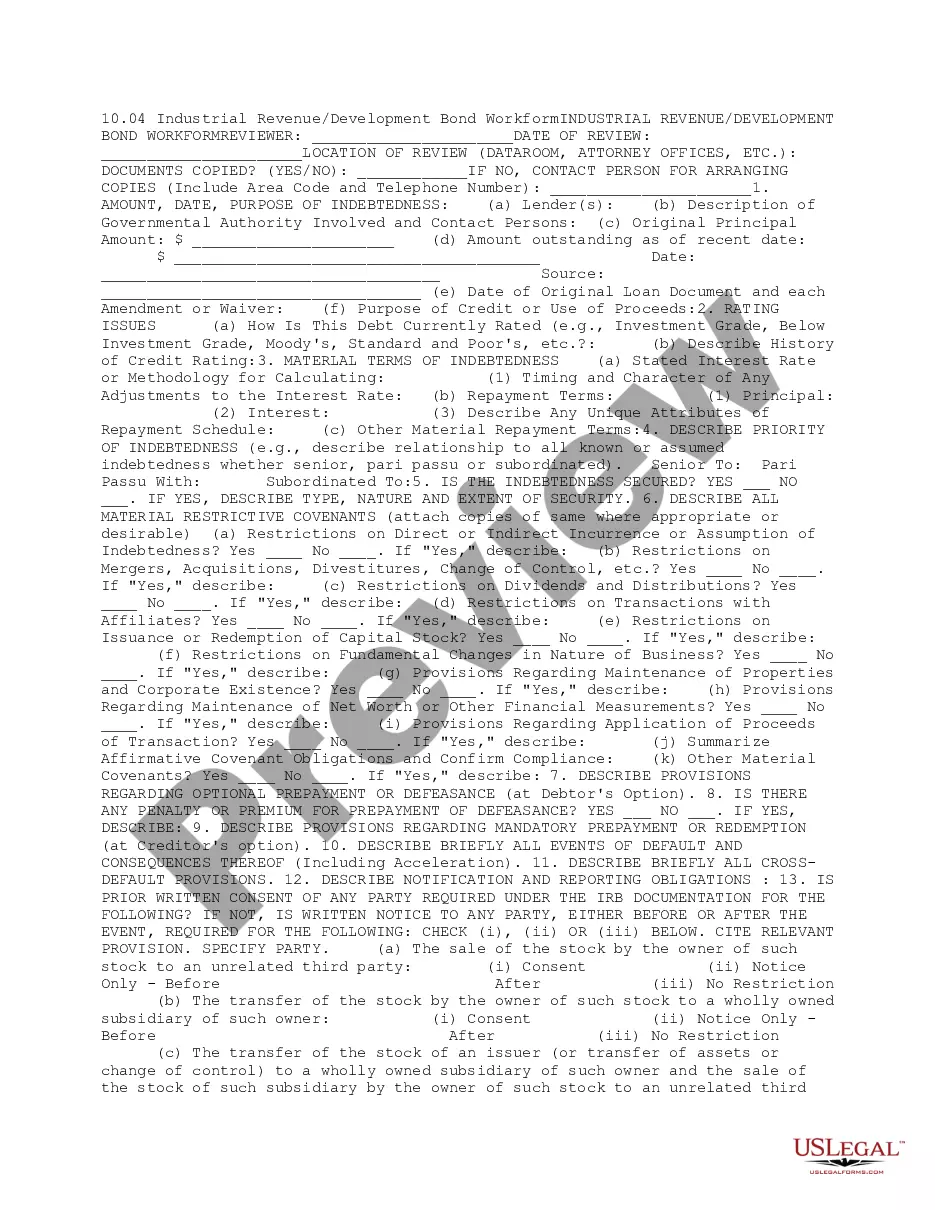
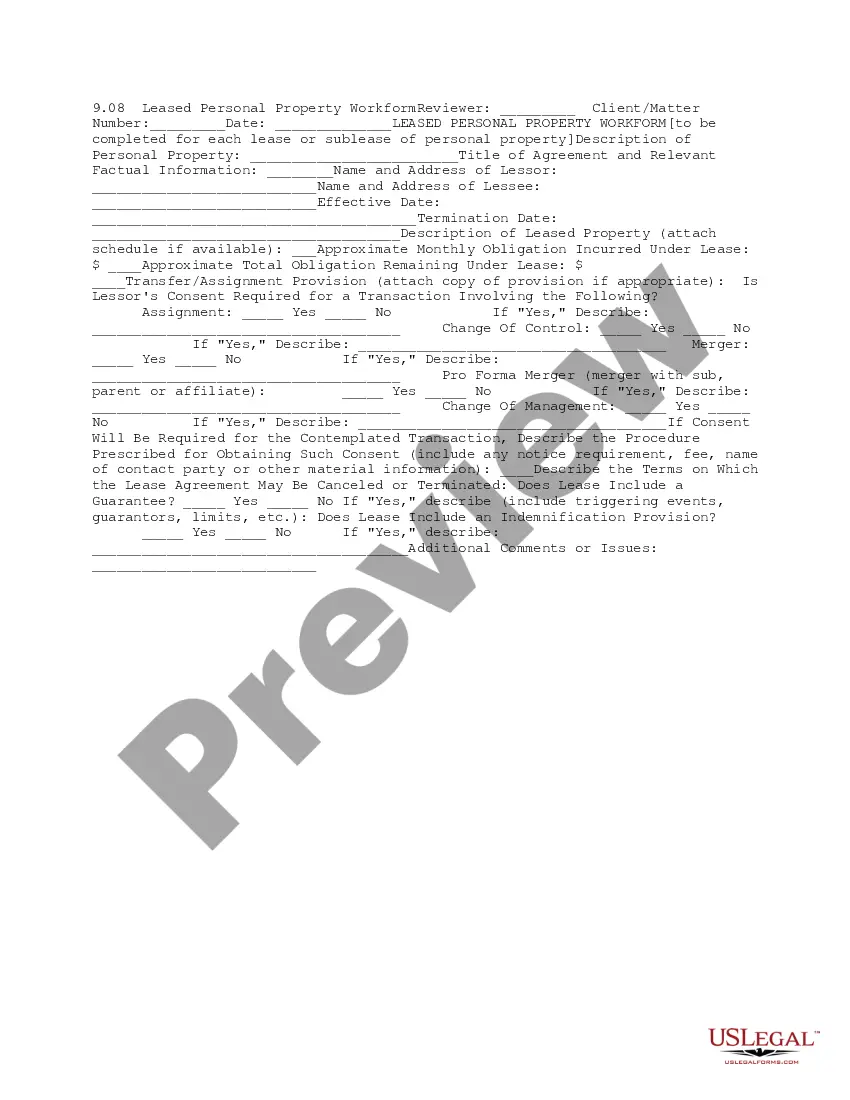
The Industrial Revenue Development Bond Workform is a legal document used for financing specific projects through industrial revenue bonds. Unlike other financial documents, this workform contains detailed sections to outline the terms of the indebtedness, including interest rates, repayment terms, and compliance obligations. It serves to ensure that all necessary information is captured for the effective management of industrial financing agreements.
Form components explained
- Amount, date, and purpose of indebtedness
- Rating issues and credit history
- Material terms of the indebtedness, including interest and repayment terms
- Priority of indebtedness concerning other debts
- Descriptive sections on security and covenants
- Events of default and notification obligations


Situations where this form applies
This form is essential when a governmental authority needs to issue industrial revenue bonds to finance a specific project. It should be used when establishing the terms of the loan, determining compliance with legal covenants, or when lenders require detailed disclosure of the financial arrangement associated with the bonds.
Who this form is for
- Governmental authorities involved in issuing industrial revenue bonds
- Financial institutions providing capital for development projects
- Legal professionals advising clients on bond financing
- Businesses seeking funding through industrial revenue bonds
Instructions for completing this form
- Identify the lender(s) and the governmental authority involved.
- Provide details about the loan amount, outstanding balance, and purpose.
- Outline the terms of the indebtedness, including interest rates and repayment schedules.
- Describe any relevant covenants, events of default, and notification requirements.
- Ensure all parties involved review and agree to the document prior to execution.
Notarization requirements for this form
This form does not typically require notarization to be legally valid. However, some jurisdictions or document types may still require it. US Legal Forms provides secure online notarization powered by Notarize, available 24/7 for added convenience.
Get your form ready online
Our built-in tools help you complete, sign, share, and store your documents in one place.
Make edits, fill in missing information, and update formatting in US Legal Forms—just like you would in MS Word.
Download a copy, print it, send it by email, or mail it via USPS—whatever works best for your next step.
Sign and collect signatures with our SignNow integration. Send to multiple recipients, set reminders, and more. Go Premium to unlock E-Sign.
If this form requires notarization, complete it online through a secure video call—no need to meet a notary in person or wait for an appointment.
We protect your documents and personal data by following strict security and privacy standards.

Make edits, fill in missing information, and update formatting in US Legal Forms—just like you would in MS Word.

Download a copy, print it, send it by email, or mail it via USPS—whatever works best for your next step.

Sign and collect signatures with our SignNow integration. Send to multiple recipients, set reminders, and more. Go Premium to unlock E-Sign.

If this form requires notarization, complete it online through a secure video call—no need to meet a notary in person or wait for an appointment.

We protect your documents and personal data by following strict security and privacy standards.
Common mistakes to avoid
- Failing to accurately report the amount outstanding as of the recent date.
- Overlooking the required consent for transferring stock or merging entities.
- Not including detailed descriptions of restrictive covenants.
- Skipping the review of events of default and their consequences.
Benefits of completing this form online
- Convenience of accessing and downloading the form anytime.
- Immediate availability, allowing for quick completion and submission.
- Editable formats that can be customized to meet specific project needs.
- Reliable templates drafted by licensed attorneys ensuring legal accuracy.
Looking for another form?


Form popularity
FAQ
Industrial revenue bonds (IRB) are municipal debt securities issued by a government agency on behalf of a private sector company and intended to build or acquire factories or other heavy equipment and tools. IRBs were formerly called Industrial Development Bonds (IDB).
There are two major types of municipal bonds: general obligation bonds and Investor Assistance (800) 732-0330 www.investor.gov Page 2 revenue bonds. Because these types come in many varieties, you should look beyond the short-hand label when deciding whether to purchase.
We recently focused on general obligation bonds, but here we'll discuss revenue bonds and what to look for when investing in them.Their interest payments are usually exempt from federal income taxes, and may be exempt from state income taxes if the bond issuer is located in the investor's home state.
General obligation bonds also serve as a way for local governments to raise funds for projects that create streams of income for things such as roads, parks, equipment, and bridges. General obligation bonds are usually used to fund government projects that will serve the public community.
Benefits. Like all municipal bonds, the interest earned from revenue bonds is exempt from federal taxes. Furthermore, those who purchase revenue bonds issued by their home states can enjoy interest payments that are tax-free at the state and local level as well.
Municipal bonds ("munis") are debt securities issued by state and local governments. These can be thought of as loans that investors make to local governments, and are used to fund public works such as parks, libraries, bridges & roads, and other infrastructure.
General obligation, or GO, bonds are backed by the general revenue of the issuing municipality, while revenue bonds are supported by a specific revenue source, such as income from a toll road, hospital, or higher-education system.
General obligation bonds are seen as good, safe investments, and some are also tax exempt. They're less risky, but also often deliver less return, than municipal revenue bonds, corporate bonds or other investments like stocks.
Revenue bonds are a class of municipal bond issued to fund public projects which then repay investors from the income created by that project.