Letter for COVID-19 Coronavirus Essential Employee Authorization to Work
About this form
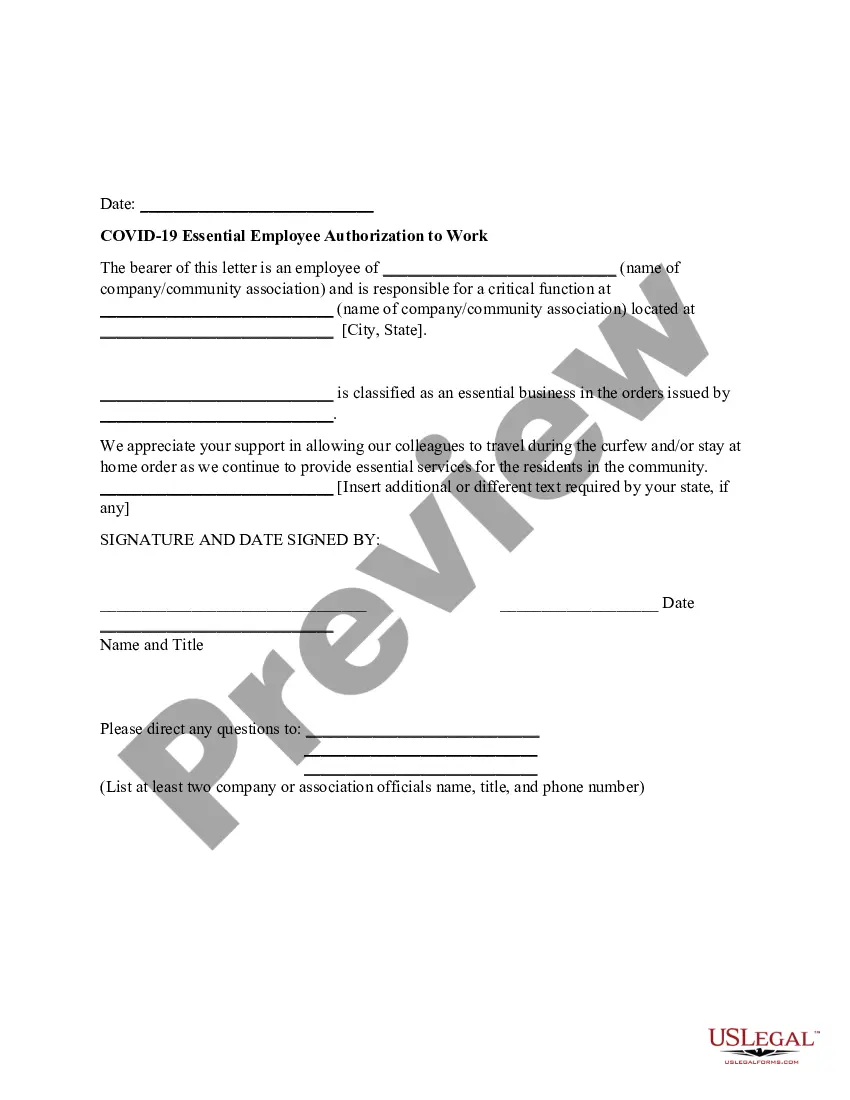
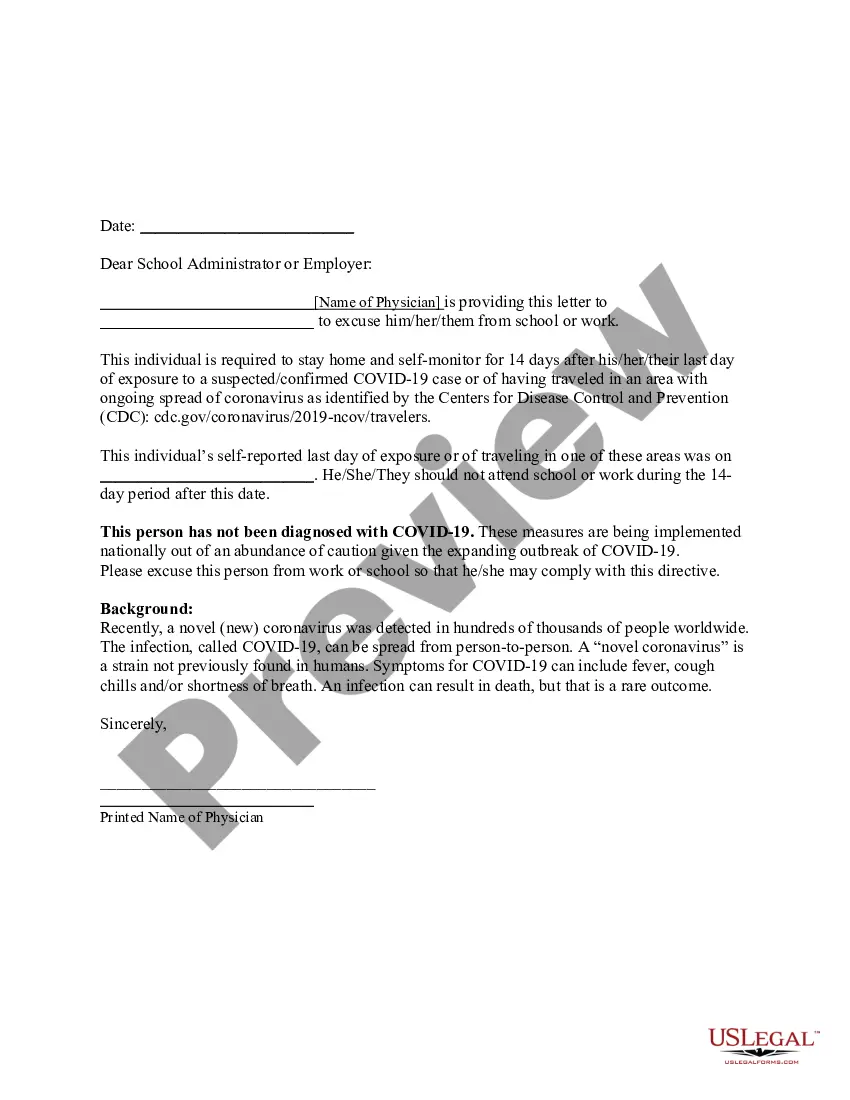
This Letter for COVID-19 Coronavirus Essential Employee Authorization to Work provides official documentation for essential employees, allowing them to travel to their workplace during restrictions enacted due to the COVID-19 pandemic. This form is essential for businesses classified under essential services as it ensures that employees can fulfill critical functions safely and legally, distinguishing it from other employment confirmation letters that may not specify essential service criteria.
Main sections of this form
- Date of issuance to validate the letter's timing.
- Name of the company or community association issuing the authorization.
- Employee's name and job function recognized as essential.
- Location of the workplace to identify the area of essential service.
- Signature and date from an authorized company official for verification.
- Contact information for company officials for any inquiries related to the authorization.
When this form is needed
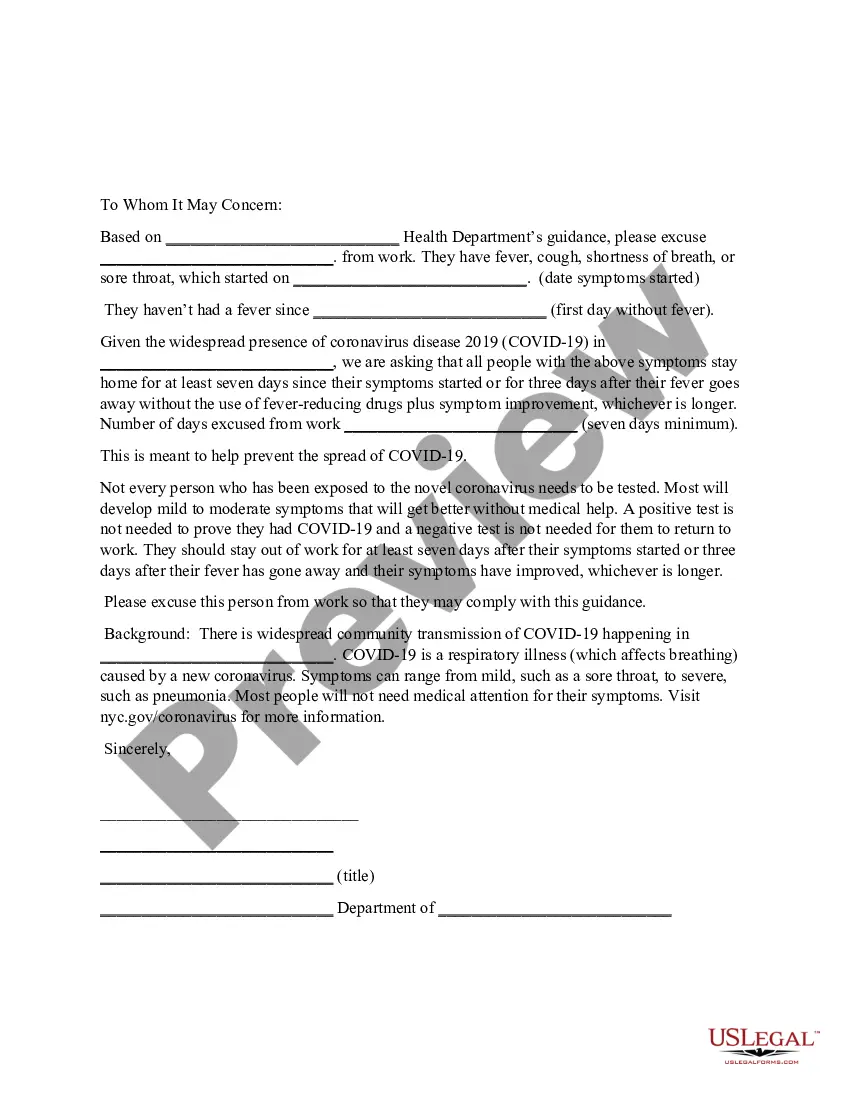
This form should be used when an essential employee needs to travel to work during a COVID-19 lockdown, curfew, or stay-at-home order. Employers can issue this letter to ensure their employees can perform critical job functions necessary for community safety and well-being, such as in healthcare, utilities, or emergency services.
Who can use this document
- Employers of essential businesses as defined by local or federal regulations.
- Employees whose roles are critical during the COVID-19 pandemic.
- Human resources personnel needing to provide formal authorization for employee travel.
- Community associations supporting their essential staff during travel restrictions.
Steps to complete this form
- Fill in the date of issuance to ensure the documentation is current.
- Enter the company's name along with the relevant location details.
- Specify the employee's name and their critical job function.
- Have an authorized official sign and date the letter for validation.
- Provide accurate contact information for any follow-up inquiries.
Does this document require notarization?
This form does not typically require notarization unless specified by local law. However, it should be signed by an authorized company official to ensure its legitimacy and acceptance by law enforcement during travel restrictions.
Get your form ready online
Our built-in tools help you complete, sign, share, and store your documents in one place.
Make edits, fill in missing information, and update formatting in US Legal Forms—just like you would in MS Word.
Download a copy, print it, send it by email, or mail it via USPS—whatever works best for your next step.
Sign and collect signatures with our SignNow integration. Send to multiple recipients, set reminders, and more. Go Premium to unlock E-Sign.
If this form requires notarization, complete it online through a secure video call—no need to meet a notary in person or wait for an appointment.
We protect your documents and personal data by following strict security and privacy standards.

Make edits, fill in missing information, and update formatting in US Legal Forms—just like you would in MS Word.

Download a copy, print it, send it by email, or mail it via USPS—whatever works best for your next step.

Sign and collect signatures with our SignNow integration. Send to multiple recipients, set reminders, and more. Go Premium to unlock E-Sign.

If this form requires notarization, complete it online through a secure video call—no need to meet a notary in person or wait for an appointment.

We protect your documents and personal data by following strict security and privacy standards.
Typical mistakes to avoid
- Not including the date of issuance, which could render the authorization invalid.
- Failing to sign the letter by an authorized individual.
- Incorrectly naming the company or employee, leading to confusion.
- Leaving out critical contact information for further verification.
Benefits of completing this form online
- Convenient access to download and print the form whenever needed.
- Editable fields to customize the letter according to specific requirements.
- Reliability derived from templates reviewed by licensed attorneys.
Looking for another form?
Form popularity
FAQ
In Phase 1b, COVID-19 vaccine should be offered to people aged 75 years and older and nonhealth care frontline essential workers, and in Phase 1c, to people aged 6574 years, people aged 1664 years with high-risk medical conditions, and essential workers not included in Phase 1b.
ACIP defines frontline essential workers as the subset of essential workers likely at greatest risk for work-related exposure to SARS-CoV-2, the virus that causes COVID-19, because their work-related duties must be performed onsite and their duties involve being in close proximity (<6 feet) to the public or coworkers.
Generally, your employer may require you to come to work during the COVID-19 pandemic. However, some government emergency orders may affect which businesses can remain open during the pandemic. Under federal law, you are entitled to a safe workplace. Your employer must provide a safe and healthful workplace.
Bringing exposed workers back should not be the first or most appropriate option to pursue in managing critical work tasks. Quarantine for 14 days is still the safest approach to limit the spread of COVID-19 and reduce the chance of an outbreak among the workforce.
Bringing exposed workers back should not be the first or most appropriate option to pursue in managing critical work tasks. Quarantine for 14 days is still the safest approach to limit the spread of COVID-19 and reduce the chance of an outbreak among the workforce.
The best way to protect yourself and others is to stay home for 14 days if you think you've been exposed to someone who has COVID-19. Check your local health department's website for information about options in your area to possibly shorten this quarantine period.
Essential (critical infrastructure) workers include health care personnel and employees in other essential workplaces (e.g., first responders and grocery store workers).
CDC recommends that initial supplies of COVID-19 vaccine be allocated to healthcare personnel and long-term care facility residents. This is referred to as Phase 1a. Phases may overlap. CDC made this recommendation on December 3, 2020.
Frontline essential workers such as fire fighters, police officers, corrections officers, food and agricultural workers, United States Postal Service workers, manufacturing workers, grocery store workers, public transit workers, and those who work in the educational sector (teachers, support staff, and daycare workers.