Retirement Plan for Outside Directors
About this form
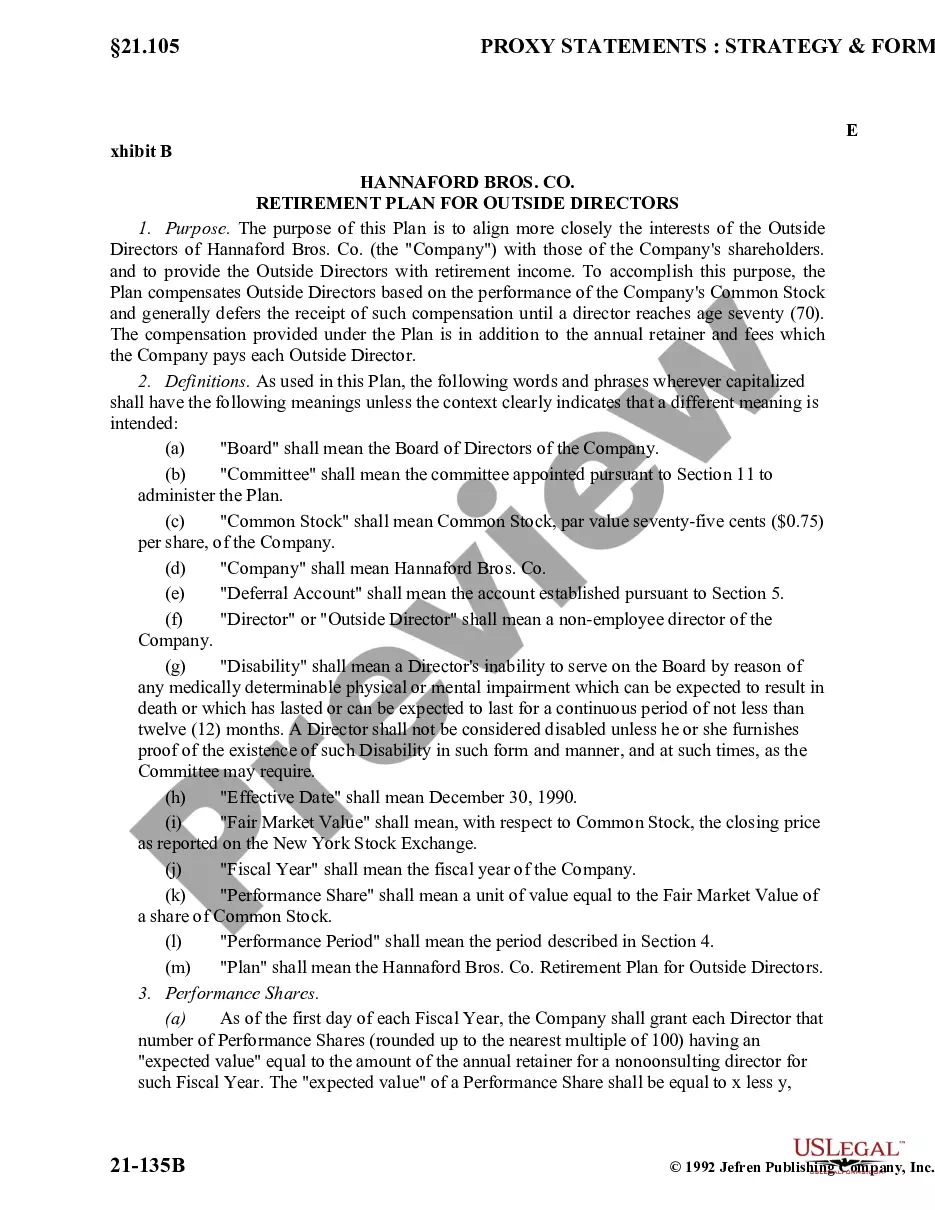
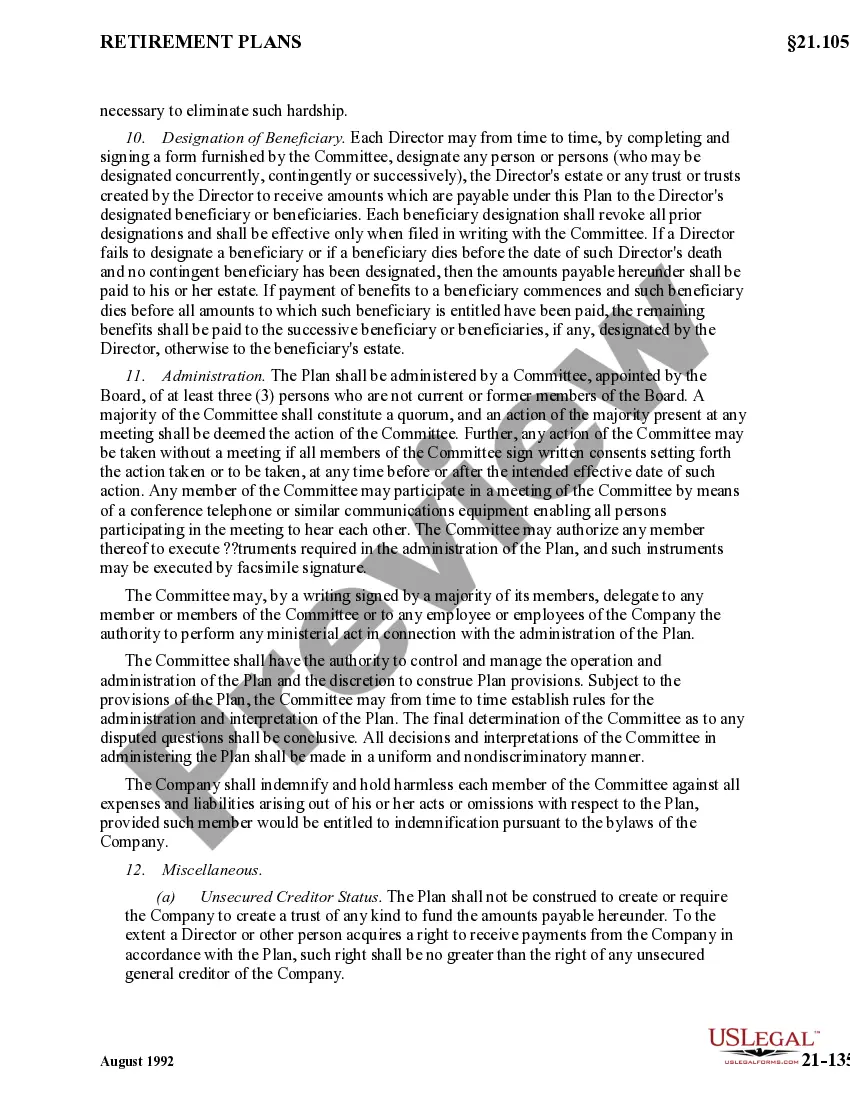
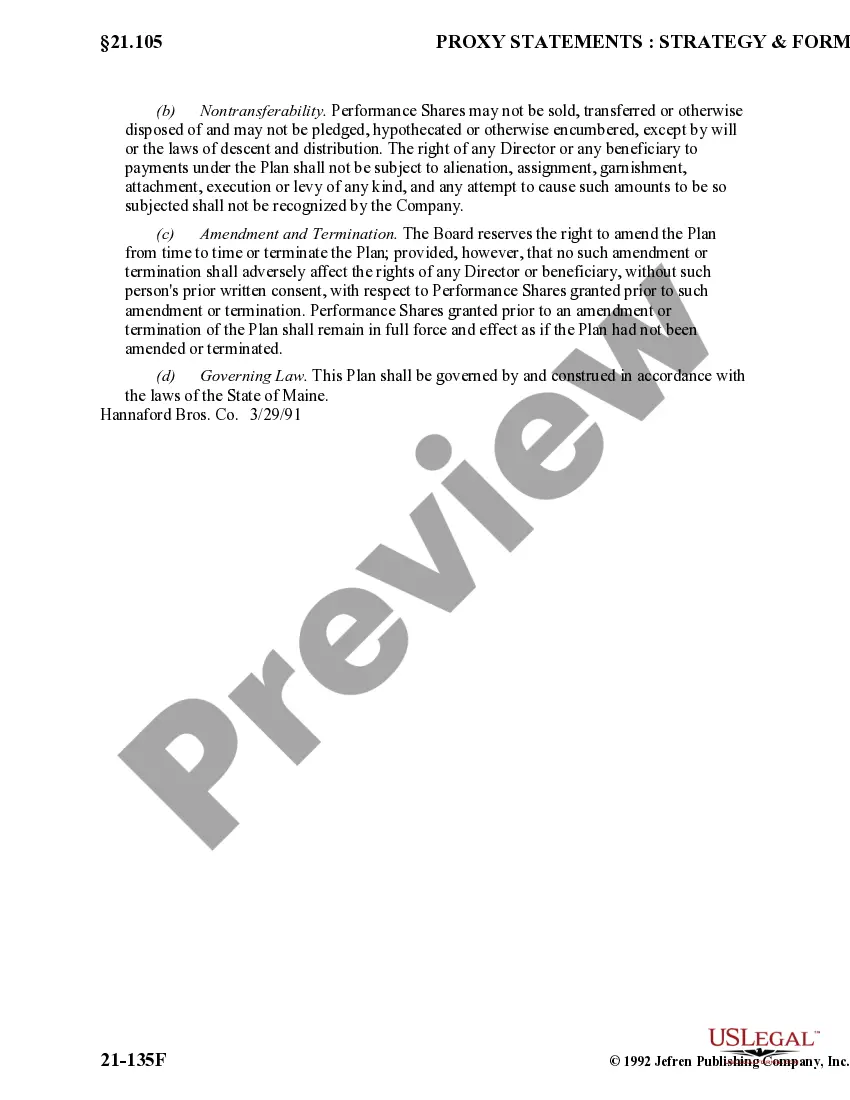
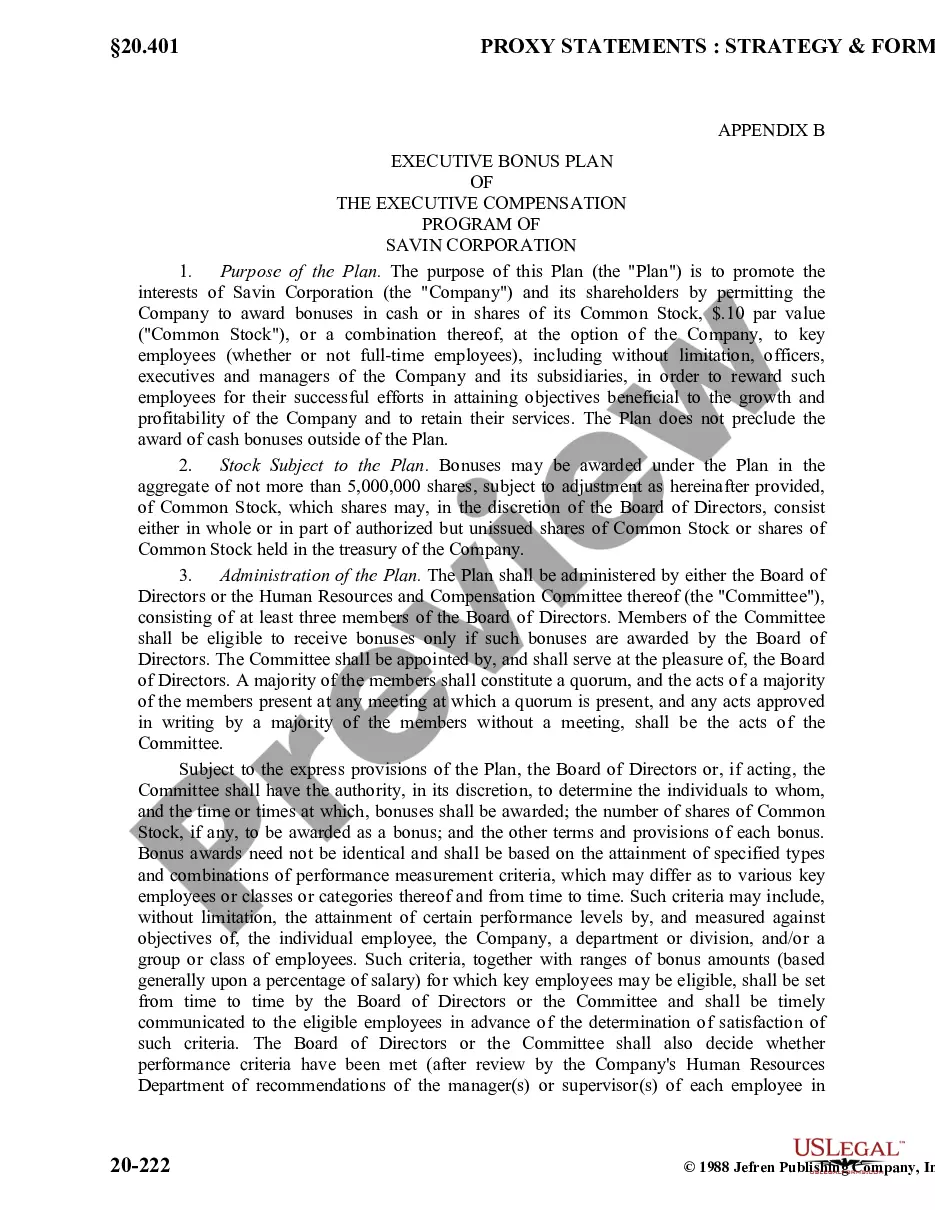
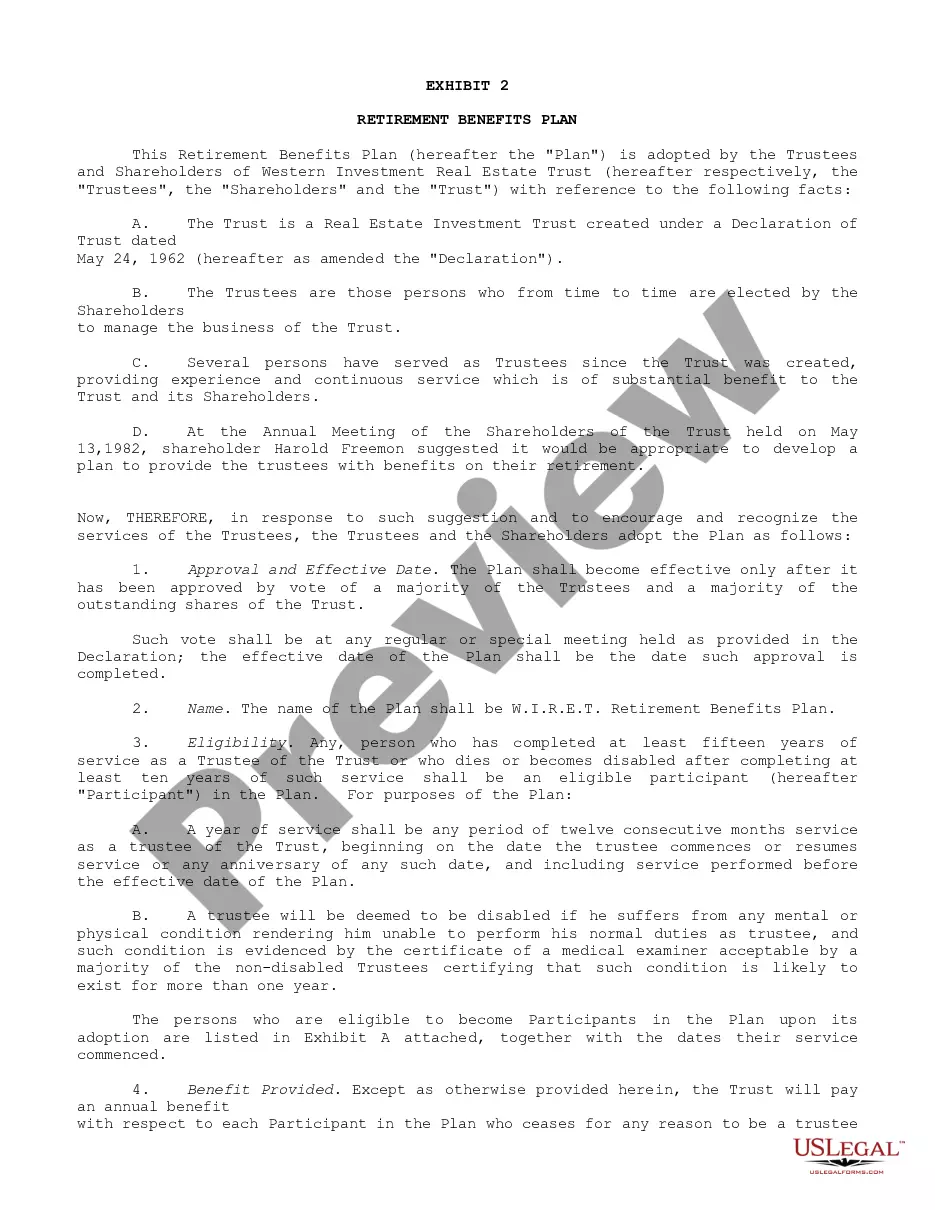
The Retirement Plan for Outside Directors is a legal document designed for companies to establish a retirement income plan specifically for their non-employee directors. This form outlines how directors will be compensated based on the company's performance and details the structure of deferred compensation until certain conditions are met, such as reaching age seventy. Unlike general retirement forms, this plan is tailored to align the interests of outside directors with those of the company's shareholders.
Form components explained
- Purpose: Aligns interests between outside directors and shareholders, providing retirement income.
- Definitions: Clear definitions of terms like "Director," "Company," and "Performance Shares."
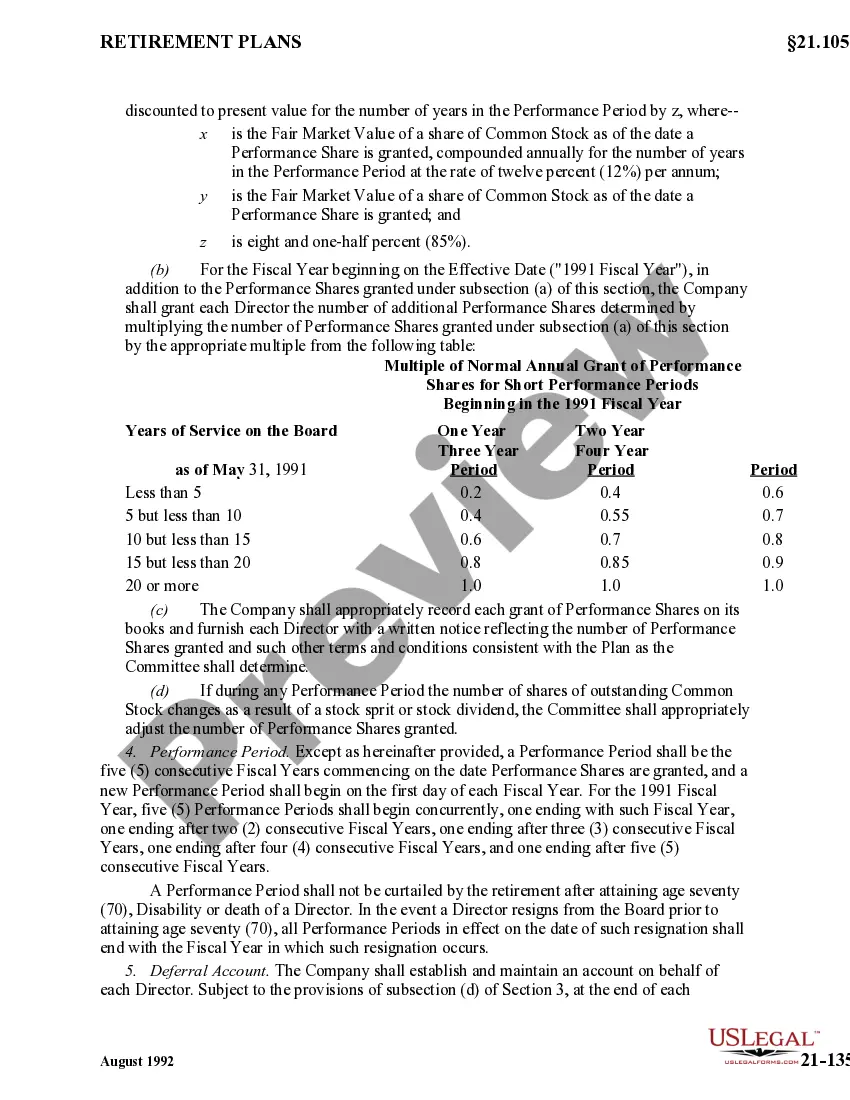
- Performance Shares: Details on how performance shares are granted and calculated based on the company's stock performance.
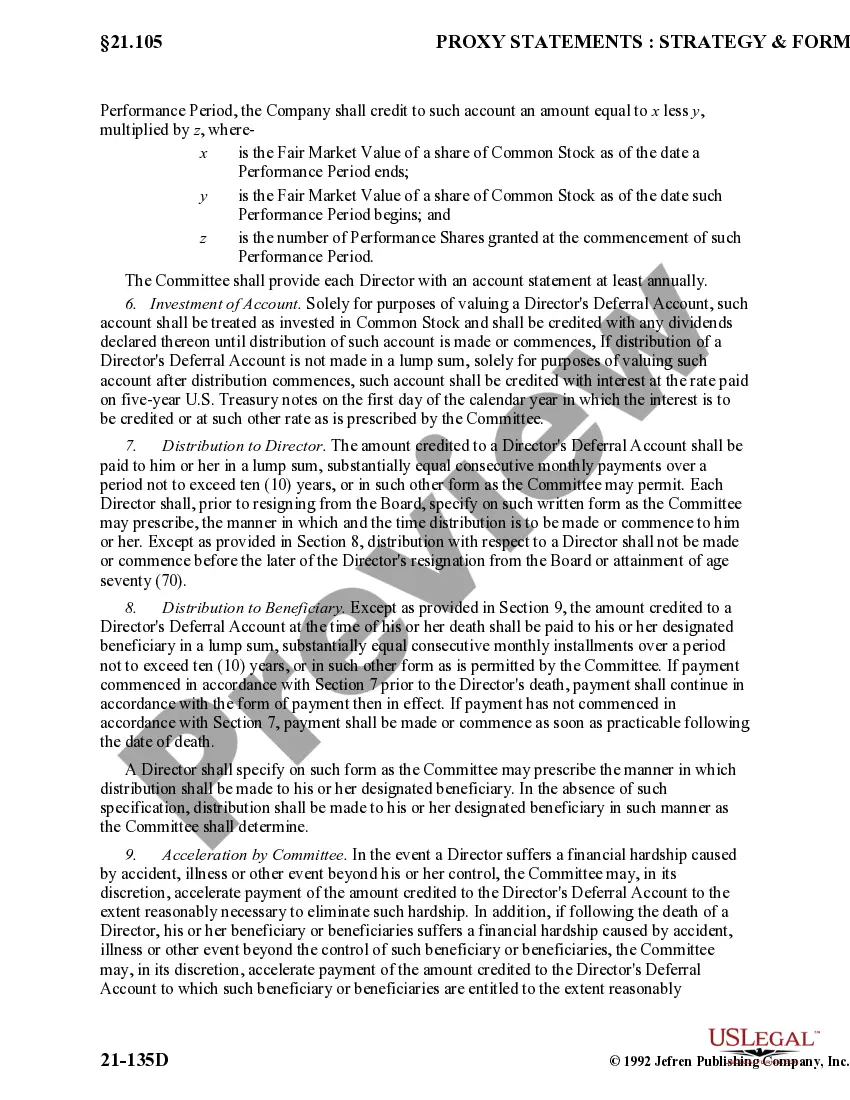
- Deferral Account: Specifies how and when compensation is credited to the directors' account.
- Distribution: Outlines how funds are distributed to directors and their beneficiaries after retirement or death.
- Committee Administration: Information about the committee responsible for managing and administering the plan.

Situations where this form applies
This form should be used by companies wishing to implement a retirement plan for their outside directors. It is particularly useful during corporate restructuring, upon the appointment of new directors, or when establishing policies that enhance long-term relationships between directors and shareholders. The plan helps ensure that directors are incentivized to prioritize the company's growth and stability.
Who can use this document
This form is intended for:
- Corporations with outside directors who are not employees.
- Legal teams and corporate governance professionals tasked with creating director compensation packages.
- Board members looking to understand their retirement benefits and the structure of their compensation.
Steps to complete this form
- Identify the company and the outside directors participating in the plan.
- Enter the effective date of the plan and any fiscal years relevant to grant performance shares.
- Specify the performance metrics or criteria that will affect the compensation of the directors.
- Indicate how compensation will be credited to each director's deferral account.
- Designate a committee to oversee the administration of the plan and outline its powers.
Notarization guidance
This form does not typically require notarization unless specified by local law. However, having the document notarized can provide additional validation for corporate records.
Get your form ready online
Our built-in tools help you complete, sign, share, and store your documents in one place.
Make edits, fill in missing information, and update formatting in US Legal Forms—just like you would in MS Word.
Download a copy, print it, send it by email, or mail it via USPS—whatever works best for your next step.
Sign and collect signatures with our SignNow integration. Send to multiple recipients, set reminders, and more. Go Premium to unlock E-Sign.
If this form requires notarization, complete it online through a secure video call—no need to meet a notary in person or wait for an appointment.
We protect your documents and personal data by following strict security and privacy standards.

Make edits, fill in missing information, and update formatting in US Legal Forms—just like you would in MS Word.

Download a copy, print it, send it by email, or mail it via USPS—whatever works best for your next step.

Sign and collect signatures with our SignNow integration. Send to multiple recipients, set reminders, and more. Go Premium to unlock E-Sign.

If this form requires notarization, complete it online through a secure video call—no need to meet a notary in person or wait for an appointment.

We protect your documents and personal data by following strict security and privacy standards.
Typical mistakes to avoid
- Failing to specify the performance metrics that will determine compensation amounts.
- Not clearly defining the roles and responsibilities of the administering committee.
- Overlooking the establishment of a distribution plan for beneficiaries in case of a director's death.
Benefits of completing this form online
- Convenience of accessing the form anytime from any location.
- Editability allows customization to fit specific corporate needs.
- Reliability of using templates drafted by licensed attorneys ensures compliance with legal standards.
Legal use & context
- This retirement plan complies with general corporate law and tax regulations concerning deferred compensation.
- Proper implementation ensures that directors receive retirement benefits in line with company performance.
- Late amendments or changes to employment law should be monitored to maintain compliance.
Summary of main points
- The Retirement Plan for Outside Directors supports both corporate governance and shareholder interests.
- Details like Performance Shares and Deferral Accounts are crucial to director compensation.
- Proper administration of the plan is essential for compliance and financial fairness.
Looking for another form?
Form popularity
FAQ
Qualified plans have tax-deferred contributions from the employee, and employers may deduct amounts they contribute to the plan. Nonqualified plans use after-tax dollars to fund them, and in most cases employers cannot claim their contributions as a tax deduction.
The Supplementary Retirement Plan (SRP) provides additional pension benefits to MEPP members whose annual salaries exceed the Salary Cap. SRP is supplementary to MEPP, however not all employers participate.
The CSU 403 (b) Supplemental Retirement Plan (SRP) is a voluntary program that allows eligible CSU employees to save toward retirement by investing pre-tax contributions in tax-deferred investments in either annuities or mutual funds, under Internal Revenue Code (IRC) Section 403 (b).
401(k). Solo 401(k). 403(b). 457(b). IRA. Roth IRA. Self-directed IRA. SIMPLE IRA.
In a broad sense, a nonqualified deferred compensation plan refers to compensation that the company promises to pay to its participants in a subsequent plan year. Essentially, workers earn a sum of money in one year and they get paid at some time in the future.
Non-qualified plans are retirement savings plans. They are called non-qualified because they do not adhere to Employee Retirement Income Security Act (ERISA) guidelines as with a qualified plan. Non-qualified plans are generally used to supply high-paid executives with an additional retirement savings option.
Open a SIMPLE IRA through a bank or another financial institution. Set up a SIMPLE IRA plan at any time January 1 through October 1. If you became self-employed after October 1, you can set up a SIMPLE IRA plan for the year as soon as administratively feasible after your business starts.
A qualified retirement plan is a retirement plan recognized by the IRS where investment income accumulates tax-deferred. Common examples include individual retirement accounts (IRAs), pension plans and Keogh plans. Most retirement plans offered through your job are qualified plans.
You're covered by an employer retirement plan for a tax year if your employer (or your spouse's employer) has a:Defined benefit plan (pension plan that pays a retirement benefit spelled out in the plan) and you are eligible to participate for the plan year ending with or within the tax year.