Employee Evaluation Form for Psychologist
Understanding this form
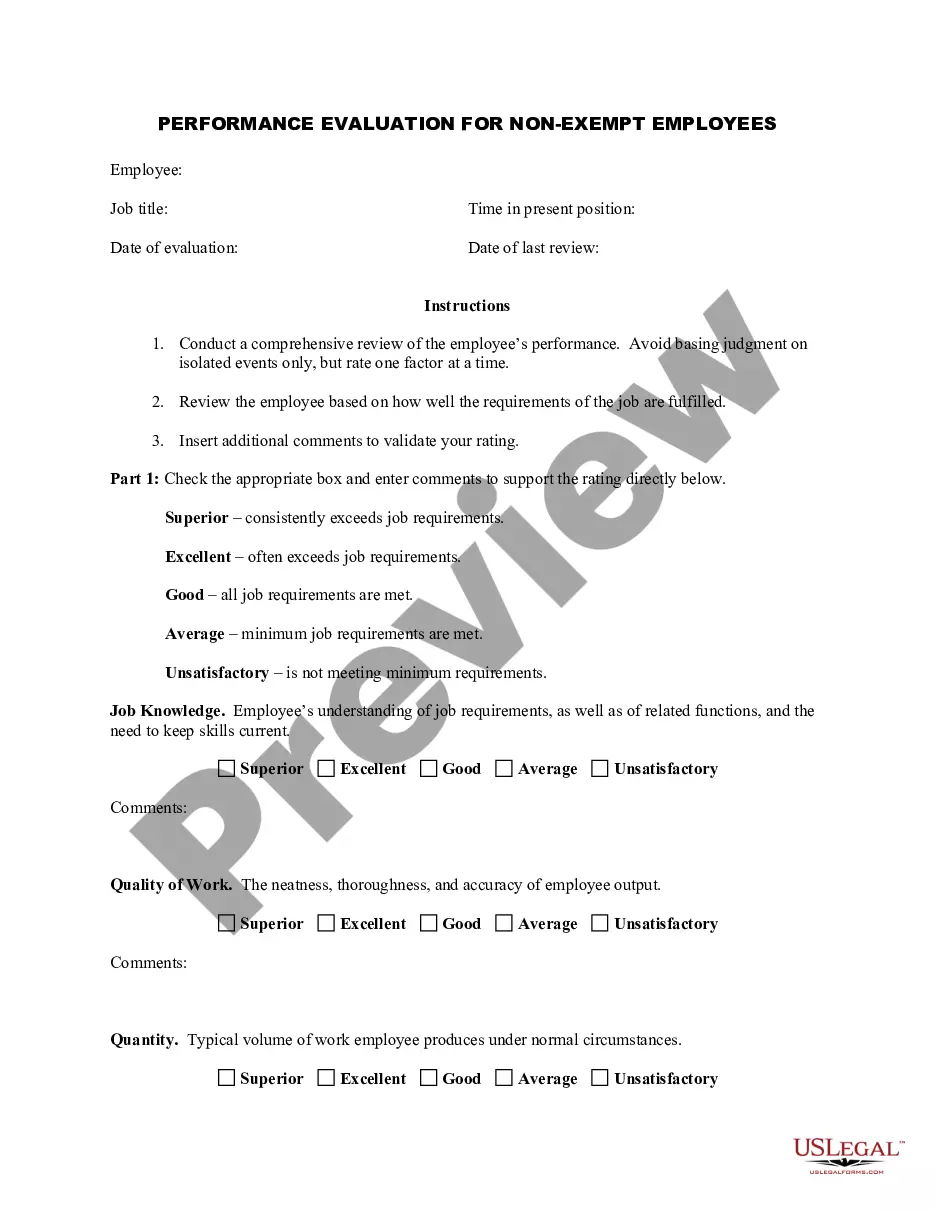
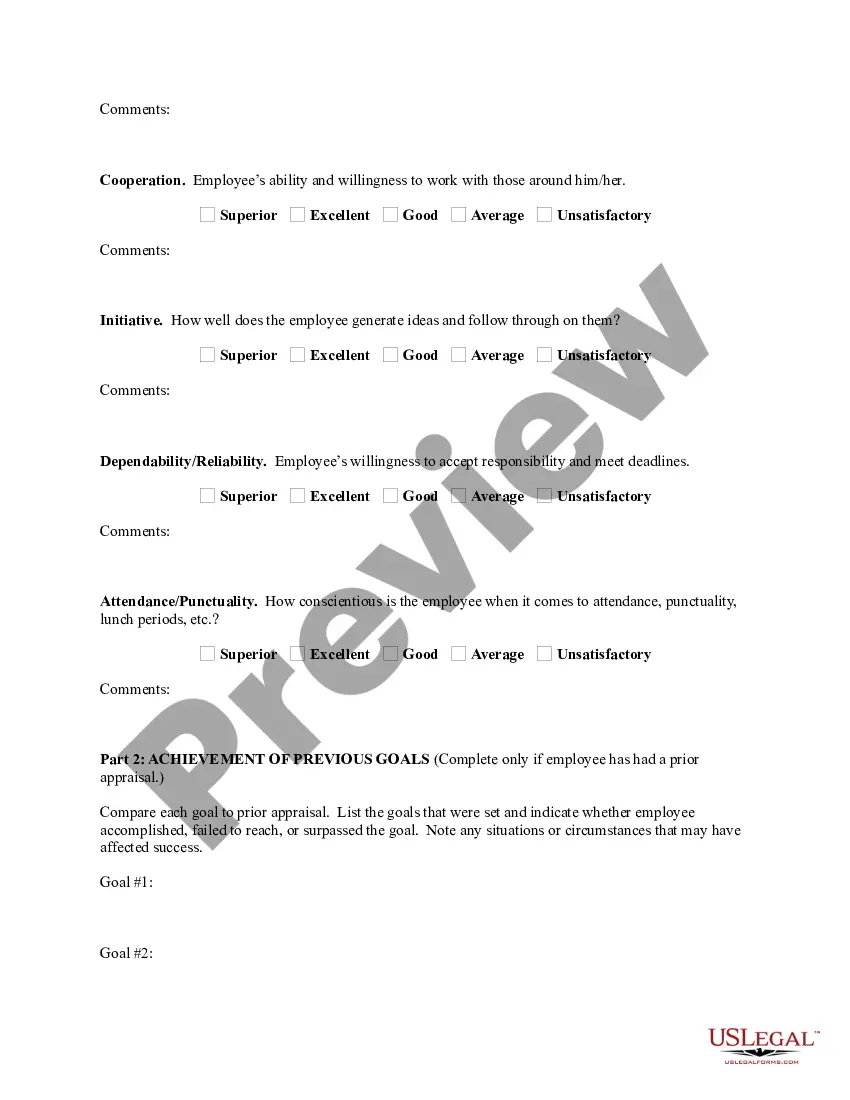
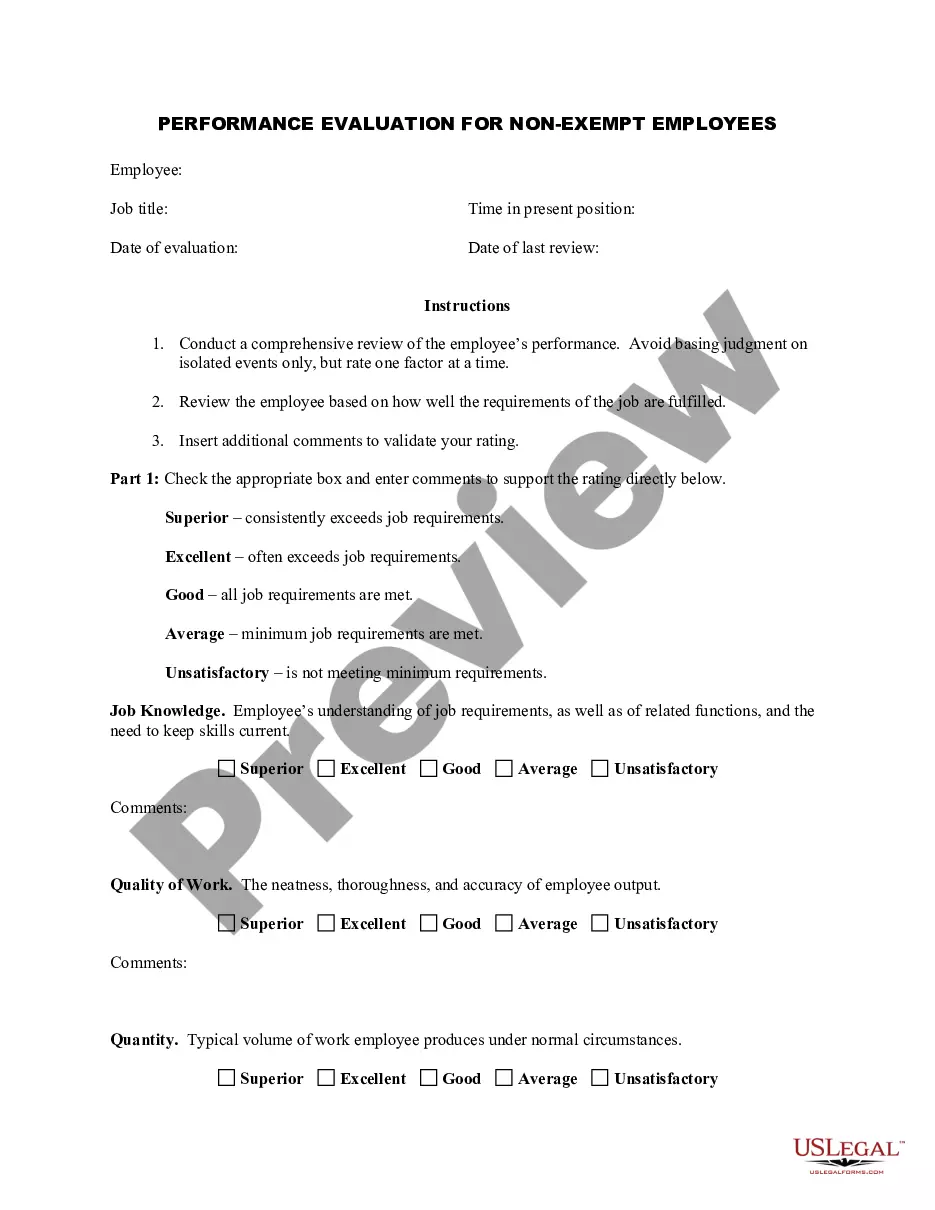
The Employee Evaluation Form for Psychologist is a standardized document designed to assess the performance of non-exempt employees in a psychological practice. This form helps supervisors to systematically evaluate employees based on various performance metrics, including job knowledge, quality of work, cooperation, initiative, and dependability. Unlike other evaluation forms that may lack specificity or structure, this form is tailored to meet the unique needs of a psychological work environment, ensuring a thorough and fair assessment process.
Key parts of this document
- Employee information and job title
- Date of evaluation and last review
- Performance metrics covering job knowledge, quality of work, and cooperation
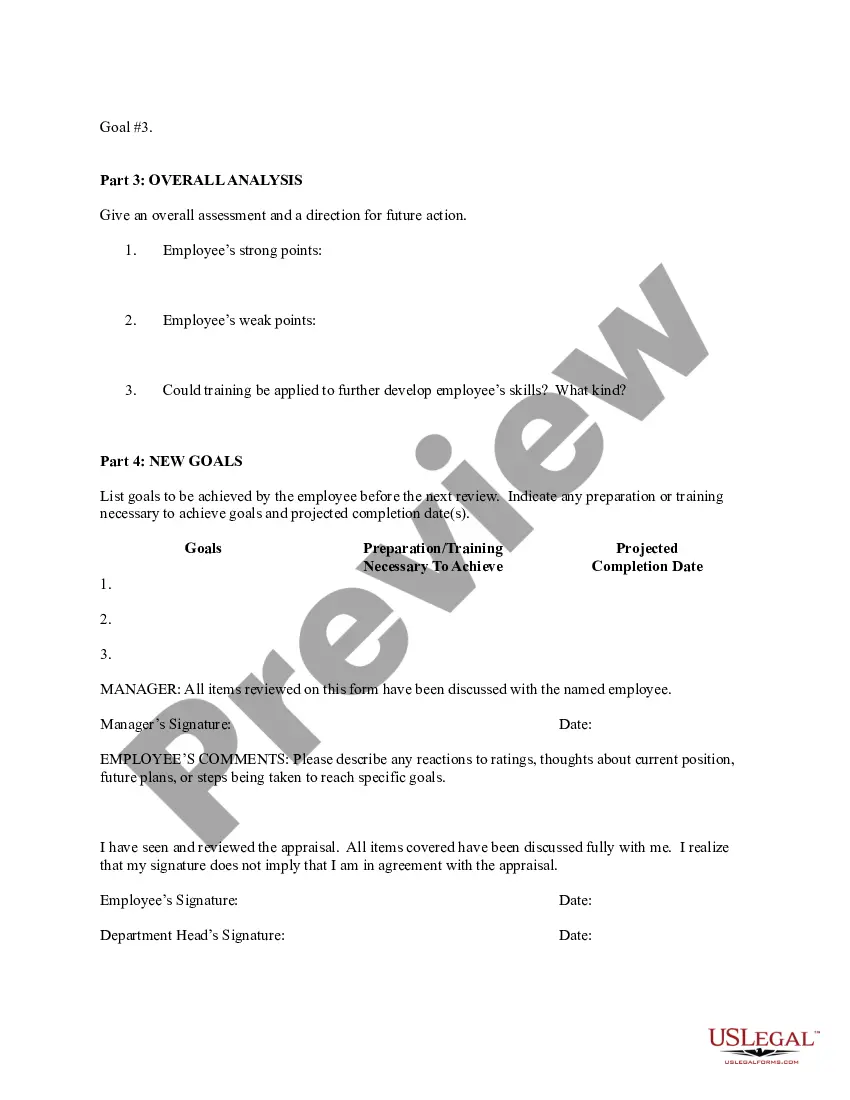
- Sections for employee goals and achievements from the previous evaluation
- Comments sections for detailed feedback from evaluators
- Signatures from both the evaluator and the employee to acknowledge the appraisal
Common use cases
This form should be used during scheduled performance evaluations, typically conducted on an annual or bi-annual basis. It is particularly important when assessing employee performance to determine suitability for promotion, training needs, or professional development opportunities. The form can also be utilized to document significant changes in performance or as part of probationary reviews for new employees.
Intended users of this form
- Supervisors and managers in psychological practices
- Human resources personnel involved in employee evaluations
- Psychologists conducting employee assessments as part of their managerial duties
Steps to complete this form
- Identify the employee's information, including name, job title, and evaluation date.
- Rate the employee on various performance metrics, selecting the appropriate options based on observed performance.
- Provide specific comments to support each rating, highlighting strengths and areas for improvement.
- Fill in previous goals and evaluate the achievement of those goals.
- Conclude with an overall assessment and set new goals to be achieved before the next evaluation.
- Ensure both the evaluator and the employee sign and date the form to acknowledge its content.
Does this document require notarization?
This form does not typically require notarization unless specified by local law. However, having it notarized can add an additional layer of validation for formal records within an organization.
Get your form ready online
Our built-in tools help you complete, sign, share, and store your documents in one place.
Make edits, fill in missing information, and update formatting in US Legal Forms—just like you would in MS Word.
Download a copy, print it, send it by email, or mail it via USPS—whatever works best for your next step.
Sign and collect signatures with our SignNow integration. Send to multiple recipients, set reminders, and more. Go Premium to unlock E-Sign.
If this form requires notarization, complete it online through a secure video call—no need to meet a notary in person or wait for an appointment.
We protect your documents and personal data by following strict security and privacy standards.

Make edits, fill in missing information, and update formatting in US Legal Forms—just like you would in MS Word.

Download a copy, print it, send it by email, or mail it via USPS—whatever works best for your next step.

Sign and collect signatures with our SignNow integration. Send to multiple recipients, set reminders, and more. Go Premium to unlock E-Sign.

If this form requires notarization, complete it online through a secure video call—no need to meet a notary in person or wait for an appointment.

We protect your documents and personal data by following strict security and privacy standards.
Avoid these common issues
- Failing to provide specific examples to justify ratings.
- Relying too heavily on recent events instead of evaluating overall performance.
- Neglecting to set clear and achievable goals for the next evaluation period.
- Not allowing employees to provide their feedback or comments.
Benefits of using this form online
- Convenience of completing the form from any location and at any time.
- Editability allows for real-time adjustments and additional comments.
- Secure storage and accessibility of completed forms for future reference.
- Integration with other HR management systems improves workflow efficiency.
Looking for another form?
Form popularity
FAQ
Level of execution. Quality of work. Level of creativity. Amount of consistent improvement. Customer and peer feedback. Sales revenue generated. Responsiveness to feedback. Ability to take ownership.
There are three main methods used to collect performance appraisal (PA) data: objective production, personnel, and judgmental evaluation. Judgmental evaluations are the most commonly used with a large variety of evaluation methods.
Reflect on feedback. Make a list of your top accomplishments and identify areas for improvements. Gather analytics to show impact. Make a commitment to improve. Set a SMART goal for yourself. Create a plan of action. Communication. Job Performance.
Self-Evaluation. A self-evaluation requires an employee to judge his or her own performance against predetermined criteria. Behavioral Checklist. 360-Degree Feedback. Management by Objectives. Ratings Scale.
Set Performance Standards. Set Specific Goals. Take Notes Throughout the Year. Be Prepared. Be Honest and Specific with Criticism. Don't Compare Employees. Evaluate the Performance, Not the Personality. Have a Conversation.
Reflect on feedback. Make a list of your top accomplishments and identify areas for improvements. Gather analytics to show impact. Make a commitment to improve. Set a SMART goal for yourself. Create a plan of action. Communication. Job Performance.
Performance Appraisals (often called reviews, evaluations, or assessments) are the measurement of a specific range of skills, knowledge, and attitudes in relation to certain objective standards. The ratings are based upon observations or empirical data in relationship to a set of predefined standards.
Communication. Collaboration and teamwork. Problem-solving. Quality and accuracy of work. Attendance, punctuality and reliability. The ability to accomplish goals and meet deadlines.