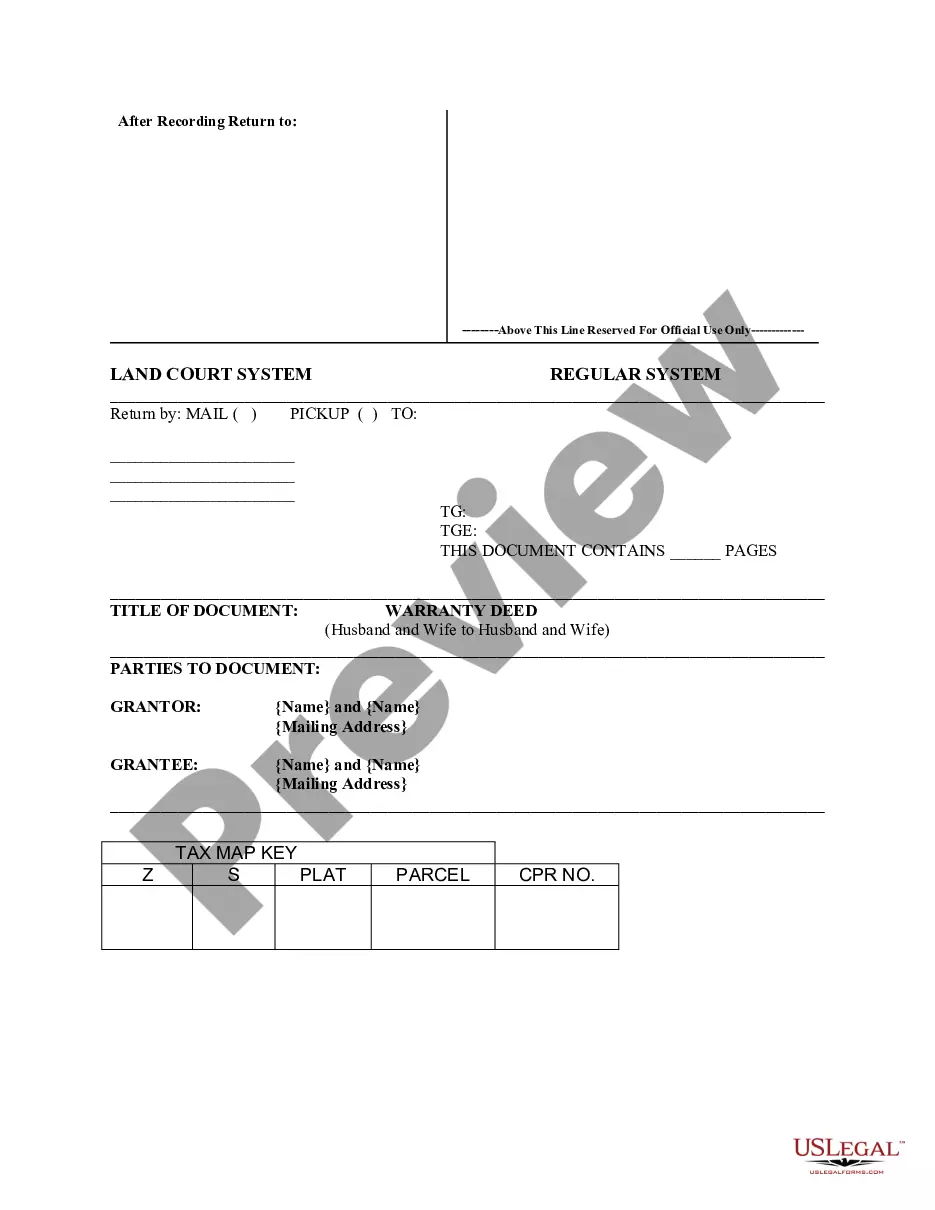
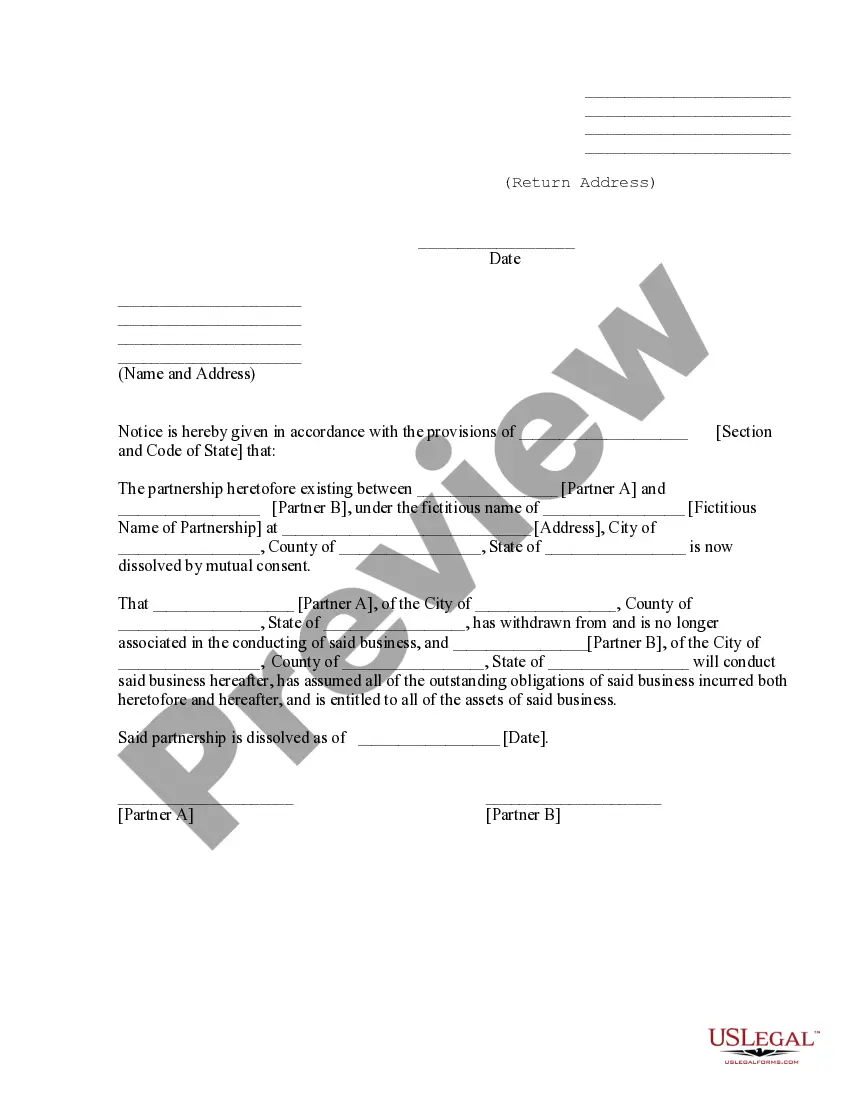
Notice of Dissolution ( Partnership )
What this document covers
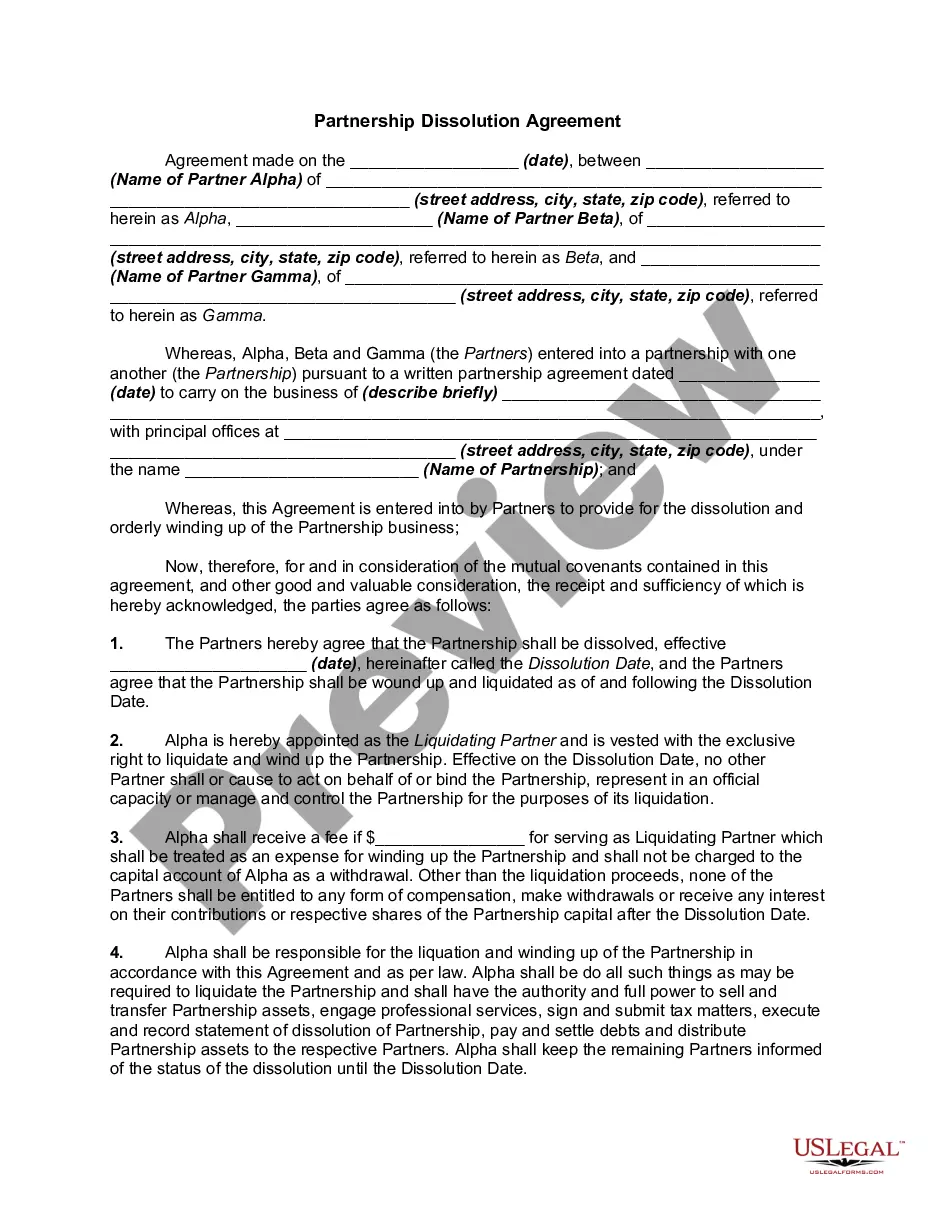
The Notice of Dissolution for a Partnership is a legal document used to formally announce the dissolution of a partnership. This form serves to notify relevant parties and the public that the partnership has been dissolved by mutual consent. Unlike similar forms, this document specifies the partners involved and outlines the distribution of obligations and assets following the dissolution. It ensures clarity and legal compliance in the process of ending a partnership agreement.
Key components of this form
- Return address for notifications
- Name and address of the partnership
- Legal citation indicating authority for dissolution
- Name of the partners involved in the dissolution
- Effective date of the dissolution
- Signatures of the partners to validate the notice
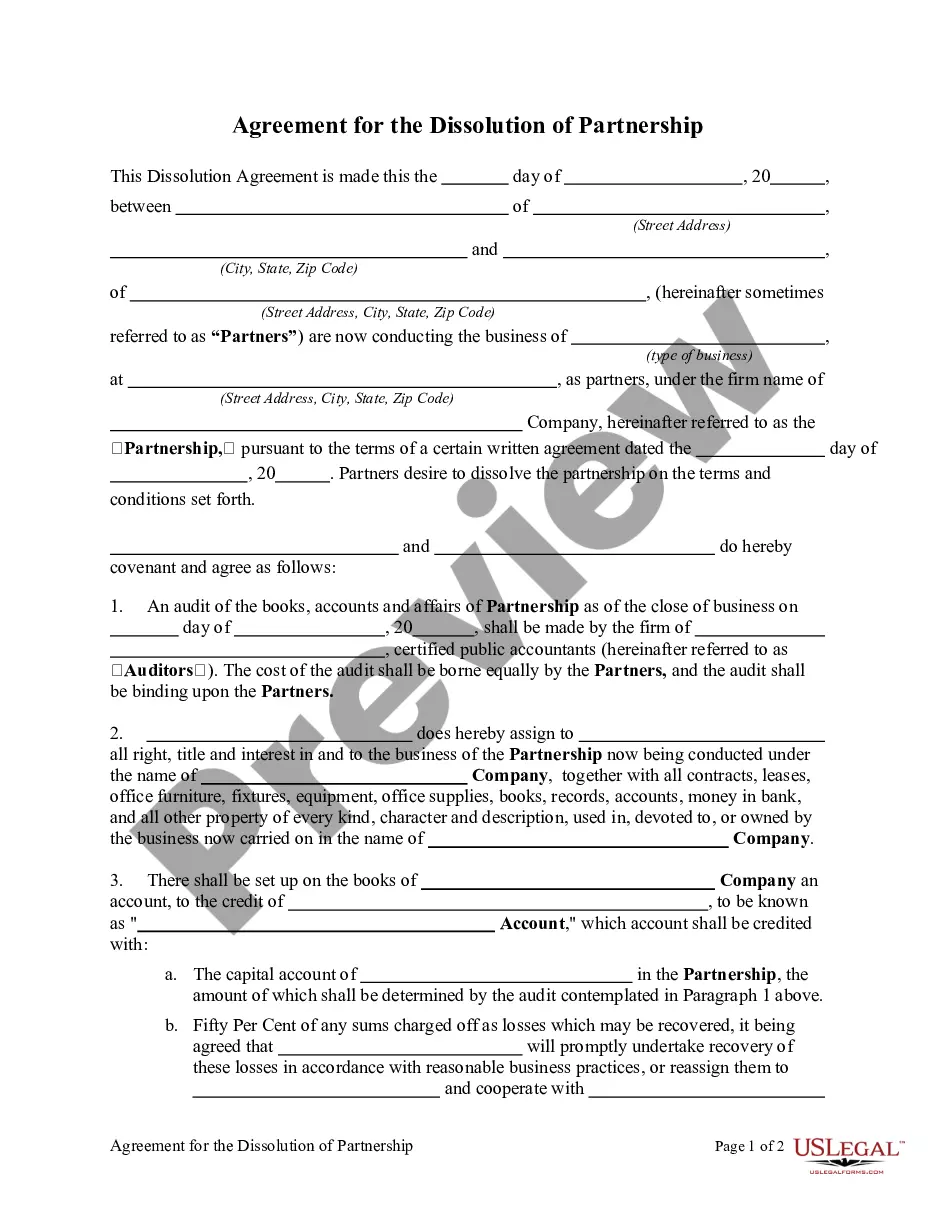
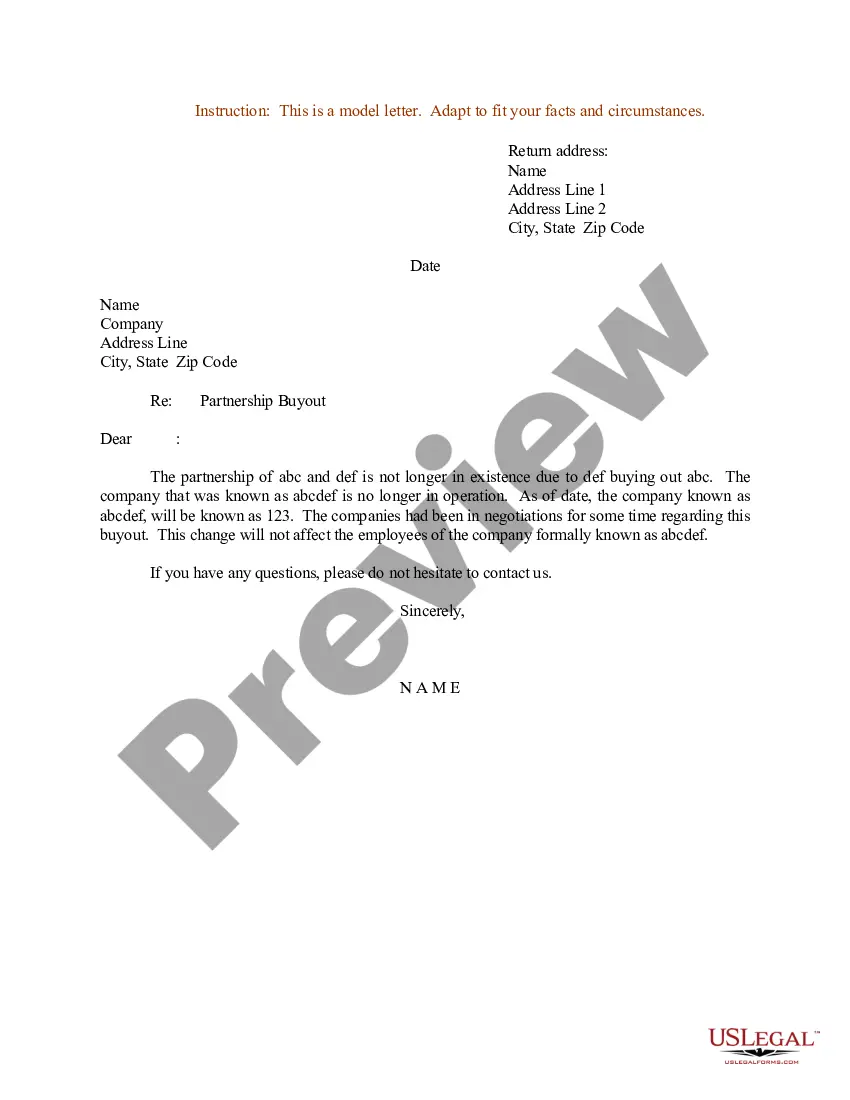
Common use cases
This form should be used when partners have agreed to dissolve their partnership and wish to formally declare the end of their business relationship. It is useful in situations where one or both partners decide to withdraw, ensuring that all parties understand the terms of the dissolution and the subsequent responsibilities regarding business obligations and assets.
Who should use this form
- Business partners wishing to dissolve their partnership
- Legal representatives acting on behalf of partners
- Individuals involved in a partnership that requires formal dissolution
How to complete this form
- Identify and enter the return address for notifications.
- Provide the names and addresses of the partners involved in the partnership.
- Specify the legal citation that supports the dissolution.
- Clearly state the effective date of the dissolution.
- Ensure both partners sign the document to validate the dissolution.
Does this document require notarization?
In most cases, this form does not require notarization. However, some jurisdictions or signing circumstances might. US Legal Forms offers online notarization powered by Notarize, accessible 24/7 for a quick, remote process.
Get your form ready online
Our built-in tools help you complete, sign, share, and store your documents in one place.
Make edits, fill in missing information, and update formatting in US Legal Forms—just like you would in MS Word.
Download a copy, print it, send it by email, or mail it via USPS—whatever works best for your next step.
Sign and collect signatures with our SignNow integration. Send to multiple recipients, set reminders, and more. Go Premium to unlock E-Sign.
If this form requires notarization, complete it online through a secure video call—no need to meet a notary in person or wait for an appointment.
We protect your documents and personal data by following strict security and privacy standards.

Make edits, fill in missing information, and update formatting in US Legal Forms—just like you would in MS Word.

Download a copy, print it, send it by email, or mail it via USPS—whatever works best for your next step.

Sign and collect signatures with our SignNow integration. Send to multiple recipients, set reminders, and more. Go Premium to unlock E-Sign.

If this form requires notarization, complete it online through a secure video call—no need to meet a notary in person or wait for an appointment.

We protect your documents and personal data by following strict security and privacy standards.
Common mistakes
- Failing to properly notify all relevant parties of the dissolution.
- Not including the effective date or legal citation in the notice.
- Using the incorrect names or addresses of the partners.
- Forgetting to obtain necessary signatures from all partners.
Benefits of using this form online
- Convenient access to downloadable templates at any time.
- Edit the form easily to fit your specific partnership details.
- Reliable and legally reviewed by licensed attorneys.
Looking for another form?
Form popularity
FAQ
While both words are concerned with the end of a business partnership, dissolution refers to the process itself, and usually to the departure (or death) of one or more individuals from the entity, while termination refers to the cessation of all operations, including the disposal of all assets.
Dissolution is the action of striking off or removing a company from the Companies House register. Once successful, it will cease to legally exist.
A letter of dissolution is an official notification of the end of a business relationship with a partner, client, vendor, or another party.
Ing to Section 43 of the Indian Partnership Act, 1932, if the partnership is at will, then any partner can give notice in writing to all other partners informing them about his intention to dissolve the firm. In such cases, the firm is dissolved on the date mentioned in the notice.
Although some people confuse dissolution and termination, dissolution does not terminate an LLC's existence. What it does is change the purpose of its existence. Instead of conducting whatever business it conducted before, a dissolved LLC exists solely for the purpose of winding up and liquidating.
Ing to California law, creditors, suppliers, customers, and other concerned parties should be notified of the partnership dissolution.
When a partnership dissolves, the individuals involved are no longer partners in a legal sense, but the partnership continues until all debts are settled, the legal existence of the business is terminated and the remaining assets of the company have been distributed.
In most cases of dissolution, a company's remaining assets are distributed to its shareholders or members after they have paid off outstanding debts from the proceeds of liquidation. The business may be wound up by a court-appointed receiver or trustee until all issues involving claims against it have been resolved.