2.08 EXPLANATORY: EVIDENCE ADMITTED AGAINST ONLY ONE PARTY
About this form
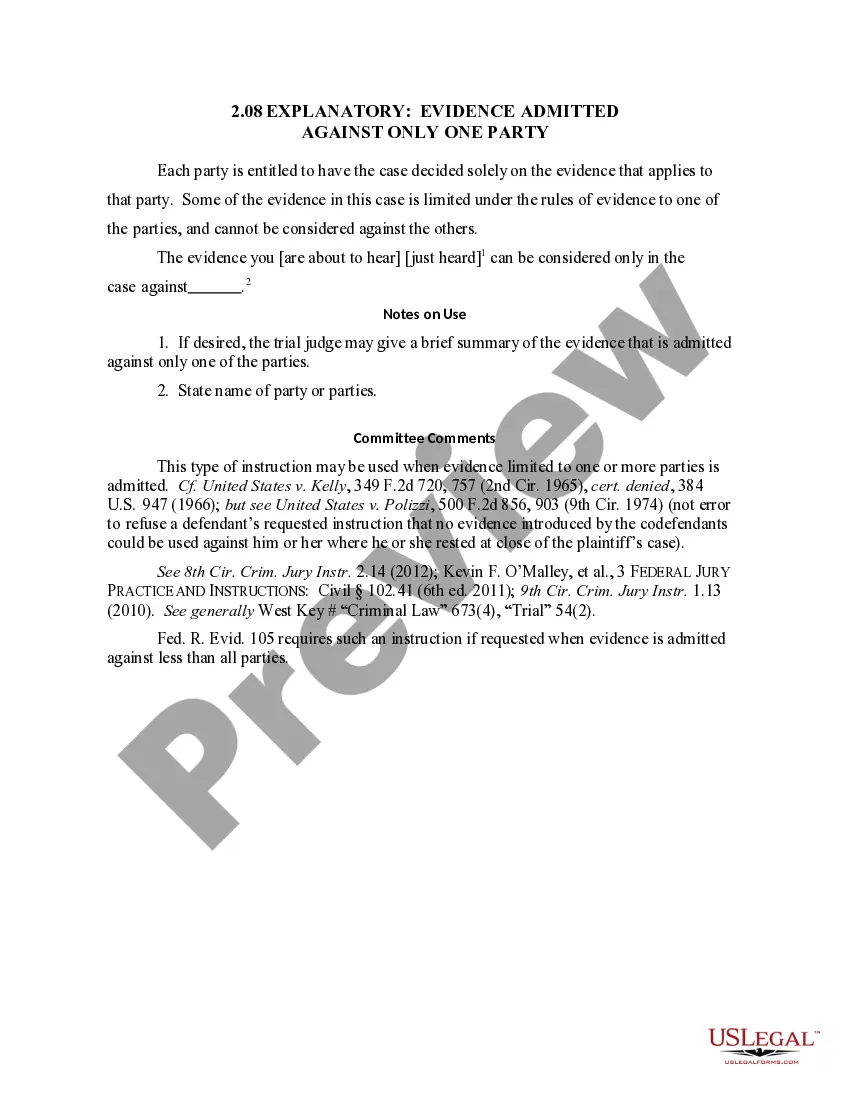
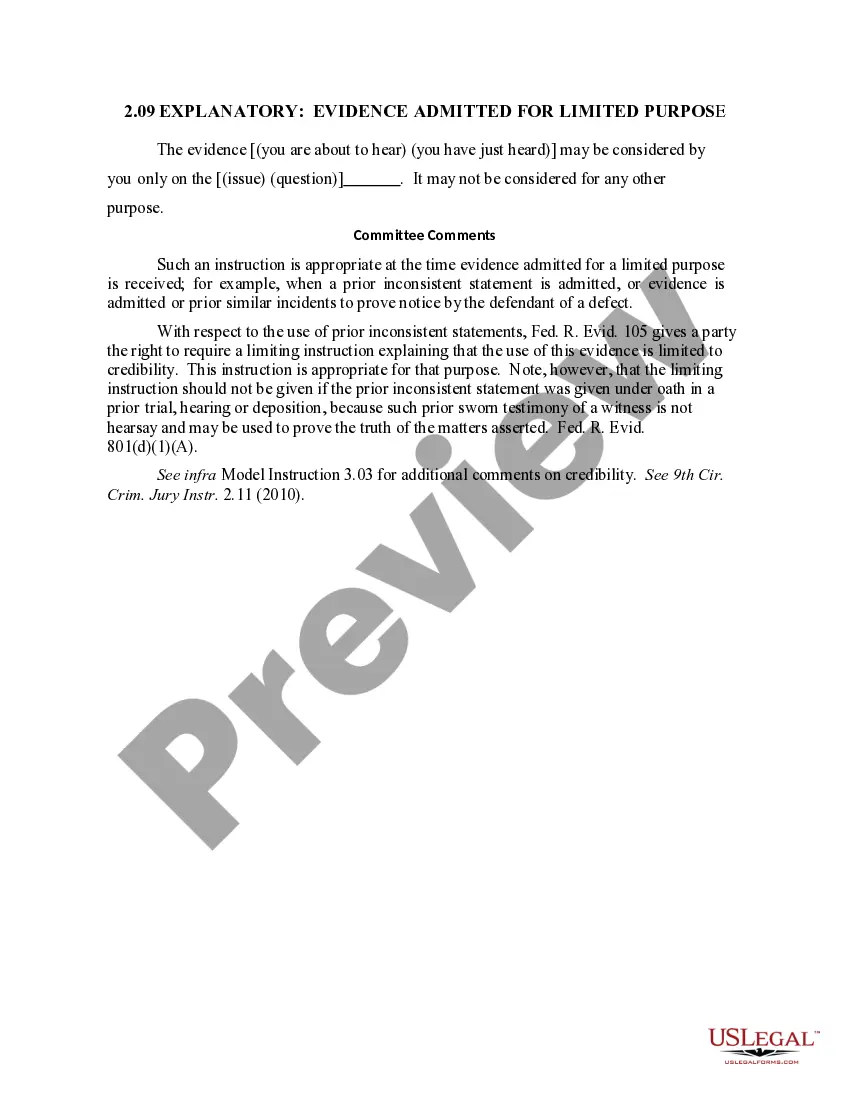
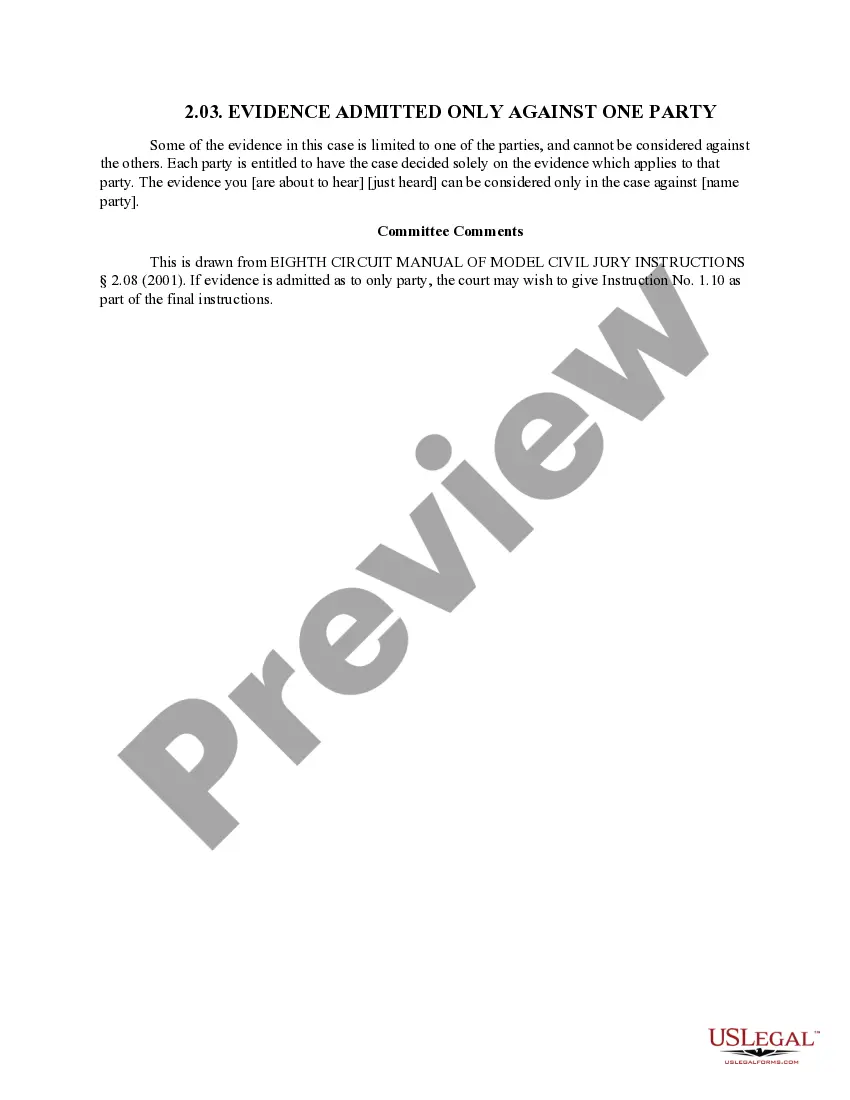
The "2.08 Explanatory: Evidence Admitted Against Only One Party" form is a legal instruction used in court proceedings. Its purpose is to clarify that certain evidence presented during a trial is admissible only against one specific party and not against others involved in the case. This ensures that each party's case is evaluated based solely on relevant evidence, minimizing potential bias from unrelated evidence. This form is distinct from general jury instructions, as it specifically addresses the limitations on the use of evidence in multi-party cases.
Key parts of this document
- Identification of the parties involved in the case.
- Clarification that evidence is limited to one party.
- Instructions for the jury on how to consider the admitted evidence.
- Optional brief summary by the trial judge of the evidence relevant to only one party.
- References to applicable legal standards and case law.
Situations where this form applies
This form should be used in situations where certain evidence is only relevant to one party in a legal case. For example, if multiple defendants are involved and some evidence presented is only applicable to one defendant, this form ensures jurors understand they cannot consider that evidence in deciding the other defendants' involvement. It is crucial in trials with multiple parties or claims to maintain a fair and impartial evaluation of each case.
Who needs this form
- Judges presiding over civil or criminal trials involving multiple parties.
- Attorneys representing clients in cases where evidence is partial to only one party.
- Legal professionals preparing jury instructions for court proceedings.
Completing this form step by step
- Identify the parties involved in the case and clearly state their names.
- Summarize the evidence to be addressed, specifying which party it applies to.
- Provide clear instructions for the jury on how to consider the evidence presented.
- If desired, offer a brief summary of the evidence that is limited to one party.
- Ensure compliance with relevant legal standards in the jurisdiction.
Does this document require notarization?
This form does not typically require notarization to be legally valid. However, some jurisdictions or document types may still require it. US Legal Forms provides secure online notarization powered by Notarize, available 24/7 for added convenience.
Get your form ready online
Our built-in tools help you complete, sign, share, and store your documents in one place.
Make edits, fill in missing information, and update formatting in US Legal Forms—just like you would in MS Word.
Download a copy, print it, send it by email, or mail it via USPS—whatever works best for your next step.
Sign and collect signatures with our SignNow integration. Send to multiple recipients, set reminders, and more. Go Premium to unlock E-Sign.
If this form requires notarization, complete it online through a secure video call—no need to meet a notary in person or wait for an appointment.
We protect your documents and personal data by following strict security and privacy standards.

Make edits, fill in missing information, and update formatting in US Legal Forms—just like you would in MS Word.

Download a copy, print it, send it by email, or mail it via USPS—whatever works best for your next step.

Sign and collect signatures with our SignNow integration. Send to multiple recipients, set reminders, and more. Go Premium to unlock E-Sign.

If this form requires notarization, complete it online through a secure video call—no need to meet a notary in person or wait for an appointment.

We protect your documents and personal data by following strict security and privacy standards.
Common mistakes to avoid
- Failing to clearly identify which evidence pertains to only one party.
- Not providing sufficient context for the jury to understand the limited applicability of evidence.
- Omitting references to applicable legal standards or precedents.
Why use this form online
- Convenient access to professionally drafted legal templates.
- Edit and customize the form to fit specific case needs quickly.
- Reliable and secure storage of legal documents for future reference.
Legal use & context
- Ensures that jurors make decisions based solely on relevant evidence.
- Enhances the fairness of trials with multiple parties or complex evidence.
- Aligns with Federal Rules of Evidence regarding the admission of evidence.
Looking for another form?

Form popularity
FAQ
Jury instructions should ideally be brief, concise, non-repetitive, relevant to the case's details, understandable to the average juror, and should correctly state the law without misleading the jury or inviting unnecessary speculation.
The American Bar Association has published a number of books on model jury instructions by topical practice area, as shown below. To find other books on jury instructions, search in the Library's catalog, for subjects: "Instructions to Juries (State)" or Instructions to Juries United States" for federal publications.
The Judicial Council of California has adopted award-winning plain language civil and criminal jury instructions that accurately convey the law using language that is understandable to jurors.
When you go to court, you will give information (called ?evidence?) to a judge who will decide your case. This evidence may include information you or someone else tells to the judge (?testimony?) as well as items like email and text messages, documents, photos, and objects (?exhibits?).
There are thirteen courts of appeals: eleven numbered circuits (First through Eleventh), the United States Court of Appeals for the District of Columbia Circuit and the United States Court of Appeals for the Federal Circuit. Not all circuits have published jury instructions: the Second and Fourth Circuits do not.
To search Jury Instruction Filings: Select. Trial Court Documents. on the Westlaw homepage. Select. Jury Instruction Filings. .