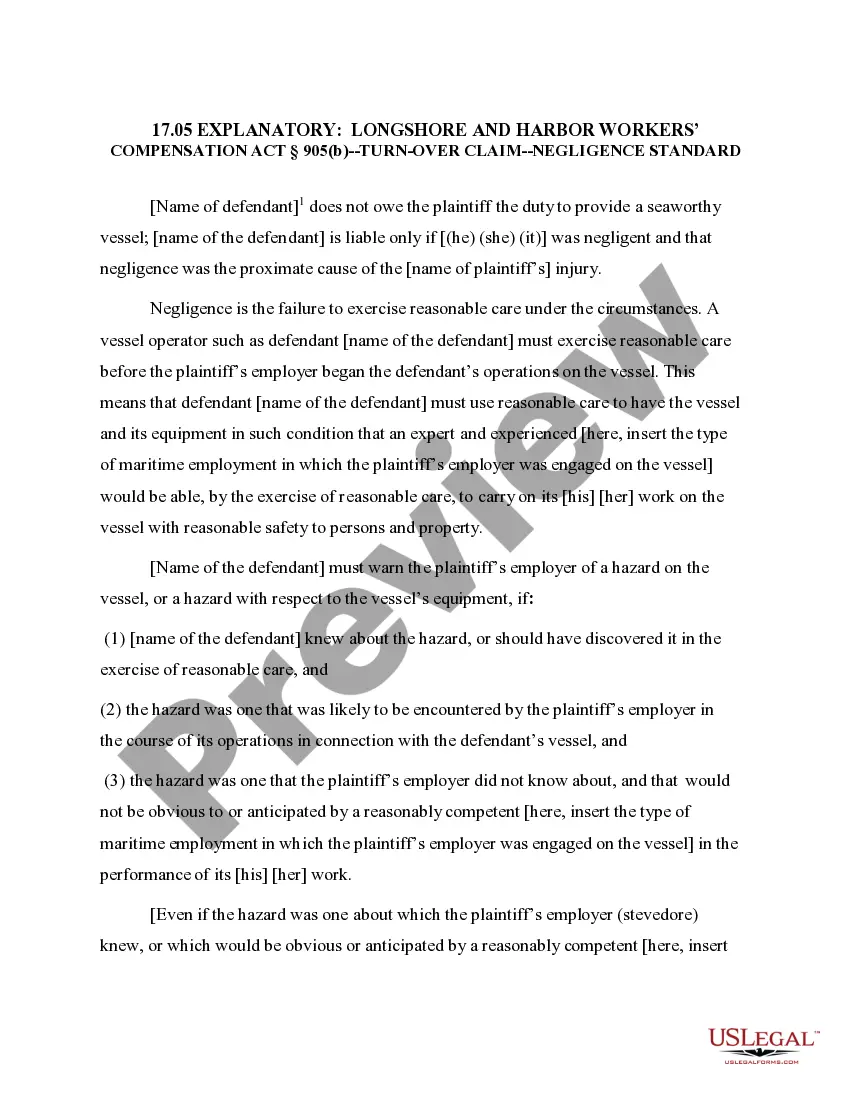
17.05 EXPLANATORY: LONGSHORE AND HARBOR WORKERS' COMPENSATION ACT Civ. 905(b)--TURN-OVER CLAIM--NEGLIGENCE STANDARD
Understanding this form
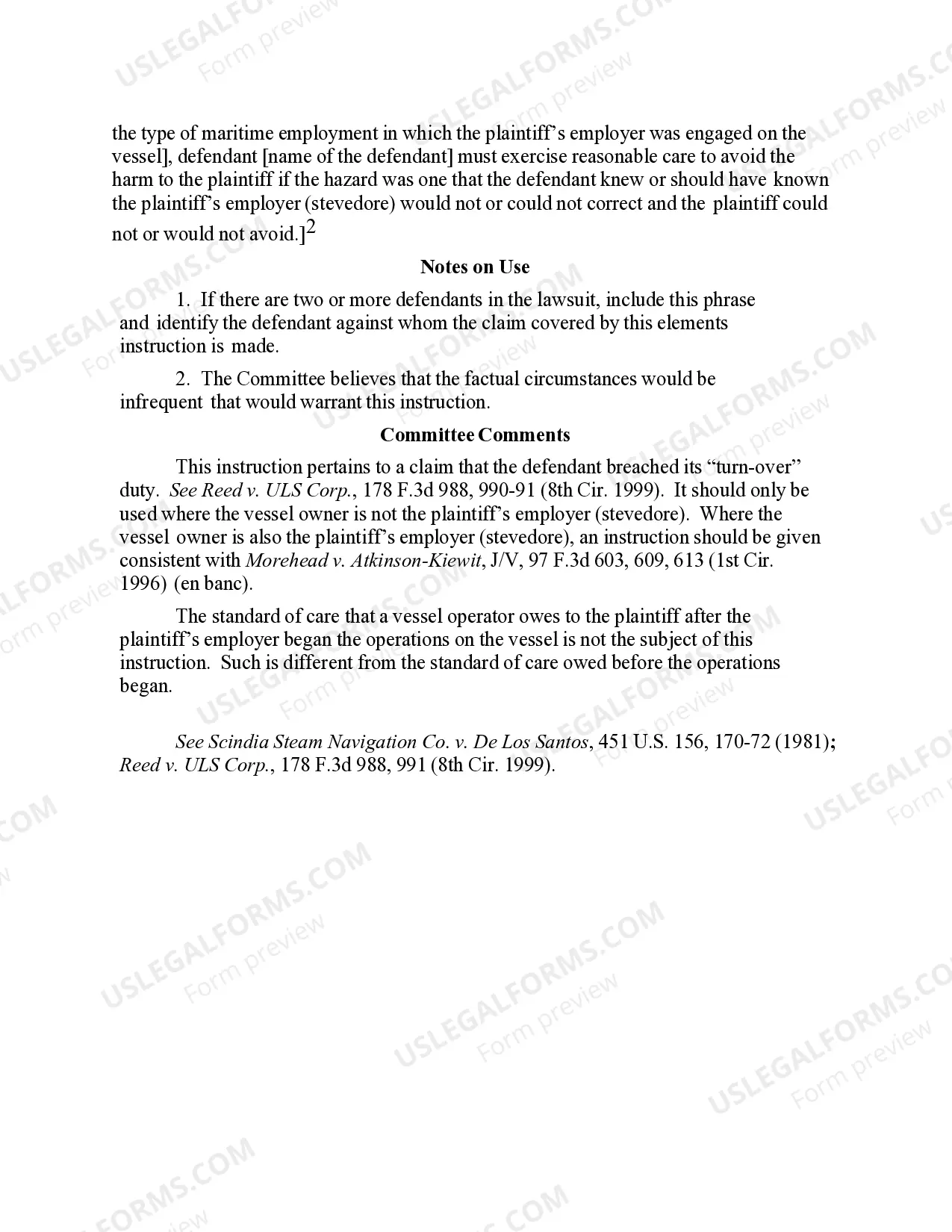
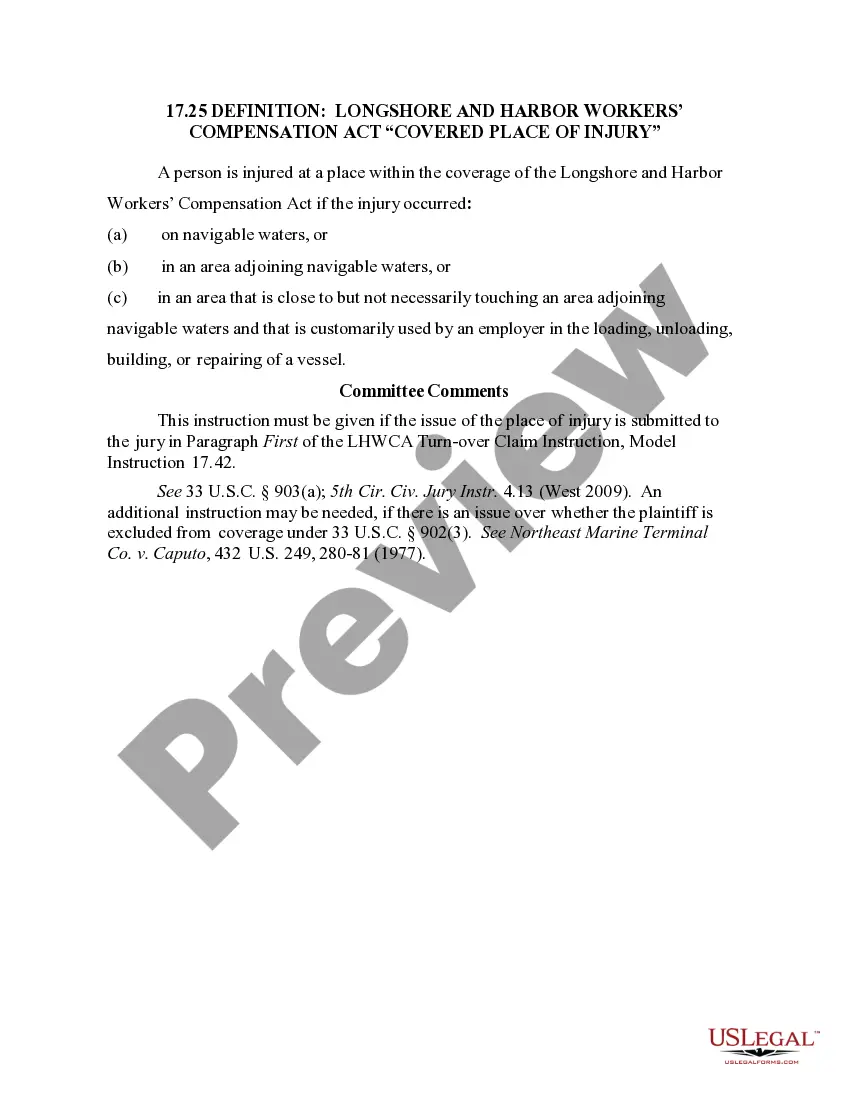
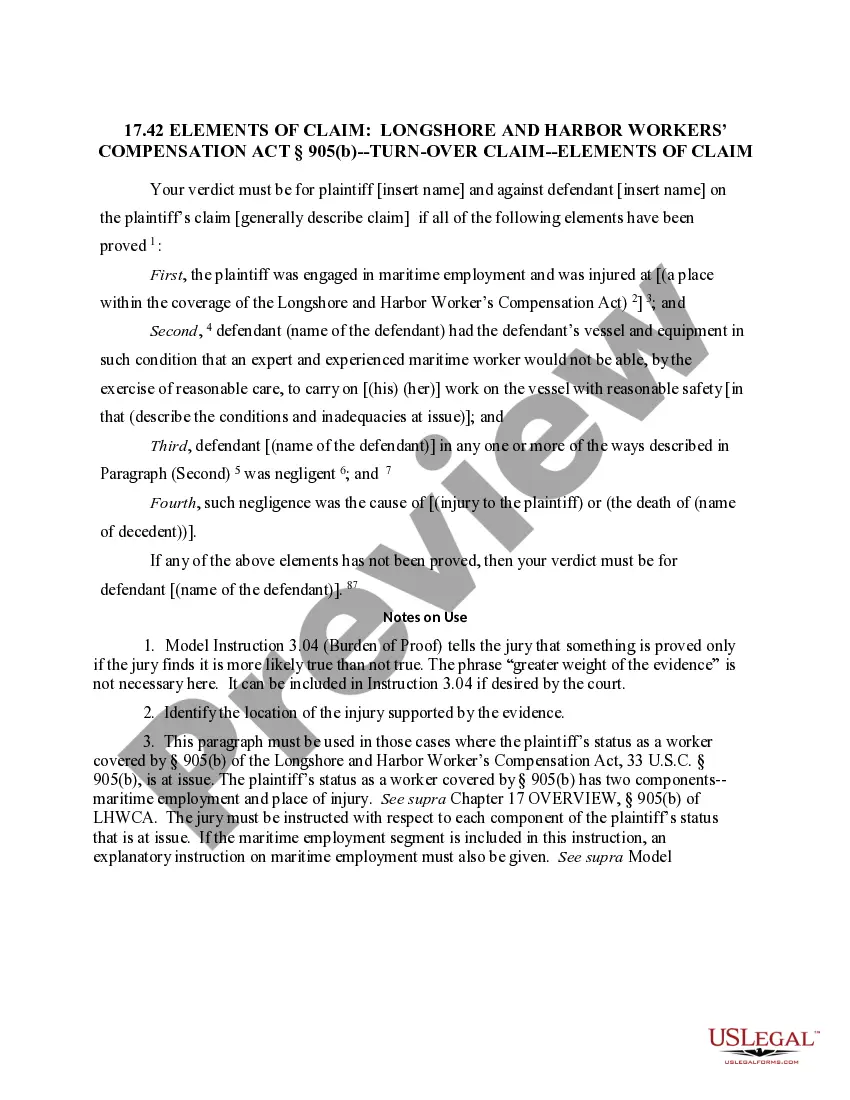
The Longshore and Harbor Workers' Compensation Act § 905(b) Turn-Over Claim Negligence Standard form is designed to guide users through the process of establishing liability for injuries sustained by a plaintiff during maritime work. This form specifically addresses the standards of negligence required for a vessel operator when a plaintiff's employer is involved, distinguishing it from other claims where vessel seaworthiness is at issue.
What’s included in this form
- Identification of the defendant and plaintiff
- Statement of negligence and its role as the proximate cause of injury
- Definition of reasonable care and specific responsibilities of the vessel operator
- Clarification of hazard warnings required by the defendant
- Guidance on circumstances when the defendant must warn about hazards
When this form is needed
This form is typically used in situations where an employee of a stevedoring company sustains an injury while working on a vessel operated by someone other than their employer. It is useful when determining liability for injuries that may arise from negligent actions or inactions of the vessel operator, particularly in complex maritime settings.
Who this form is for
- Maritime workers who have sustained injuries while working on a vessel
- Lawyers representing injured plaintiffs in longshore or harbor worker claims
- Employers engaged in maritime work who need guidance on potential liability
How to prepare this document
- Identify the parties involved, including the name of the defendant and plaintiff.
- Detail the factual circumstances surrounding the claim, including the nature of the work at the time of the injury.
- Clearly state the specific allegations of negligence and how they relate to the injury.
- Specify any known hazards and whether the defendant had a duty to warn the plaintiff's employer.
- Review and ensure all sections accurately reflect the incident and legal standards applicable.
Notarization requirements for this form
This form does not typically require notarization unless specified by local law.
Get your form ready online
Our built-in tools help you complete, sign, share, and store your documents in one place.
Make edits, fill in missing information, and update formatting in US Legal Forms—just like you would in MS Word.
Download a copy, print it, send it by email, or mail it via USPS—whatever works best for your next step.
Sign and collect signatures with our SignNow integration. Send to multiple recipients, set reminders, and more. Go Premium to unlock E-Sign.
If this form requires notarization, complete it online through a secure video call—no need to meet a notary in person or wait for an appointment.
We protect your documents and personal data by following strict security and privacy standards.

Make edits, fill in missing information, and update formatting in US Legal Forms—just like you would in MS Word.

Download a copy, print it, send it by email, or mail it via USPS—whatever works best for your next step.

Sign and collect signatures with our SignNow integration. Send to multiple recipients, set reminders, and more. Go Premium to unlock E-Sign.

If this form requires notarization, complete it online through a secure video call—no need to meet a notary in person or wait for an appointment.

We protect your documents and personal data by following strict security and privacy standards.
Avoid these common issues
- Failing to accurately identify all parties involved in the case.
- Omitting crucial details regarding the circumstances of the injury.
- Not sufficiently establishing the connection between the defendantâs negligence and the plaintiff's injury.
Benefits of completing this form online
- Convenient access to legal templates that can be completed quickly.
- Editable forms allow customization to fit specific case details.
- Access to professionally drafted legal content ensures compliance with legal standards.
Legal use & context
- The form is based on established maritime law principles governing negligence.
- It specifically addresses claims under the Longshore and Harbor Workers' Compensation Act.
- It is designed to aid in legal proceedings where a breach of duty is alleged against a vessel operator.
Summary of main points
- The form outlines the liability standards under the Longshore Act.
- It is essential to provide clear evidence of negligence to support a claim.
- Users need to be mindful of state-specific regulations that may apply.
Looking for another form?

Form popularity
FAQ
A 905(b) claim allows for injured workers to file a third-party tort claim against a vessel if the injury was caused, at least in part, by negligence.
If you need to undergo medical treatment for your work-related injuries, the Longshore Act will fully cover the cost of any related medical treatment. What is particularly helpful is that the medical benefits are provided without any deductibles, copayments, or costs paid by you, the injured workers.
The Limitation of Liability Act. In cases of a maritime personal injury or wrongful death claims, the Limitation Act allows vessel owners to limit or restrict liability owed to the injured parties to the value of the vessel.
Intentional acts: When a worker intentionally causes their workplace injuries or illnesses, they are not covered under a workers' comp insurance policy. Illegal activities: Employee injuries due to illegal activities at the worksite are not covered by an organization's workers' compensation insurance policy.
What Is the Limitations of Liability Act? The Limitations of Liability Act allows vessel owners to limit their liability after a maritime incident or casualty to the post-casualty value of the vessel and its cargo. The incident must happen in United States waters for the law to be used.
Those covered by the Jones Act include masters, captains, officers, and crew members who spend at least 30 percent of their work time on a "vessel in navigation" or group of vessels under common ownership. A vessel in navigation is one that is afloat, operational, capable of moving, and on navigable waters.