Sample Energy Conservation Policy for Business
About this form
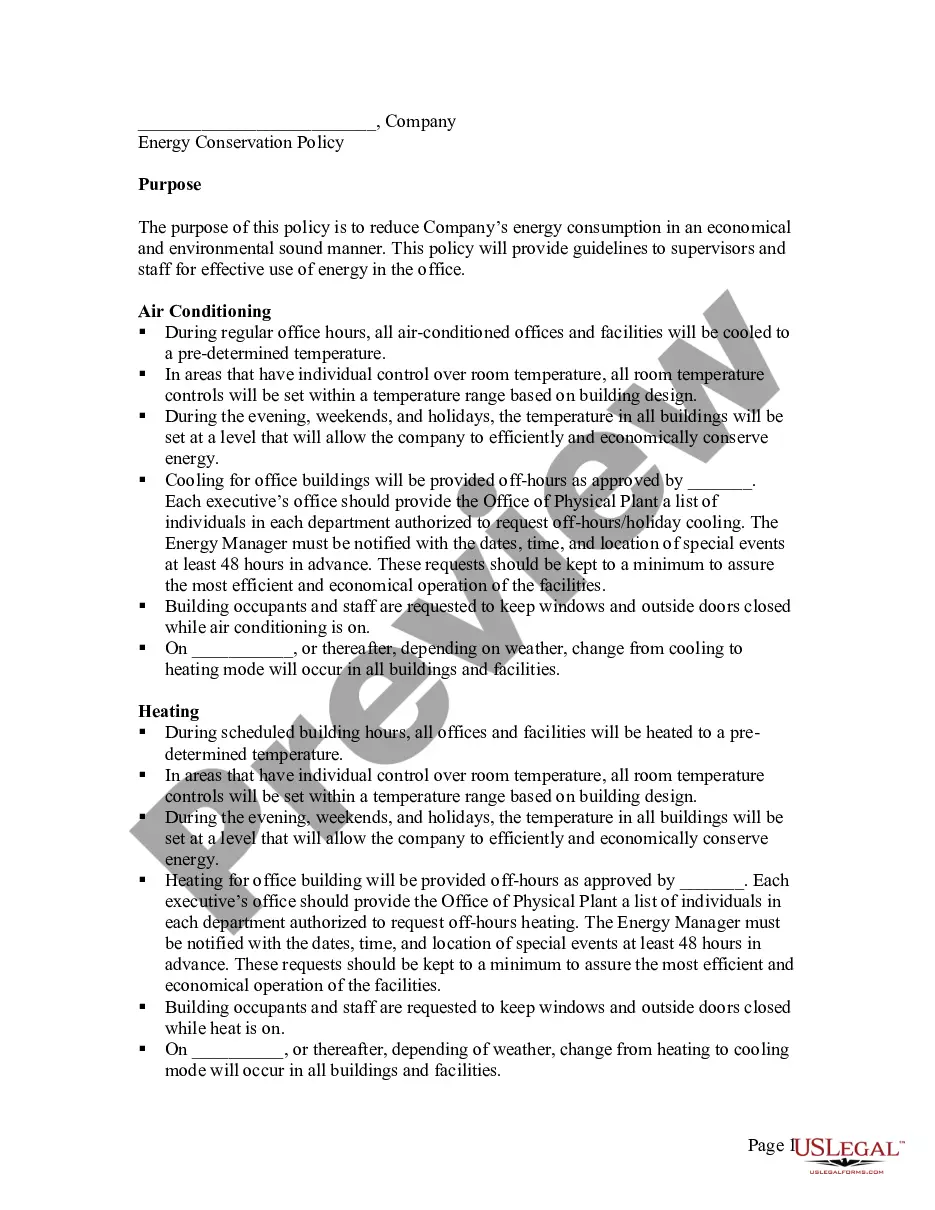
The Sample Energy Conservation Policy for Business is a template designed to help businesses establish a framework for reducing energy consumption. This policy specifically addresses the management of heating, air conditioning, lighting, and the use of electronic office equipment. Unlike other forms, which may focus on broader sustainability practices, this policy provides targeted guidelines to promote energy efficiency in daily business operations.
Form components explained
- Policy Purpose: Outlines the goals for energy conservation and efficiency within the company.
- Air Conditioning Guidelines: Specifies temperature settings during office hours and off-hours cooling requirements.
- Heating Procedures: Details heating temperature ranges and controls during business hours and after hours.
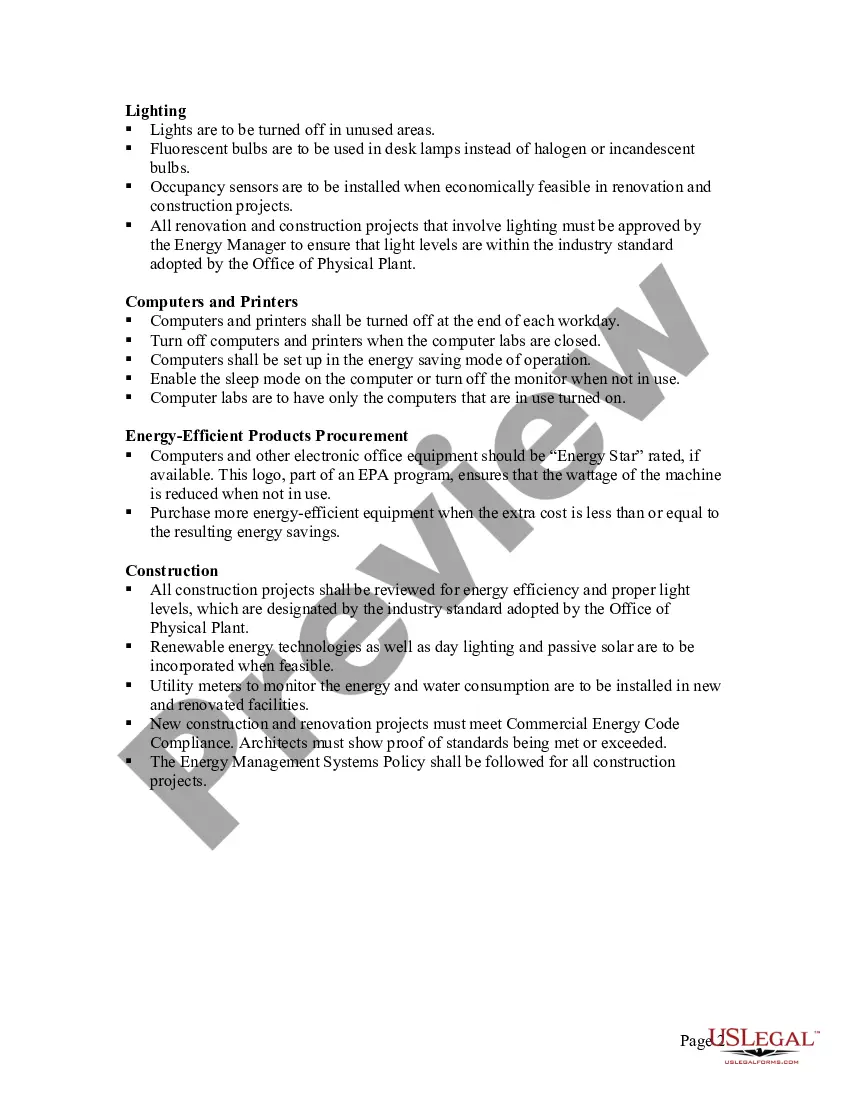
- Lighting Usage: Provides instructions on turning off lights in unused areas and adopting energy-efficient lighting solutions.
- Computers and Printers: Advises on proper usage, including shut-off procedures and energy-saving modes.
- Procurement Standards: Encourages the purchase of energy-efficient equipment, such as Energy Star rated devices.
When this form is needed
This form is suitable for businesses looking to formalize their energy conservation efforts. It is useful when establishing new energy consumption policies, during renovations or construction projects, or when aiming to improve sustainability practices in response to regulatory requirements or company goals.
Who needs this form
- Business owners seeking to implement energy-saving measures.
- Facility managers responsible for overseeing energy usage in corporate environments.
- HR managers tasked with developing sustainability policies.
- Employees involved in energy management or environmental compliance roles.
How to prepare this document
- Read the policy carefully to understand its purpose and guidelines.
- Adjust any sections based on your specific organizational needs or state regulations.
- Designate responsible individuals for monitoring compliance with the policy.
- Set pre-determined temperature settings and lighting practices as per the guidelines.
- Implement reviews for energy efficiency in construction projects as outlined in the policy.
Notarization guidance
This form usually doesn’t need to be notarized. However, local laws or specific transactions may require it. Our online notarization service, powered by Notarize, lets you complete it remotely through a secure video session, available 24/7.
Get your form ready online
Our built-in tools help you complete, sign, share, and store your documents in one place.
Make edits, fill in missing information, and update formatting in US Legal Forms—just like you would in MS Word.
Download a copy, print it, send it by email, or mail it via USPS—whatever works best for your next step.
Sign and collect signatures with our SignNow integration. Send to multiple recipients, set reminders, and more. Go Premium to unlock E-Sign.
If this form requires notarization, complete it online through a secure video call—no need to meet a notary in person or wait for an appointment.
We protect your documents and personal data by following strict security and privacy standards.

Make edits, fill in missing information, and update formatting in US Legal Forms—just like you would in MS Word.

Download a copy, print it, send it by email, or mail it via USPS—whatever works best for your next step.

Sign and collect signatures with our SignNow integration. Send to multiple recipients, set reminders, and more. Go Premium to unlock E-Sign.

If this form requires notarization, complete it online through a secure video call—no need to meet a notary in person or wait for an appointment.

We protect your documents and personal data by following strict security and privacy standards.
Mistakes to watch out for
- Not customizing the policy to fit specific business operations and energy needs.
- Failing to communicate the policy to all employees, leading to poor adherence.
- Overlooking periodic reviews and updates as energy standards and technologies change.
Benefits of using this form online
- Easy access to a professionally drafted policy template that saves time.
- Edit and customize the document to fit your business needs without legal jargon.
- Secure online platform ensures that your forms are stored safely and can be retrieved anytime.
Legal use & context
- This energy conservation policy can serve as a legally recognized guide for internal energy management practices.
- It may be used as part of a compliance strategy for energy efficiency programs mandated by local regulations.
- Effective implementation can reduce liability related to energy waste and enhance environmental stewardship.
Main things to remember
- The Sample Energy Conservation Policy for Business provides a concise framework for managing energy consumption.
- Properly completing this form can lead to significant energy savings and cost reductions.
- Understanding the specific requirements relevant to the business's location is critical for compliance.
- Engaging staff and ensuring enforcement are essential for the policy's success.
Looking for another form?

Form popularity
FAQ
Energy conservation is the effort made to reduce the consumption of energy by using less of an energy service. This can be achieved either by using energy more efficiently (using less energy for a constant service) or by reducing the amount of service used (for example, by driving less).
Adjust your day-to-day behaviors. Replace your light bulbs. Use smart power strips. Install a programmable or smart thermostat. Purchase energy efficient appliances.
Switch off artificial lights and use natural light. Choose energy efficient light bulbs. Choose laptops over desktops. Use hibernation feature on all computers. Use energy saving features of all devices.
Energy conservation can be as simple as turning off lights or appliances when you do not need them. You can also use energy-intensive appliances less by performing household tasks manually, such as hang-drying your clothes instead of putting them in the dryer, or washing dishes by hand.
Focus on insulation. The outside envelop of your building should be designed to lower heating and cooling needs. Choose the right ventilation system. Buy certified equipment. Use LED lights. Consider upgrading to LEED. Calculate your return on investment.
Step 1: Energy baselining. Step 2: Savings calculations. Step 3: Equipment selection. Step 4: Design, construction and verification. Step 5: Implement operations, maintenance and monitoring. Step 6: Measurement and verification.
Step 1 - get commitment and appoint an energy manager. Step 2 - understand the issues. Step 3 - plan and organise. Step 4 - develop an action plan. Step 5 - involve your staff. Step 6 - control, monitor and report.
Turn off the fan when you leave a room. Close your drapes or drop your window shades during the day. Wash your clothes in cold water. Wrap or cover foods and drinks in the refrigerator. Always use the cold water faucet, unless you really want hot water.