Issues-Claim for Damages Based Upon Defamation-Private Figure-Report of Official Proceeding or Public Meeting
What is this form?
This form, titled "Issues-Claim for Damages Based Upon Defamation-Private Figure-Report of Official Proceeding or Public Meeting," is designed for individuals seeking to file a claim for damages resulting from defamation as a private figure. It provides a structured approach to alleging that false statements were made about the plaintiff in connection with an official proceeding or public meeting, distinguishing it from claims by public figures or other types of defamation cases.
Key parts of this document
- Identification of the parties involved: Plaintiff and Defendant.
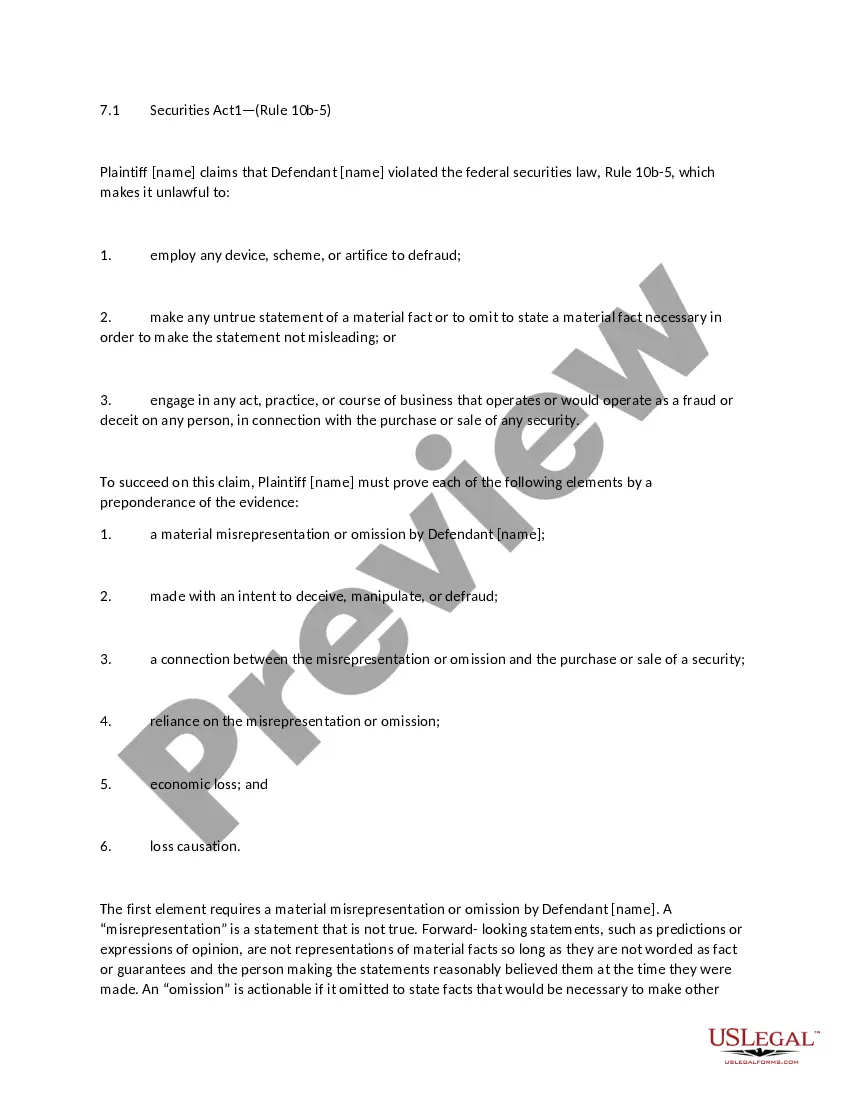
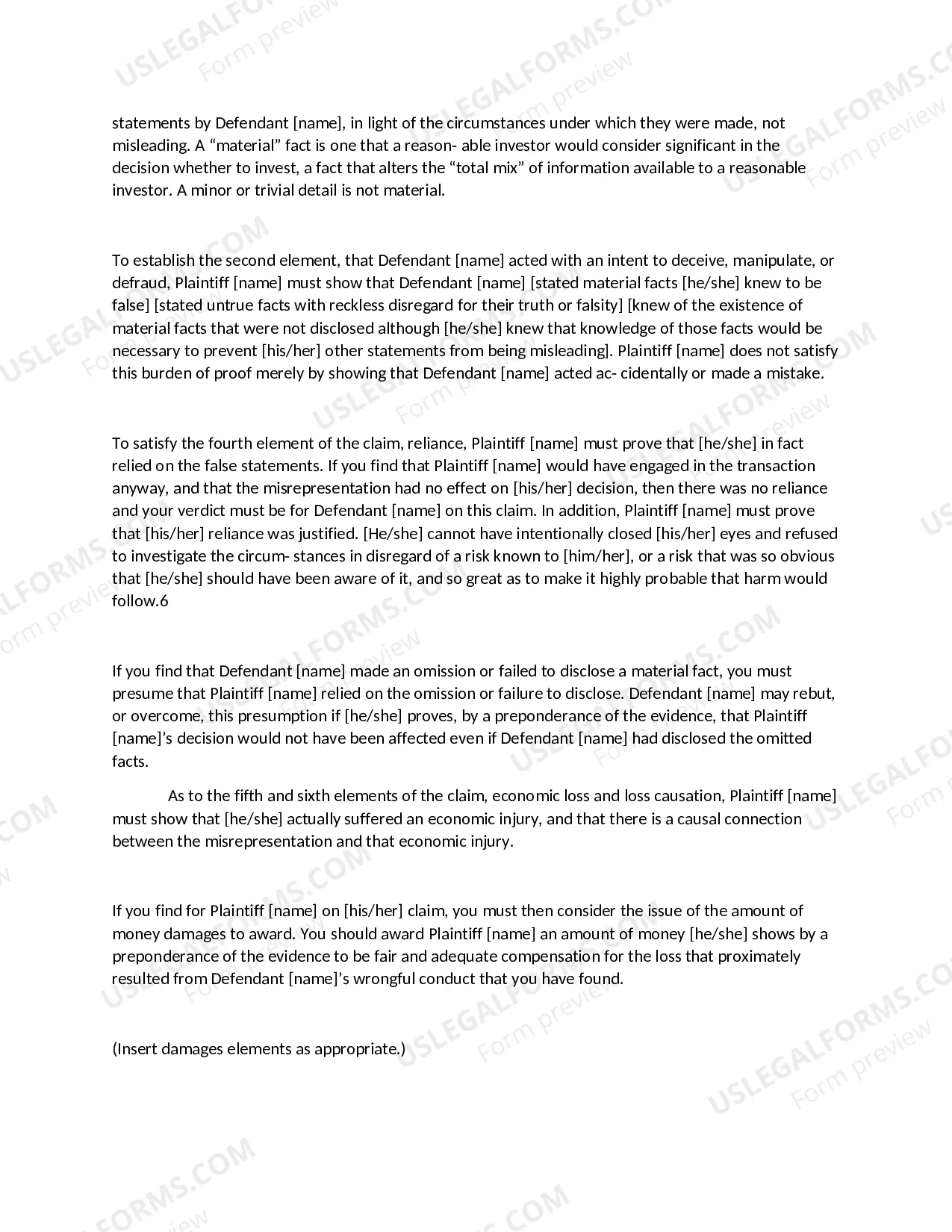
- Allegations regarding material misrepresentations or omissions made by the Defendant.
- Criteria for proving intent to deceive or defraud.
- Proof of economic loss and causation linked to the Defendant's actions.
- Instructions for assessing damages if the claim is successful.
Common use cases
This form is used when a private individual believes they have been defamed through false statements made in connection with official proceedings or public meetings. It's applicable in situations such as disputes arising from statements made during public governmental meetings, commission hearings, or similar contexts where reputational harm has occurred due to the misrepresentation of facts.
Intended users of this form
- Private individuals who have been defamed in the context of an official proceeding or public meeting.
- Claimants seeking to recover damages for reputational harm caused by false statements.
- Individuals looking to establish a clear legal claim against another party for defamation.
Instructions for completing this form
- Identify the plaintiff and defendant by entering their names and addresses.
- State the specific false statements made by the defendant, along with the context in which they were made.
- Detail the economic losses incurred as a result of the defamation.
- Specify how the defendant's actions meet the legal criteria for fraud or deceit.
- Sign and date the form to affirm its authenticity.
Does this document require notarization?
This form does not typically require notarization unless specified by local law. However, having the signatures notarized can add an extra layer of authenticity.
Get your form ready online
Our built-in tools help you complete, sign, share, and store your documents in one place.
Make edits, fill in missing information, and update formatting in US Legal Forms—just like you would in MS Word.
Download a copy, print it, send it by email, or mail it via USPS—whatever works best for your next step.
Sign and collect signatures with our SignNow integration. Send to multiple recipients, set reminders, and more. Go Premium to unlock E-Sign.
If this form requires notarization, complete it online through a secure video call—no need to meet a notary in person or wait for an appointment.
We protect your documents and personal data by following strict security and privacy standards.

Make edits, fill in missing information, and update formatting in US Legal Forms—just like you would in MS Word.

Download a copy, print it, send it by email, or mail it via USPS—whatever works best for your next step.

Sign and collect signatures with our SignNow integration. Send to multiple recipients, set reminders, and more. Go Premium to unlock E-Sign.

If this form requires notarization, complete it online through a secure video call—no need to meet a notary in person or wait for an appointment.

We protect your documents and personal data by following strict security and privacy standards.
Avoid these common issues
- Failing to clearly specify the false statements and their context.
- Not providing sufficient evidence of economic loss or causation.
- Omitting details about the defendant's intent to deceive.
- Submitting the form without proper signatures and dates.
Benefits of completing this form online
- Convenience of accessing and completing the form from home.
- Editability allows for easy updates and revisions as needed.
- Reliability in ensuring the form meets legal standards set by attorneys.
Legal use & context
- This form is valid for initiating a legal claim in cases of defamation against private figures.
- It must be completed accurately to ensure enforceability in court.
- Understanding the legal standards for defamation is crucial for successfully proceeding with the claim.
Quick recap
- The form is specifically designed for private individuals claiming defamation related to public proceedings.
- Successful claims depend on proving specific elements, including intent and economic damages.
- Using the form online simplifies the process and can help prevent common errors.
Looking for another form?

Form popularity
FAQ
With this standard, a public official must show that the defendant made a libelous statement with ?knowledge that it was false or with reckless disregard of whether it was false or not.?
To prove prima facie defamation, a plaintiff must show four things: 1) a false statement purporting to be fact; 2) publication or communication of that statement to a third person; 3) fault amounting to at least negligence; and 4) damages, or some harm caused to the reputation of the person or entity who is the subject
If a libel plaintiff is a public figure, he or she must prove, by clear and convincing evidence, that the defendant acted with actual malice in making the defamatory statement. If the plaintiff is a private figure, the First Amendment does not impose any restriction on the liability standards that states may adopt.
A public figure is a person who has achieved notoriety, prominence or fame within a society, whether through achievement, luck, action, or in some cases through no purposeful action of their own.
V. Sullivan (1964), the Supreme Court has held that public officials cannot recover damages for libel without proving that a statement was made with actual malice ? defined as ?with knowledge that it was false or with reckless disregard of whether it was false or not.?
The Supreme Court ruled that, for a public figure to recover damages in a defamation case, he must prove not only that the statement was defamatory but also that it was made with actual malice.
For public figures, there is an additional requirement to bring a defamation claim. They must prove that the defamer acted with actual malice. In other words, the defamer knew that the statement was false?or they acted with reckless disregard for whether the statement was true or false.
There are two types of "public figures" recognized under defamation law: "all-purpose" public figures and "limited-purpose" public figures. All-purpose public figures are private individuals who occupy "positions of such persuasive power and influence that they are deemed public figure for all purposes. . . .