Attempted Rescue-Negligence
What this document covers
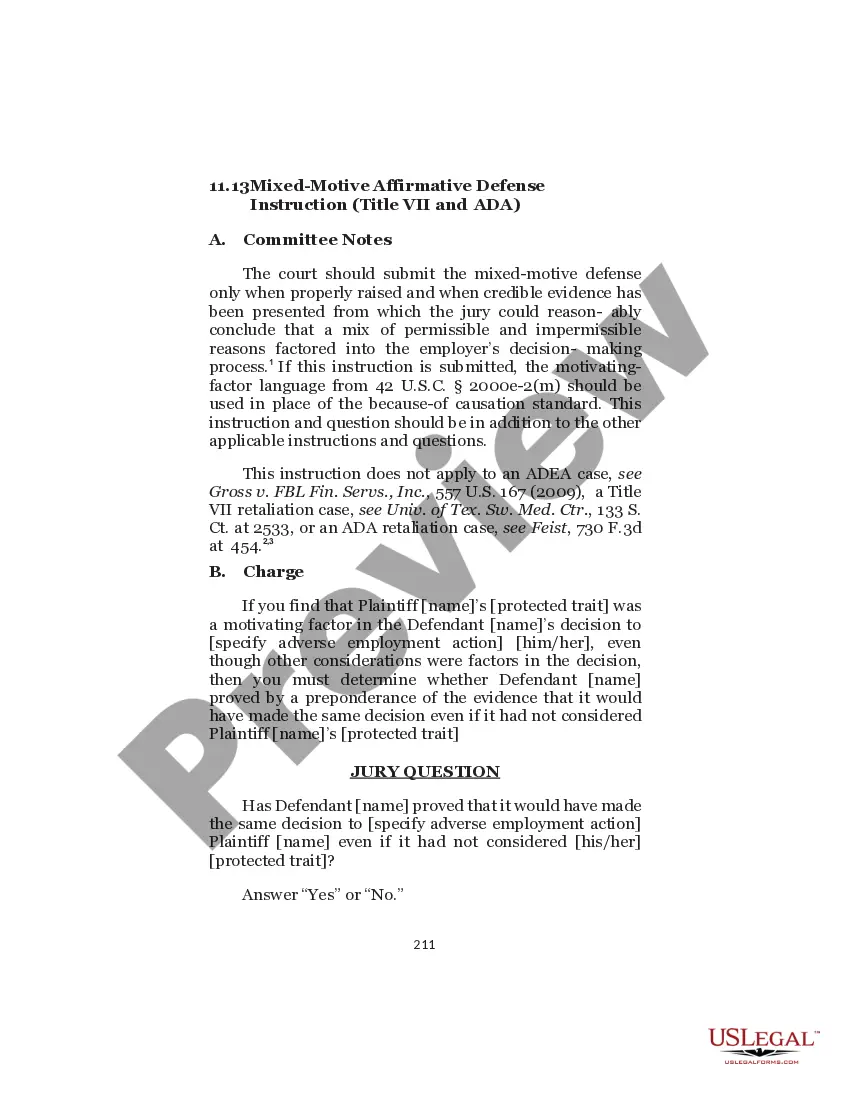
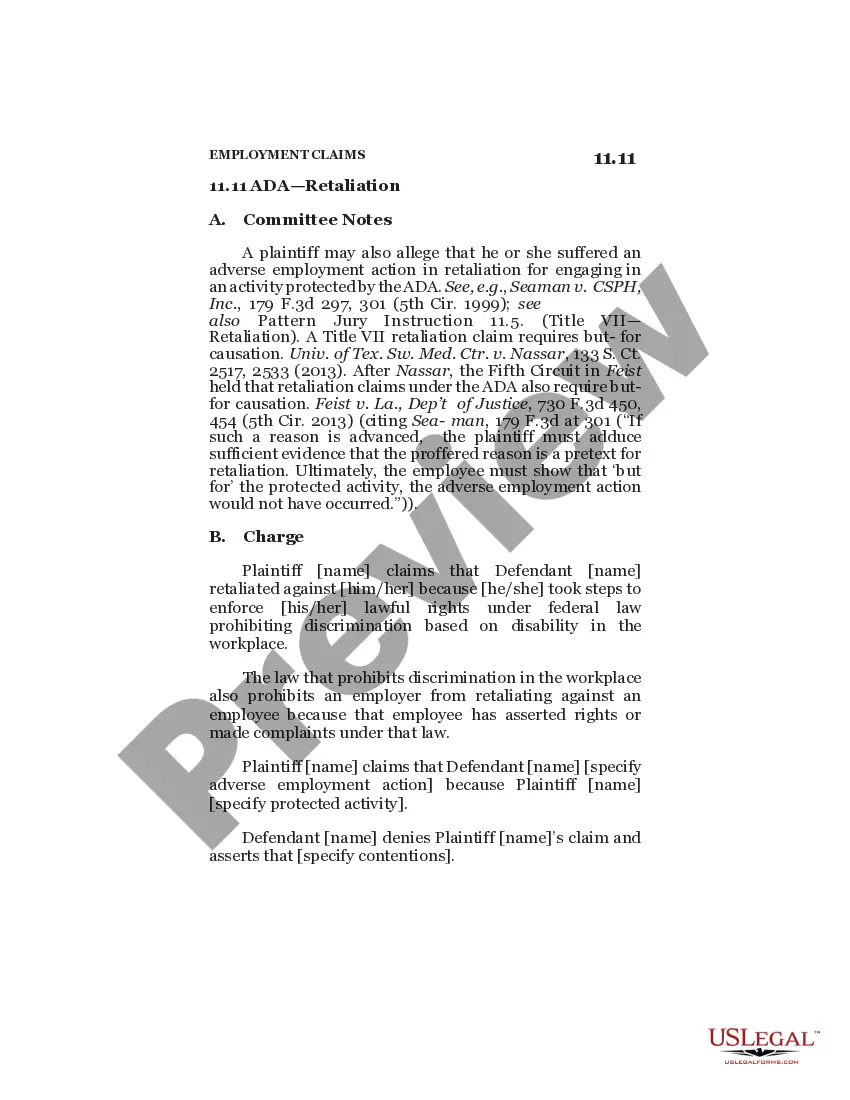
The Attempted Rescue-Negligence form addresses the legal concepts surrounding mixed-motive affirmative defenses in employment law cases under Title VII and the Americans with Disabilities Act (ADA). This form is particularly relevant when an employer's decision may be influenced by both permissible and impermissible reasons, allowing the jury to determine if a protected trait was a motivating factor in an employment decision.
Key parts of this document
- Affirmative defense instruction for mixed motives in employment decisions.
- Legal standards concerning motivating factors as defined by U.S. law.
- Jury question to determine if the employer would have made the same decision without considering the protected trait.
- Clear explanation of the scope and application for Title VII and ADA cases, excluding ADEA.


Common use cases
This form is used when navigating cases involving employment discrimination claims, specifically when there is a question about whether an employee's protected trait influenced an adverse employment action. It is applicable in situations where an employer may have legitimate and illegitimate reasons for their decision-making process.
Who needs this form
- Employees who believe they have been discriminated against based on protected traits.
- Employers looking to understand their defenses against discrimination claims.
- Attorneys or legal professionals representing clients in employment discrimination cases.
Completing this form step by step
- Identify the relevant parties involved, including plaintiff and defendant.
- Specify the protected trait in question and the adverse employment action that occurred.
- Ensure your facts support a claim of mixed motives in the decision-making process.
- Assemble supporting evidence to substantiate claims for presentation to the jury.
- Review the filled form to ensure clarity and legal compliance before final use.
Is notarization required?
This form usually doesn’t need to be notarized. However, local laws or specific transactions may require it. Our online notarization service, powered by Notarize, lets you complete it remotely through a secure video session, available 24/7.
Get your form ready online
Our built-in tools help you complete, sign, share, and store your documents in one place.
Make edits, fill in missing information, and update formatting in US Legal Forms—just like you would in MS Word.
Download a copy, print it, send it by email, or mail it via USPS—whatever works best for your next step.
Sign and collect signatures with our SignNow integration. Send to multiple recipients, set reminders, and more. Go Premium to unlock E-Sign.
If this form requires notarization, complete it online through a secure video call—no need to meet a notary in person or wait for an appointment.
We protect your documents and personal data by following strict security and privacy standards.

Make edits, fill in missing information, and update formatting in US Legal Forms—just like you would in MS Word.

Download a copy, print it, send it by email, or mail it via USPS—whatever works best for your next step.

Sign and collect signatures with our SignNow integration. Send to multiple recipients, set reminders, and more. Go Premium to unlock E-Sign.

If this form requires notarization, complete it online through a secure video call—no need to meet a notary in person or wait for an appointment.

We protect your documents and personal data by following strict security and privacy standards.
Common mistakes to avoid
- Failing to clearly articulate the mixed motives involved in the employer's decision.
- Not providing sufficient evidence to support claims made in the form.
- Neglecting to differentiate between Title VII/ADA and other legal standards.
- Using ambiguous language that may confuse the jury or misrepresent facts.
Why use this form online
- Easy access to professionally drafted legal templates by experienced attorneys.
- Convenience of downloading and completing the form at your own pace.
- Ability to edit and customize the form to meet your specific needs.
- Secure storage of forms for future reference and legal use.
Looking for another form?

Form popularity
FAQ
Other jurisdictions, such as California, extend the duty to rescue to all persons who enter upon real property regardless whether they are classified as invitees, social guests or trespassers. Spouses have a duty to rescue each other in all U.S. jurisdictions.
Negligence claims must prove four things in court: duty, breach, causation, and damages/harm. Generally speaking, when someone acts in a careless way and causes an injury to another person, under the legal principle of "negligence" the careless person will be legally liable for any resulting harm.
A rescuer is a foreseeable plaintiff as long as the rescue is not reckless; hence, the defendant is liable if he negligently puts himself in peril and the plaintiff is injured attempting a rescue. A plaintiff may take extraordinary risks when attempting a rescue without being considered contributorily negligent.
The rule of law that if a rescuer of a person hurt or put in peril due to the negligence or intentional wrongdoing of another (the tortfeasor) is injured in the process of the rescue, the original wrongdoer is responsible in damages for the rescuer's injury.
Essentially, the rescue doctrine means that the rescuer can recover damages from a defendant when the rescuer is injured rescuing someone. The defendant is usually negligent in causing the accident to occur. Other cases have occurred where the plaintiff is injured rescuing the defendant and is able to collect damages.
A negligence claim requires that the person bringing the claim (the plaintiff) establish four distinct elements: duty of care, breach, causation, and damages.
The rescue doctrine authorizes a person injured while rescuing another to bring a negligence claim against the party whose conduct created the need for rescue.
Rescue doctrine provides that when person sees victim in imminent and serious peril caused by tortious conduct of third person, rescuer will not be guilty of contributory negligence as matter of law provided he does not act recklessly.