Hobbs Act - Property
About this form
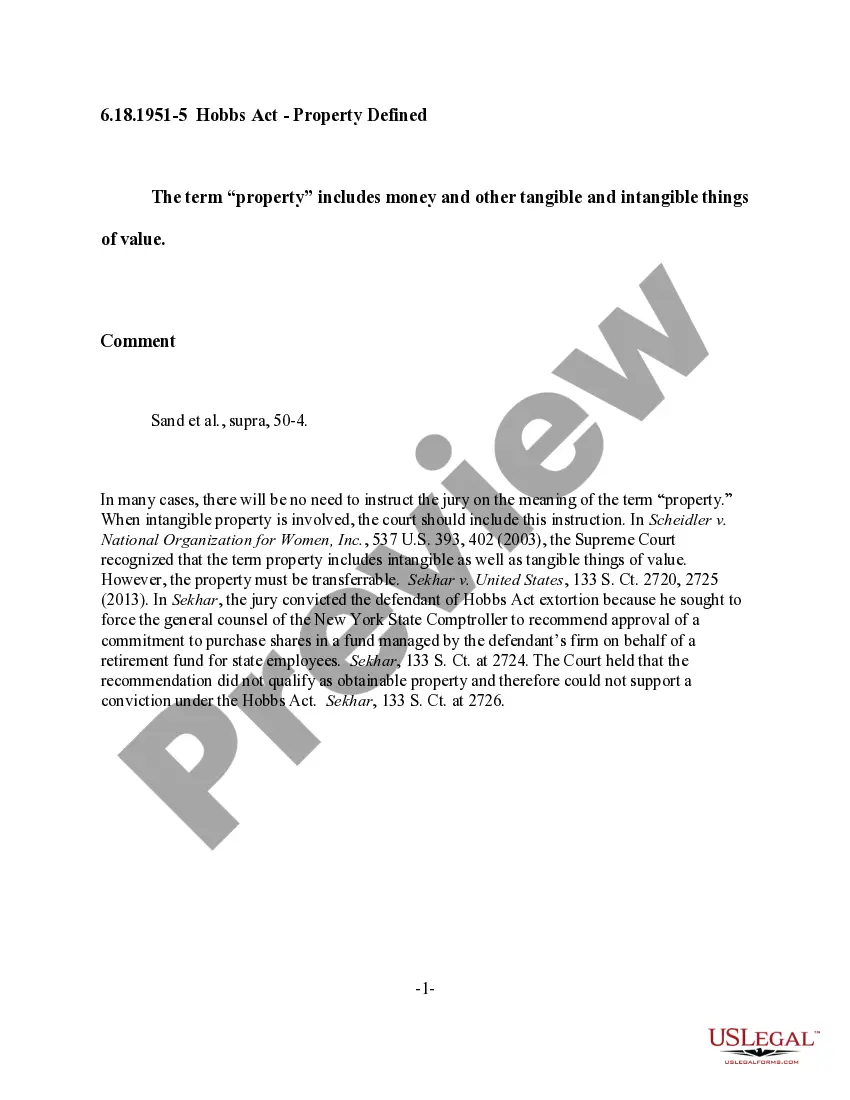
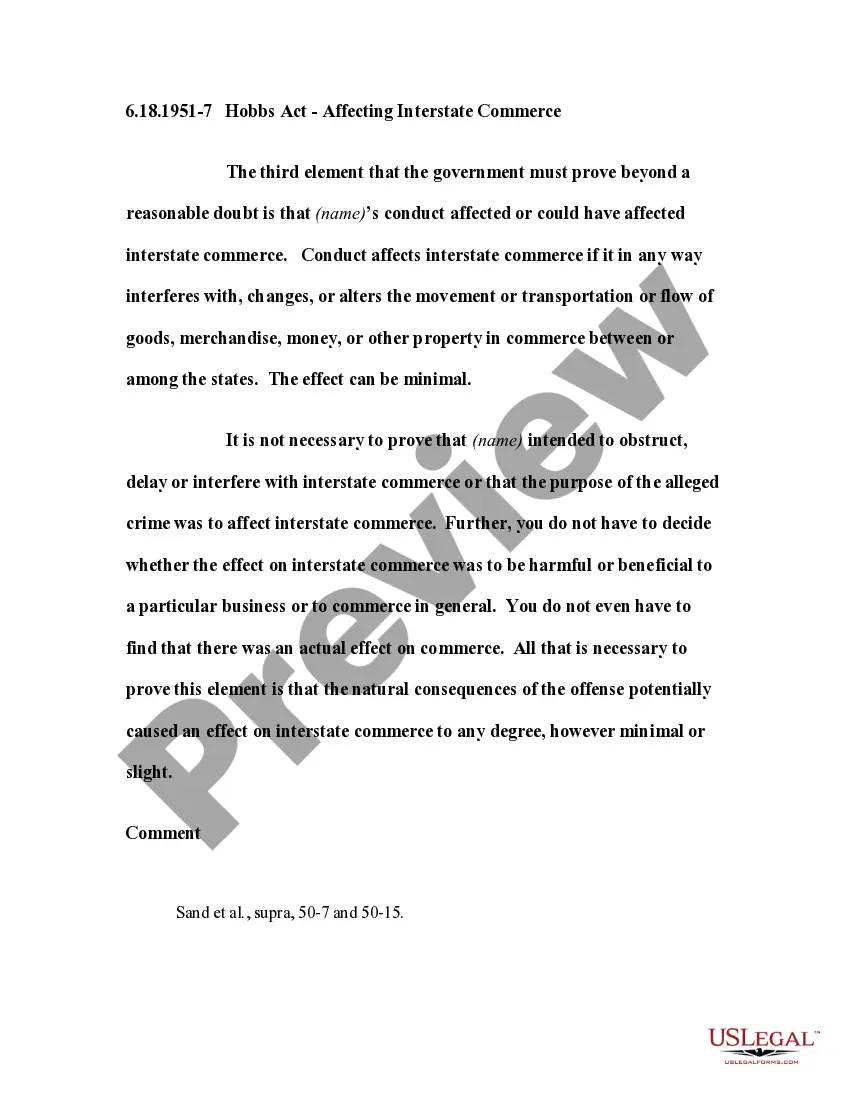
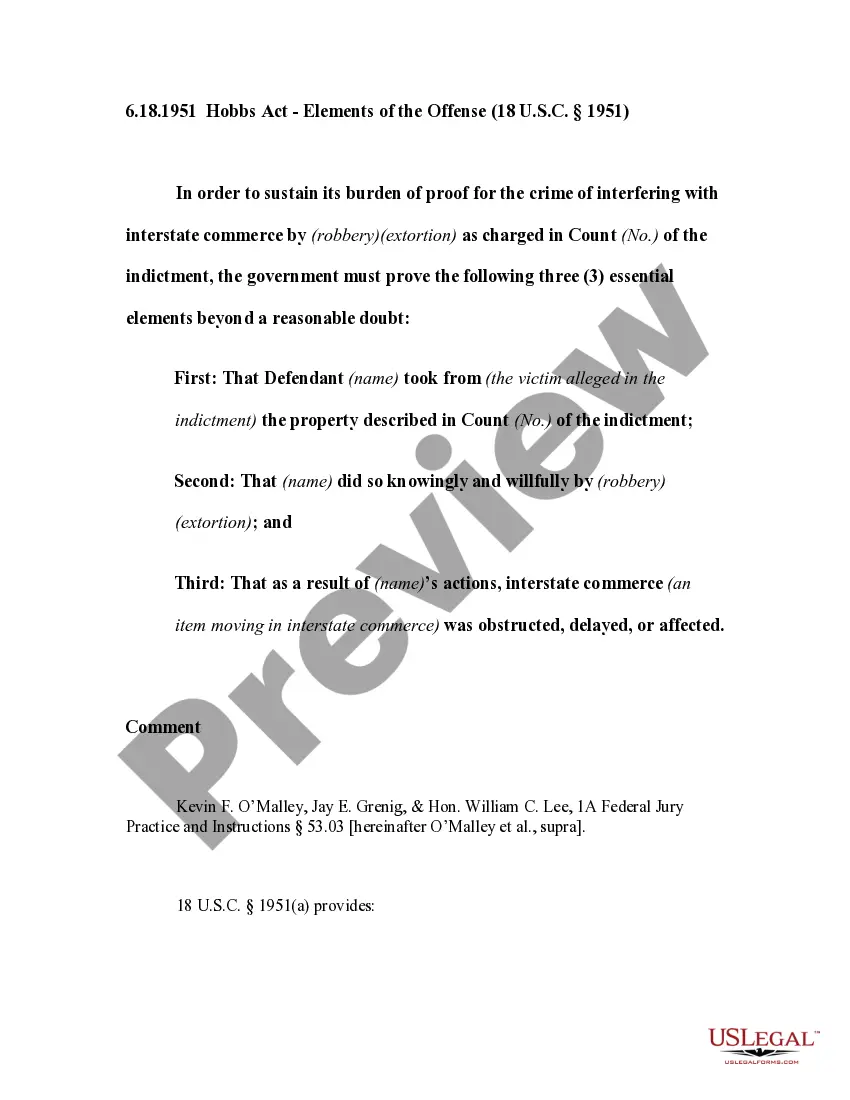
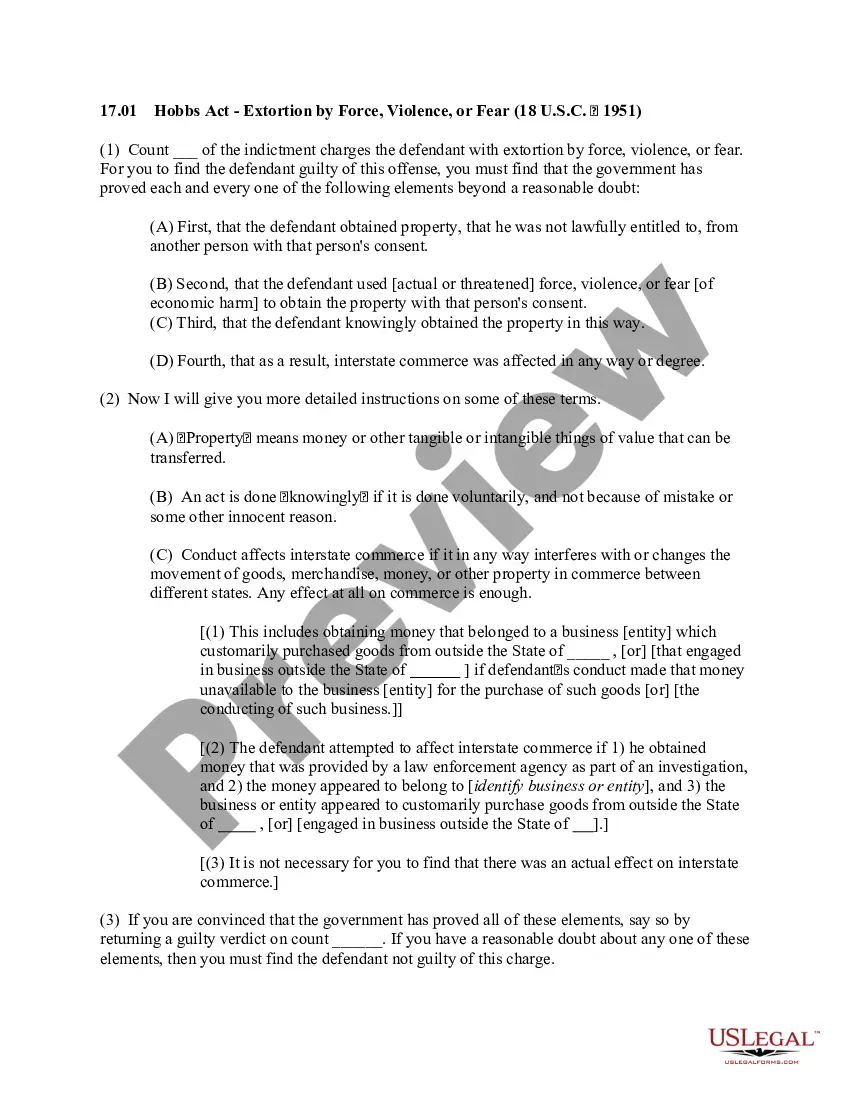
The Hobbs Act - Property form outlines the legal definition of "property" as applied in criminal cases involving extortion under the Hobbs Act. It differentiates between tangible and intangible assets, clarifying that property must be transferrable to support legal claims. This form is essential for understanding the scope of property in extortion cases, providing clarity for both legal practitioners and laypersons alike.
Key components of this form
- Definition of "property" including money and value items
- Clarification on tangible versus intangible property
- Legal context derived from Scheidler v. National Organization for Women, Inc. and Sekhar v. United States
- Guidance on when jury instruction on property definition is necessary
Situations where this form applies
This form should be used in legal contexts involving allegations of extortion under the Hobbs Act. It is particularly applicable when defining the property involved in such cases. Legal professionals may refer to this form when preparing cases, advising clients, or instructing juries on the nuances of property in legal arguments.
Intended users of this form
- Criminal defense attorneys involved in Hobbs Act cases
- Prosecutors handling extortion charges
- Law students studying criminal law
- Individuals seeking to understand the legal definition of property in this context
Steps to complete this form
- Identify the type of property involved in the case.
- Determine if the property is tangible or intangible.
- Reference applicable case law to support the property classification.
- Ensure the property's characteristics meet the transferrable criteria.
- Input the legal context surrounding the property and any related allegations.
Is notarization required?
This form usually doesn’t need to be notarized. However, local laws or specific transactions may require it. Our online notarization service, powered by Notarize, lets you complete it remotely through a secure video session, available 24/7.
Get your form ready online
Our built-in tools help you complete, sign, share, and store your documents in one place.
Make edits, fill in missing information, and update formatting in US Legal Forms—just like you would in MS Word.
Download a copy, print it, send it by email, or mail it via USPS—whatever works best for your next step.
Sign and collect signatures with our SignNow integration. Send to multiple recipients, set reminders, and more. Go Premium to unlock E-Sign.
If this form requires notarization, complete it online through a secure video call—no need to meet a notary in person or wait for an appointment.
We protect your documents and personal data by following strict security and privacy standards.

Make edits, fill in missing information, and update formatting in US Legal Forms—just like you would in MS Word.

Download a copy, print it, send it by email, or mail it via USPS—whatever works best for your next step.

Sign and collect signatures with our SignNow integration. Send to multiple recipients, set reminders, and more. Go Premium to unlock E-Sign.

If this form requires notarization, complete it online through a secure video call—no need to meet a notary in person or wait for an appointment.

We protect your documents and personal data by following strict security and privacy standards.
Mistakes to watch out for
- Failing to clarify the distinction between tangible and intangible property.
- Neglecting to reference recent case law that defines property under the Hobbs Act.
- Misinterpreting the requirement that property must be transferrable.
Benefits of completing this form online
- Convenient access to essential legal definitions and contexts.
- Editable format allows users to customize information as needed.
- Reliable resources drafted by licensed attorneys ensure accuracy.
Looking for another form?
Form popularity
FAQ
It was originally used to curtail racketeering in labor disputes, which was a common phenomenon at that time. Today, the Hobbs Act is commonly used by federal prosecutors to target public corruption, street gangs, commercial disputes, and union corruption.
The Hobbs Act extortion. The government need not prove that the conspirators sought or obtained money from someone outside the conspiracy or that each member of the conspiracy was capable of carrying out the Hobbs Act extortion.
The Hobbs Act prohibits actual or attempted robbery or extortion affecting interstate or foreign commerce "in any way or degree." Section 1951 also proscribes conspiracy to commit robbery or extortion without reference to the conspiracy statute at 18 U.S.C. § 371.
What is the sentence for violation of the Hobbs Act? This law imposes fines and a maximum sentence of twenty years for extortion that inhibits interstate commerce by depleting an enterprise's assets that would normally be used for the purchase of goods.
Hobbs Act Defense Lawyer ? 18 U.S.C § 1951 This federal stature prohibits public officials from acquiring property under color of official right or using their authority for extorting property. Further, it prohibits individuals from making threats to use force, violence, or fear to acquire property.
Prosecuted under 18 USC 1951, a violation of the Hobbs Act is committed by obstructing, delaying, or affecting commerce or the movement of any article or commodity in commerce, by robbery or extortion or an attempt or conspiracy so to do, or if one commits or threatens physical violence to any person or property in
A conviction under the Hobbs Act requires proof beyond a reasonable doubt that (1) the defendant knowingly or willfully committed, or attempted or conspired to commit, robbery or extortion, and (2) the defendant's conduct affected interstate commerce. See United States v. Powell, 693 F. 3d 398 (3d Cir. 2012).
The Hobbs Act, named after United States Representative Sam Hobbs (D-AL) and codified as 18 U.S.C. § 1951, is a United States federal law enacted in 1946 that prohibits actual or attempted robbery or extortion that affect intrastate or foreign commerce. It also forbids conspiracy to do so.