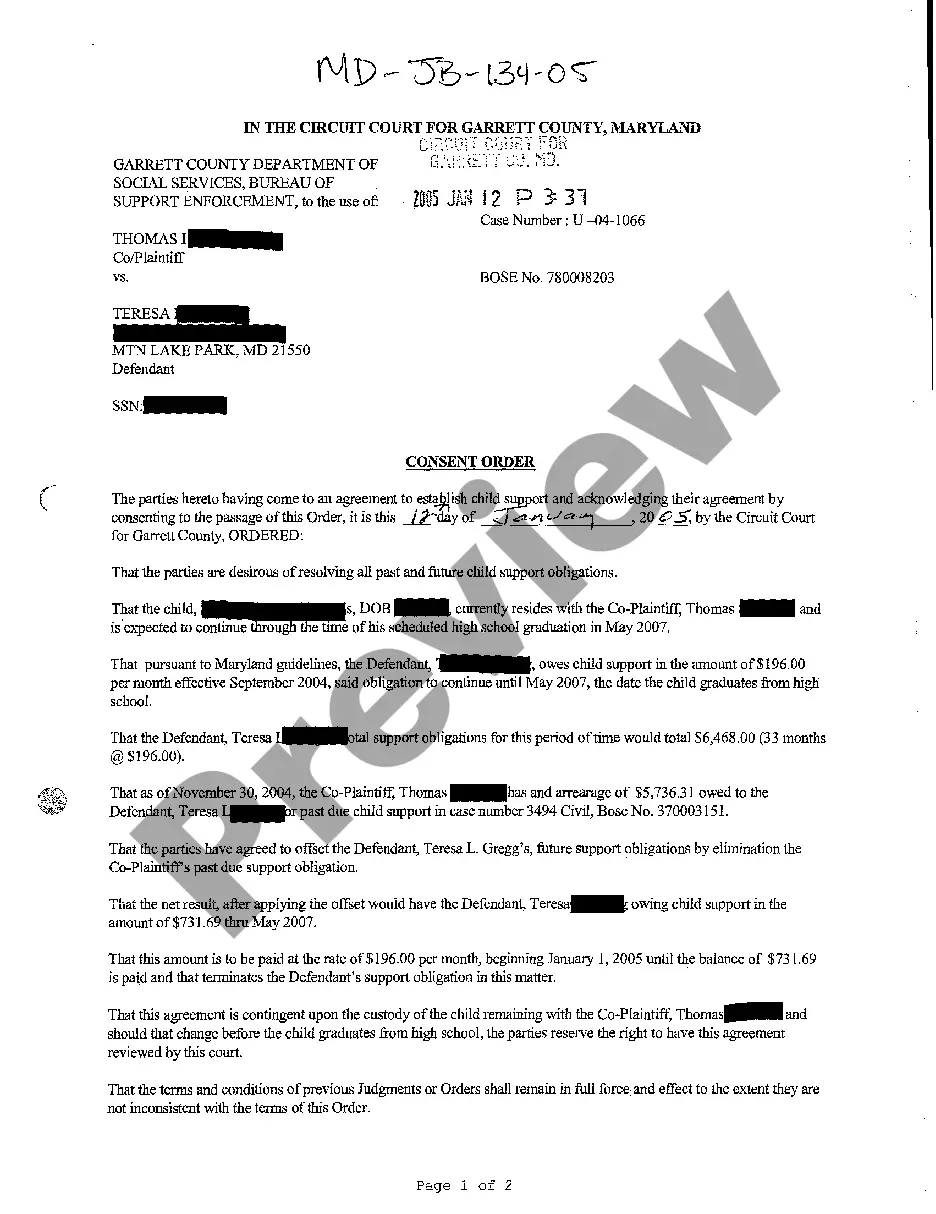
Affirmative Defense - Truth-Seeking Lawful Conduct
What this document covers
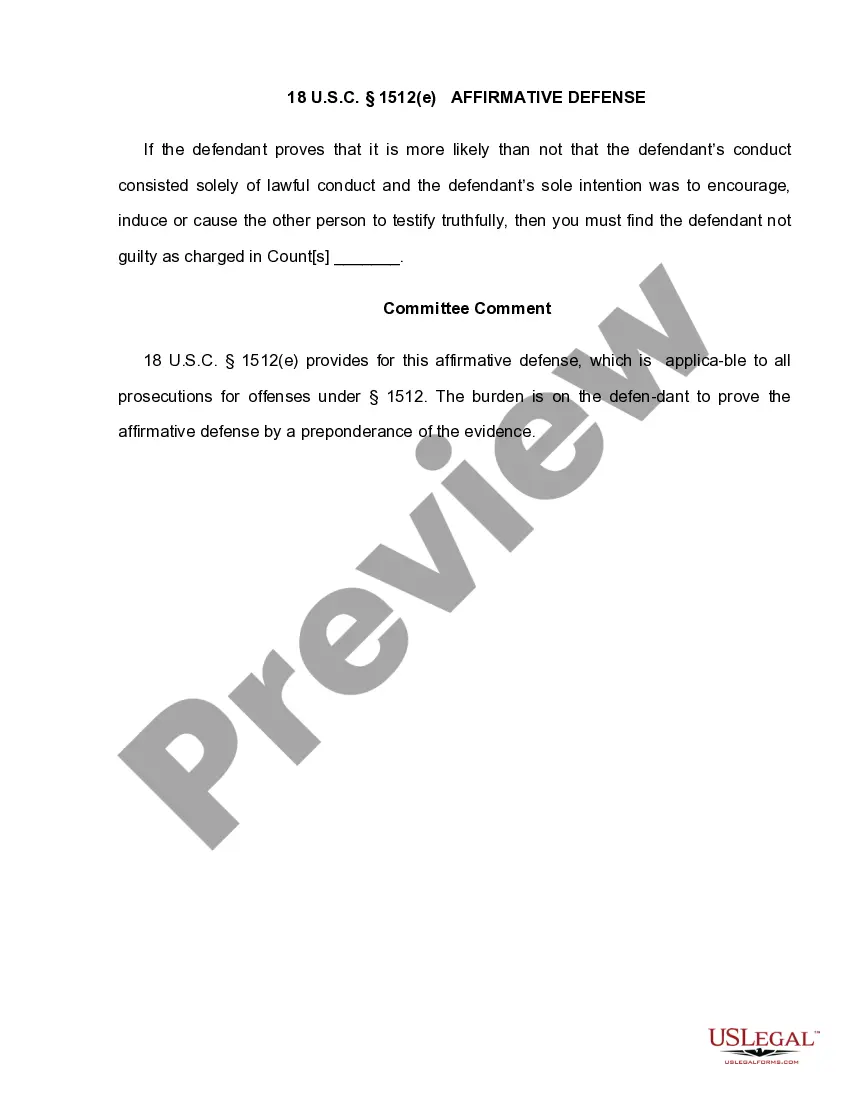
The Affirmative Defense - Truth-Seeking Lawful Conduct form is a legal document that allows a defendant to assert a defense when accused of unlawful conduct. This form is specifically utilized when the defendant's sole intention is to encourage someone to testify truthfully through lawful means. It sets out important legal provisions that differentiate it from other forms of defense by affirmatively stating the defendant's lawful actions and motives.
What’s included in this form
- Identification of the accused individual and the specific count against them.
- Statement of the defendant's intention to encourage truthful testimony.
- Clarification that the conduct in question must be lawful.
- Requirements for the burden of proof regarding the defense.
- Reference to applicable federal statutes governing the affirmative defense.
When to use this document
This form is used in cases where an individual faces charges related to testimony tampering, but the individual wishes to assert that their actions were solely intended to promote truthful testimony and were lawful. It is applicable in circumstances where threats or coercive behavior have been alleged but the accused can demonstrate lawful motivation and conduct.
Intended users of this form
- Defendants accused of crimes related to tampering with witnesses.
- Individuals seeking to present a lawful affirmative defense in a criminal trial.
- Legal professionals representing defendants in cases involving testimony manipulation charges.
How to complete this form
- Begin by entering the name of the accused individual and the specific charge count against them.
- Clearly state the intention of the accused to promote truthful testimony.
- Describe the conduct of the accused, ensuring it reflects lawful actions.
- Include any relevant evidence that supports the affirmative defense.
- Sign and date the form where required.
Notarization requirements for this form
In most cases, this form does not require notarization. However, some jurisdictions or signing circumstances might. US Legal Forms offers online notarization powered by Notarize, accessible 24/7 for a quick, remote process.
Get your form ready online
Our built-in tools help you complete, sign, share, and store your documents in one place.
Make edits, fill in missing information, and update formatting in US Legal Forms—just like you would in MS Word.
Download a copy, print it, send it by email, or mail it via USPS—whatever works best for your next step.
Sign and collect signatures with our SignNow integration. Send to multiple recipients, set reminders, and more. Go Premium to unlock E-Sign.
If this form requires notarization, complete it online through a secure video call—no need to meet a notary in person or wait for an appointment.
We protect your documents and personal data by following strict security and privacy standards.

Make edits, fill in missing information, and update formatting in US Legal Forms—just like you would in MS Word.

Download a copy, print it, send it by email, or mail it via USPS—whatever works best for your next step.

Sign and collect signatures with our SignNow integration. Send to multiple recipients, set reminders, and more. Go Premium to unlock E-Sign.

If this form requires notarization, complete it online through a secure video call—no need to meet a notary in person or wait for an appointment.

We protect your documents and personal data by following strict security and privacy standards.
Typical mistakes to avoid
- Failing to clearly articulate lawful intentions and conduct.
- Insufficiently substantiating the evidence required to support the defense.
- Omitting necessary signatures or dates on the form.
Why use this form online
- Convenient access to legal forms at any time.
- Easily editable templates to tailor according to specific case needs.
- Reliable guidance from licensed attorneys in drafting the document.
Looking for another form?
Form popularity
FAQ
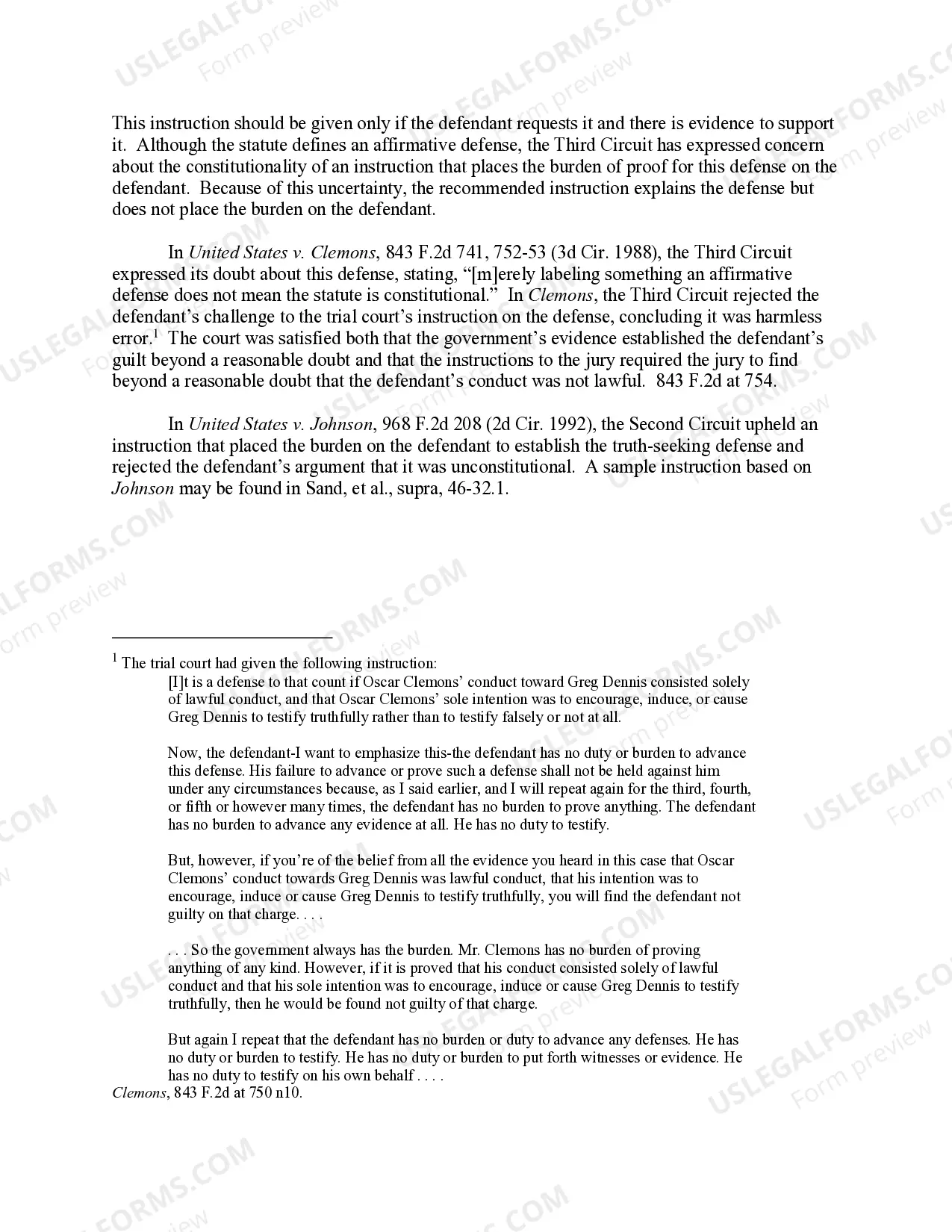
A defendant must prove each element of the defense, or it fails. 29 In other words, a defendant has the burden of proving an affirmative defense, just as a plaintiff has the burden of proving a cause of action. Most affirmative defense must be proven by a preponderance of the evidence.
Self-defense, entrapment, insanity, necessity, and respondeat superior are some examples of affirmative defenses.
An affirmative defense is a reason given by the defendant for why the plaintiff should not win the lawsuit, even if what the plaintiff says is true. In Texas, defendants must assert affirmative defenses in their Answer at the beginning of the case or risk not being able to use them later.
Self-defense, however, is not an affirmative defense because the burden of proof always stays on the prosecutor in a self-defense claim.
When arguing an affirmative defense, a defendant must meet the ?preponderance of the evidence? burden of proof ? a much lower standard. Subsequently, the burden of proof shifts back to the prosecution who must disprove the affirmative defense raised beyond a reasonable doubt.
In many cases, truth is what the law calls an ?affirmative defense? to a defamation claim. That means that it's up to you as the defendant to prove that your statement was true to get the case dismissed.
The three burdens of proof for criminal cases are "beyond a reasonable doubt," "probable cause," and "reasonable suspicion."
Truth is a Defense Truth, or substantial truth, is a complete defense to a claim of defamation. The only real issue is who has the burden of proving what is true.
Before a jury may consider an affirmative defense, defendant must produce sufficient evidence to put the item in issue (burden of production). Once the defendant meets this burden, the prosecution must prove beyond a reasonable doubt that the defendant's actions were not justified or excused under the law.