Stipulation of Fact
What is this form?
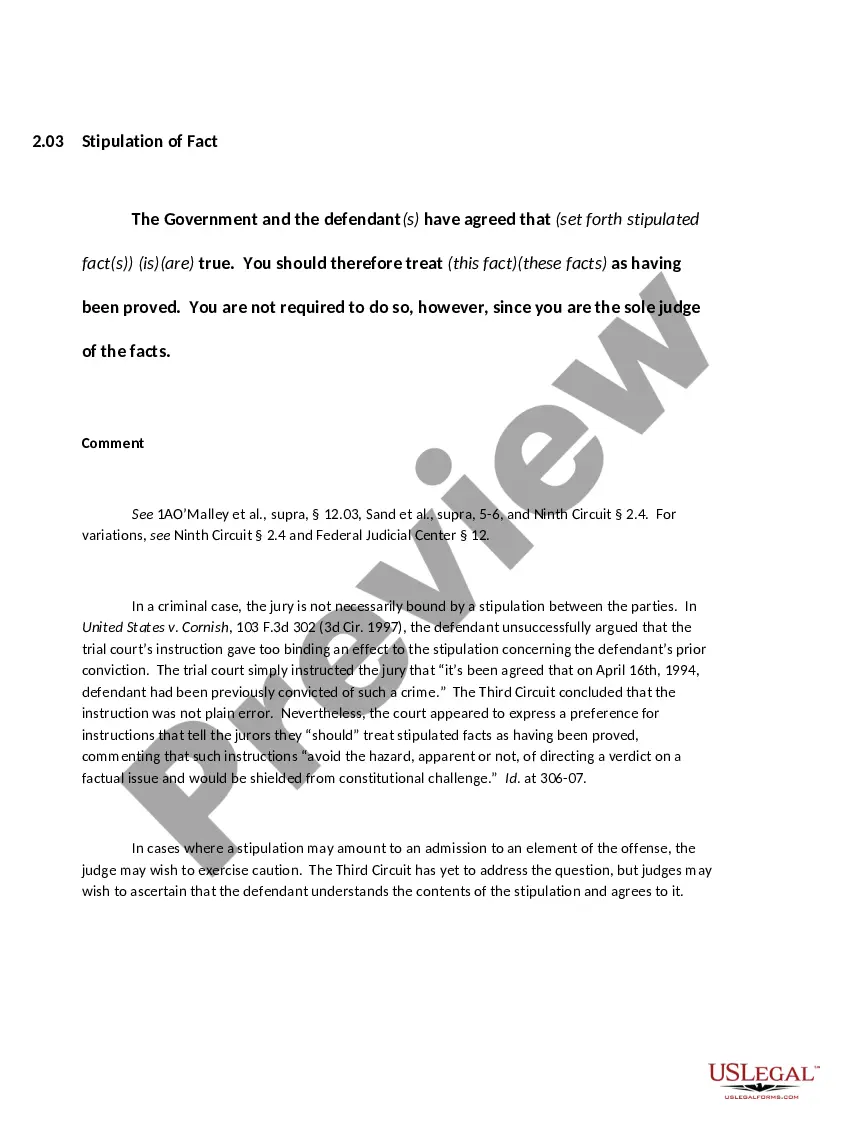
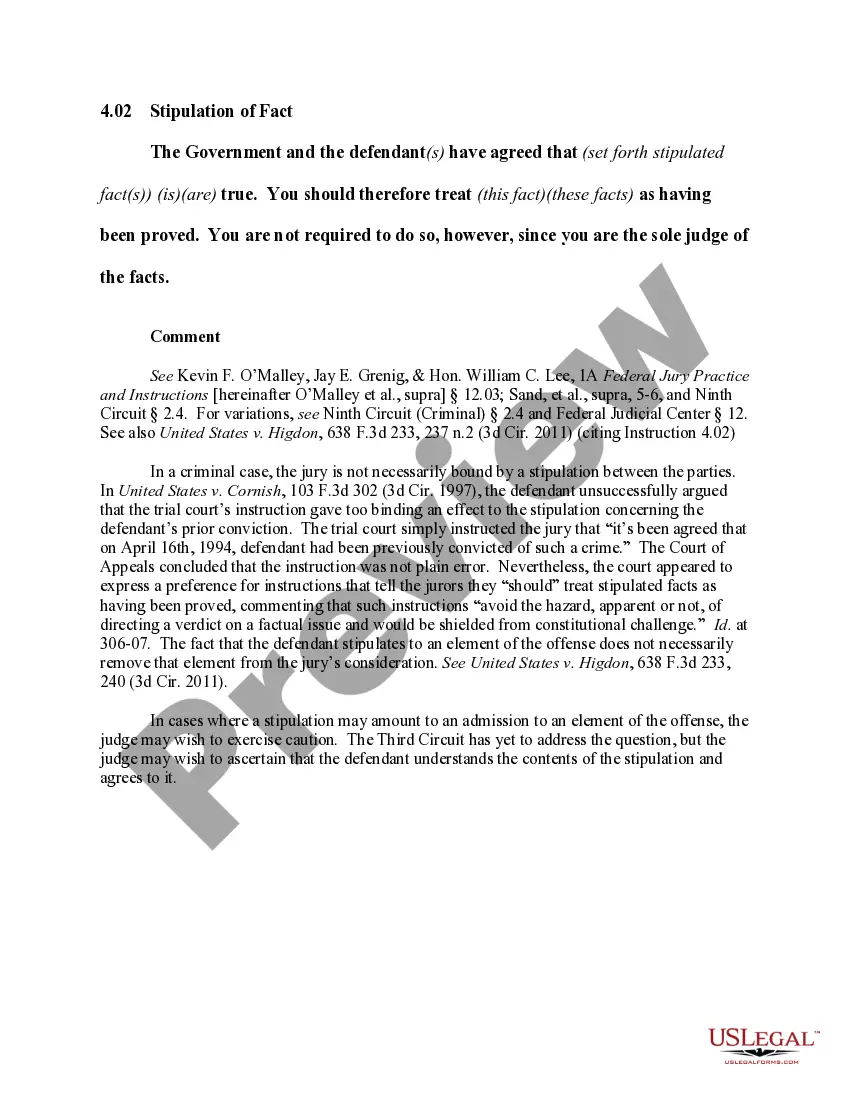
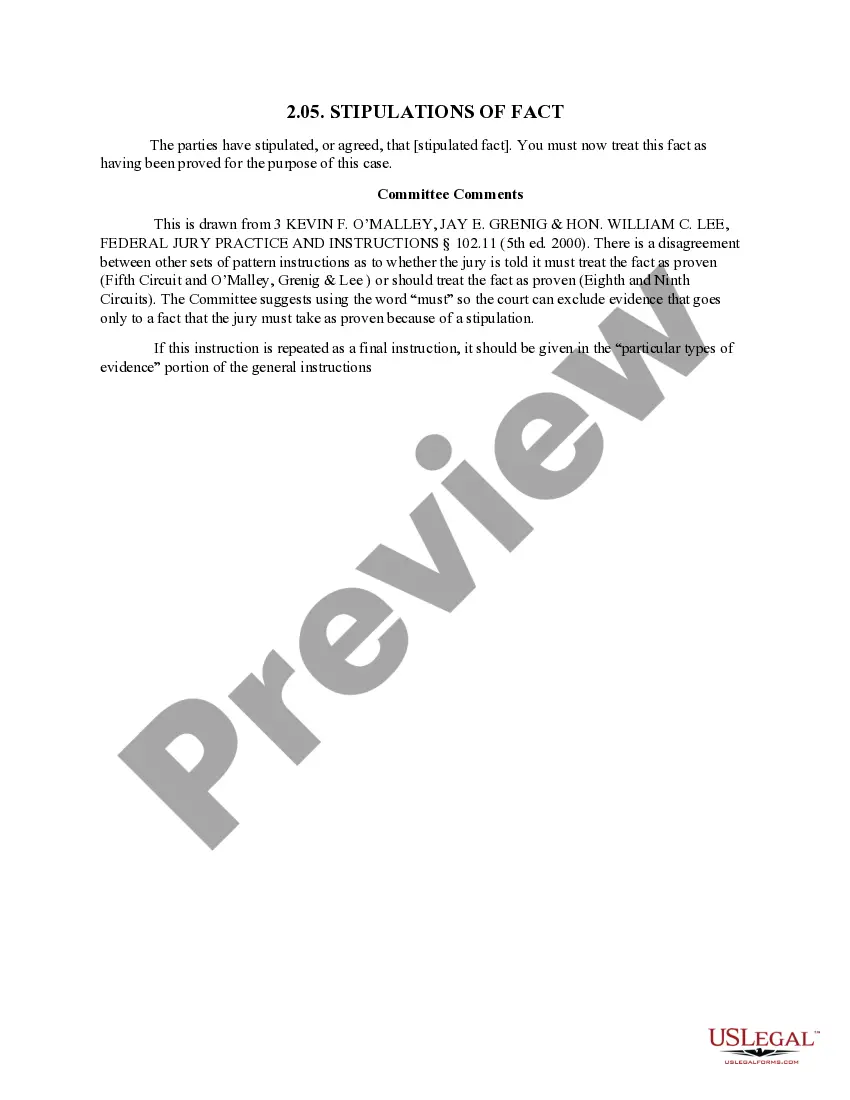
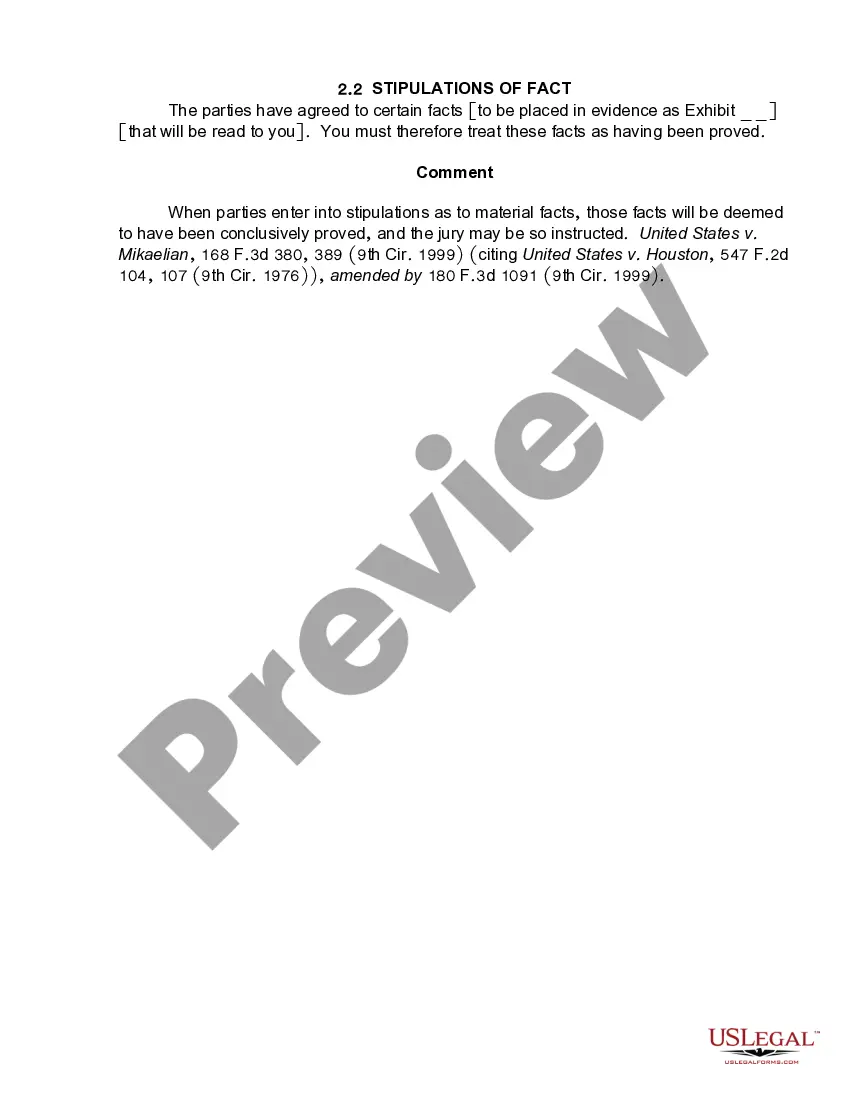
The Stipulation of Fact is a legal document in which the government and the defendant agree on certain facts as being true. This form is used primarily in criminal cases to simplify proceedings by acknowledging specific details, allowing the jury to accept these facts as established without further proof. Unlike some other forms, a stipulation does not compel the jury to accept the facts but suggests that they treat them as proven, offering clarity in the judicial process.
Main sections of this form
- Identification of stipulated facts agreed upon by both parties.
- A declaration that the jury should treat these facts as proven.
- Clear wording to indicate that the jury is not obligated to accept these stipulations as truth.
- Guidance for judges on how to instruct juries regarding stipulations.

When to use this document
This form is typically used in criminal cases when both parties agree on certain facts relevant to the case. By using a stipulation, the parties can expedite the trial process and avoid unnecessary evidence presentation, especially for undisputed facts such as prior convictions or other critical details that do not need further contestation.
Who should use this form
- Defendants involved in criminal cases.
- Government prosecutors seeking to establish agreed-upon facts.
- Legal representatives for either party aiming to clarify points of agreement.
How to prepare this document
- Identify the parties involved, including the government and the defendant.
- Clearly state the facts that both parties agree upon.
- Ensure the language indicates that the jury is encouraged, but not required, to accept these facts as true.
- Include any necessary signatures from both parties to confirm the agreement.
- Review the form for clarity and accuracy before submission.
Does this document require notarization?
This form usually doesn’t need to be notarized. However, local laws or specific transactions may require it. Our online notarization service, powered by Notarize, lets you complete it remotely through a secure video session, available 24/7.
Get your form ready online
Our built-in tools help you complete, sign, share, and store your documents in one place.
Make edits, fill in missing information, and update formatting in US Legal Forms—just like you would in MS Word.
Download a copy, print it, send it by email, or mail it via USPS—whatever works best for your next step.
Sign and collect signatures with our SignNow integration. Send to multiple recipients, set reminders, and more. Go Premium to unlock E-Sign.
If this form requires notarization, complete it online through a secure video call—no need to meet a notary in person or wait for an appointment.
We protect your documents and personal data by following strict security and privacy standards.

Make edits, fill in missing information, and update formatting in US Legal Forms—just like you would in MS Word.

Download a copy, print it, send it by email, or mail it via USPS—whatever works best for your next step.

Sign and collect signatures with our SignNow integration. Send to multiple recipients, set reminders, and more. Go Premium to unlock E-Sign.

If this form requires notarization, complete it online through a secure video call—no need to meet a notary in person or wait for an appointment.

We protect your documents and personal data by following strict security and privacy standards.
Typical mistakes to avoid
- Failing to clearly define the stipulated facts, leading to ambiguity.
- Not obtaining the necessary signatures from both parties.
- Using complex legal jargon that may confuse the jury rather than clarify.
- Assuming the jury must accept the stipulation without proper instruction.
Benefits of completing this form online
- Convenience of accessing and downloading the form at any time.
- Easy to edit and customize to fit specific case requirements.
- Reliability of templates drafted by licensed attorneys.
Looking for another form?


Form popularity
FAQ
A stipulation is simply an agreement between the parties. To be effective, the stipulation must be in writing and signed by the judge or made on the record in open court.
A pretrial stipulation contains information that the parties agree are not in dispute and agree are in dispute. For facts and law that are in dispute, a judge may require that the parties identify the law and facts on which they intend to rely.
The Defendant is only stipulating (agreeing, not admitting) to what the State's evidence would be, based on what he/she has been told the witnesses would say. And he/she is interposing no defense. It's basically a shortened trial. Based on that, the Court finds the Defendant guilty on the evidence before it.
This stipulation might put some sort of limit on the agreement. For example, if you run a fencing company and offer a sale, you can stipulate that to get the sale price, the fence must be ordered by a certain date. Your customer, in turn, might stipulate that the work must be finished before the ground freezes.
A stipulation is an agreement between adverse parties as to the definition or identification of a statement or pieces of evidence that are material to the case. Trial judges typically accept stipulations of fact presented by parties.
Stipulated facts may be offered as evidence, without objection, except relevancy objections may be permitted.
You should enter into a stipulation of facts (a formal written document in which you and the IRS representative agree to facts and documents). The stipulation of facts is usually a typewritten document that results from conversations between you and the IRS attorney.