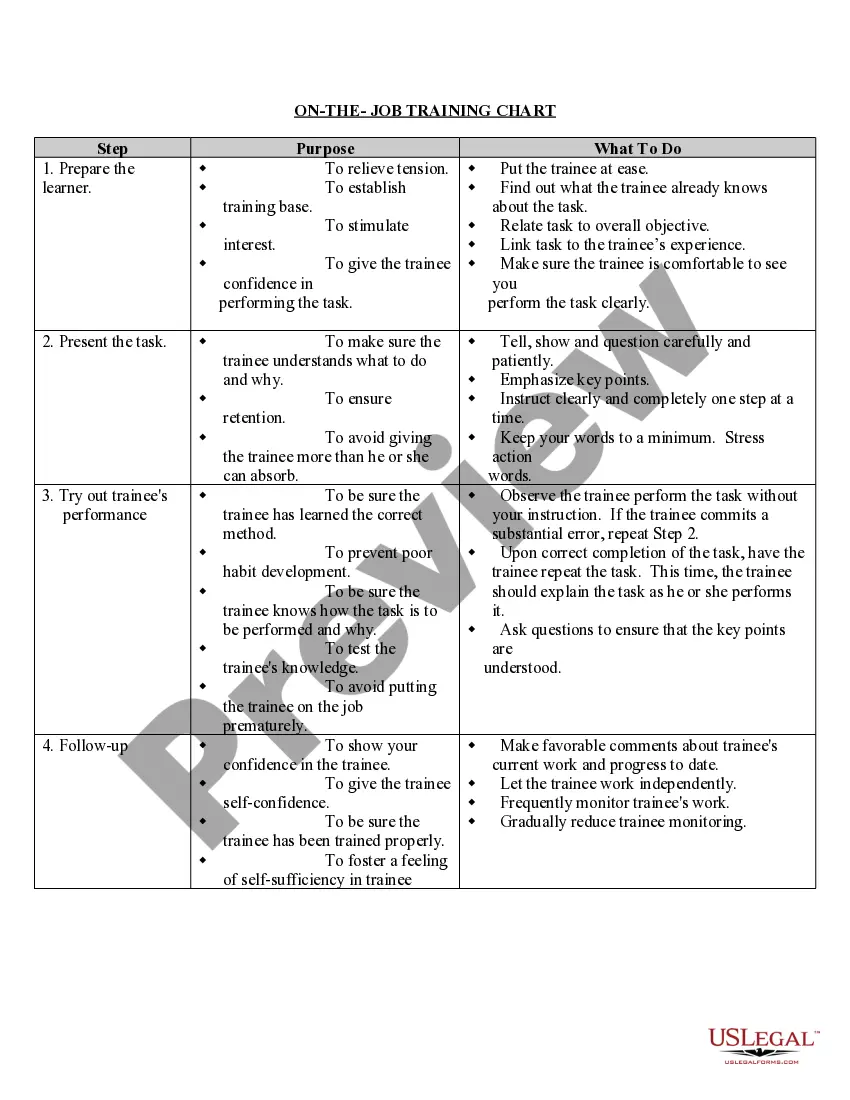
On-the-Job Training Chart
What this document covers
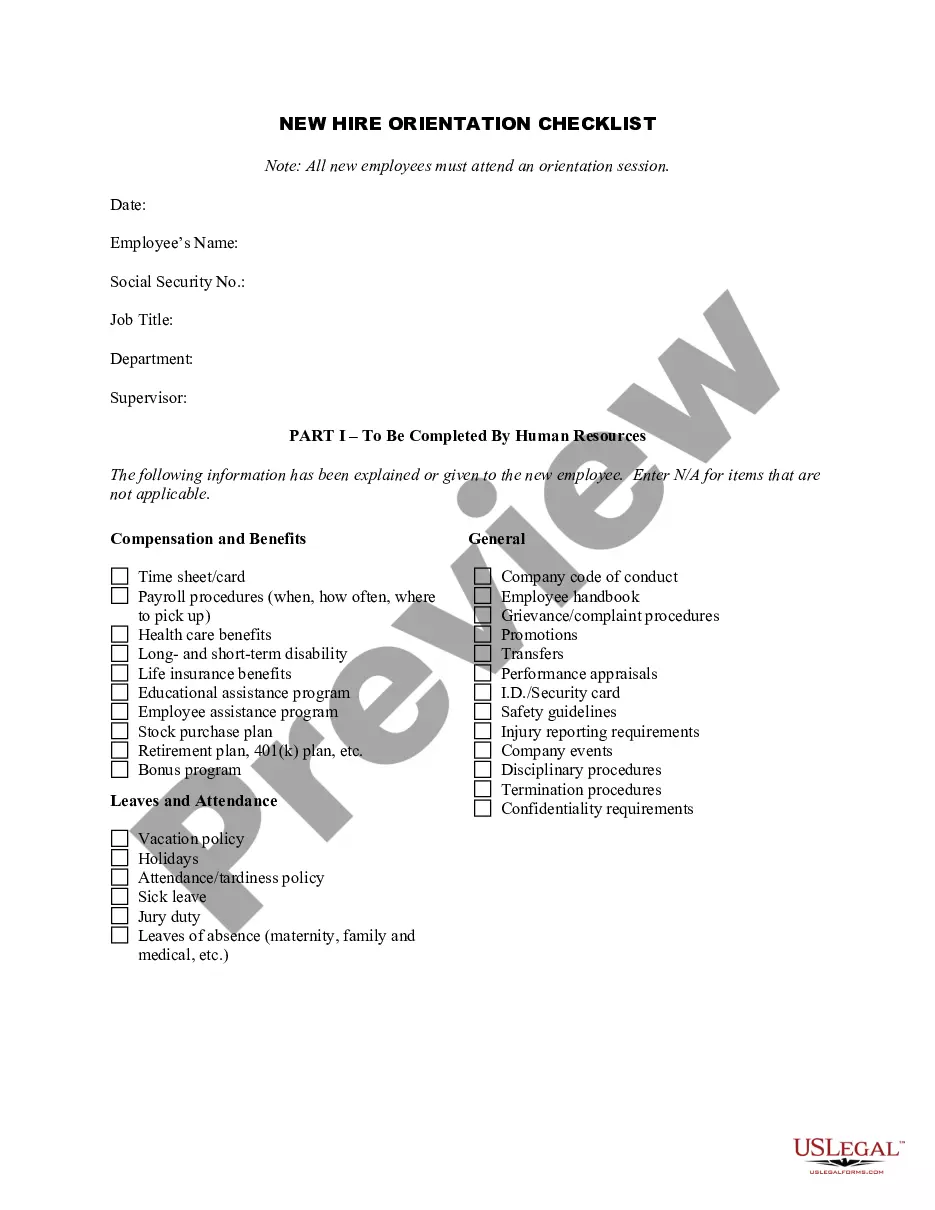
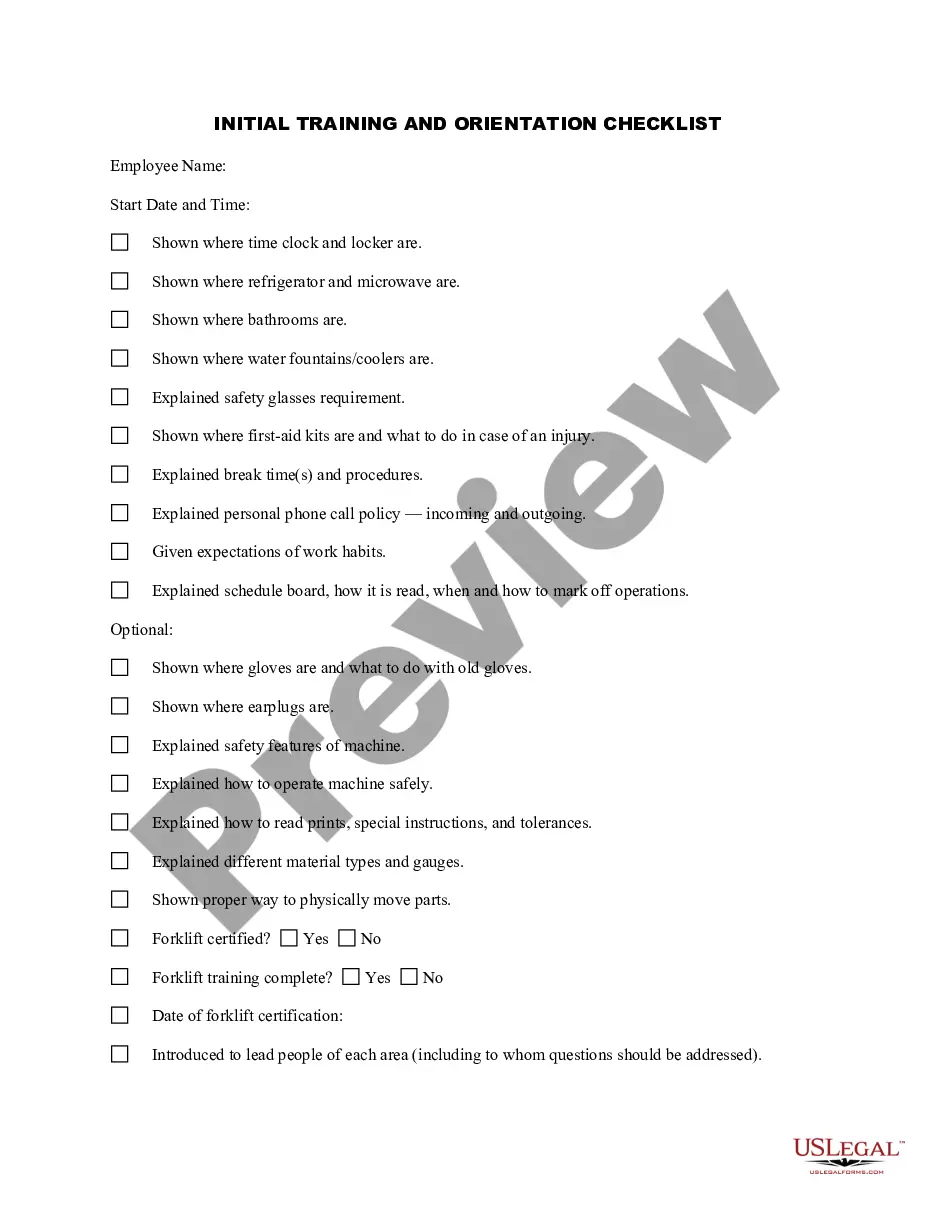
The On-the-Job Training Chart is a structured guide used by supervisors to effectively train employees on specific tasks. This form differs from simple training checklists by providing a comprehensive framework that enhances employee understanding and retention of job duties, ensuring that they are adequately prepared to perform their roles with confidence.
Main sections of this form
- Establish training bases to stimulate interest and confidence.
- Detailed instructions for presenting tasks clearly and effectively.
- Evaluation section to test trainee performance and knowledge retention.
- Follow-up procedures to reinforce learning and foster independence.
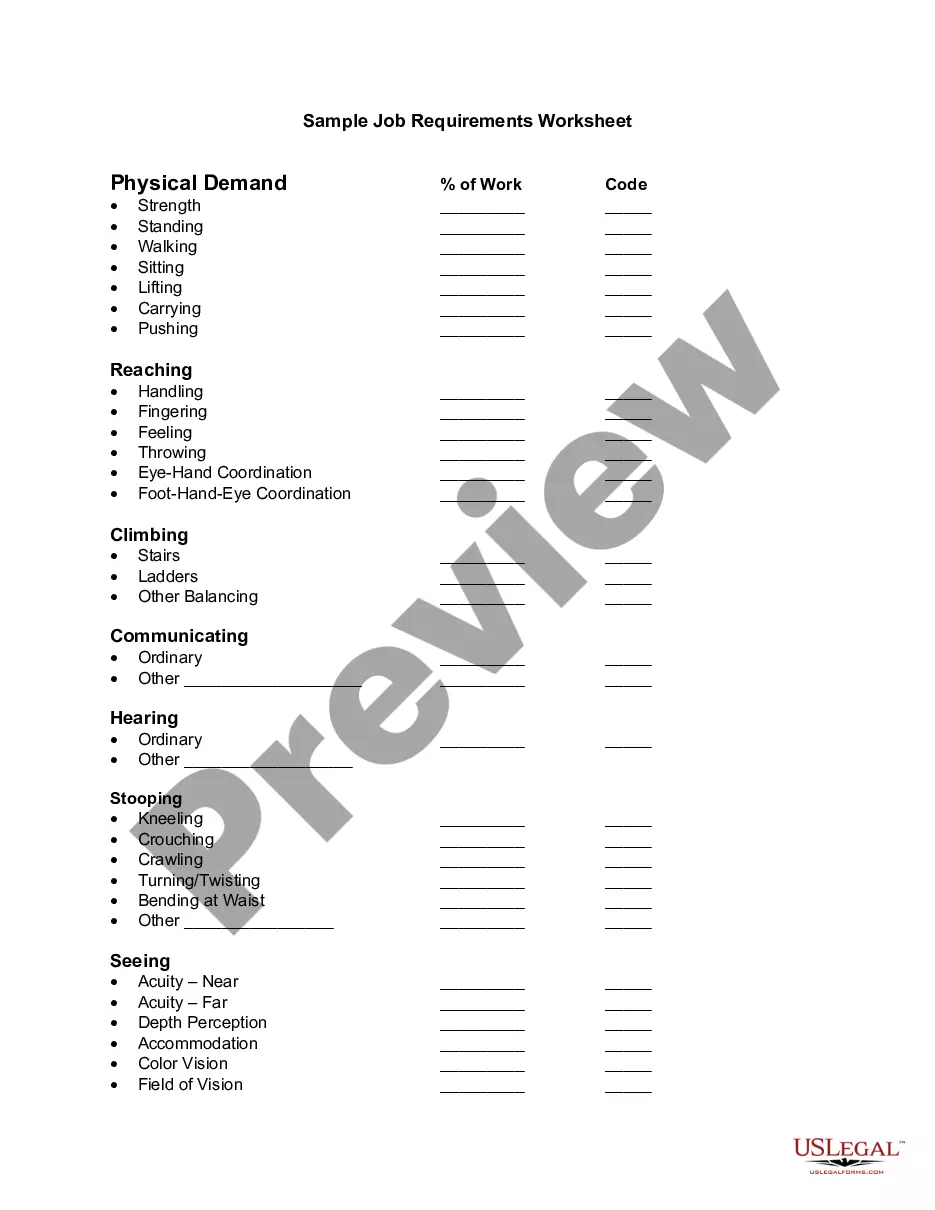
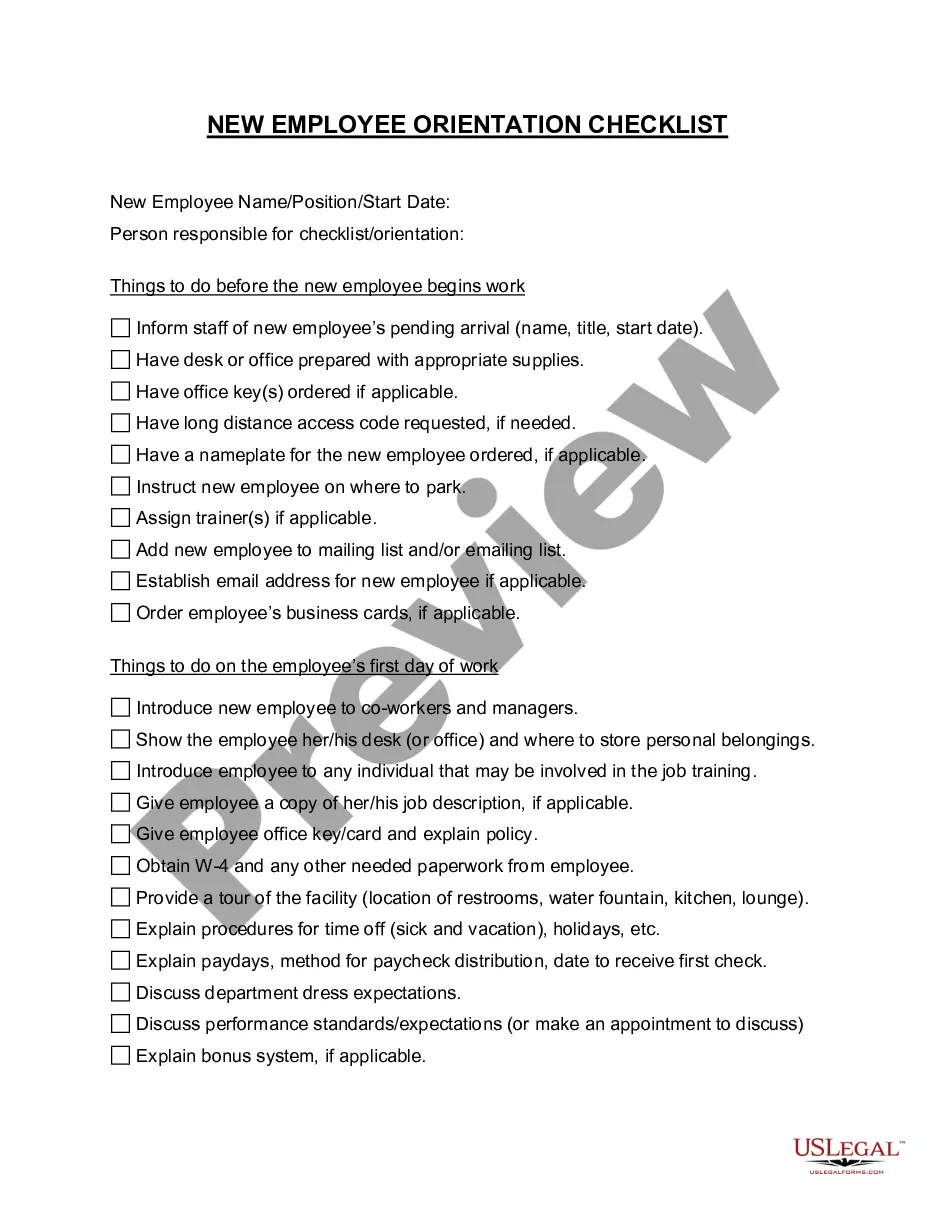
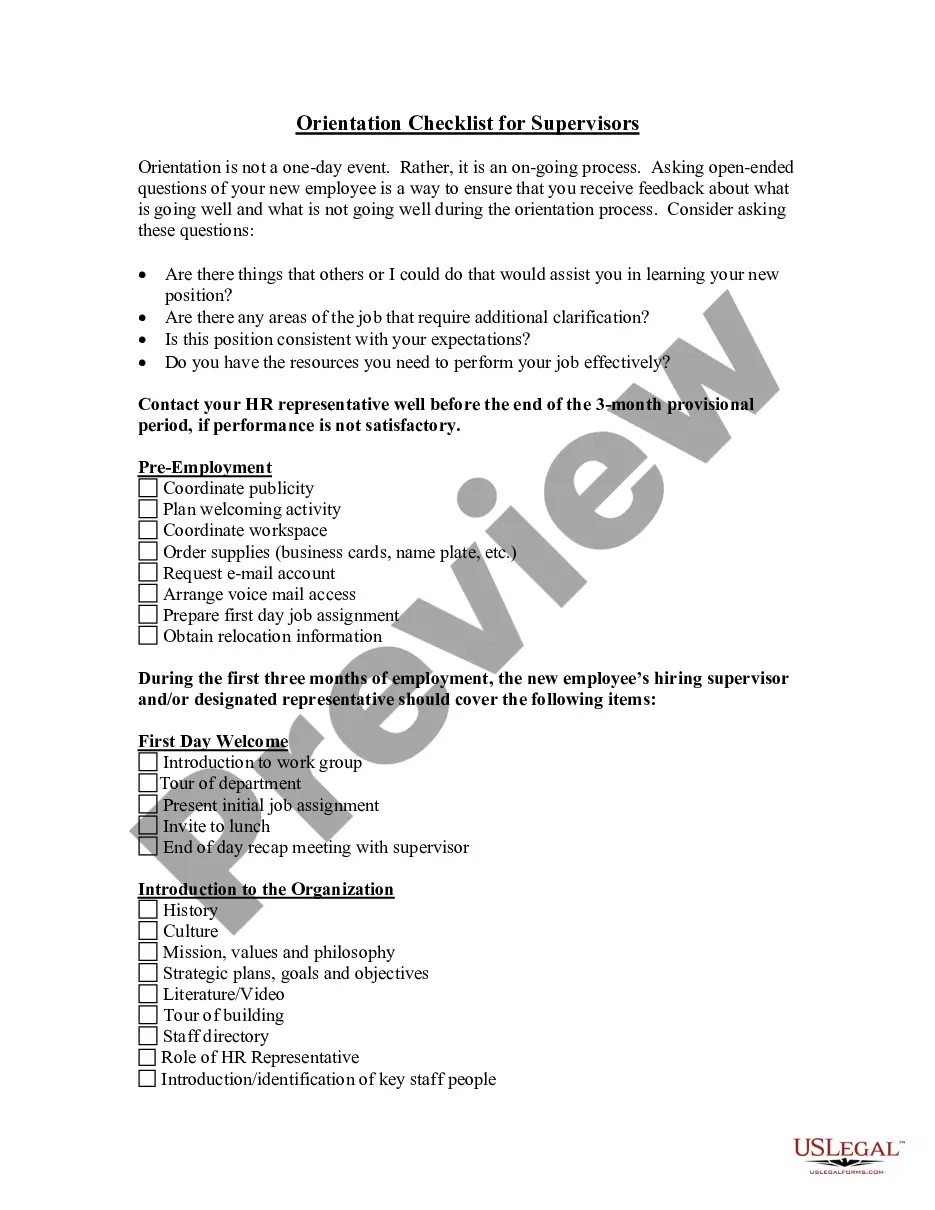
When to use this form
This form should be utilized when onboarding new employees or when existing staff need to learn new tasks or procedures. It is particularly helpful during job transitions, promotions, or when introducing updated methodologies or technologies within an organization.
Who should use this form
The On-the-Job Training Chart is intended for:
- Supervisors seeking to train new or existing employees.
- Team leaders responsible for developing training programs.
- Human resources professionals involved in employee onboarding processes.
Instructions for completing this form
- Identify the training objectives and desired outcomes for the employee.
- Provide clear, step-by-step instructions for each task to be learned.
- Observe and assess the trainee during their performance of the task.
- Conduct a follow-up to reinforce skills and encourage independent work.
Notarization guidance
Notarization is not commonly needed for this form. However, certain documents or local rules may make it necessary. Our notarization service, powered by Notarize, allows you to finalize it securely online anytime, day or night.
Get your form ready online
Our built-in tools help you complete, sign, share, and store your documents in one place.
Make edits, fill in missing information, and update formatting in US Legal Forms—just like you would in MS Word.
Download a copy, print it, send it by email, or mail it via USPS—whatever works best for your next step.
Sign and collect signatures with our SignNow integration. Send to multiple recipients, set reminders, and more. Go Premium to unlock E-Sign.
If this form requires notarization, complete it online through a secure video call—no need to meet a notary in person or wait for an appointment.
We protect your documents and personal data by following strict security and privacy standards.

Make edits, fill in missing information, and update formatting in US Legal Forms—just like you would in MS Word.

Download a copy, print it, send it by email, or mail it via USPS—whatever works best for your next step.

Sign and collect signatures with our SignNow integration. Send to multiple recipients, set reminders, and more. Go Premium to unlock E-Sign.

If this form requires notarization, complete it online through a secure video call—no need to meet a notary in person or wait for an appointment.

We protect your documents and personal data by following strict security and privacy standards.
Avoid these common issues
- Overloading the trainee with too much information at once.
- Neglecting to assess the trainee's prior knowledge before beginning training.
- Failing to provide enough support during the follow-up phase.
Advantages of online completion
- Convenient access to structured training materials at any time.
- Editable templates that allow customization to fit specific training needs.
- Reliable framework that boosts trainee confidence and enhances retention.
Summary of main points
- The On-the-Job Training Chart is essential for effectively training staff.
- Clear objectives and structured follow-up ensure successful learning outcomes.
- Using this form can prevent common pitfalls in employee training processes.
Looking for another form?

Form popularity
FAQ
Training is the process of being conditioned or taught to do something, or is the process of learning and being conditioned. When you teach a new employee how the business works, this is an example of training. When the employee is learning how the business works, this is an example of training.
Mentoring. Provide Periodic In-House Training From Internal or External Resources. Implement a Book Club at Work. Require Employees Who Attend External Training to Do Job Training. Promotion. Transfer. Lateral Move. Hold Brown Bag Lunches.
'On the job' training involves learning by doing the task while 'off the job' training involves learning by acquiring knowledge.On-the-job training is carried out by the experienced employees. Unlike off-the-job training which is provided by the experts. On the job training is less expensive than off the job training.
On-the-job training methods include job rotation, coaching, job instruction or training through step-by-step and committee assignments.
Define Learner Personas, Goals, And Success Metrics. Create A Training Program Outline. Build Your Program. Optimize Engagement. Measure Success. Summary.
On-the Job Training (OJT) means training in the public or private sector that is given to. a paid employee while he or she is engaged in productive work and that provides. knowledge and skills essential to the full and adequate performance on the job.
Understand your needs. Identify the skills and knowledge your employees need to succeed now and in the future. Determine training methods. Be inclusive. Choose trainers carefully. Consider different learning styles. Look for government incentives. Evaluate. Follow-up.
On-the-job training, also known as OJT, is a hands-on method of teaching the skills, knowledge, and competencies needed for employees to perform a specific job within the workplace. Employees learn in an environment where they will need to practice the knowledge and skills obtained during their training.
Many manufacturers have discovered that employee-driven structured On the Job Training (OJT) provides long term benefits. This is a process by which teams of employees who perform the same or similar jobs tasks work together to analyze, design, develop, implement, and evaluate their own on-the-job training program.