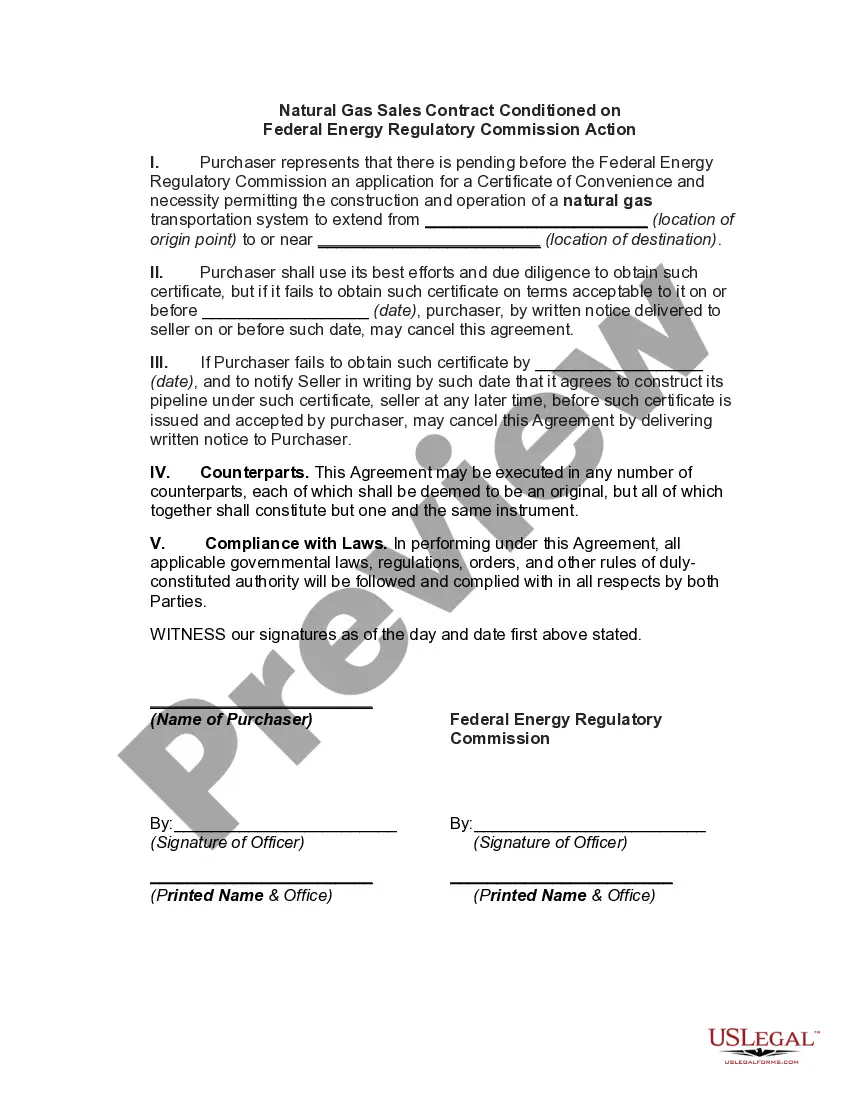
Natural Gas Sales Contract Conditioned on Federal Energy Regulatory Commission Action is a contractual agreement between a gas seller and a buyer that is subject to the approval of the Federal Energy Regulatory Commission (FERC). This agreement governs the sale of natural gas, including the price, quantity, and quality, as well as related terms and conditions. There are two types of Natural Gas Sales Contracts Conditioned on Federal Energy Regulatory Commission Action: Long-Term and Short-Term. Long-Term contracts are agreements that last for more than one year, while Short-Term contracts are agreements that are for a period of one year or less. The FERC oversees the sale of natural gas in order to ensure that it is conducted in a fair and equitable manner. The FERC reviews contracts to ensure that they are in compliance with all applicable laws and regulations. Once a contract is approved by the FERC, the parties involved in the sale of natural gas are obligated to follow the terms of the contract. The Natural Gas Sales Contract Conditioned on Federal Energy Regulatory Commission Action is an important part of the natural gas industry, as it helps protect buyers and sellers alike. This type of contract ensures that natural gas sales are conducted in a regulated and safe manner. It also helps to protect consumers by ensuring that natural gas prices remain competitive.
Natural Gas Sales Contract Conditioned on Federal Entergy Regulatory Commission Action
Description
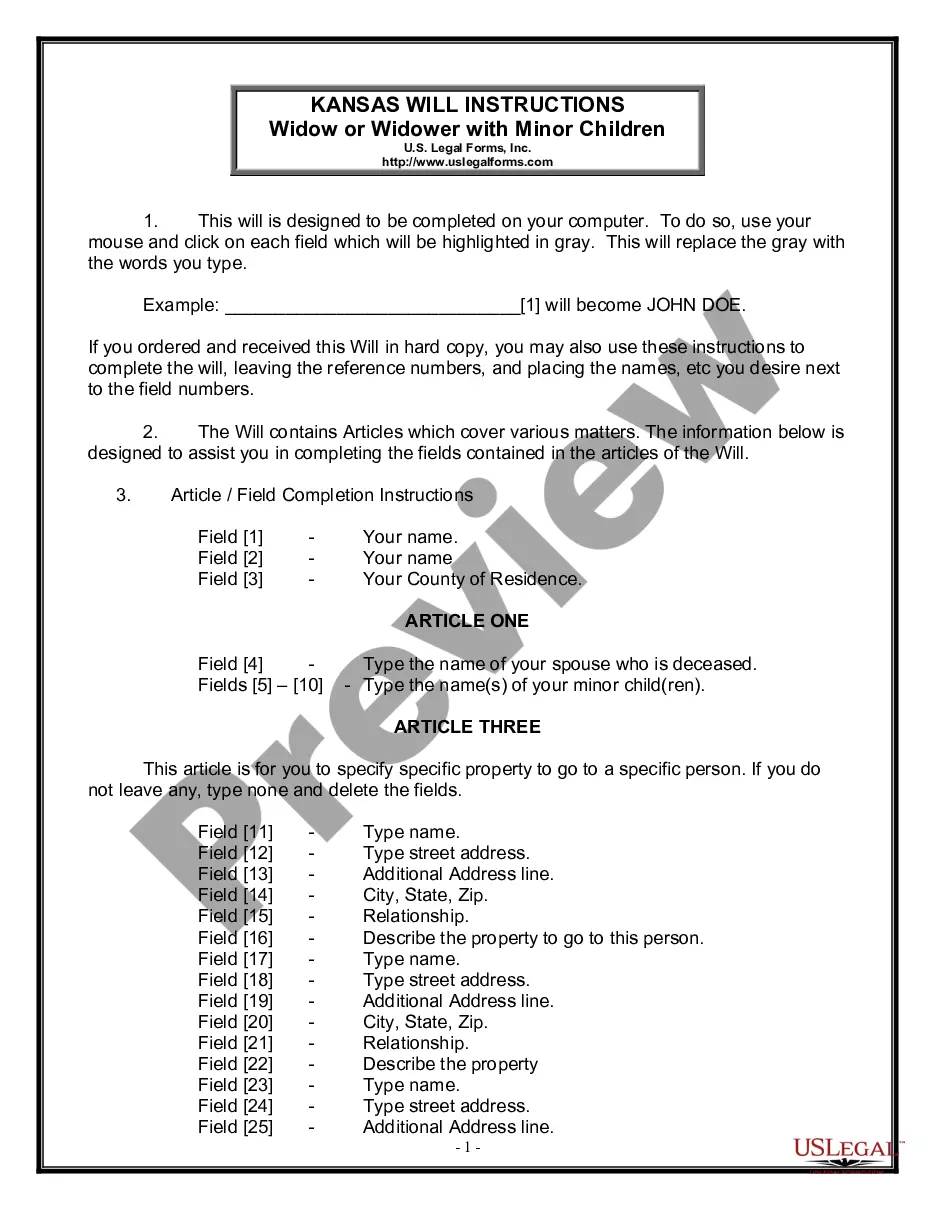



How to fill out Natural Gas Sales Contract Conditioned On Federal Entergy Regulatory Commission Action?
Preparing legal paperwork can be a real burden unless you have ready-to-use fillable templates. With the US Legal Forms online library of formal documentation, you can be confident in the blanks you find, as all of them comply with federal and state laws and are examined by our specialists. So if you need to prepare Natural Gas Sales Contract Conditioned on Federal Entergy Regulatory Commission Action, our service is the perfect place to download it.
Getting your Natural Gas Sales Contract Conditioned on Federal Entergy Regulatory Commission Action from our library is as easy as ABC. Previously registered users with a valid subscription need only sign in and click the Download button after they locate the correct template. Afterwards, if they need to, users can take the same document from the My Forms tab of their profile. However, even if you are unfamiliar with our service, signing up with a valid subscription will take only a few moments. Here’s a brief instruction for you:
- Document compliance verification. You should carefully examine the content of the form you want and check whether it suits your needs and meets your state law requirements. Previewing your document and looking through its general description will help you do just that.
- Alternative search (optional). Should there be any inconsistencies, browse the library through the Search tab on the top of the page until you find an appropriate blank, and click Buy Now when you see the one you need.
- Account registration and form purchase. Register for an account with US Legal Forms. After account verification, log in and select your preferred subscription plan. Make a payment to continue (PayPal and credit card options are available).
- Template download and further usage. Choose the file format for your Natural Gas Sales Contract Conditioned on Federal Entergy Regulatory Commission Action and click Download to save it on your device. Print it to complete your paperwork manually, or take advantage of a multi-featured online editor to prepare an electronic version faster and more effectively.
Haven’t you tried US Legal Forms yet? Subscribe to our service now to obtain any official document quickly and easily whenever you need to, and keep your paperwork in order!
Form popularity
FAQ
When FERC was established in 1977 as a replacement for the Federal Power Commission, its mandate was to determine whether wholesale electricity prices were unjust and unreasonable and, if so, to regulate pricing and order refunds for overcharges to ratepayers.
Domestic natural gas markets are regulated in part by the Federal Energy Regulatory Commission . The commission's chief area of concern is the interstate natural gas market. Natural gas moves for the most part by pipeline in the United States.
Pipeline Regulatory and Environmental Permits FERC regulations began with the passing of The Natural Gas Act of 1938. This act gave the Federal Power Commission (FPC), forerunner of FERC, jurisdiction over the regulation of interstate natural gas sales.
The Federal Energy Regulatory Commission (FERC) is an independent agency within the Department of Energy which regulates the interstate transmission of electricity, natural gas, and oil.
The FERC aims to preserve and enhance the energy independence and reliability of the United States' electrical power systems. The government created the FERC to protect the public from fuel shortages, price gouging, rate discrimination, and other predatory practices by market participants.
The Natural Gas Policy Act of 1978 (NGPA) authorized the Federal Energy Regulatory Commission (FERC) to regulate both intrastate and interstate natural gas production and transmission. In addition, the act set price ceilings for wellhead first sales of gas, though these were later repealed.
The Federal Energy Regulatory Commission regulates interstate transmission of electricity, natural gas, and oil, and also regulates hydropower projects and natural gas terminals.