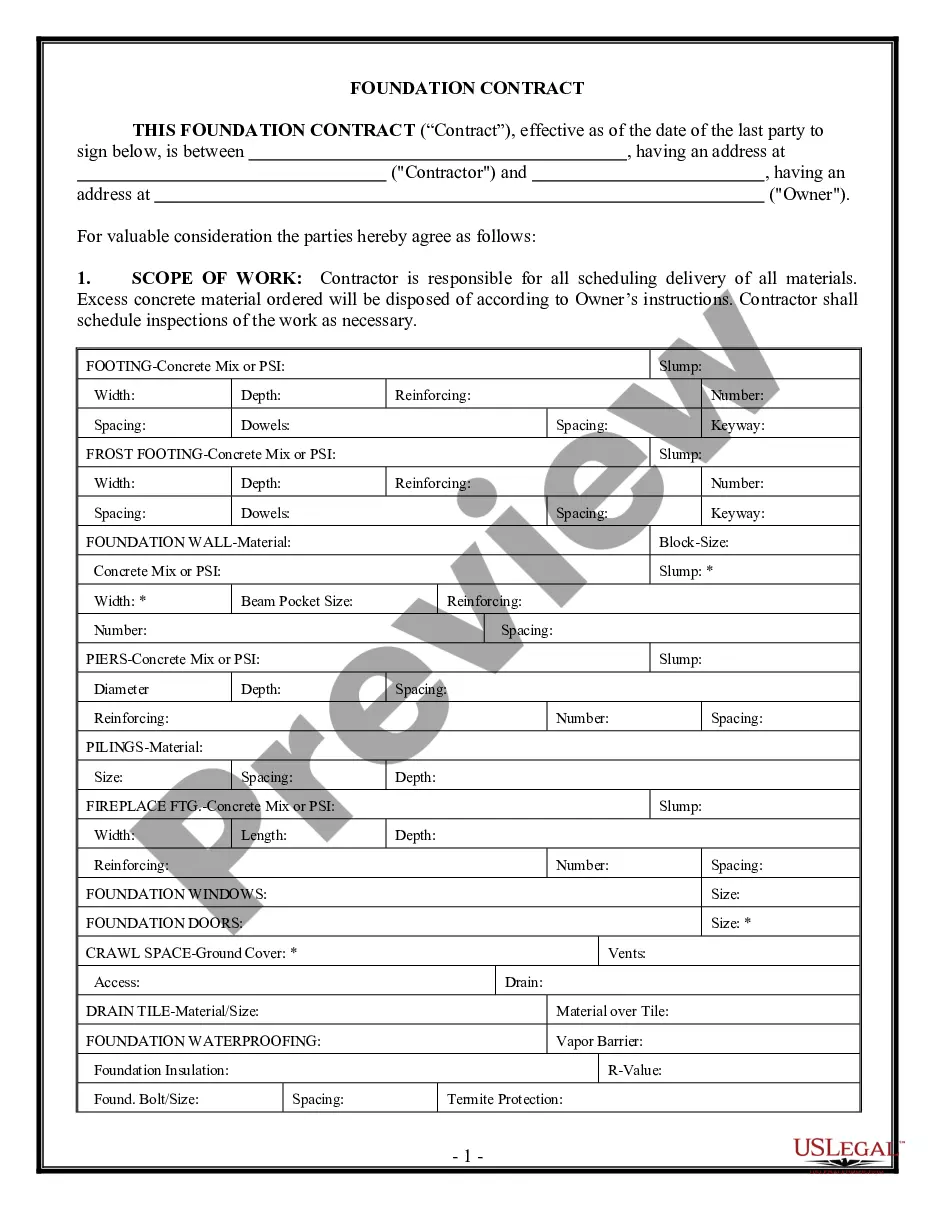
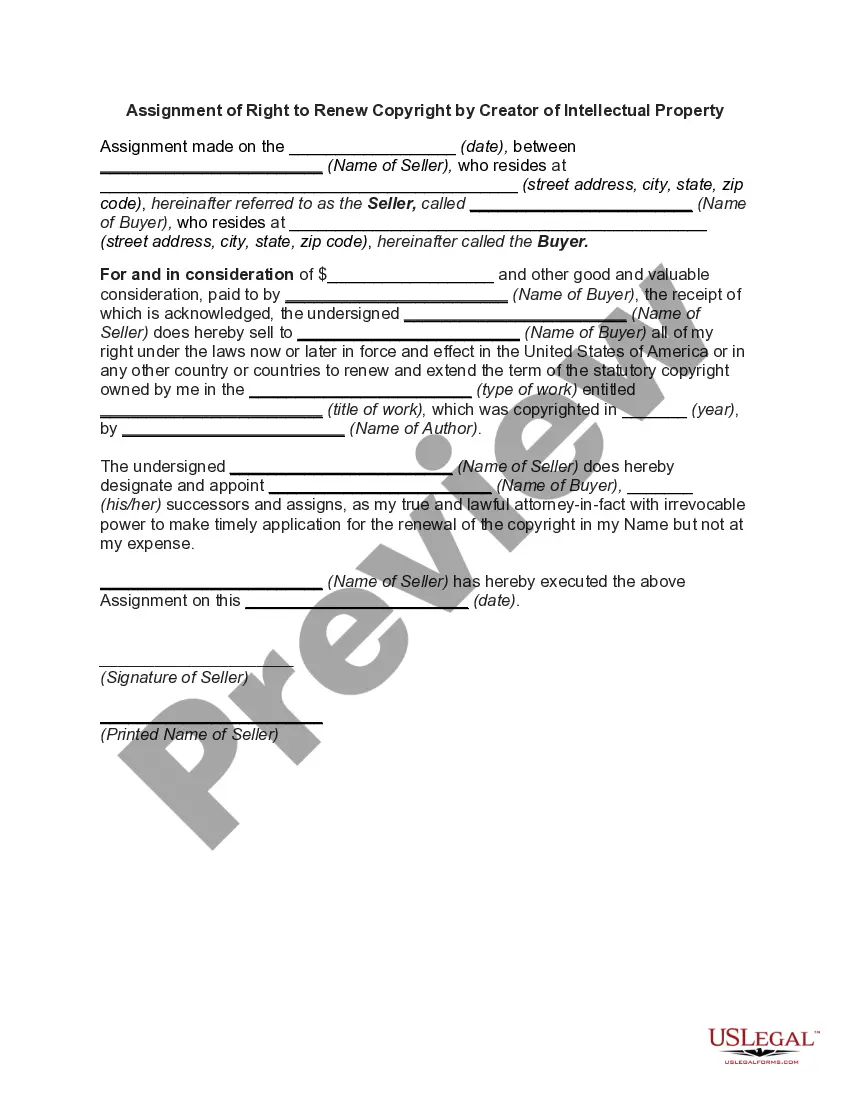
Assignment of Right to Renew Copyright by Creator of Intellectual Property
What this document covers
The Assignment of Right to Renew Copyright by Creator of Intellectual Property is a legal document that allows the original creator of a copyrighted work to transfer their right to renew the copyright to another party. Unlike standard copyright transfer agreements, this form specifically addresses the renewal rights associated with copyright that may extend up to 67 years beyond the original term. This form ensures that the buyer obtains the right to renew the copyright and potentially extend the protection of the creative work.
Key parts of this document
- Identifies the parties involved, including the seller (original creator) and the buyer (assignee).
- Specifies the type of work and its title that is subject to copyright.
- Details the consideration (payment) being exchanged for the assignment of rights.
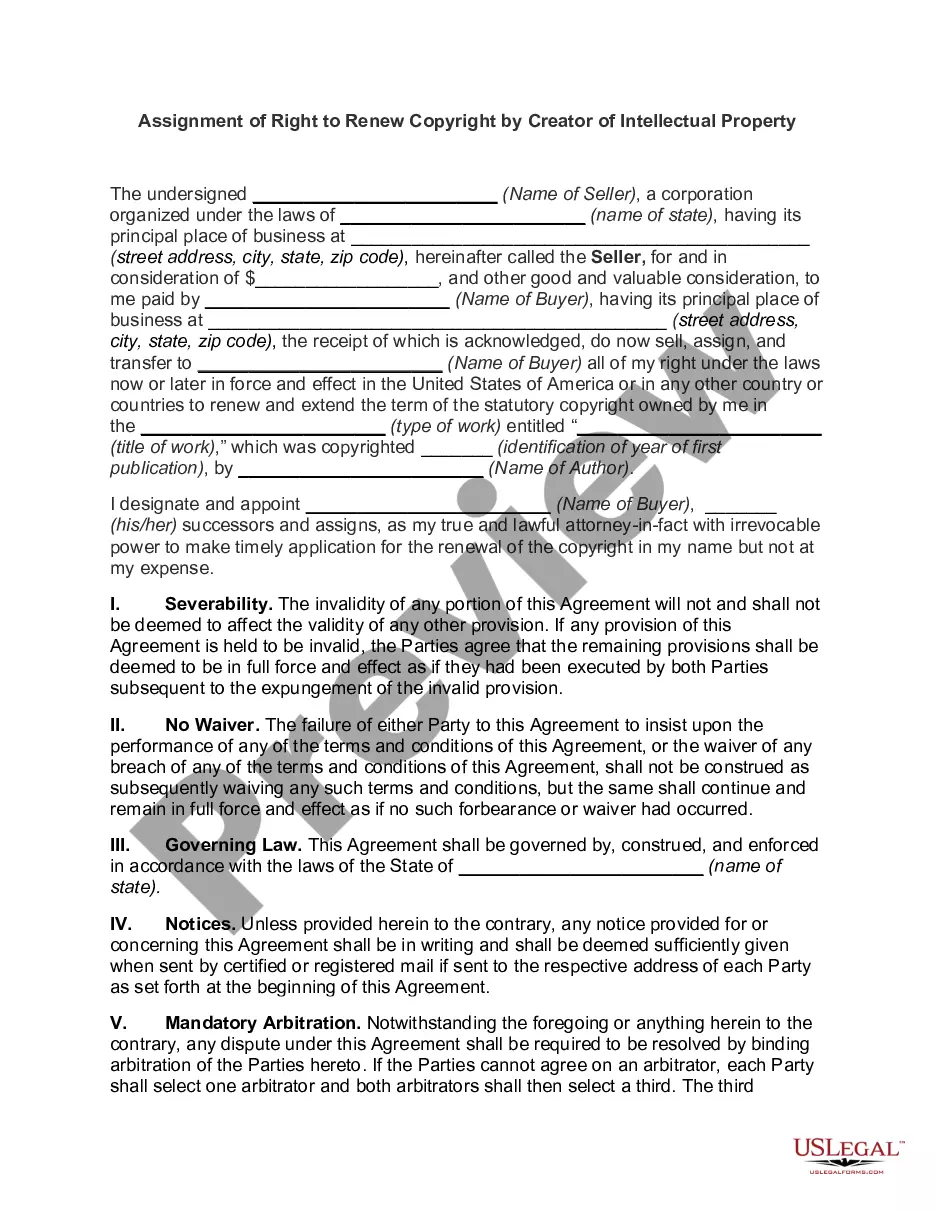
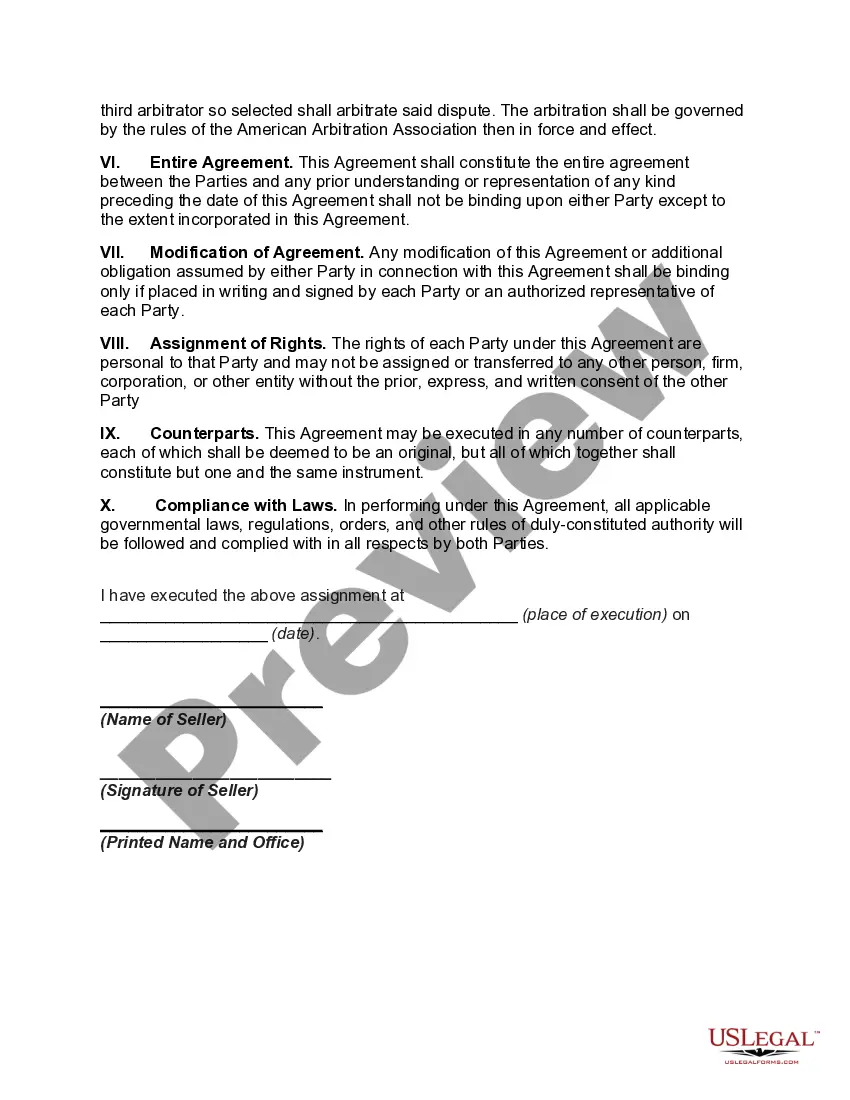
- Includes clauses for severability, governing law, mandatory arbitration, and entire agreement terms.
- Designates the buyer as the attorney-in-fact for making renewal applications.

When this form is needed
This form is essential when a creator of intellectual property wishes to transfer their renewal rights to another entity. It is commonly used in scenarios where the original copyright holder wants to secure a buyer for the renewal rights, ensuring that the work remains protected under copyright law for an extended period. Such situations may include selling the rights to a publisher, production company, or any other organization that may wish to renew the copyright in the future.
Who needs this form
This form is intended for:
- Independent creators or authors of copyrighted works.
- Corporations and other entities engaged in the purchase of copyright renewal rights.
- Executors or representatives of deceased authors who manage their intellectual property.
- Anyone wishing to establish clear transfer of renewal rights to protect creative works.
How to complete this form
- Identify the seller and buyer by filling in their names, addresses, and business structure details.
- Specify the copyrighted work type and its title.
- Indicate the year of first publication and the original authorâs name.
- Complete the monetary consideration field, reflecting the payment for the rights.
- Have both parties sign and date the agreement, ensuring correct execution.
Is notarization required?
This form does not typically require notarization unless specified by local law. However, having it notarized can add an extra layer of validation and security to the agreement.
Get your form ready online
Our built-in tools help you complete, sign, share, and store your documents in one place.
Make edits, fill in missing information, and update formatting in US Legal Forms—just like you would in MS Word.
Download a copy, print it, send it by email, or mail it via USPS—whatever works best for your next step.
Sign and collect signatures with our SignNow integration. Send to multiple recipients, set reminders, and more. Go Premium to unlock E-Sign.
If this form requires notarization, complete it online through a secure video call—no need to meet a notary in person or wait for an appointment.
We protect your documents and personal data by following strict security and privacy standards.

Make edits, fill in missing information, and update formatting in US Legal Forms—just like you would in MS Word.

Download a copy, print it, send it by email, or mail it via USPS—whatever works best for your next step.

Sign and collect signatures with our SignNow integration. Send to multiple recipients, set reminders, and more. Go Premium to unlock E-Sign.

If this form requires notarization, complete it online through a secure video call—no need to meet a notary in person or wait for an appointment.

We protect your documents and personal data by following strict security and privacy standards.
Common mistakes
- Failing to accurately identify the work being transferred, leading to ambiguity.
- Not specifying the correct year of first publication.
- Overlooking to have the agreement signed by both parties, which may render the document invalid.
- Inadvertently omitting required details, such as the addresses of the parties involved.
Benefits of completing this form online
- Convenient access to legal forms that can be downloaded and completed at your own pace.
- Editability allows users to customize the form to fit their specific needs easily.
- The forms are drafted by licensed attorneys, ensuring reliability and legal compliance.
- No need to visit a legal office in person; complete the process from home.
Looking for another form?

Form popularity
FAQ
The assignor is the party giving up its ownership interest and the assignee is the party receiving it. Recitals offer up key background information about the parties involved. This section is known as the whereas clause because it explains the intent to transfer intellectual property rights.
Copyright in a work created on or after January 1, 1978, subsists from its creation and, except as provided by the following subsections, endures for a term consisting of the life of the author and 70 years after the author's death.
As a general rule, for works created after January 1, 1978, copyright protection lasts for the life of the author plus an additional 70 years.
No, once a work enters the public domain, an individual cannot copyright that work. Even though this rule is simple, a bit of clarifying is in order.
Once that period of time expires, or if the creator failed to comply with any legal formalities required at the time of creation or thereafter, the work enters the public domain - meaning it belongs to everyone, without restriction.
First, there are only certain people who can claim copyright renewal: the author or, if the author is dead, the surviving spouse and/or the author's children.
An IP assignment is a transfer of ownership of an intellectual property right, such as a patent, trade mark or copyright, from one party (the assignor) to another party (the assignee). This infographic adds together the benefits, risks and the key elements of assignment agreements.
Works Created on or after January 1, 1978 The law automatically protects a work that is created and fixed in a tangible medium of expression on or after Janu- ary 1, 1978, from the moment of its creation and gives it a term lasting for the author's life plus an additional 70 years.