Agreement to Partition Real Property Between Children of Decedent
Understanding this form
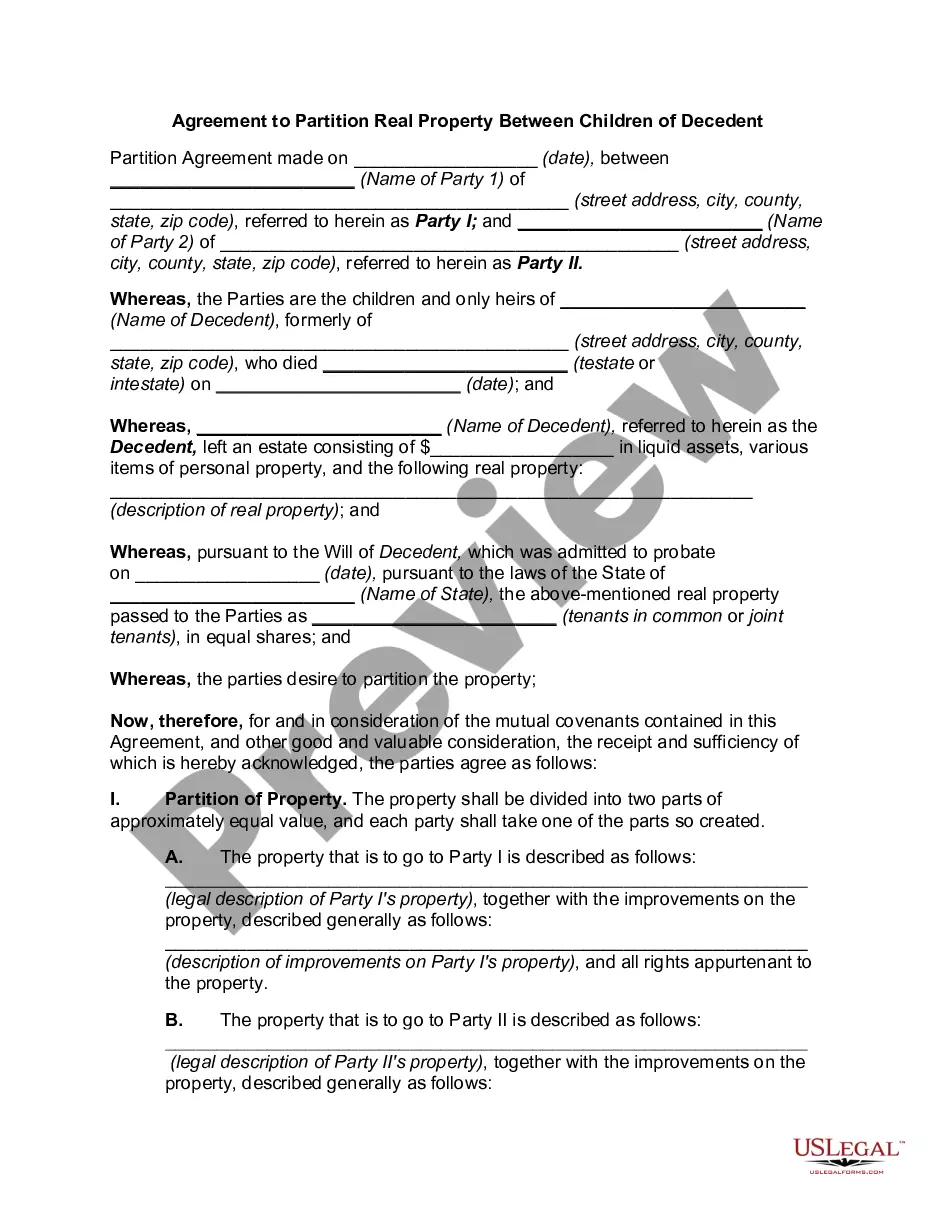
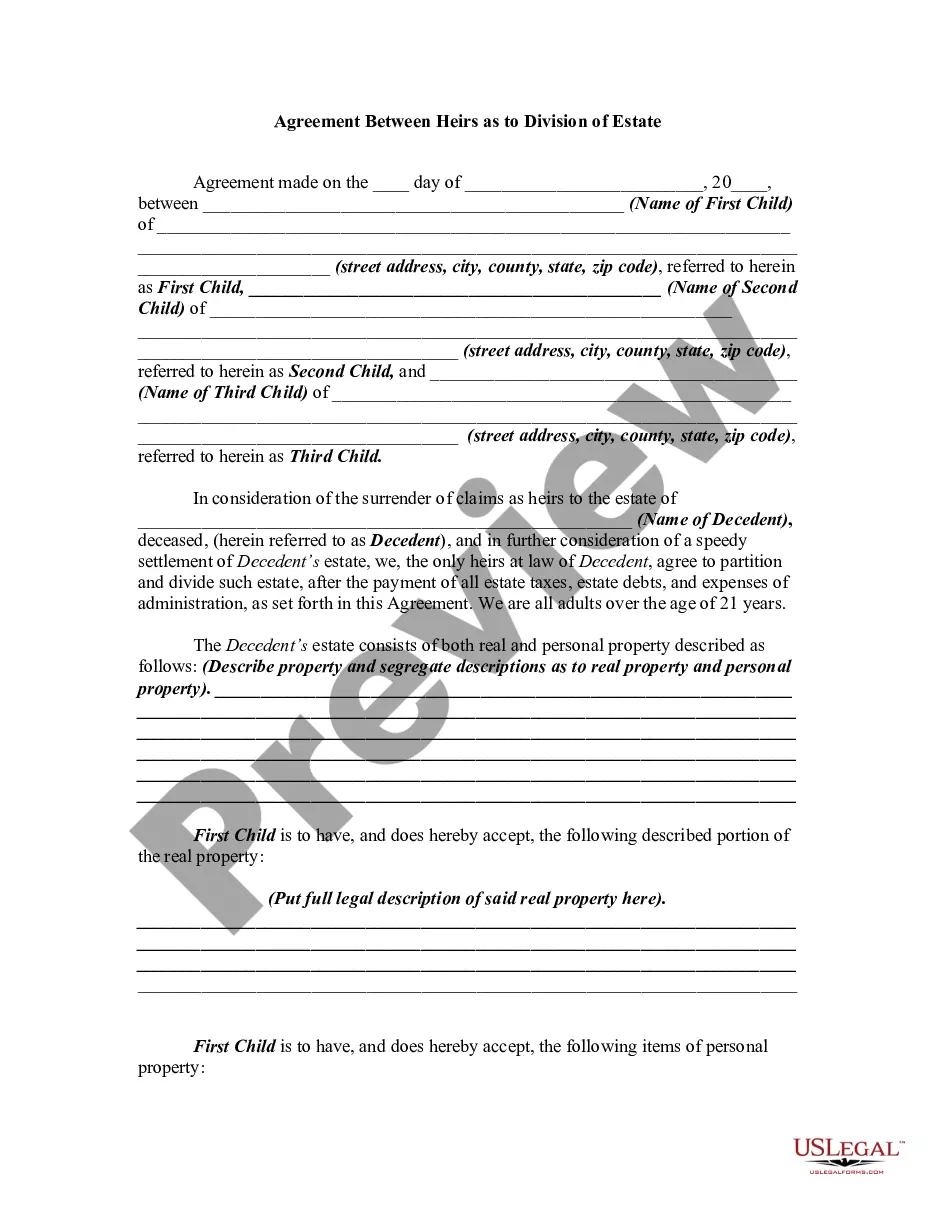
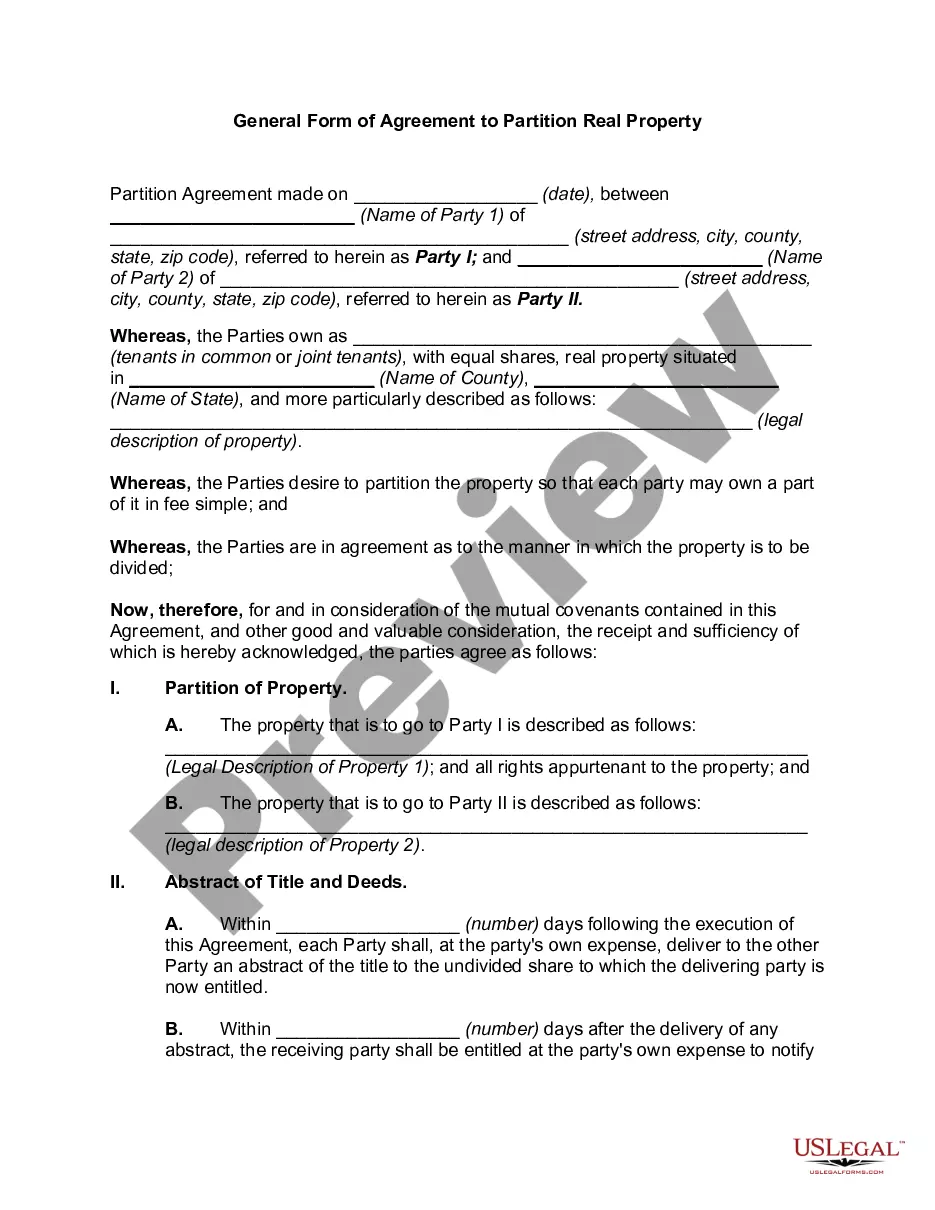
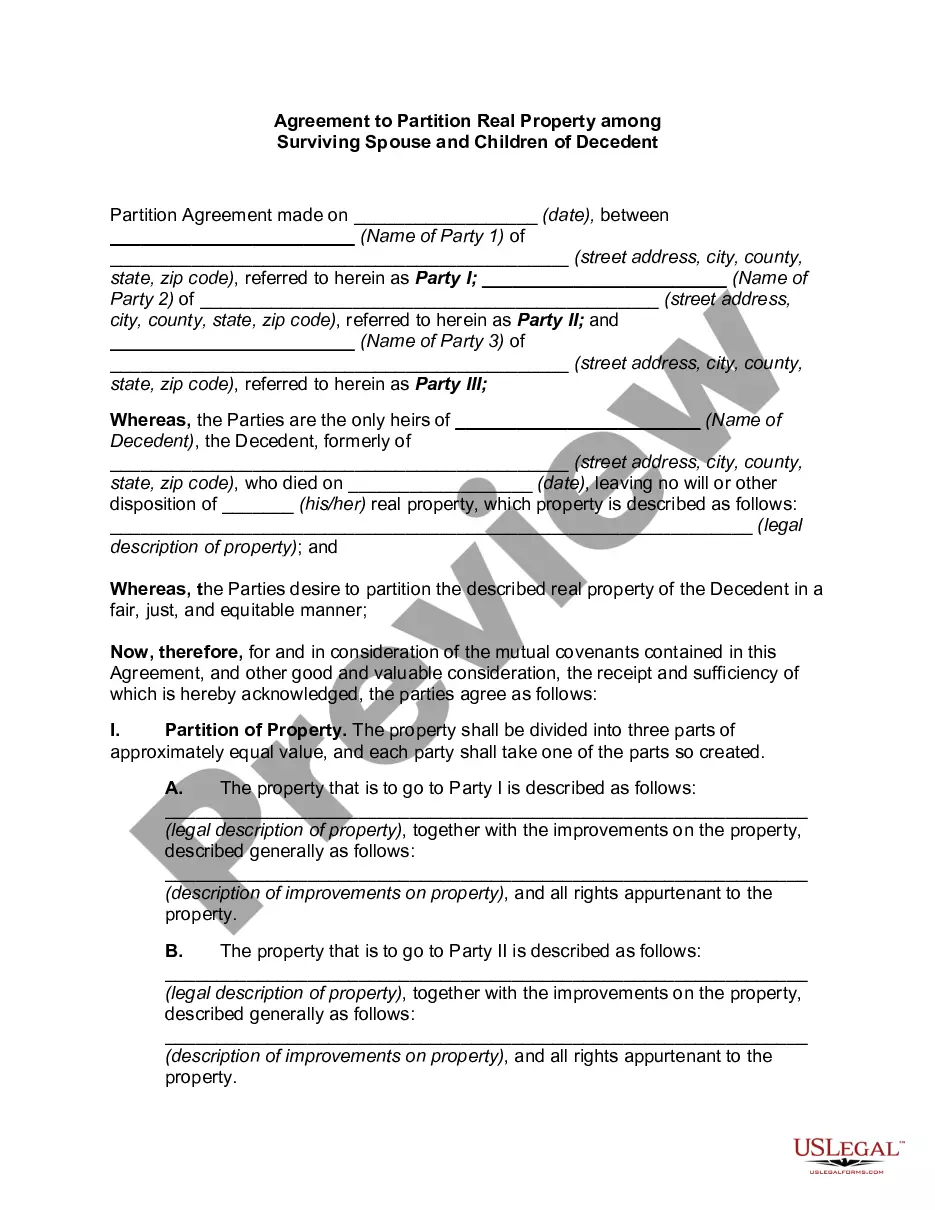
The Agreement to Partition Real Property Between Children of Decedent is a legal document that outlines the division of property owned by children of a deceased parent. This form is essential for ensuring that the property is fairly partitioned among heirs, helping to avoid disputes in the absence of clear arrangements. Unlike other general partition agreements, this form is tailored specifically for situations involving the children of a decedent, addressing the unique circumstances that arise when heirs seek to divide inherited real property.
Key components of this form
- Identification of parties involved, including names and addresses of the heirs.
- Details about the decedent and the estate, including descriptions of the property and its valuation.
- Provision for the fair division of property into distinct parts for each heir.
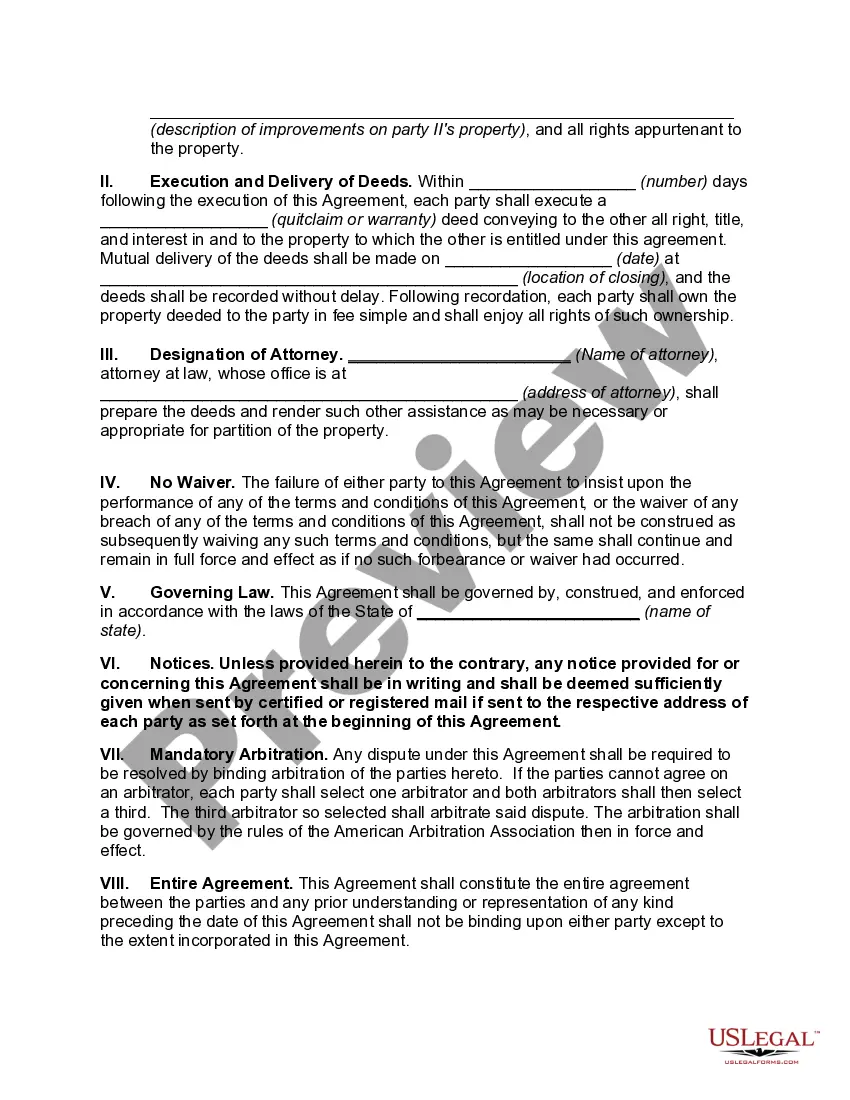
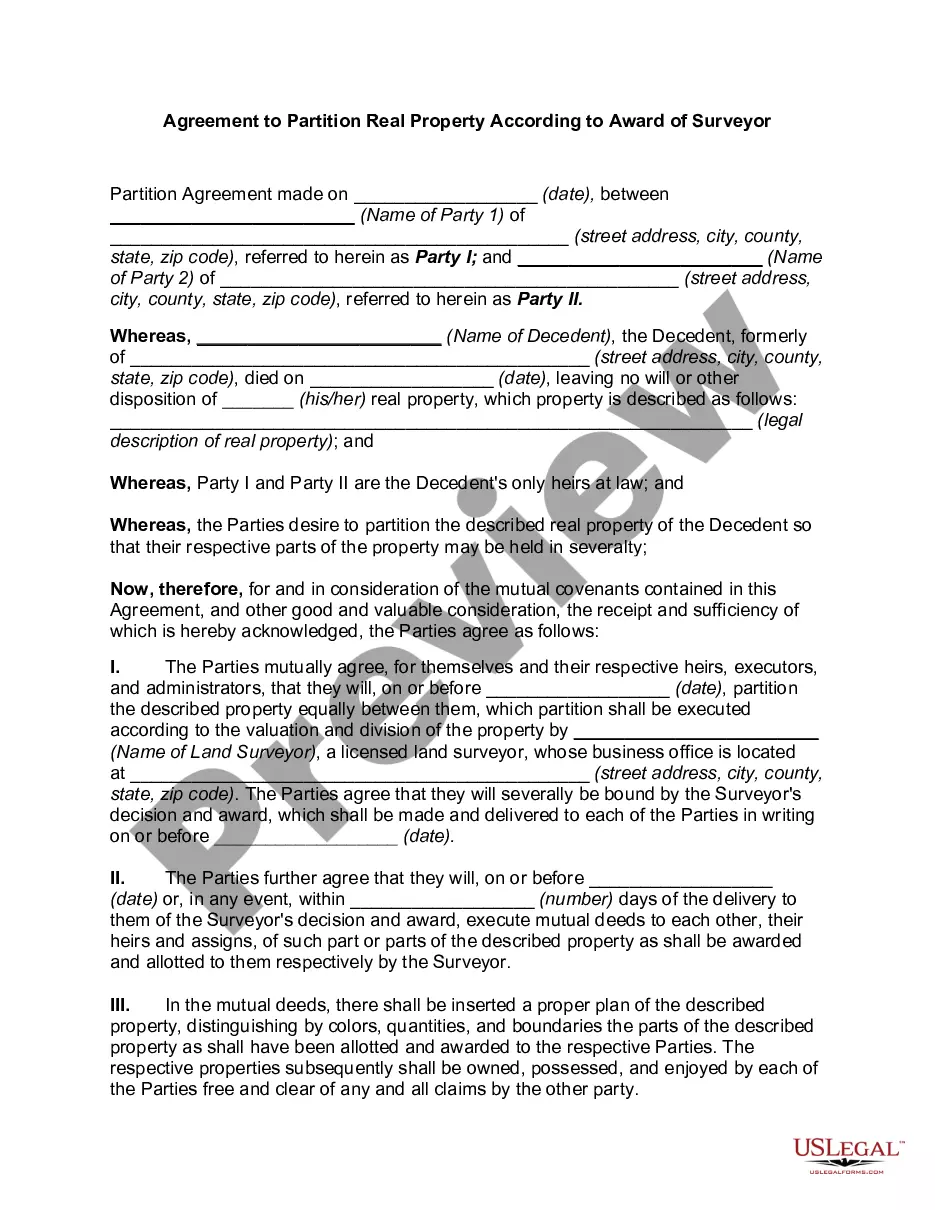
- Execution and delivery of deeds to formalize the transfer of property rights.
- Designation of an attorney to assist with the legal obligations of the partitioning process.
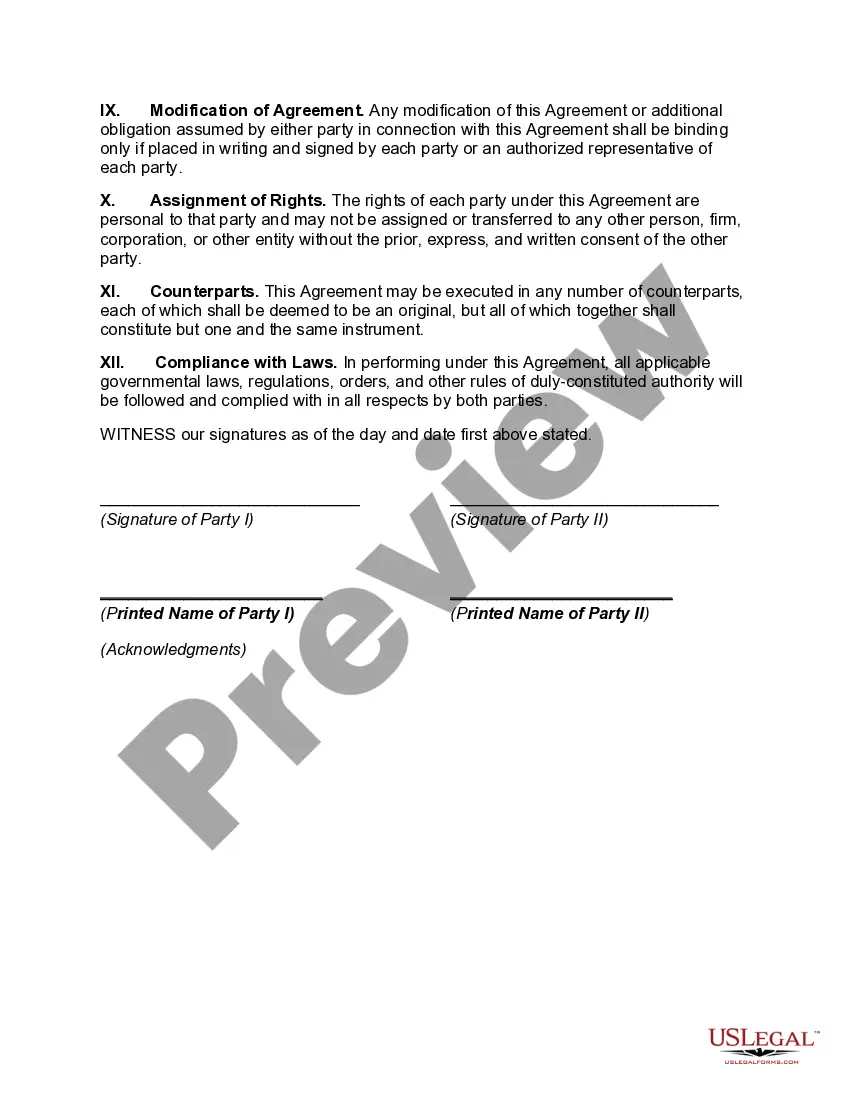
- Clauses regarding governing law, dispute resolution, and non-waiver provisions.

When to use this form
This form is appropriate when multiple heirs inherit real property from a deceased parent and agree to divide the property fairly. It is particularly useful when the heirs wish to avoid potential conflicts regarding property rights. If the heirs have agreed on how to partition the property, utilizing this formal agreement helps ensure that all parties are protected and clear on their rights and obligations.
Who can use this document
- Children who have inherited property from a deceased parent.
- Heirs seeking a clear legal agreement for the division of shared real estate.
- Individuals wanting to prevent disputes regarding inherited property.
Steps to complete this form
- Identify the parties involved by entering the names and addresses of the heirs.
- Specify the decedentâs name and the details of the property being partitioned.
- Determine the division of the property and describe the specific parts allocated to each heir.
- Include execution details for the transfer of property titles, including the type of deed to be used.
- Have the form reviewed and signed by all parties involved, including an attorney if necessary.
Notarization requirements for this form
This form does not typically require notarization unless specified by local law. However, having the signatures notarized can provide an extra layer of validation and legal assurance during the partition process.
Get your form ready online
Our built-in tools help you complete, sign, share, and store your documents in one place.
Make edits, fill in missing information, and update formatting in US Legal Forms—just like you would in MS Word.
Download a copy, print it, send it by email, or mail it via USPS—whatever works best for your next step.
Sign and collect signatures with our SignNow integration. Send to multiple recipients, set reminders, and more. Go Premium to unlock E-Sign.
If this form requires notarization, complete it online through a secure video call—no need to meet a notary in person or wait for an appointment.
We protect your documents and personal data by following strict security and privacy standards.

Make edits, fill in missing information, and update formatting in US Legal Forms—just like you would in MS Word.

Download a copy, print it, send it by email, or mail it via USPS—whatever works best for your next step.

Sign and collect signatures with our SignNow integration. Send to multiple recipients, set reminders, and more. Go Premium to unlock E-Sign.

If this form requires notarization, complete it online through a secure video call—no need to meet a notary in person or wait for an appointment.

We protect your documents and personal data by following strict security and privacy standards.
Mistakes to watch out for
- Failing to include complete legal descriptions of the property being partitioned.
- Not specifying the type of deeds to be used for transferring property rights.
- Missing signatures from all parties, which may render the agreement invalid.
- Overlooking the requirement for notarization or witnessing, if applicable in the state.
- Neglecting to address the handling of disputes related to the partitioning process.
Advantages of online completion
- Convenient access to the form at any time for quick and easy download.
- Editability allows users to tailor the document to their specific situation and needs.
- Reliability of having a form created by licensed attorneys, ensuring legal compliance.
- Immediate use without needing to schedule appointments with legal professionals.
Looking for another form?
Form popularity
FAQ
Give the house, the land or the business to just one child and make up the difference with a monetary share for the others. Alternatively, stipulate that the asset be sold and the proceeds divided evenly. That way, the one who really wants the asset can buy the others out.
The short answer is that just receiving land as an inheritance usually will not trigger income taxes for you, but you will owe capital gains taxes if you sell the property later at a gain.
Draw lots and take turns picking items. Use colored stickers for each person to indicate what he wants. Get appraisals. Make copies. Use an online service like FairSplit.com to catalog and divide personal property in an estate.
Start by determining a value for the real estate in the estate, and then decide how to divide the total value of the inheritance between the heirs. There are several easy ways to do this. You can value the real estate and then decide how to divide it, where one heir take one piece and the other take the rest.
Get the proper estate distribution documents. Verify your role as executor or administrator. Bring the will to the city or county office in charge of estate disbursements. Open a bank account in the name of the decedent's estate. Itemize the property of the estate. Pay the estate's bills.
All forms of intestate property are divided among the heirs upon the basis of the fair market value, which is represented by a cash value. The quantity of any particular form of property does not affect how it is distributed or divided.
Generally the heirs don't decide if the house is sold unless somehow it is titled in all their names. If is a specific gift and the will requires it be transferred to all six, and one does not want to sell, that person can buy out the other 5. There of course is always a partition Acton.