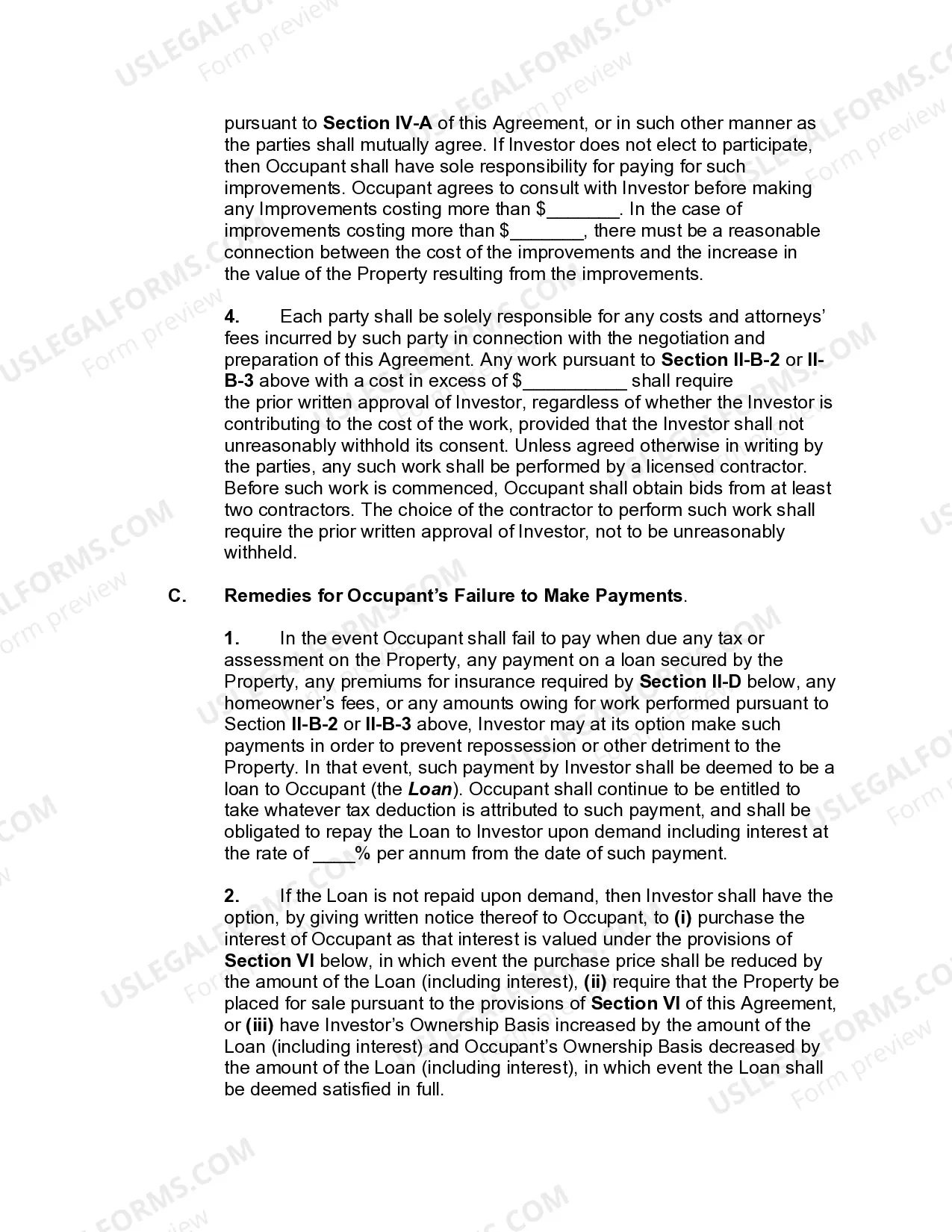
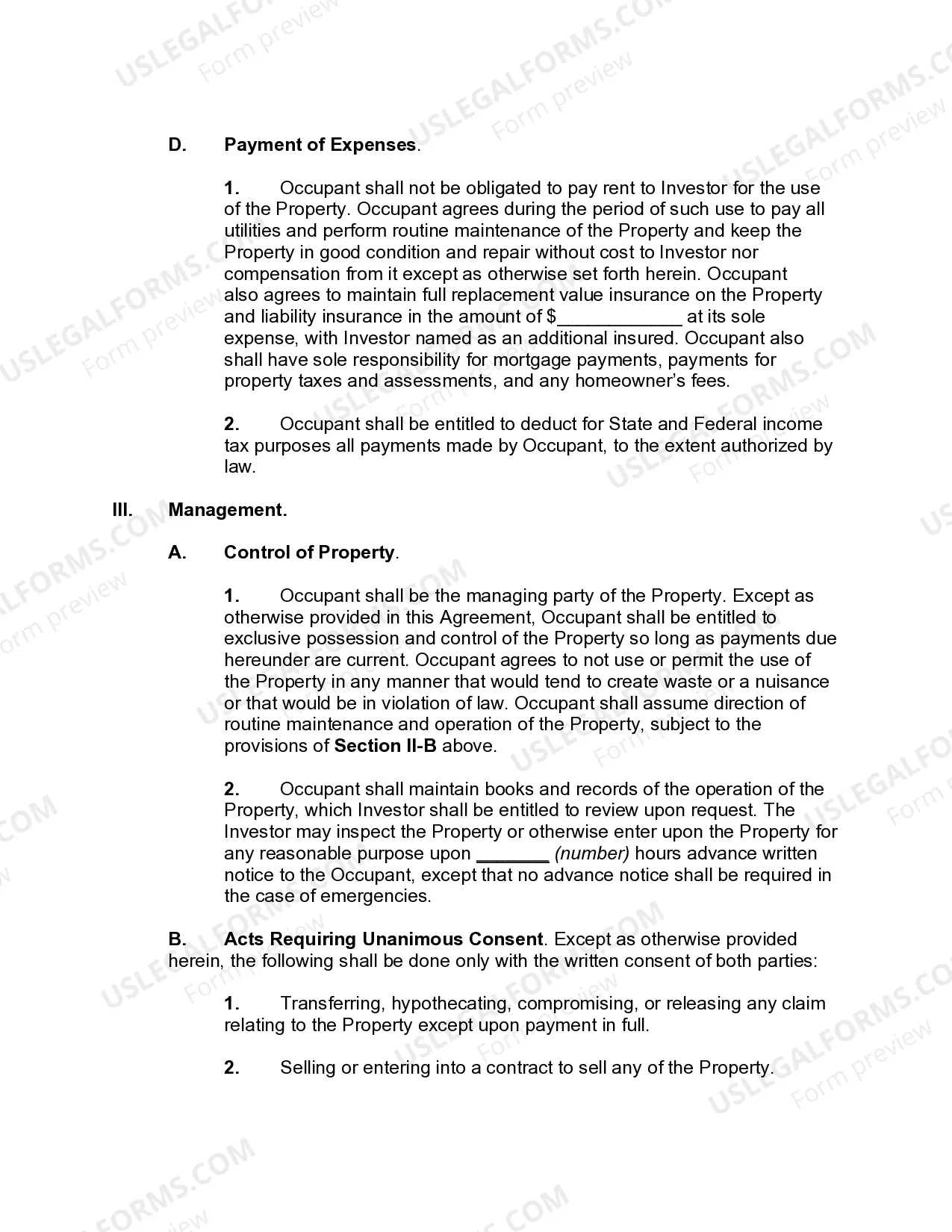
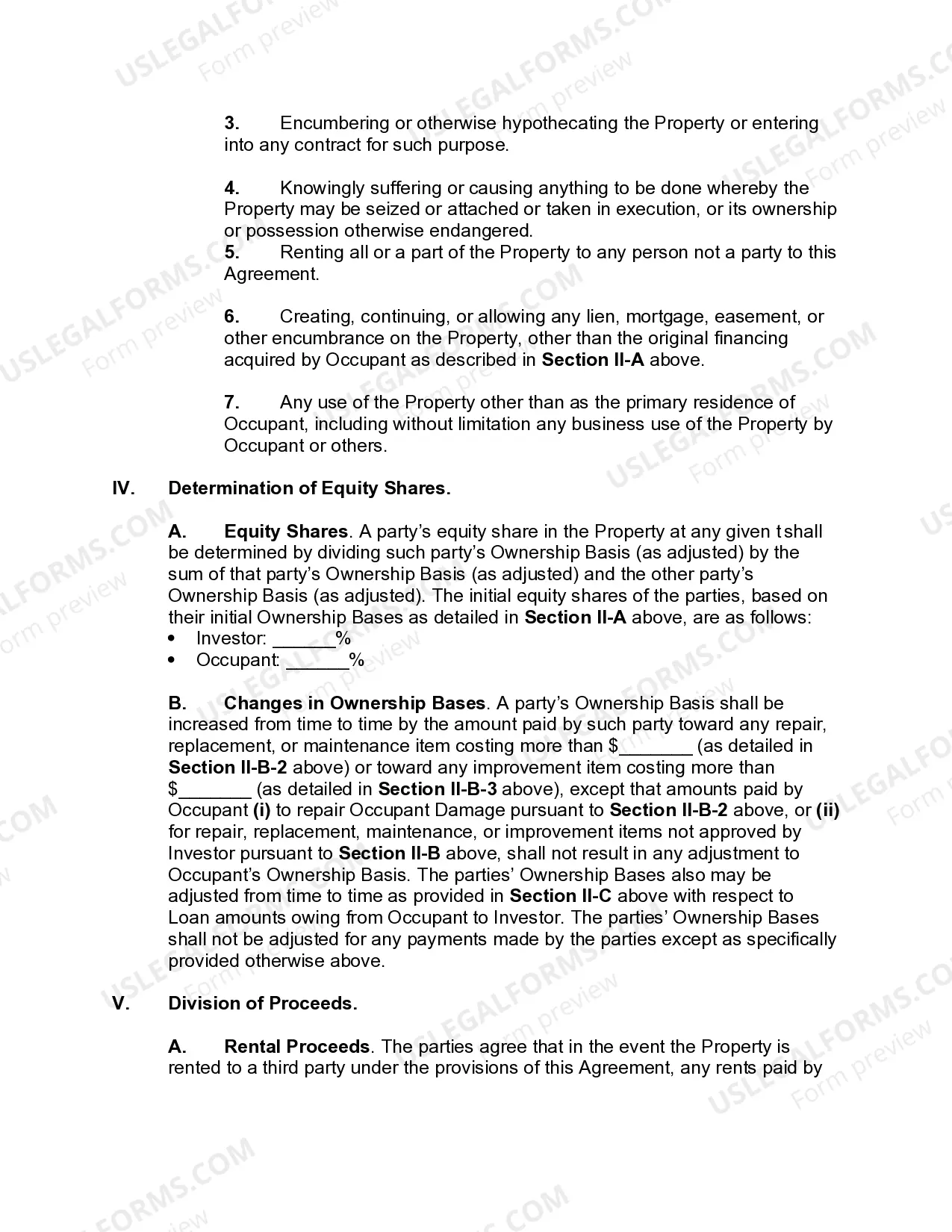
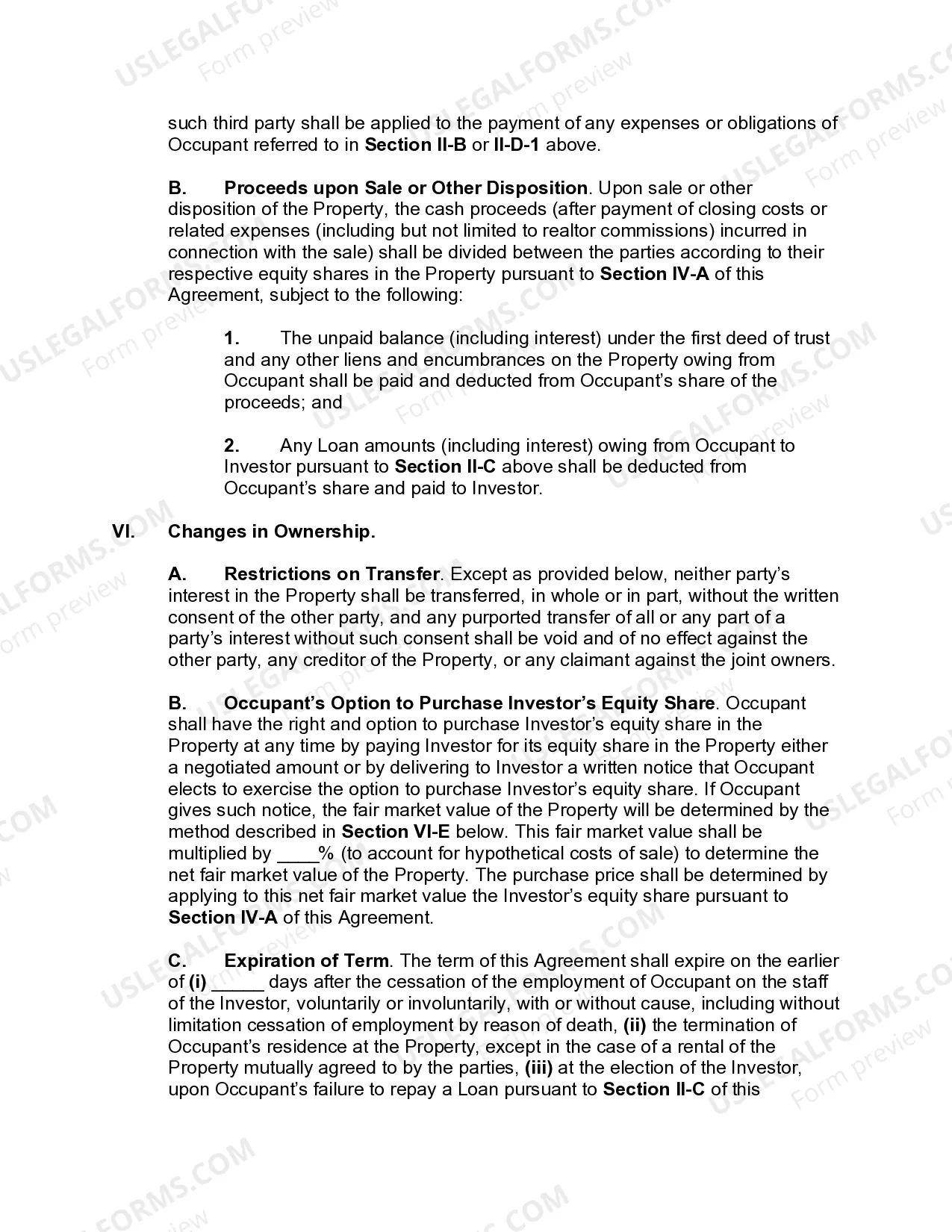
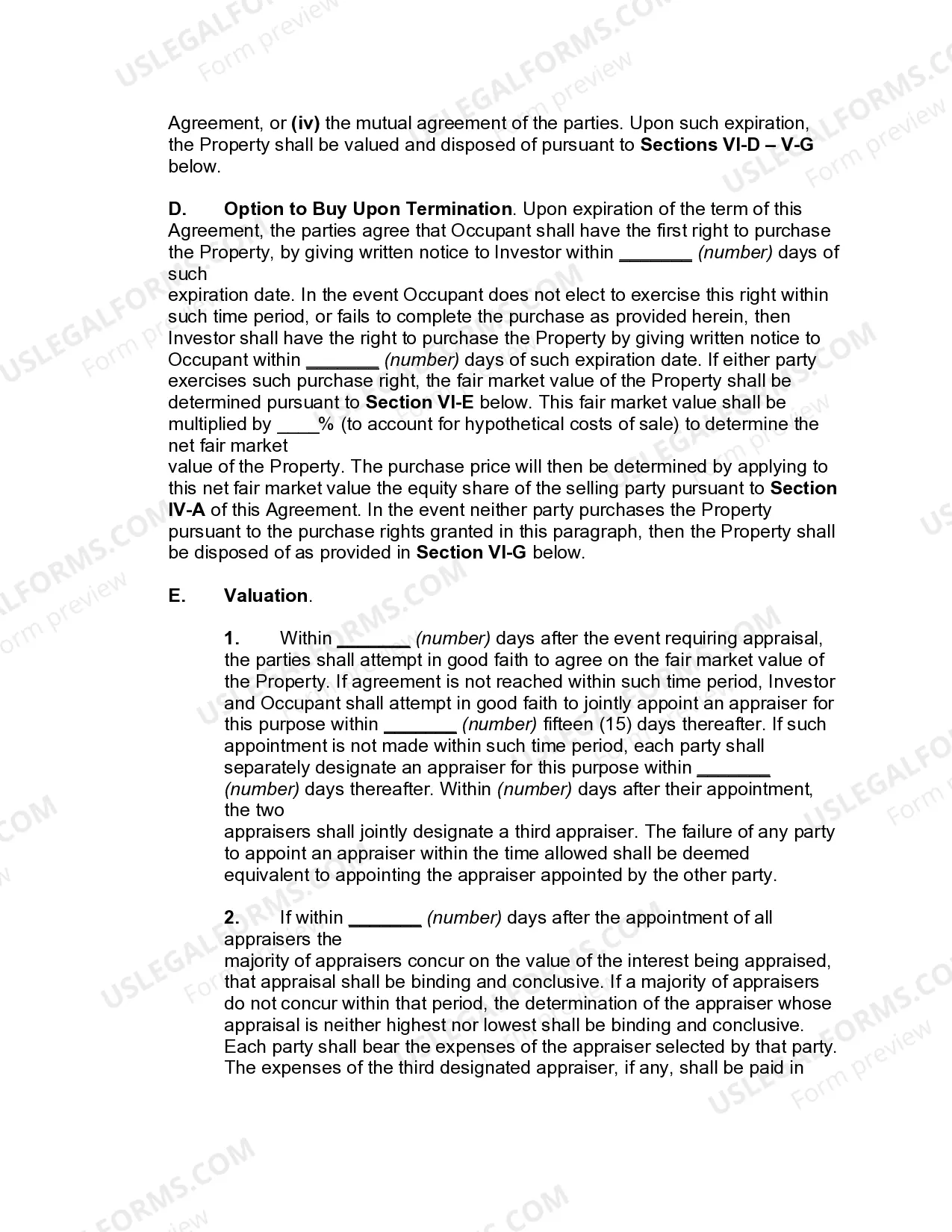
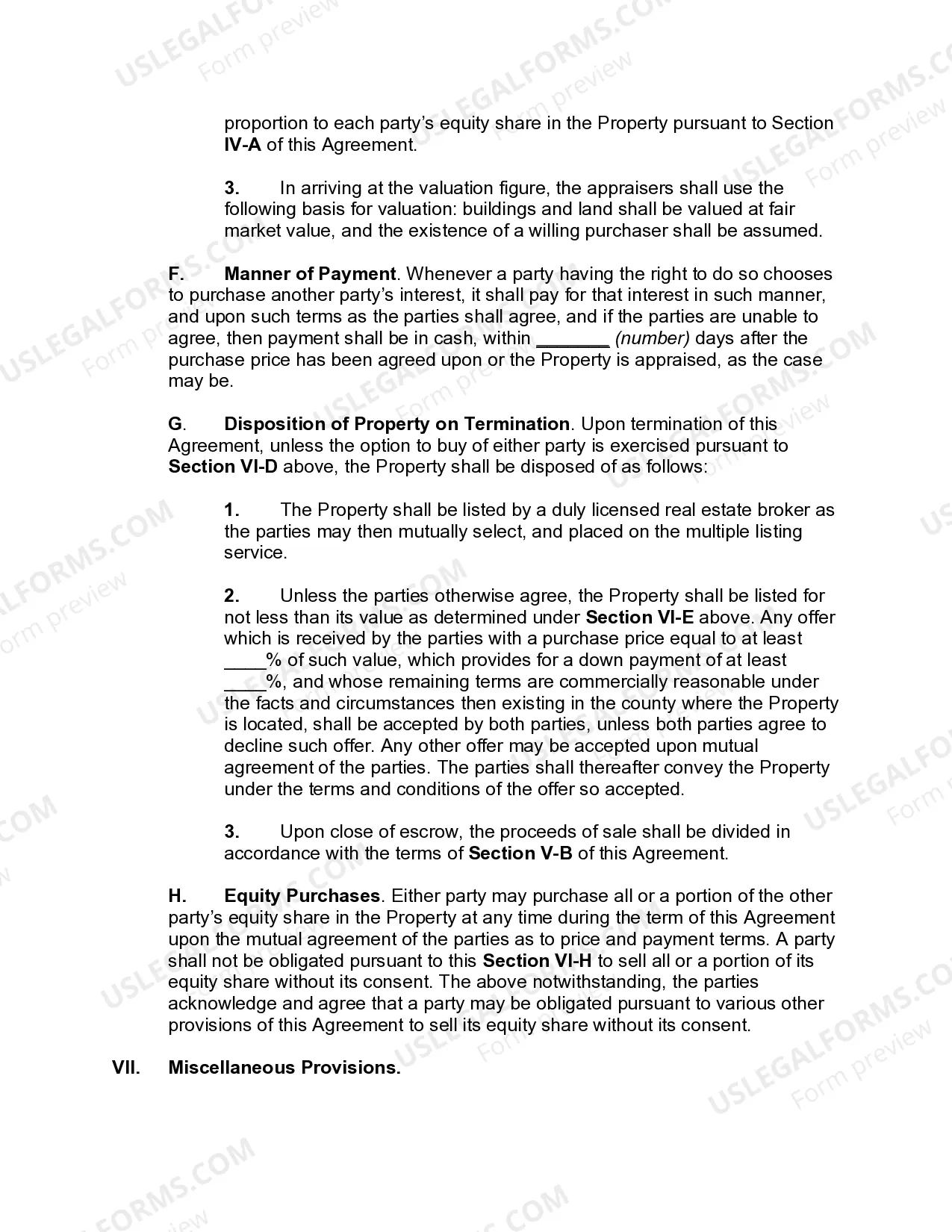
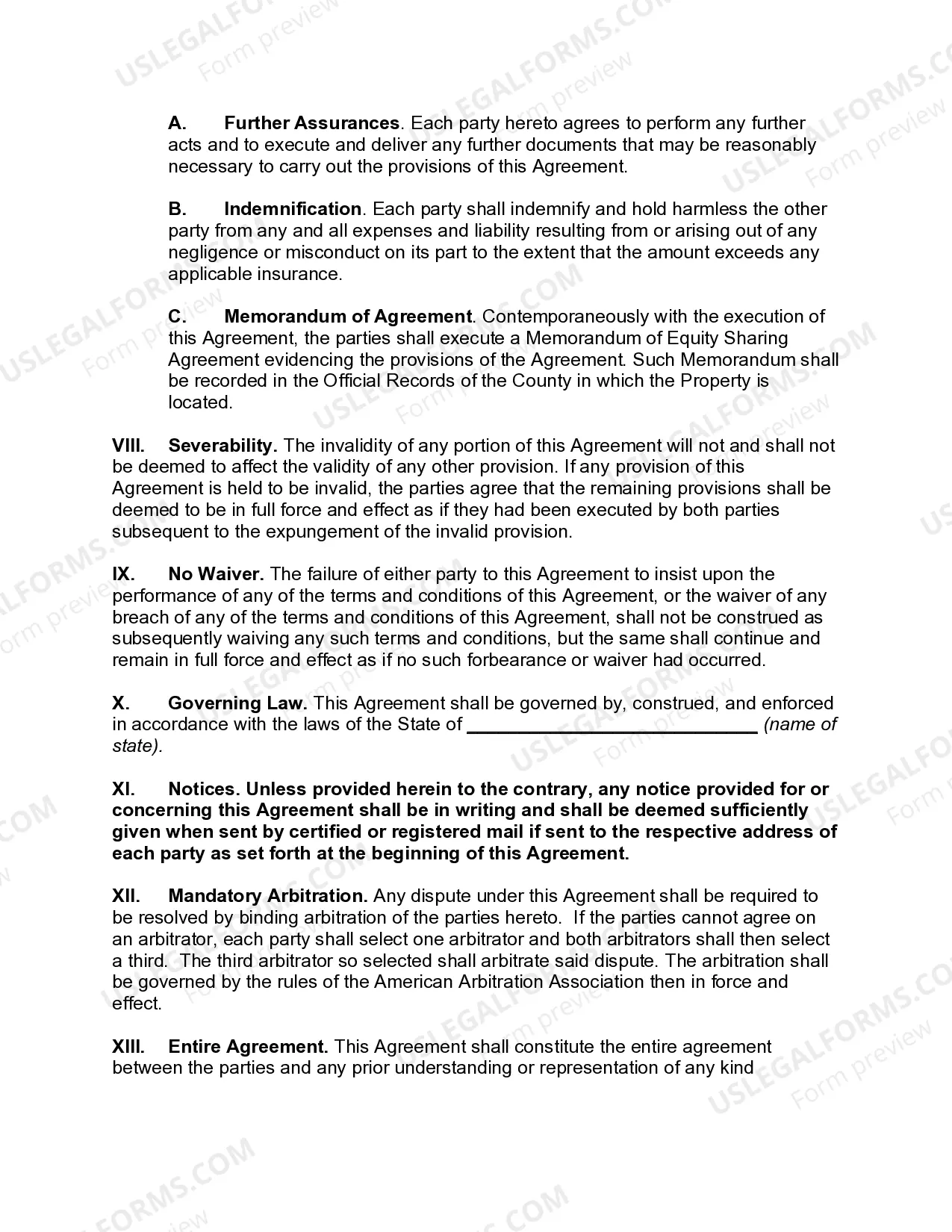
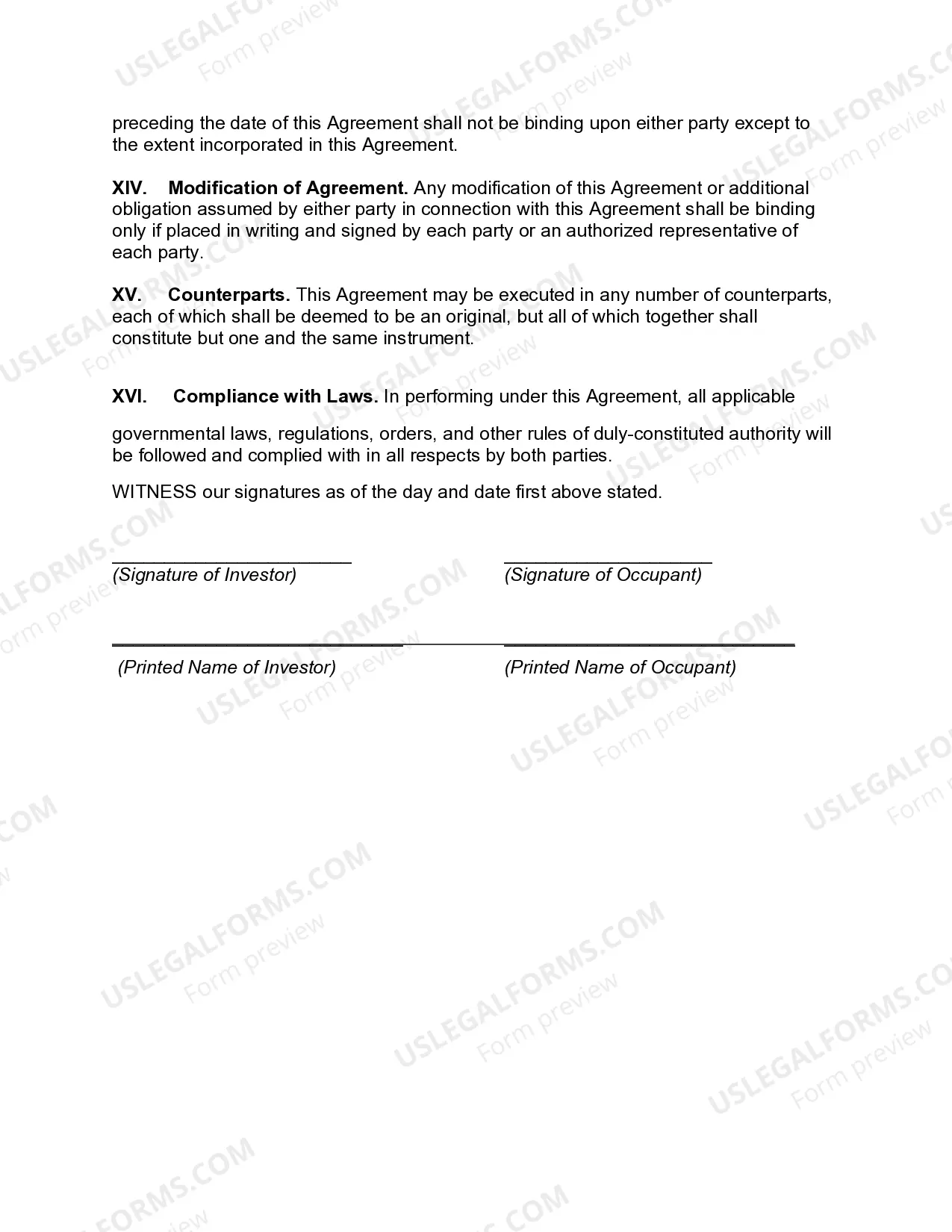
Equity Sharing Agreement

State:
Multi-State
Control #:
US-0955BG
Format:
Word; 
Rich Text
Instant download
This website is not affiliated with any governmental entity
Public form

Description

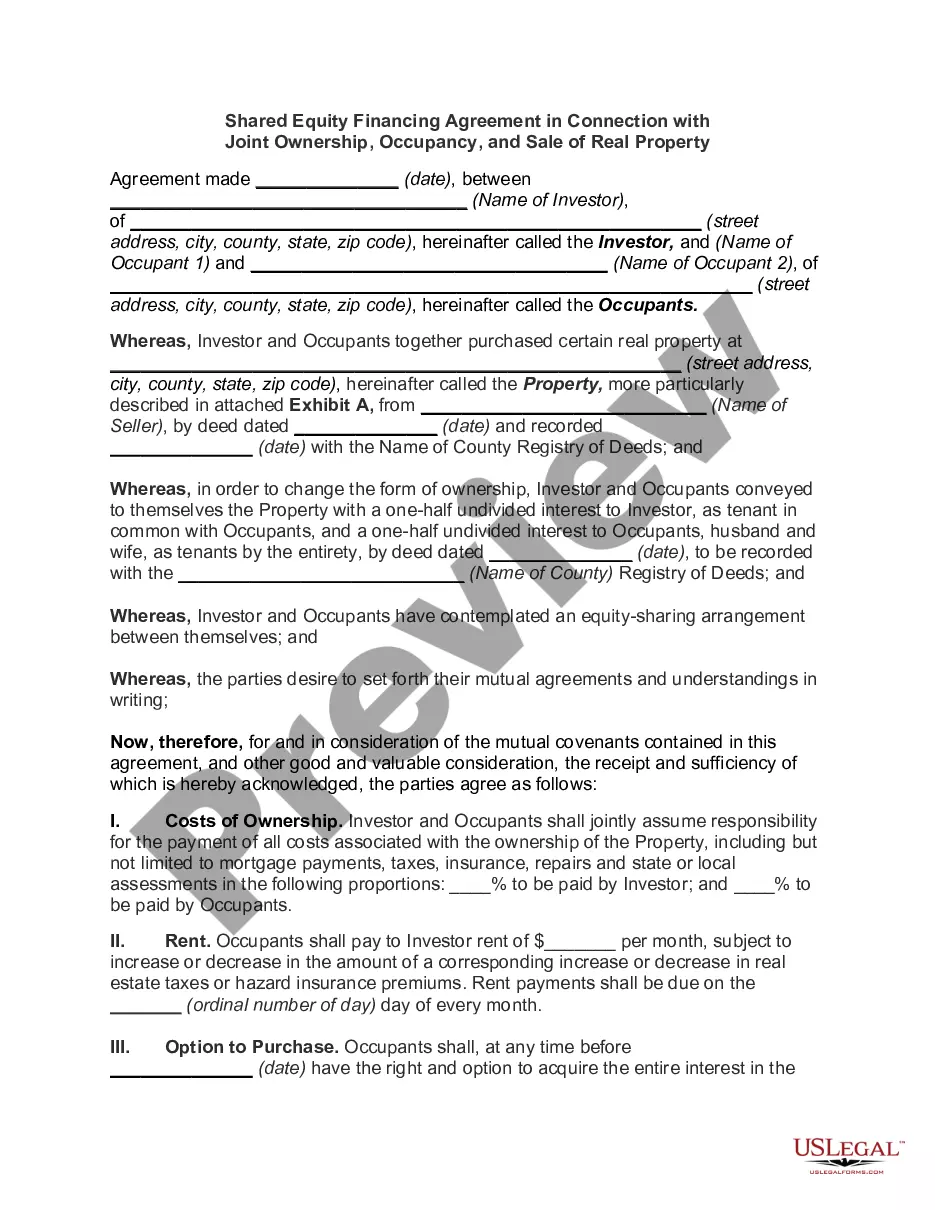
Equity sharing is an arrangement typically used when a homebuyer cannot afford the full down payment of the home he/she wishes to purchase, but has enough income to pay the full monthly payments. An equity share can also be used where the homebuyer can afford the home but cannot qualify for a mortgage.
Equity sharing is another name for shared ownership or co-ownership. It takes one property, more than one owner, and blends them to maximize profit and tax deductions. Typically, the parties find a home and buy it together as co-owners, but sometimes they join to co-own a property one of them already owns. At the end of an agreed term, they buy one another out or sell the property and split the equity.

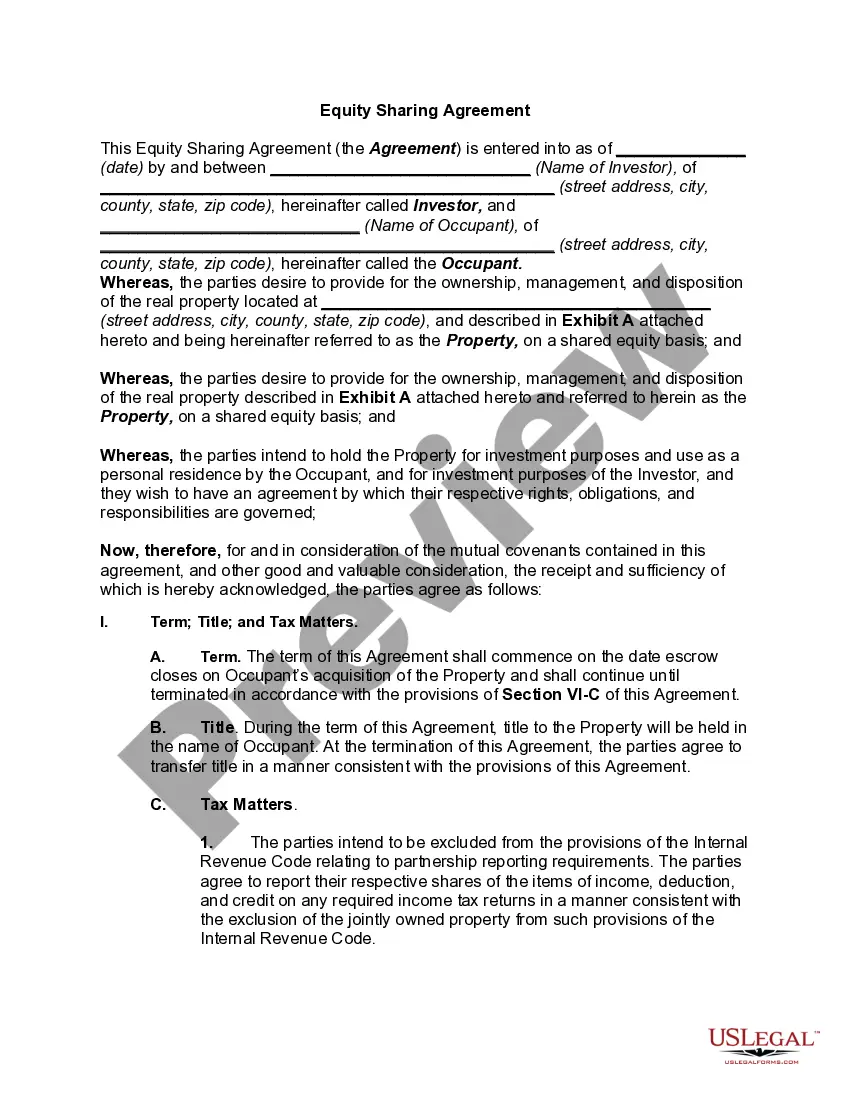
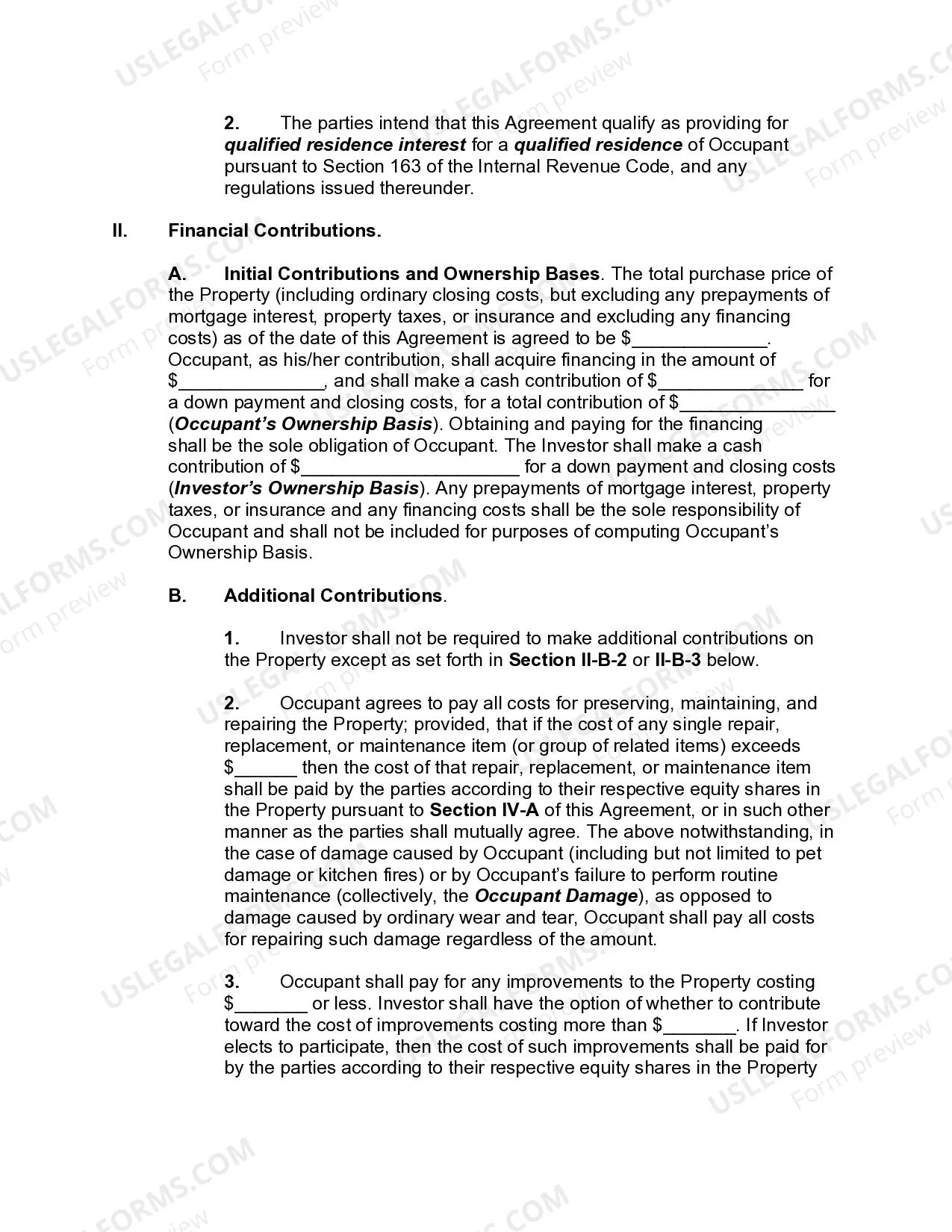
An Equity Sharing Agreement is a contract between two or more parties that outlines the terms and conditions of a shared ownership of stocks or other equity-based assets. This agreement specifies the percentage of ownership, voting rights, and other rights and responsibilities of each party. The two most common types of Equity Sharing Agreements are Cross-Equity Ownership Agreements and Cross-Equity Financing Agreements. A Cross-Equity Ownership Agreement allows two parties to purchase an asset together, with each party holding a share of the asset's equity. This agreement outlines the ownership structure, voting rights, and other rights and responsibilities of each party. A Cross-Equity Financing Agreement allows one party to loan funds to the other in order to purchase an asset. In exchange for the loan, the lender will receive a share of the asset's equity. This agreement outlines the loan terms, repayment schedule, voting rights, and other rights and responsibilities of each party.
What Is an Equity Sharing Agreement?

An equity sharing agreement is a contractual framework where two or more parties agree to share the ownership equity in a particular asset or property, commonly real estate. In the United States, these agreements are often used to facilitate cooperative investments between homeowners looking to unlock equity without selling, and investors seeking real estate exposure without direct property management responsibilities.

Step-by-Step Guide to Creating an Equity Sharing Agreement

  1. Determine the Purpose: Clearly define why you are entering into an equity sharing agreement, be it investment, residential use, or business application.
  2. Select the Right Participants: Identify the equity partners who will share ownership, ensuring they have aligned interests and resources.
  3. Valuation of the Property: Get a professional appraisal to determine the current market value of the property involved in the agreement.
  4. Legal Documentation: Draft the equity sharing contract with the help of a legal professional to include terms about the distribution of costs, profit shares, duration of the agreement, and exit strategies.
  5. Finalize and Sign: Review the agreement thoroughly with all parties involved and finalize it by signing under legal consultation to ensure all legal requirements are met.

Risk Analysis of Equity Sharing Agreements

  • Market Risk: Changes in the real estate market could affect property values and profitability.
  • Legal Risks: Inadequate drafting of agreements can lead to disputes over rights and responsibilities.
  • Partnership Risk: Conflicts or financial instability of a partner might influence the stability of the agreement and property management.
  • Liquidity Risk: Equity shares in real estate are not easily liquidable, making it difficult to exit the investment.

Pros & Cons of Equity Sharing Agreements

  • Pros:
    • Allows access to real estate markets without full property ownership commitments.
    • Enables homeowners to unlock equity without moving out.
    • Distributes the risks and responsibilities associated with property ownership.
  • Cons:
    • Potential conflicts between parties over operational decisions.
    • Dependent on property market fluctuations which can impact returns.
    • Complexity in legal structures and potential for disputes.

Best Practices in Setting Up an Equity Sharing Agreement

  1. Engage Professional Advisors: Involve an attorney and a financial advisor from the start to ensure all aspects are legally covered and financially viable.
  2. Transparent Communication: Maintain clear and open communication among all parties involved to foster cooperation and prevent misunderstandings.
  3. Regular Reviews: Schedule regular reviews of the agreement's conditions and the property's status to reflect any changes in the market or the partnership.

Common Mistakes & How to Avoid Them

  • Lack of Clear Exit Strategy: Always define clear terms for exits and buyouts in the agreement to prevent future conflicts.
  • Ignoring Tax Implications: Consult with a tax advisor to understand and plan for the tax impacts of equity sharing.
  • Underestimating Costs: Accurately account for all costs, including maintenance, taxes, and unforeseen expenses, in the budget planning.

How to fill out Equity Sharing Agreement?

Handling legal documentation requires attention, accuracy, and using well-drafted templates. US Legal Forms has been helping people countrywide do just that for 25 years, so when you pick your Equity Sharing Agreement template from our service, you can be sure it complies with federal and state laws.

Working with our service is simple and fast. To obtain the required document, all you’ll need is an account with a valid subscription. Here’s a quick guide for you to find your Equity Sharing Agreement within minutes:

  1. Remember to carefully look through the form content and its correspondence with general and legal requirements by previewing it or reading its description.
  2. Search for an alternative official template if the previously opened one doesn’t match your situation or state regulations (the tab for that is on the top page corner).
  3. ​Log in to your account and save the Equity Sharing Agreement in the format you need. If it’s your first experience with our service, click Buy now to proceed.
  4. Register for an account, select your subscription plan, and pay with your credit card or PayPal account.
  5. Choose in what format you want to obtain your form and click Download. Print the blank or upload it to a professional PDF editor to prepare it electronically.

All documents are drafted for multi-usage, like the Equity Sharing Agreement you see on this page. If you need them in the future, you can fill them out without re-payment - simply open the My Forms tab in your profile and complete your document whenever you need it. Try US Legal Forms and prepare your business and personal paperwork quickly and in total legal compliance!

Form popularity

FAQ

An equity purchase agreement, also known as a share purchase agreement or stock purchase agreement, is a contract that transfers shares of a company from a seller to a buyer. Equity purchases can be used to acquire a business in whole or in part.

The biggest benefit of home equity sharing is that it's not a debt. There are no monthly payments, no interest, and you can use the funds as you wish. Equity sharing agreements may also be easier to qualify for than a loan would be. For example, home equity sharing company Unlock allows for credit scores as low as 500.

Example of using Equity Agreement For example, the parents may decide to enter into an agreement in which they pay the down payment and sign a mortgage. This means they will be compelled to pay half of the mortgage until the loan is paid in full.

An equity partnership agreement should list the rights, responsibilities, and obligations of each partner. The contract should also address the proportion of the company's profits that each partner will receive. Partnership agreements should also allocate losses to future partners.

A shared equity finance agreement allows multiple parties to go in on the purchase of a property, splitting the equity ownership ingly. This type of arrangement is often structured when one party on their own cannot afford to purchase a home?for instance, when a parent helps an adult child.

A shared equity mortgage is an arrangement under which a lender and a borrower share ownership of a property. The borrower must occupy the property. When the property sells, the allocation of equity goes to each part, ing to their equity contribution.

Equity agreements allow entrepreneurs to secure funding for their start-up by giving up a portion of ownership of their company to investors. In short, these arrangements typically involve investors providing capital in exchange for shares of stock which they will hold and potentially sell in the future for a profit.

Example of using Equity Agreement For example, the parents may decide to enter into an agreement in which they pay the down payment and sign a mortgage. This means they will be compelled to pay half of the mortgage until the loan is paid in full.

Trusted and secure by over 3 million people of the world’s leading companies

Equity Sharing Agreement