Joint-Venture Agreement to Develop and Sell Real Property Between Individual and Corporation
Understanding this form
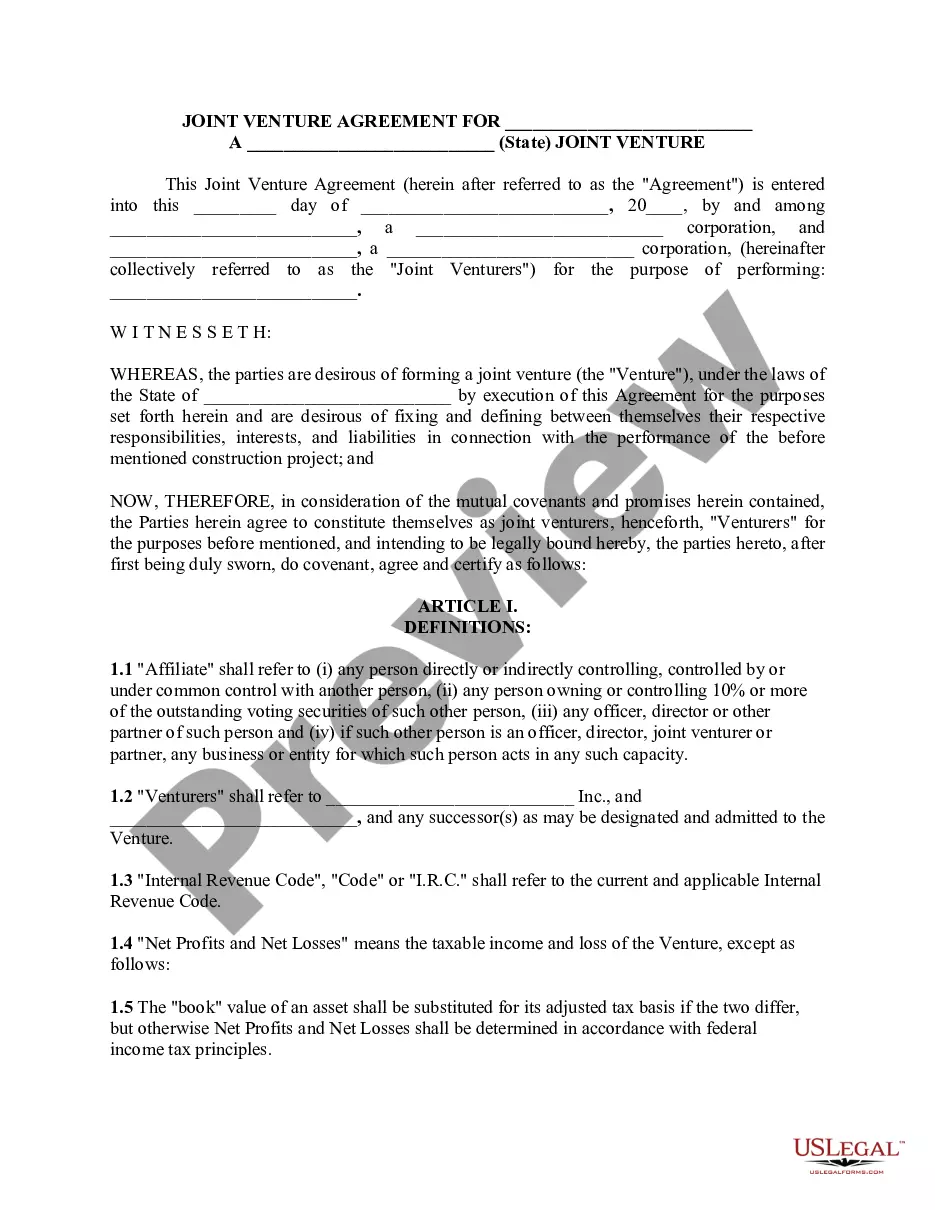
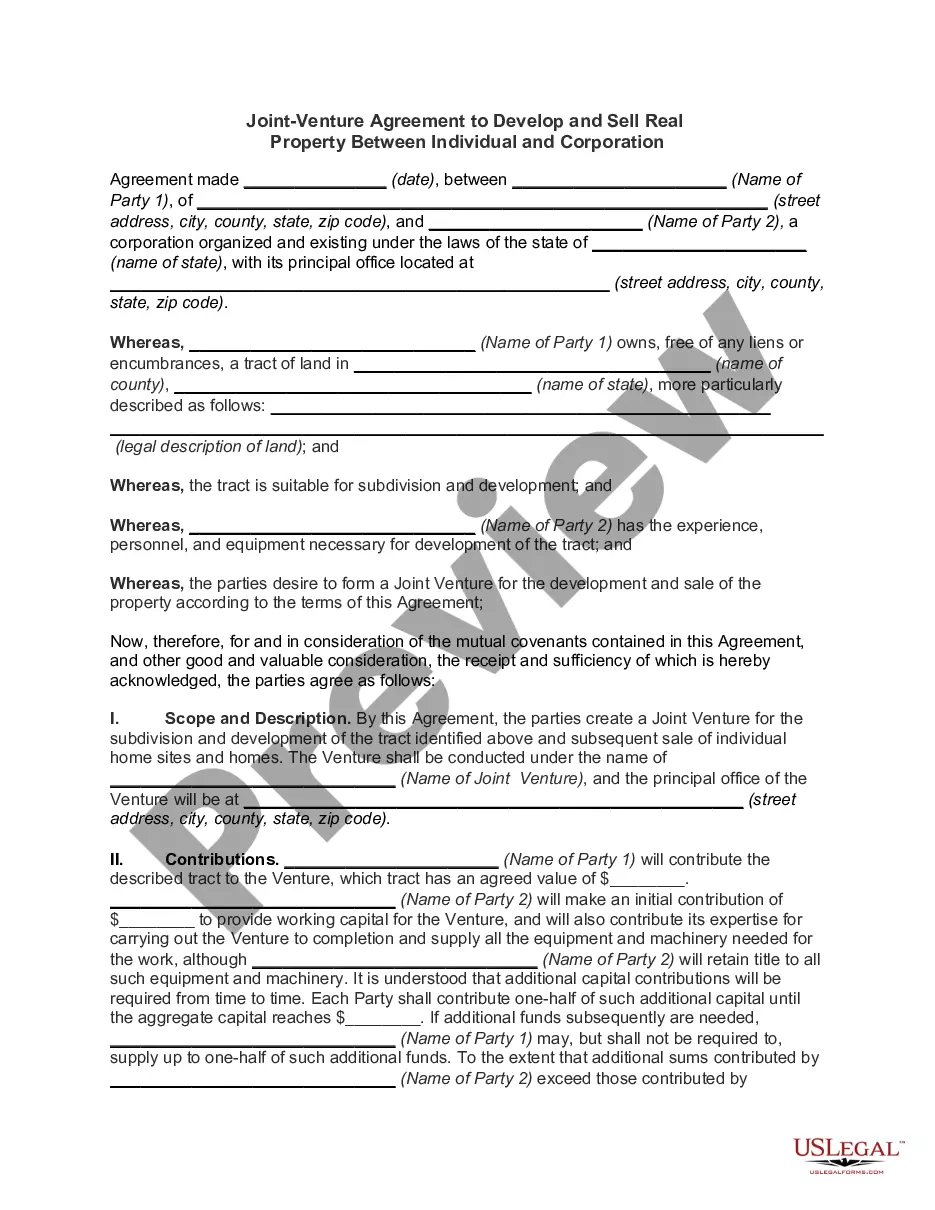
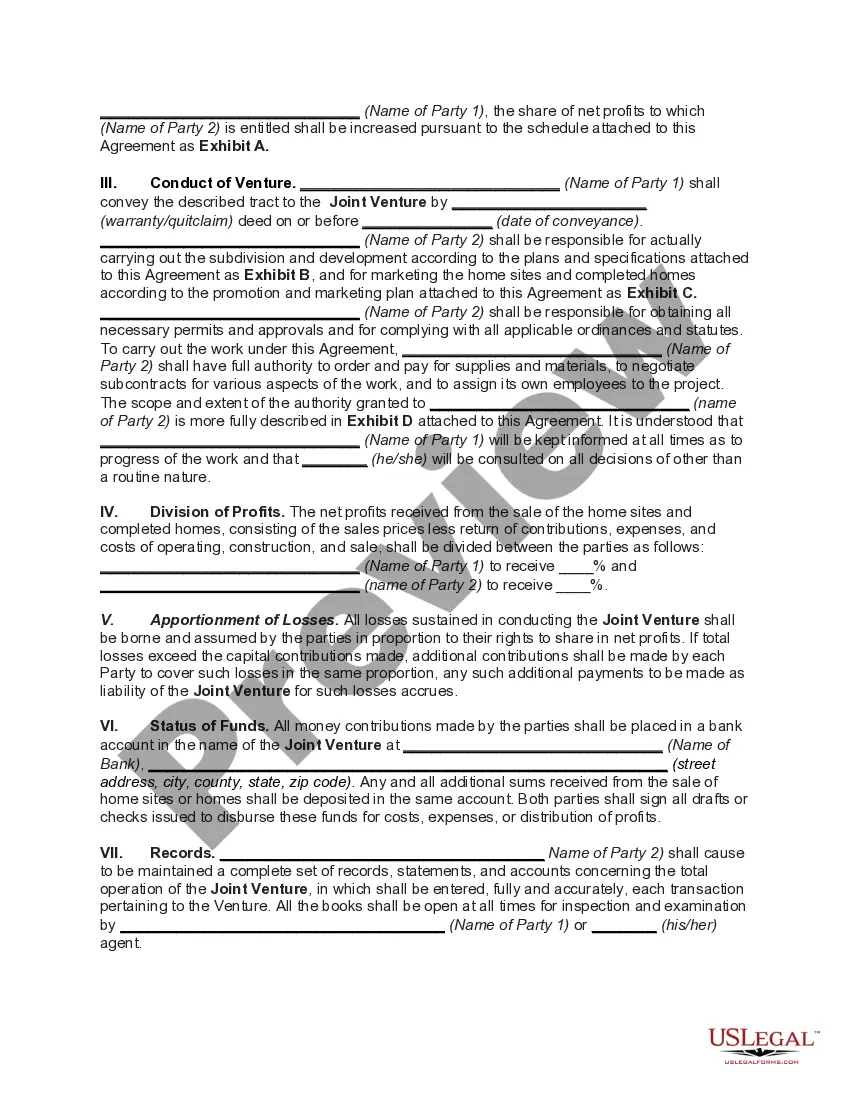
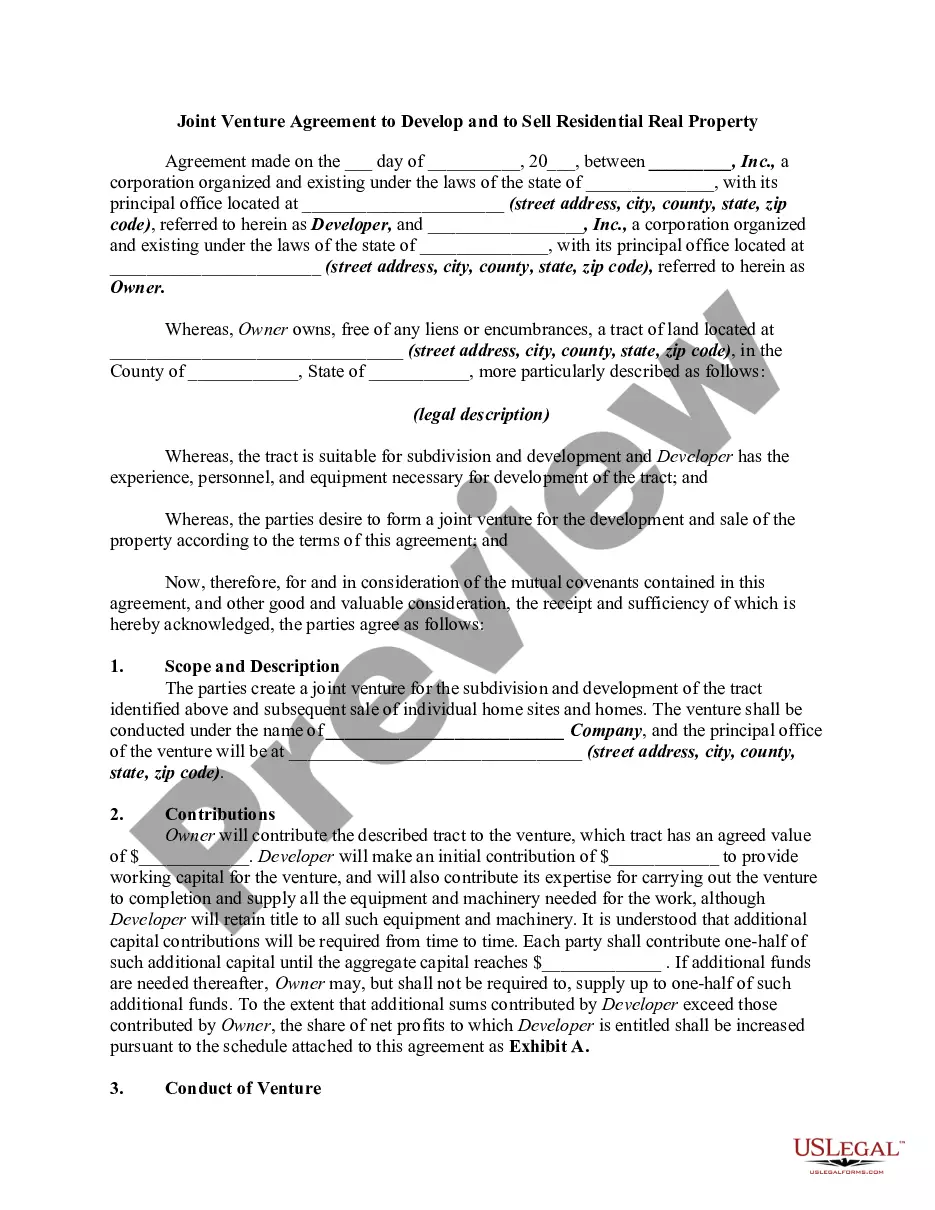
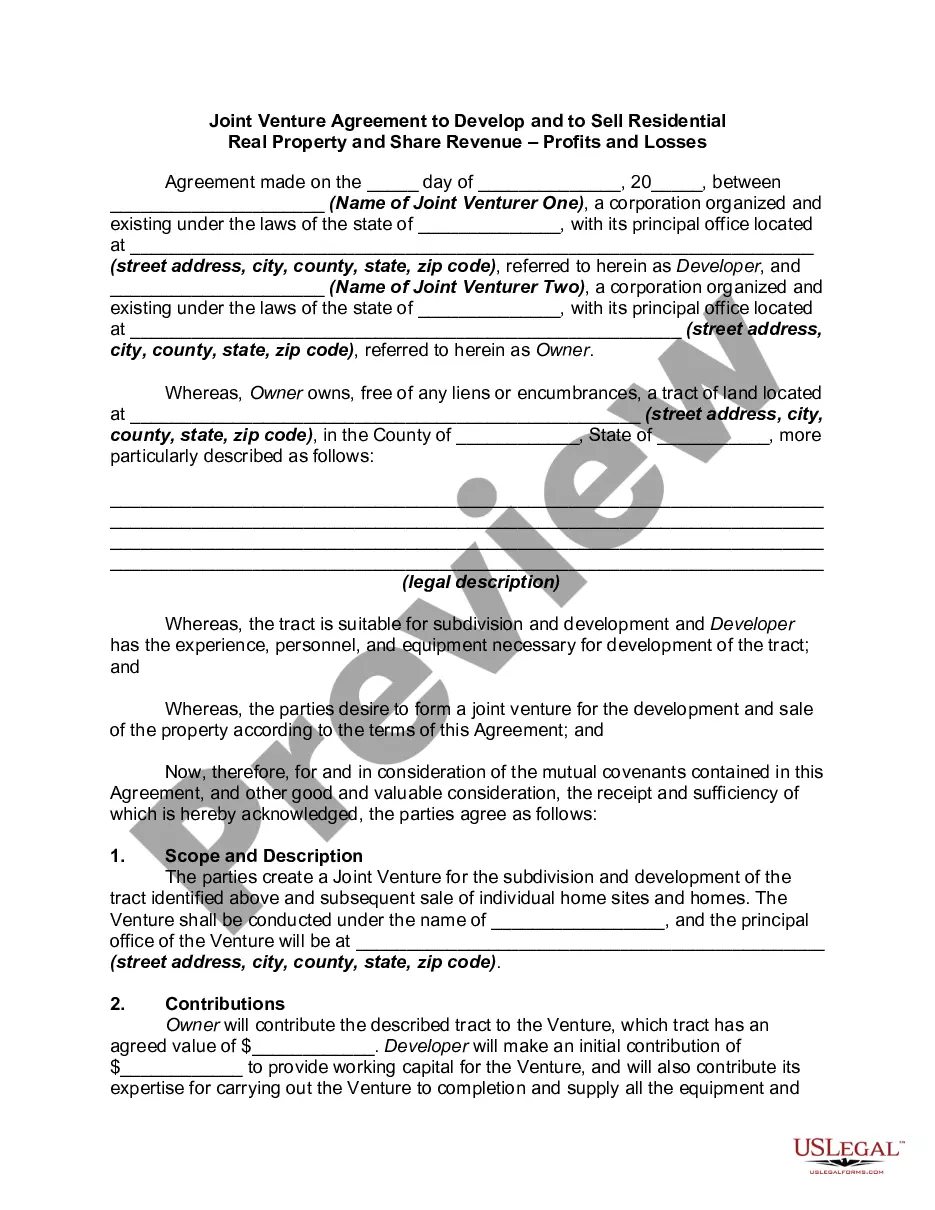
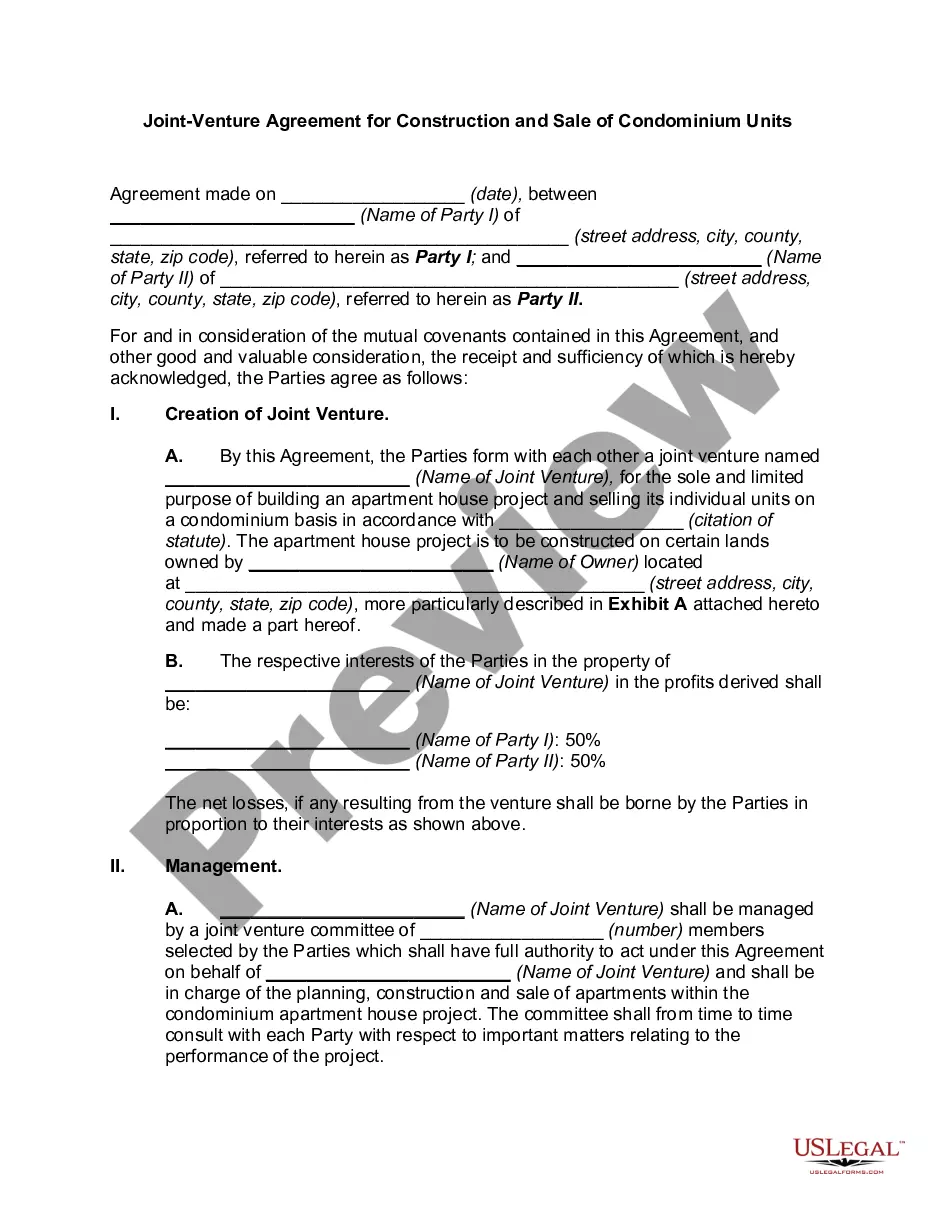
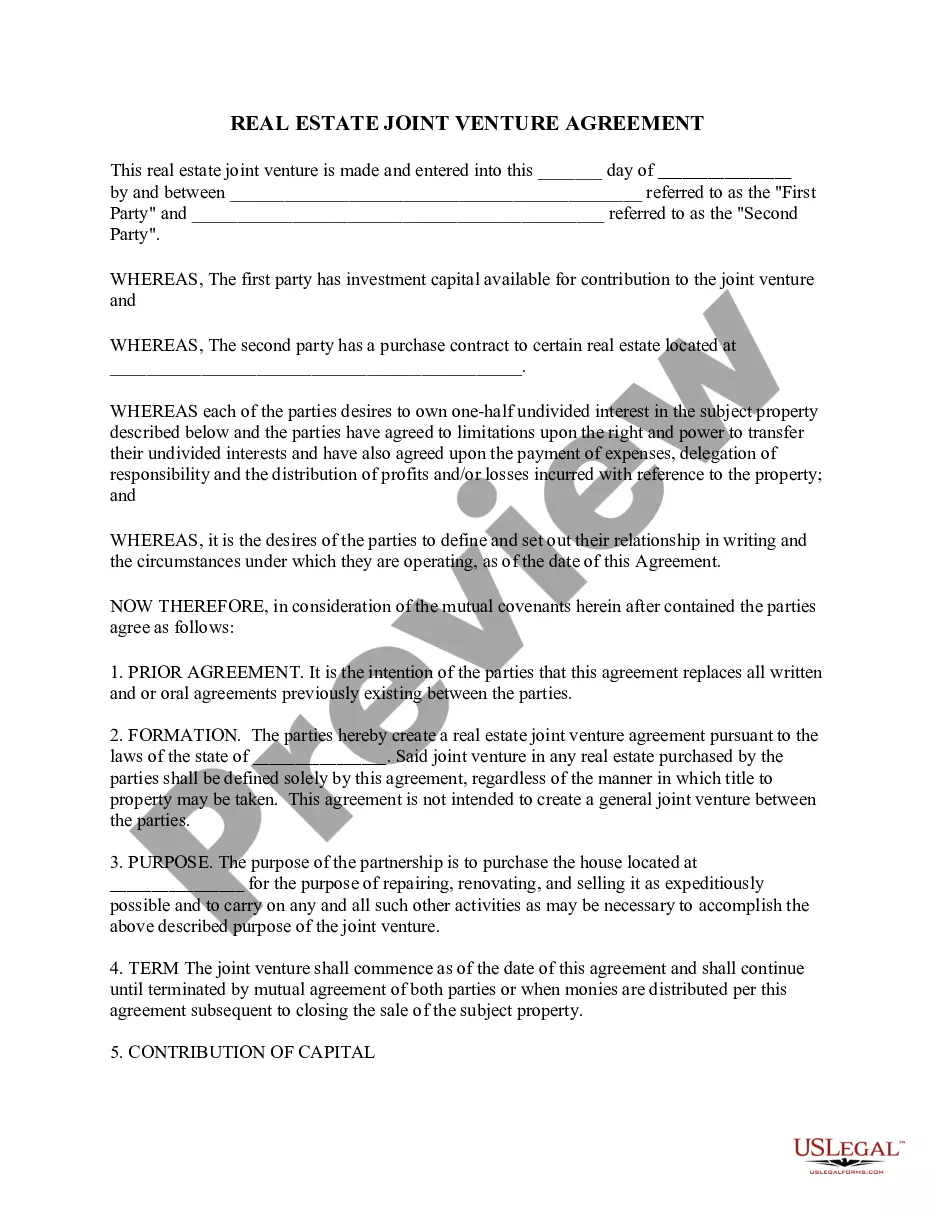
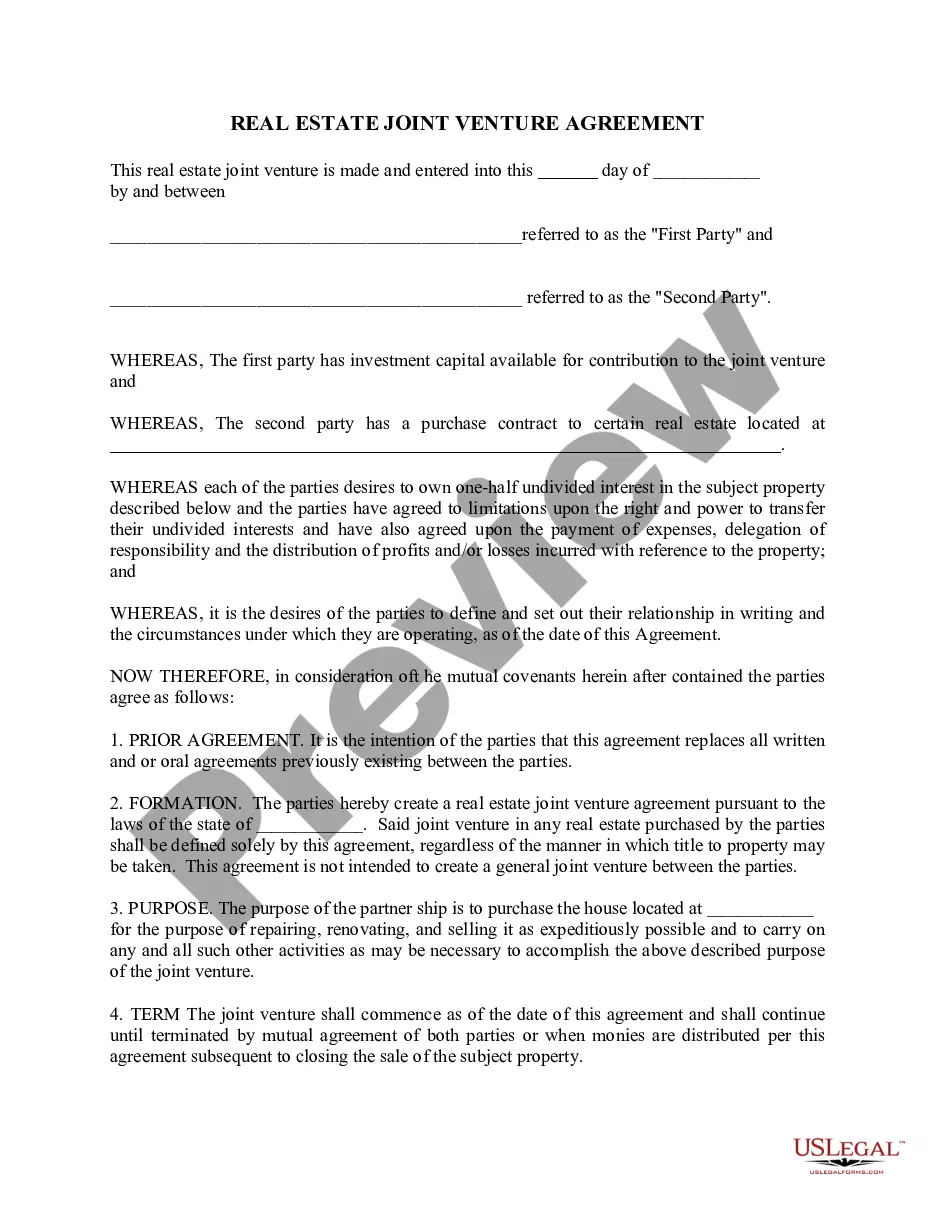
The Joint-Venture Agreement to Develop and Sell Real Property Between Individual and Corporation is a legal document that outlines the relationship between an individual and a corporation as they collaborate to develop and sell real estate. This agreement details the contributions, responsibilities, and profit-sharing arrangements of each party. It distinguishes itself from a general partnership by focusing on a specific project rather than an ongoing business activity. Both parties agree to share resources, expertise, and responsibilities in a mutually beneficial venture.
Key parts of this document
- Parties involved: Identification of the individual and corporation entering into the agreement.
- Property description: Details of the land to be developed, including legal descriptions.
- Scope of the venture: Objectives and operations defined for the development project.
- Profit-sharing model: How profits will be divided between the parties.
- Management and responsibilities: Allocation of duties for project execution and marketing.
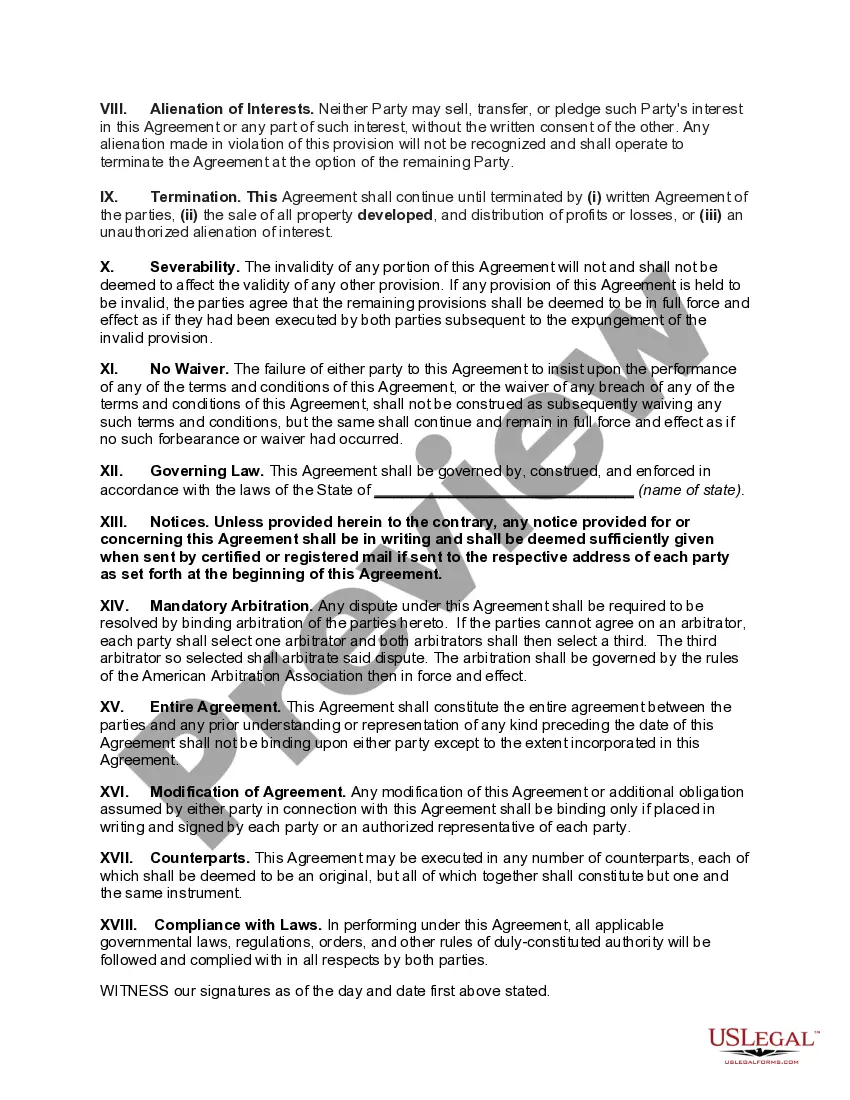
- Termination conditions: Terms under which the agreement can be concluded.
Common use cases
This form is needed when an individual and a corporation wish to collaborate on a real estate development project. It is particularly useful when the individual owns land and the corporation has the expertise and resources to develop it. Examples include embarking on residential subdivision projects or developing commercial real estate for sale.
Who needs this form
- Individuals who own real estate and want to partner with a corporation for development.
- Corporations looking to invest in real estate projects with individual partners.
- Real estate developers seeking to formalize agreements between varied interest parties.
Steps to complete this form
- Identify the parties: Enter the names and addresses of the individual and corporation.
- Specify the property: Provide a detailed legal description of the real property involved.
- Define contributions: Clearly state the contributions each party will make to the joint venture.
- Outline responsibilities: Describe the roles and duties each party will undertake in the project.
- Enter profit-sharing terms: Specify how profits and losses will be distributed between the parties.
Notarization requirements for this form
Notarization is required for this form to take effect. Our online notarization service, powered by Notarize, lets you verify and sign documents remotely through an encrypted video session, available 24/7.
Get your form ready online
Our built-in tools help you complete, sign, share, and store your documents in one place.
Make edits, fill in missing information, and update formatting in US Legal Forms—just like you would in MS Word.
Download a copy, print it, send it by email, or mail it via USPS—whatever works best for your next step.
Sign and collect signatures with our SignNow integration. Send to multiple recipients, set reminders, and more. Go Premium to unlock E-Sign.
If this form requires notarization, complete it online through a secure video call—no need to meet a notary in person or wait for an appointment.
We protect your documents and personal data by following strict security and privacy standards.

Make edits, fill in missing information, and update formatting in US Legal Forms—just like you would in MS Word.

Download a copy, print it, send it by email, or mail it via USPS—whatever works best for your next step.

Sign and collect signatures with our SignNow integration. Send to multiple recipients, set reminders, and more. Go Premium to unlock E-Sign.

If this form requires notarization, complete it online through a secure video call—no need to meet a notary in person or wait for an appointment.

We protect your documents and personal data by following strict security and privacy standards.
Mistakes to watch out for
- Failing to clearly define each party's contributions and responsibilities, leading to misunderstandings.
- Not including detailed legal descriptions of the property, which can create disputes later.
- Neglecting to outline termination terms, which may complicate the end of the agreement.
Why use this form online
- Convenient access: Download anytime and anywhere for immediate use.
- Editability: Easily customize the agreement to fit the specific needs of the parties involved.
- Reliable templates: Forms prepared by licensed attorneys ensure compliance with legal standards.
Looking for another form?

Form popularity
FAQ
Spouses electing qualified joint venture status are treated as sole proprietors for Federal tax purposes. The spouses must share the businesses' items of income, gain, loss, deduction, and credit. Therefore, the spouses must take into account the items in ance with each spouse's interest in the business.
Four types of joint ventures Project-based joint venture. A project-based joint venture has two or more parties working on a specific project.Functional-based joint venture.Vertical joint venture.Horizontal joint venture.
The parties to the joint venture must be at least a combination of two natural persons or entities. The parties may contribute capital, labor, assets, skill, experience, knowledge, or other resources useful for the single enterprise or project. The creation of a joint venture is a matter of facts specific to each case.
A joint venture involves two or more persons or entities joining together for a particular project. A partnership is described as a relationship which exists between people carrying on a business, with a common view of making a profit. It also includes incorporated limited partnerships.
A joint venture, on the other hand, can be individuals or entities such as corporations, or even governments and businesses. It can also be individuals, whereas a partnership is often only individuals.
A joint venture involves two or more persons or entities joining together in particular project, whereas in a partnership, it is individuals who join together for a combined business. A joint venture can be described as a contractual arrangement between two or more entities that aims to undertake a specific task.
A joint venture (JV) is a business arrangement in which two or more parties agree to pool their resources for the purpose of accomplishing a specific task. This task can be a new project or any other business activity. Each of the participants in a JV is responsible for profits, losses, and costs associated with it.
The agreement between corporations become a joint venture when it is limited to a particular project that will allow the Boards of the co-venturers to anticipate and evaluate their respective corporations' responsibilities and liabilities Ibid.