Agreement between Adjoining Landowners Granting Permission to Install Foundation Under Adjacent Real Estate
Understanding this form
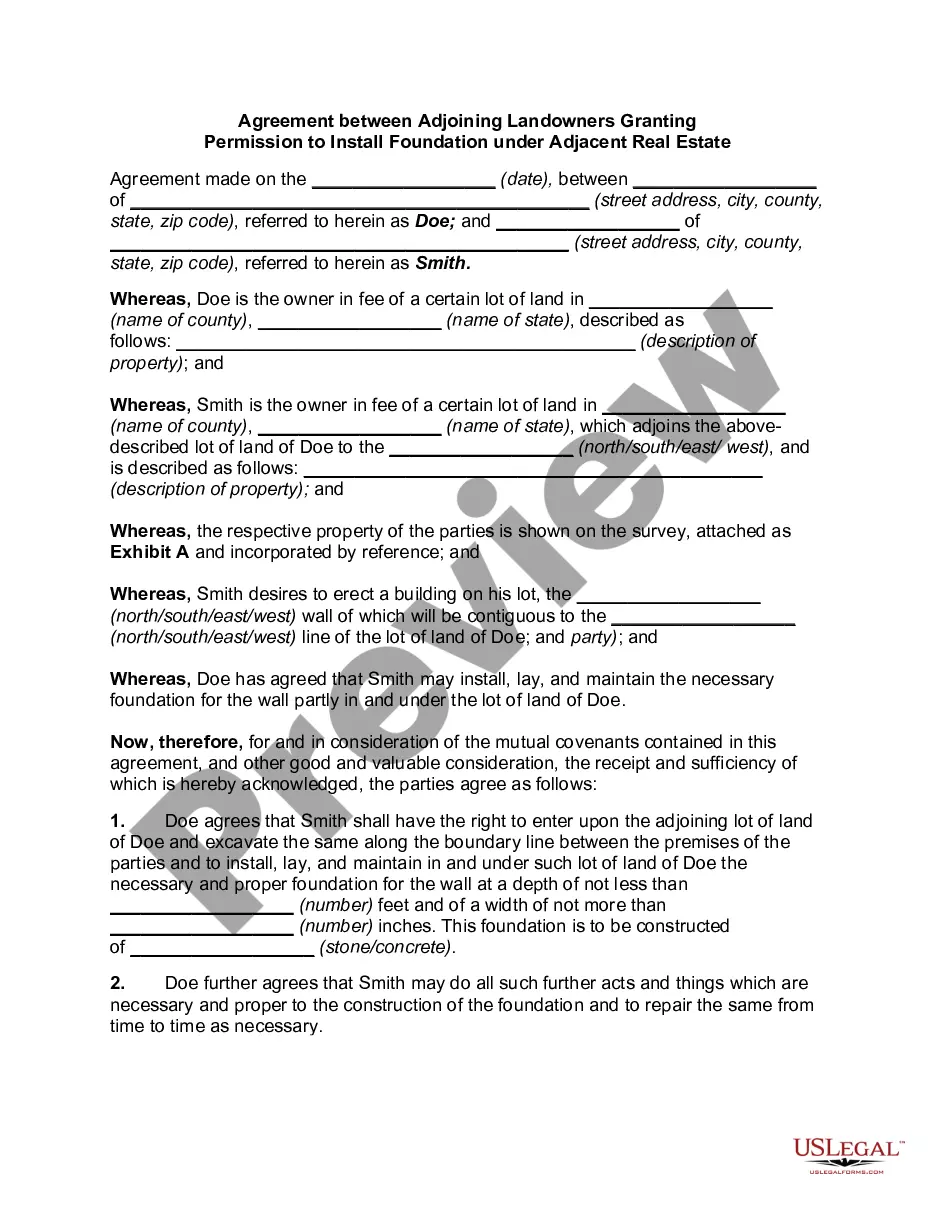
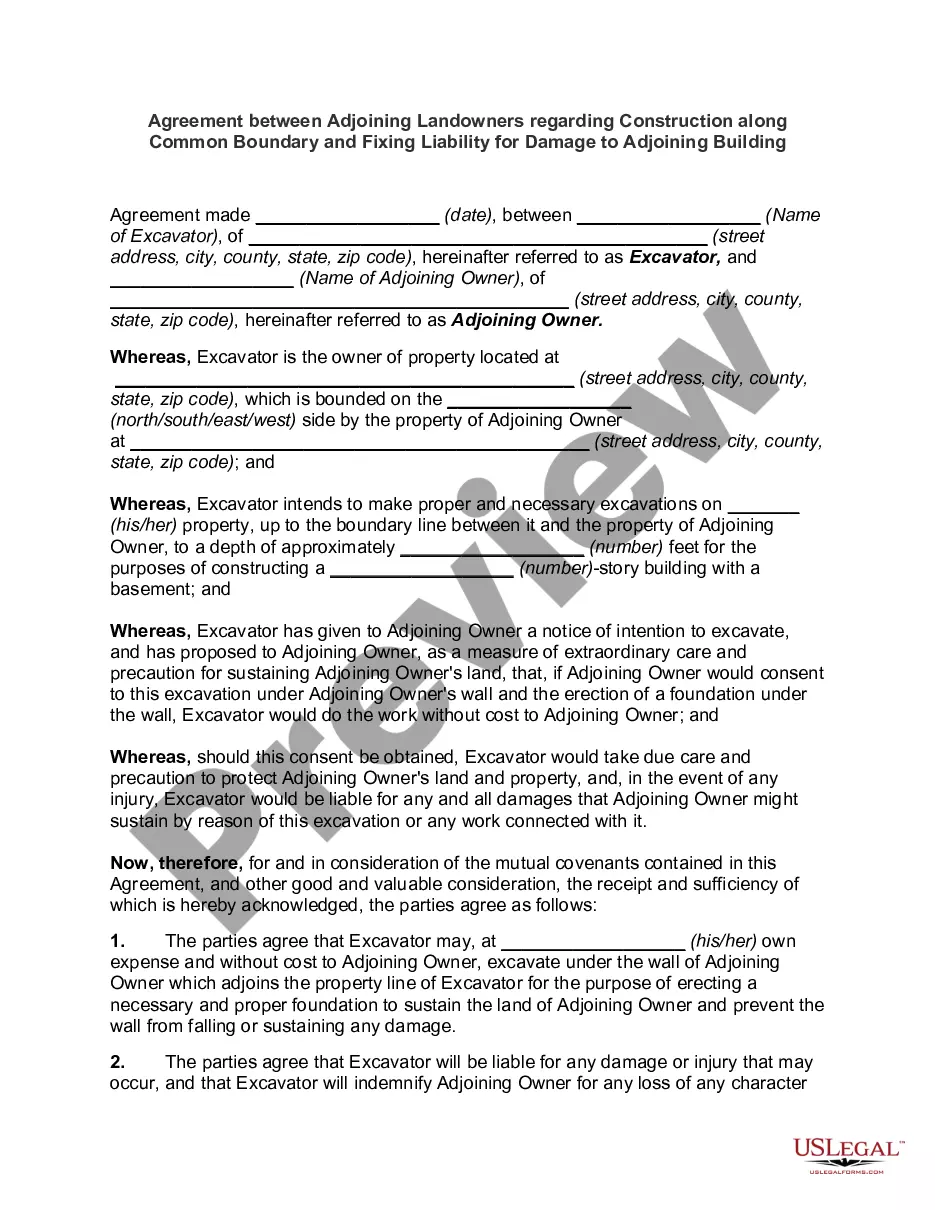
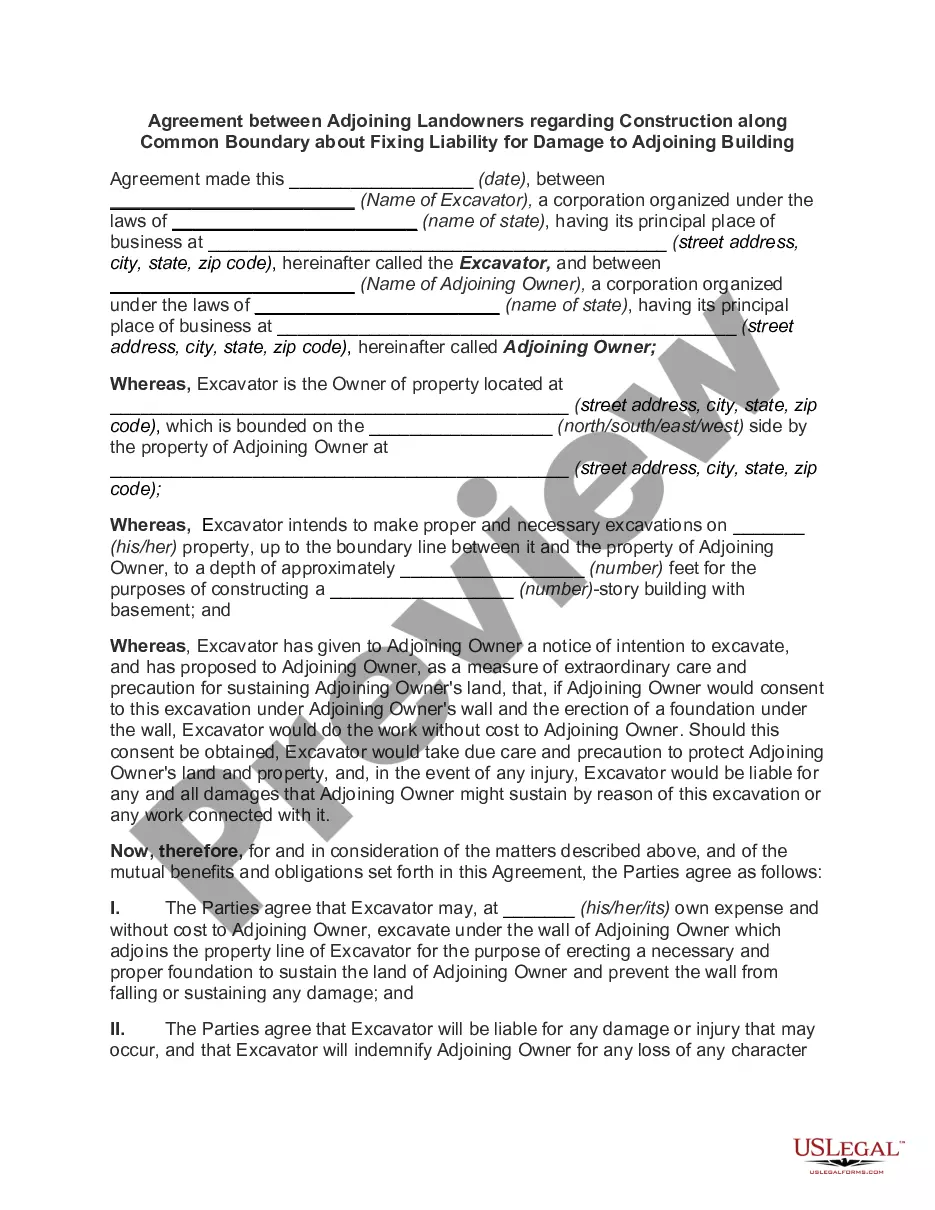
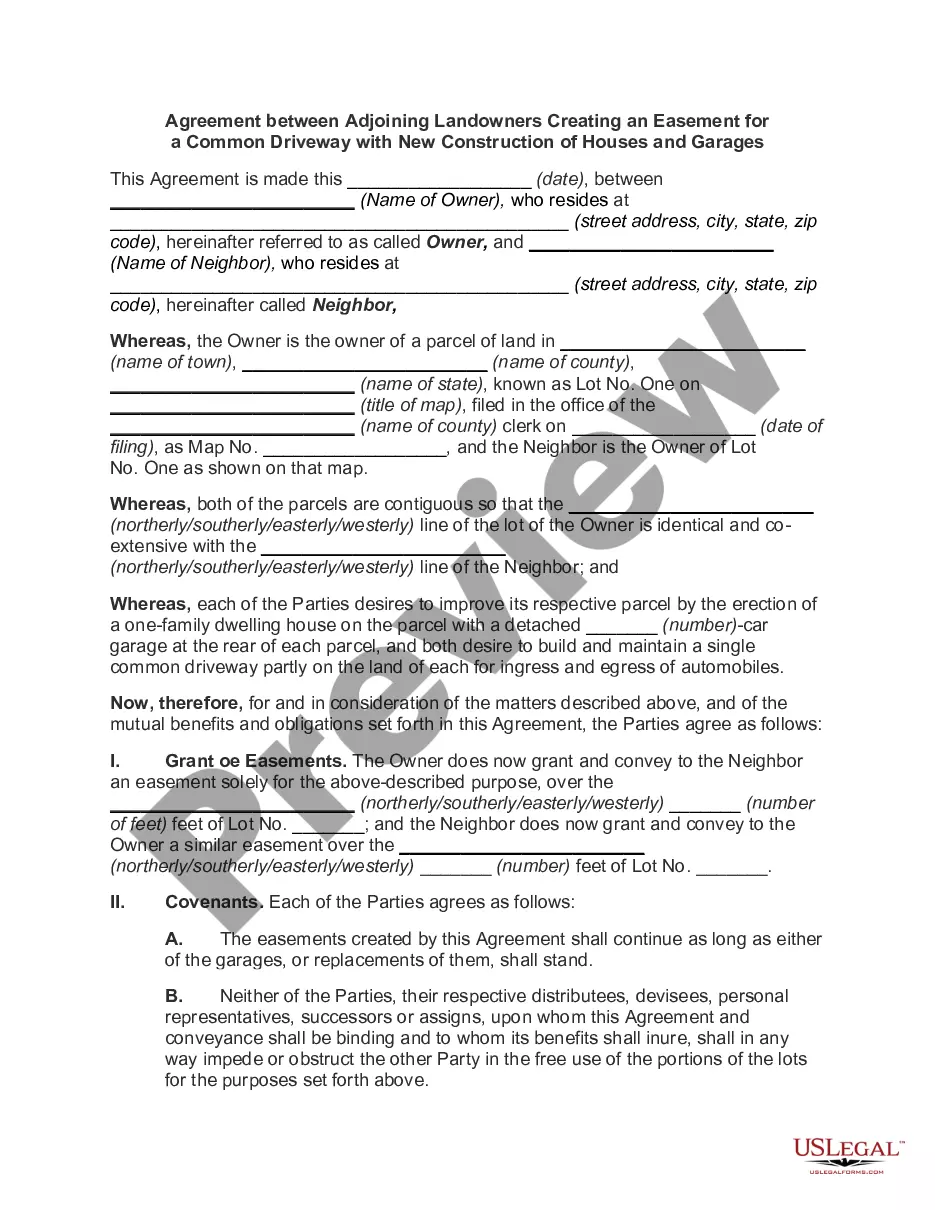
This form is an Agreement between Adjoining Landowners Granting Permission to Install Foundation Under Adjacent Real Estate. It allows property owners to formalize consent for one landowner to build a foundation that extends onto the adjoining landowner's property. This agreement ensures that both parties understand their rights and responsibilities, which can prevent disputes and ensure cooperation during construction projects. It is particularly useful in situations where the construction of a wall or other structure is planned close to a boundary line between two properties.
Form components explained
- Identification of the parties involved, referred to as Doe and Smith.
- A description of each property, including address and boundaries.
- Details regarding the construction of the foundation, including depth and width specifications.
- Clauses on minimizing damage and restoring the land to its original condition.
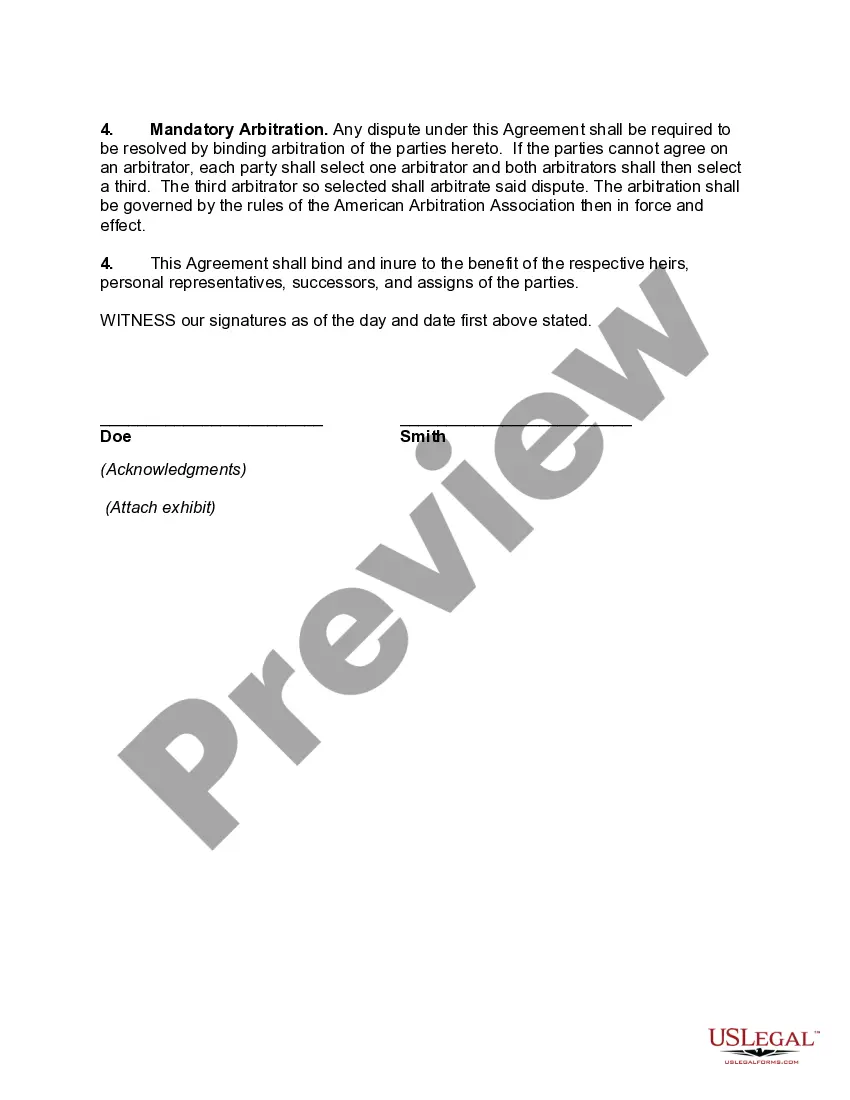
- Mandatory arbitration clause for resolving disputes under the agreement.
- Signatures of both parties to validate the agreement.
Situations where this form applies
You should use this form when you are an adjoining landowner and want to allow your neighbor to install a foundation on your property. Typical scenarios include when your neighbor is planning to build a structure that requires a foundation extending onto your land, and both parties need to agree on the terms of access, construction, damage recovery, and property restoration. This form helps in avoiding conflicts that could arise during construction projects and clarifies the mutual understanding between the landowners.
Who should use this form
- Adjoining landowners who plan to undertake construction projects close to property lines.
- Property owners looking to clarify permissions and responsibilities related to foundation installations.
- Individuals who want a legally binding agreement to prevent disputes with their neighbors during construction.
- Anyone involved in real estate activities that require cooperation between neighbors.
How to complete this form
- Identify the parties by entering their names and addresses at the beginning of the agreement.
- Provide a clear description of each property involved, including locations and boundaries.
- Specify the details of the foundation, including the required depth, width, and construction material.
- Ensure both parties agree on the terms by signing and dating the document.
- Consider including an exhibit that visually displays property boundaries for clarity.
Does this form need to be notarized?
This form does not typically require notarization unless specified by local law. However, having it notarized can add an extra layer of validity, confirming the identity of the signers and the voluntary nature of the agreement.
Get your form ready online
Our built-in tools help you complete, sign, share, and store your documents in one place.
Make edits, fill in missing information, and update formatting in US Legal Forms—just like you would in MS Word.
Download a copy, print it, send it by email, or mail it via USPS—whatever works best for your next step.
Sign and collect signatures with our SignNow integration. Send to multiple recipients, set reminders, and more. Go Premium to unlock E-Sign.
If this form requires notarization, complete it online through a secure video call—no need to meet a notary in person or wait for an appointment.
We protect your documents and personal data by following strict security and privacy standards.

Make edits, fill in missing information, and update formatting in US Legal Forms—just like you would in MS Word.

Download a copy, print it, send it by email, or mail it via USPS—whatever works best for your next step.

Sign and collect signatures with our SignNow integration. Send to multiple recipients, set reminders, and more. Go Premium to unlock E-Sign.

If this form requires notarization, complete it online through a secure video call—no need to meet a notary in person or wait for an appointment.

We protect your documents and personal data by following strict security and privacy standards.
Typical mistakes to avoid
- Failing to accurately describe the property boundaries and addresses involved.
- Neglecting to specify the dimensions and materials for the foundation.
- Not including signatures or dates from both parties, which invalidates the agreement.
- Overlooking local laws that may affect the validity of the agreement.
Why complete this form online
- Convenience of accessing and downloading a legally vetted form any time.
- Ability to fill out the form at your own pace without the pressure of consulting a lawyer in person.
- Editable fields allow for customization to fit specific situations easily.
- Reliability of templates drafted by licensed attorneys ensures legal adequacy.
Legal use & context
- Establishes clear permissions between adjoining landowners.
- Helps prevent future disputes regarding property use and rights.
- Legally binding if completed correctly and signed by all parties.
Quick recap
- This form facilitates cooperation between neighboring property owners regarding construction.
- It is important to accurately specify property details and foundation requirements.
- Having a clear agreement can prevent misunderstandings and legal disputes.
Looking for another form?


Form popularity
FAQ
Generally, if you go onto to your neighbours land without their permission, you are trespassing. However, if you wish to repair your home, you may go onto your neighbours land without getting their permission. Before going on your neighbours land, you should still ask their permission.
The short answer is yes, subject to serving a valid notice and following the processes set out in The Party Wall Act. The party wall act only applies to structures (ie: a wall with a foundation), it does not apply to timber fences or other screens.
The Neighbour Consultation Scheme or Larger Home Extension scheme allows home owners to build a single storey extension to: A terraced house and semi-detached house can be extended up to 6 metres and a detached house up to 8 metres from the original house. However, your neighbours do have the right to object to this.
Although it is recommended that you first try to resolve any problems by talking the issue through with your neighbour, or by using mediation, your local council has a duty to investigate noise from a building project if it is deemed to be damaging to health or a nuisance, known as a statutory nuisance.
Start by talking to your neighbour and asking them to check if their insurance will cover the damage. They will need to lodge a claim with their insurance provider. If you're submitting a claim to your neighbour's home insurance provider, you'll need to prove that the damage was, in fact, their fault.
Filing a Lawsuit to Stop Your Neighbor's Construction If you are unsatisfied with the decision of your local planning board or if your neighbor continues to damage your property, then you may file a civil suit for an injunction. An injunction would prevent your neighbor from continuing with his construction.
Simply put, if your neighbour wants to build a new structure, you don't have to say yes. The work must relate to the preservation of an existing structure, not a new structure currently being built or any future planned structure. Any structure that has already been built means that they could gain access.
A terraced house and semi-detached house can be extended up to 6 metres and a detached house up to 8 metres from the original house. However, your neighbours do have the right to object to this. They have a 21 day period in which they can give valid reasons as to why they believe the extension should not be built.
Lateral support exists when the adjoining lands are side-by-side. It is the right of the land to be naturally upheld by its neighboring land(s) and supported against subsidence, i.e. slippage, cave-in or landslide. Subjacent support exists when the adjoining lands are above and below.