Agreement for Maintenance of Wall Along Common Boundary Between Adjoining Landowners
What this document covers
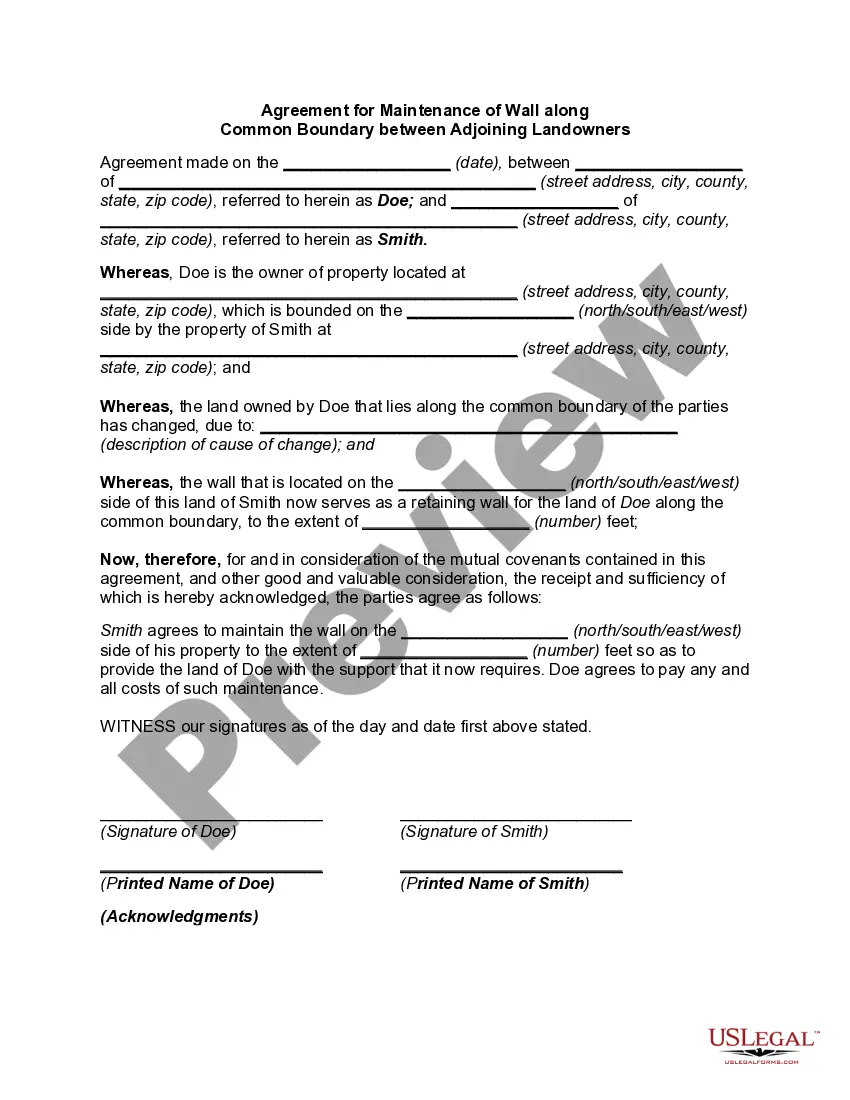
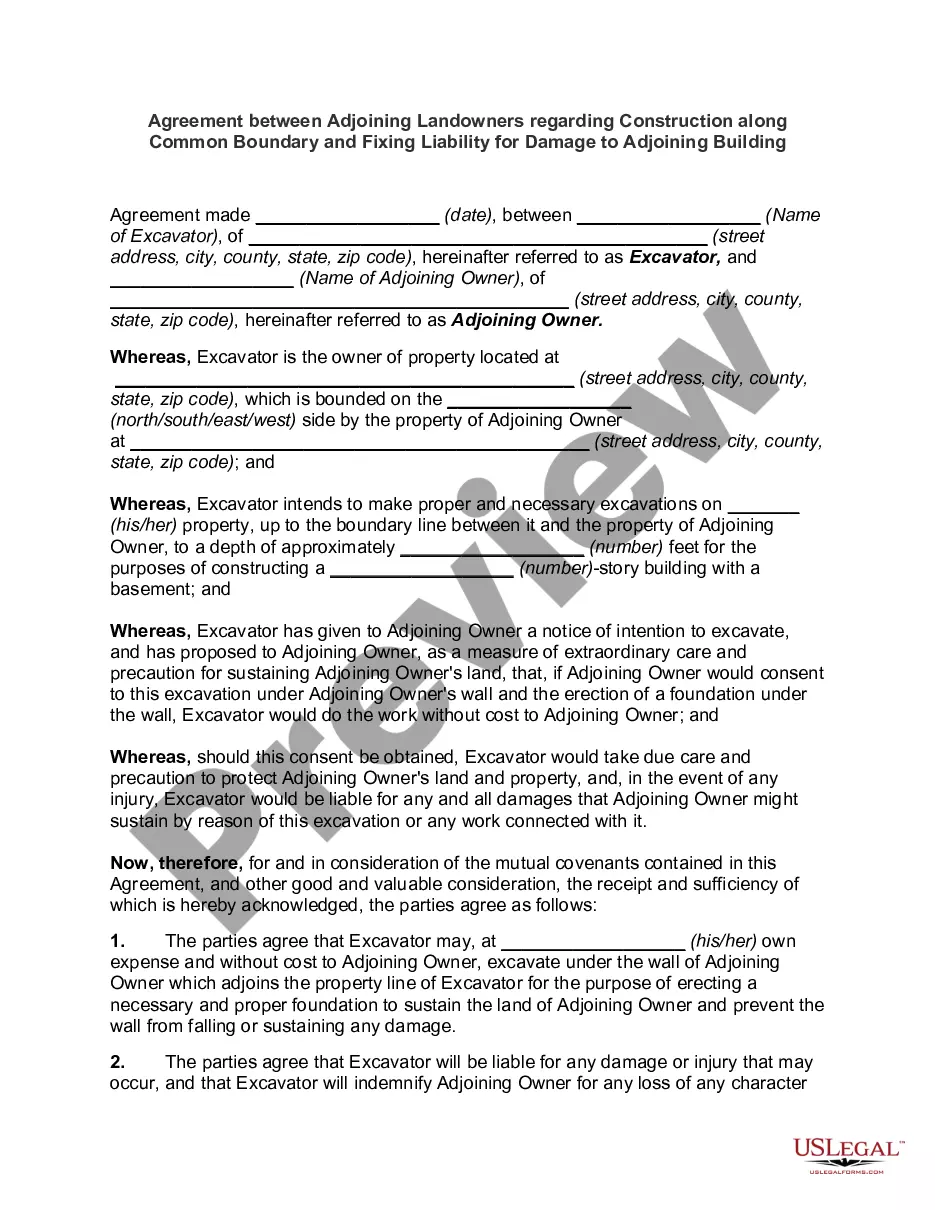
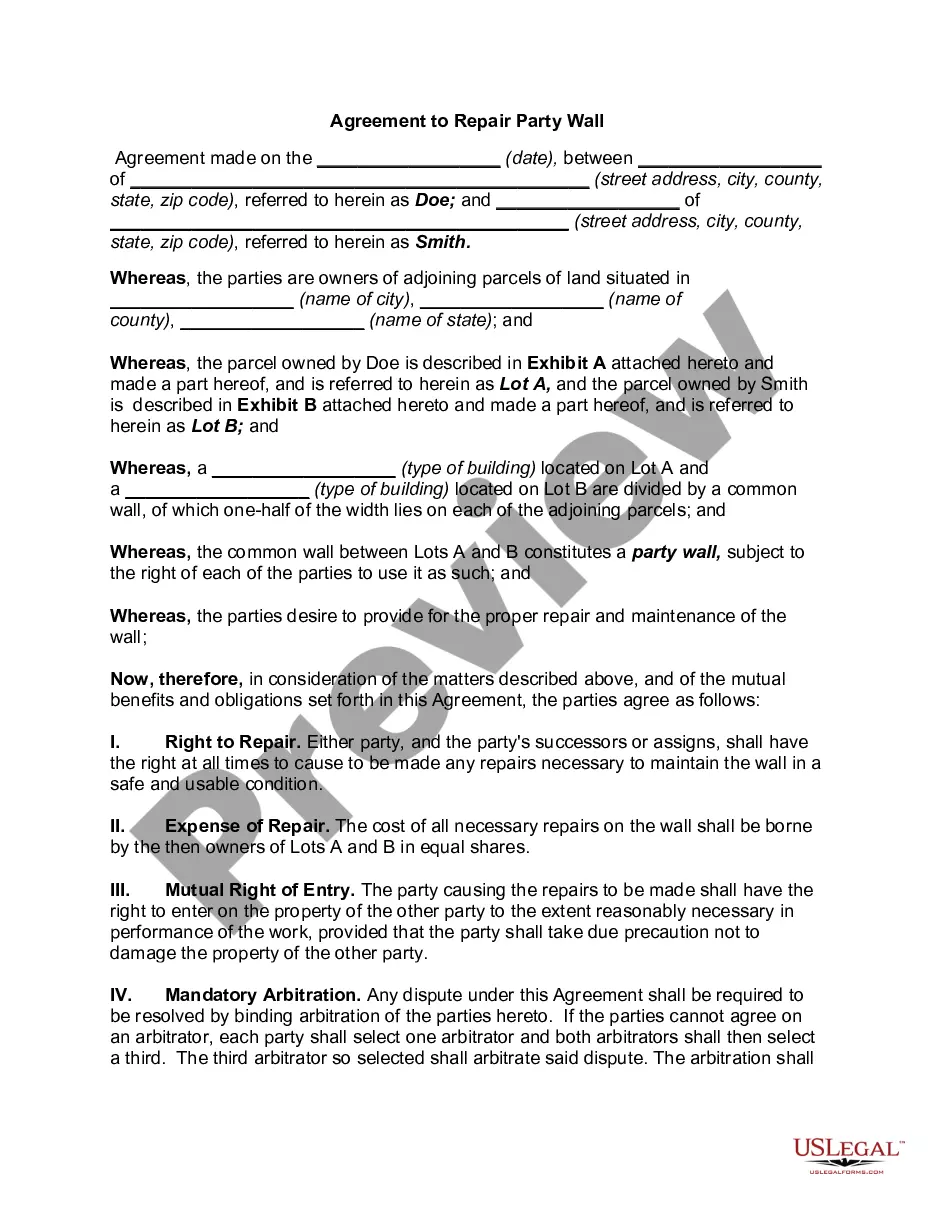
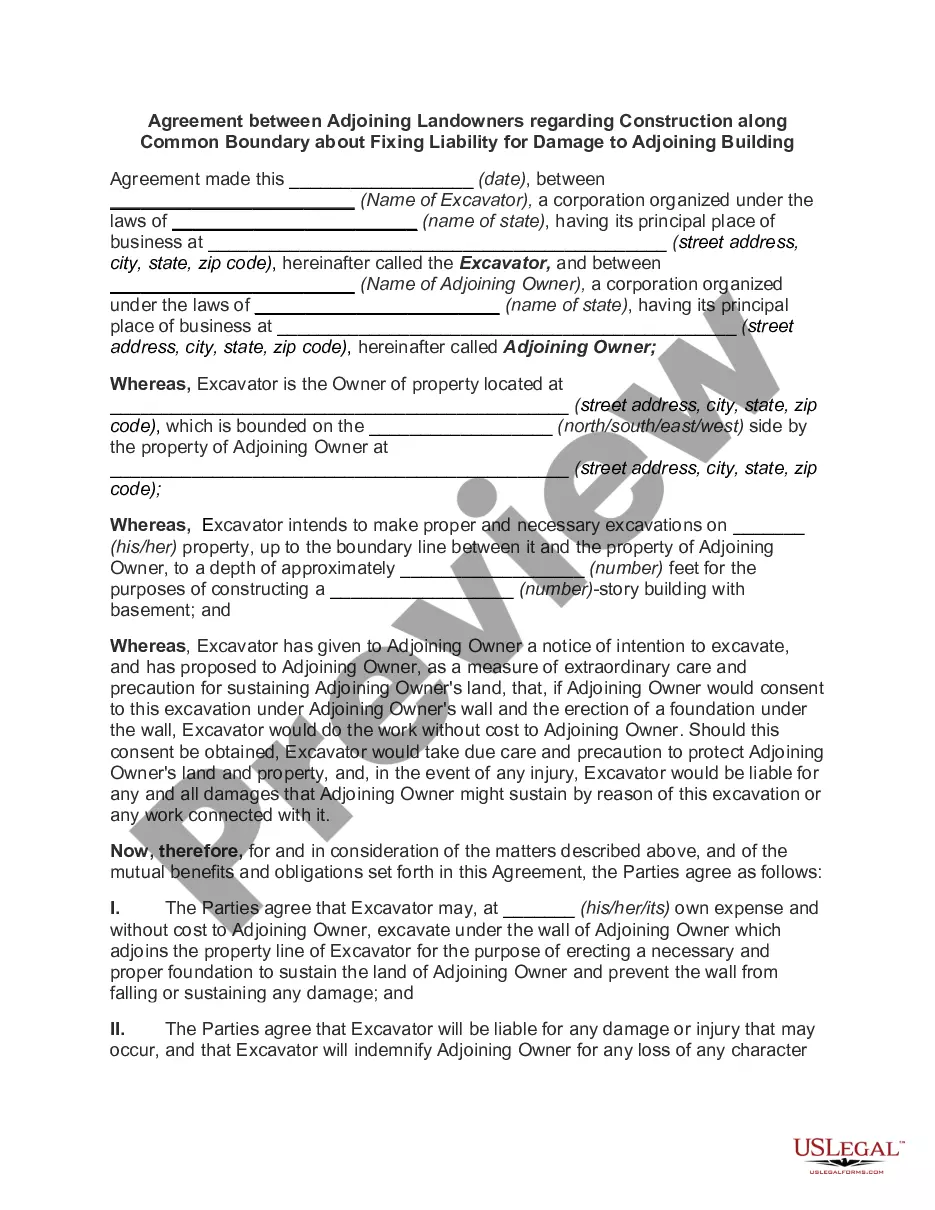
The Agreement for Maintenance of Wall Along Common Boundary Between Adjoining Landowners is a legal document that outlines the responsibilities of two property owners regarding the maintenance of a wall that lies on their shared boundary. This form helps ensure that both parties agree on who is responsible for upkeep, thus safeguarding property rights and preventing disputes. Unlike other agreements, this specific one focuses on the maintenance of a physical structure that is critical for land support between adjoining properties.
Form components explained
- Date of agreement
- Names and addresses of both property owners
- Description of the properties involved
- Details about the wall's maintenance obligations
- Signatures of both parties indicating consent
Common use cases
This form is useful in scenarios where two neighboring property owners need to establish responsibility for a wall that serves as a boundary and retaining structure. It is suitable if the wall has been affected by changes in the land, such as erosion or other factors that might require maintenance. Use this form to clearly delineate each party's duties, minimizing the risk of conflicts over property boundaries and structural integrity.
Who can use this document
- Adjoining landowners seeking to formalize maintenance responsibilities
- Individuals who have experienced changes to their property affecting the shared wall
- Property owners looking to prevent disputes regarding boundary maintenance
- People with limited legal experience who need a straightforward agreement template
How to complete this form
- Identify the parties by entering the full names and addresses of both property owners.
- Specify the date on which the agreement is made.
- Provide a description of the properties involved, focusing on the common boundary.
- Detail the extent of the wall maintenance obligation, including the specific area concerned.
- Complete the agreement with signatures and printed names of both parties.
Notarization requirements for this form
This form does not typically require notarization unless specified by local law. However, confirming the need for notarization based on the jurisdiction is always a good practice.
Get your form ready online
Our built-in tools help you complete, sign, share, and store your documents in one place.
Make edits, fill in missing information, and update formatting in US Legal Forms—just like you would in MS Word.
Download a copy, print it, send it by email, or mail it via USPS—whatever works best for your next step.
Sign and collect signatures with our SignNow integration. Send to multiple recipients, set reminders, and more. Go Premium to unlock E-Sign.
If this form requires notarization, complete it online through a secure video call—no need to meet a notary in person or wait for an appointment.
We protect your documents and personal data by following strict security and privacy standards.

Make edits, fill in missing information, and update formatting in US Legal Forms—just like you would in MS Word.

Download a copy, print it, send it by email, or mail it via USPS—whatever works best for your next step.

Sign and collect signatures with our SignNow integration. Send to multiple recipients, set reminders, and more. Go Premium to unlock E-Sign.

If this form requires notarization, complete it online through a secure video call—no need to meet a notary in person or wait for an appointment.

We protect your documents and personal data by following strict security and privacy standards.
Common mistakes
- Failing to include the correct addresses for the properties involved.
- Not clearly defining the responsibilities related to the wall maintenance.
- Omitting signatures or printed names from the agreement.
- Leaving out the date of the agreement.
Benefits of completing this form online
- Convenience of downloading a ready-to-use template.
- Editability allows customization to meet specific needs.
- Reliable legal language drafted by licensed attorneys.
Legal use & context
- This form is enforceable as a contract between the parties once signed.
- Both parties must comply with the terms as outlined in the agreement.
- Any changes to the form after it has been signed may require consent from both parties.
Quick recap
- The agreement clarifies maintenance duties for a boundary wall.
- It prevents potential disputes between adjoining landowners.
- Completion requires accurate property descriptions and mutual agreement on responsibilities.
Looking for another form?
Form popularity
FAQ
Party wall: i.e. a wall within a building that joins two properties and forms the boundary between them; Boundary wall, within a garden, so placed as to separate two parcels of land in different ownership;Building faces: a boundary may run along the side (or front or rear) face of a building.
If you wish to allow your neighbour to build his extension on the boundary line you should agree and sign a party wall agreement stating that you can also use this wall at a later stage if you decide to make changes, or whatever to your property.
Single story extensions to the side of your property to be no more than four meters in height and no wider than half the original size of the property. For those building a double extension on their property, you cannot go closer than seven meters to the boundary.
A neighbor will not own the part of a structure that encroaches on their land. Instead, the encroachment will be viewed as an act of trespass. Also, although the neighbor will be able to sue that person for trespass, they will not automatically gain legal title to the portion of the building that is now on their land.
Don't Let Your Extension Go To The (Party) Wall Act 1996 () where you intend to:construct a new wall or structure at or astride the boundary line with an adjoining property, or. excavate within 3 or 6 metres of an adjoining building or structure (depending on the depth of the works)
You can drill into them. But you would be damaging their property, and so liable for the damage you cause. And, of course, you would be committing trespass. And that's ignoring any criminal implications you could be at risk of criminal damage.
You must tell your neighbour if you want to: build on or at the boundary of your 2 properties. work on an existing party wall or party structure. dig below and near to the foundation level of their property.
Talk to your neighbor: Your neighbor may be willing to move whatever is on your property over to theirs if it's something like a garden or something else that can be easily moved. Sell the land to your neighbor: Another option would be to sell the land that's being encroached upon by your neighbor to that neighbor.
As a last resort, if you feel confident that your property is being encroached upon, you can file a claim in court and ask a judge to decide the boundariesbut the more you involve the legal system, the more cost you will incur.