Agreement not to Compete during Continuation of Partnership and After Dissolution
Understanding this form
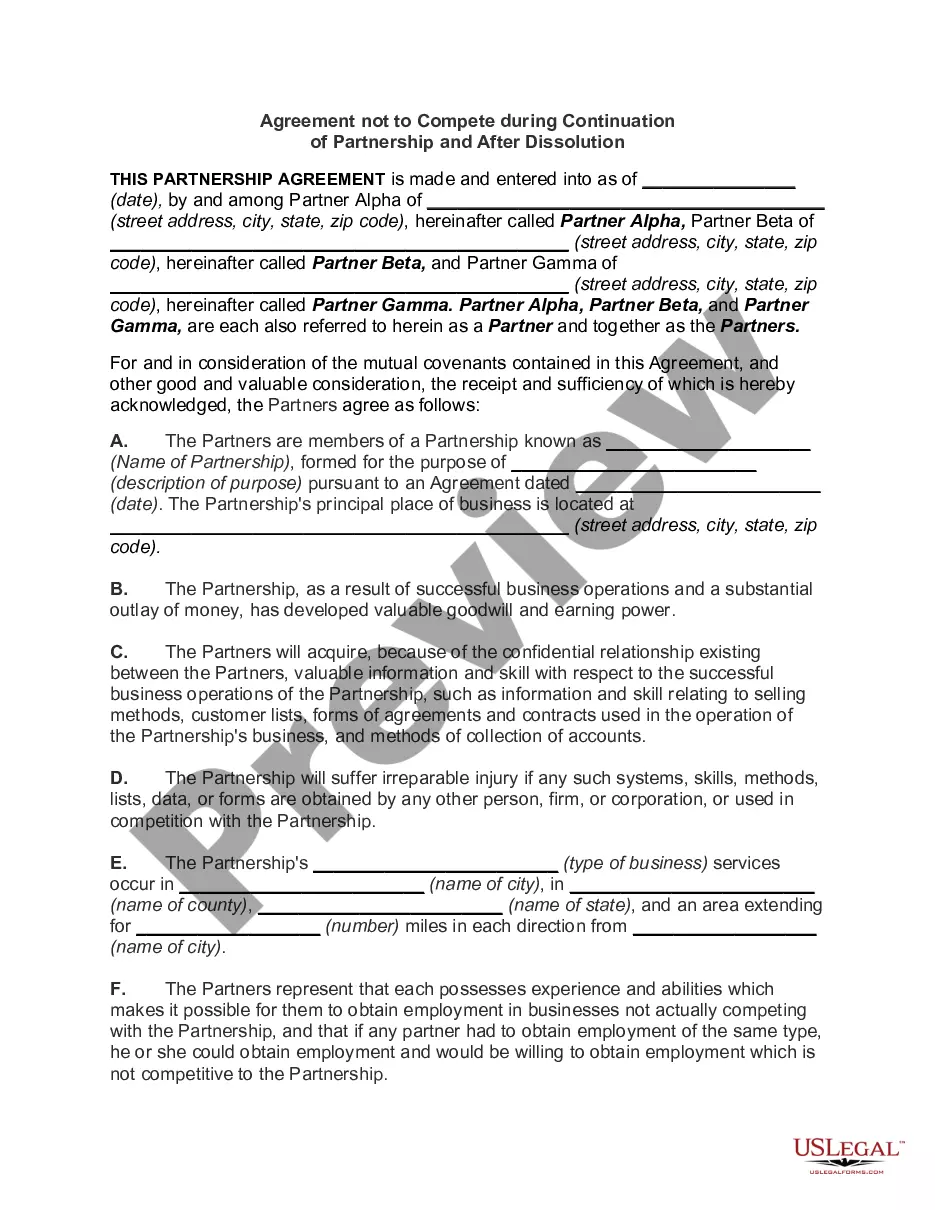
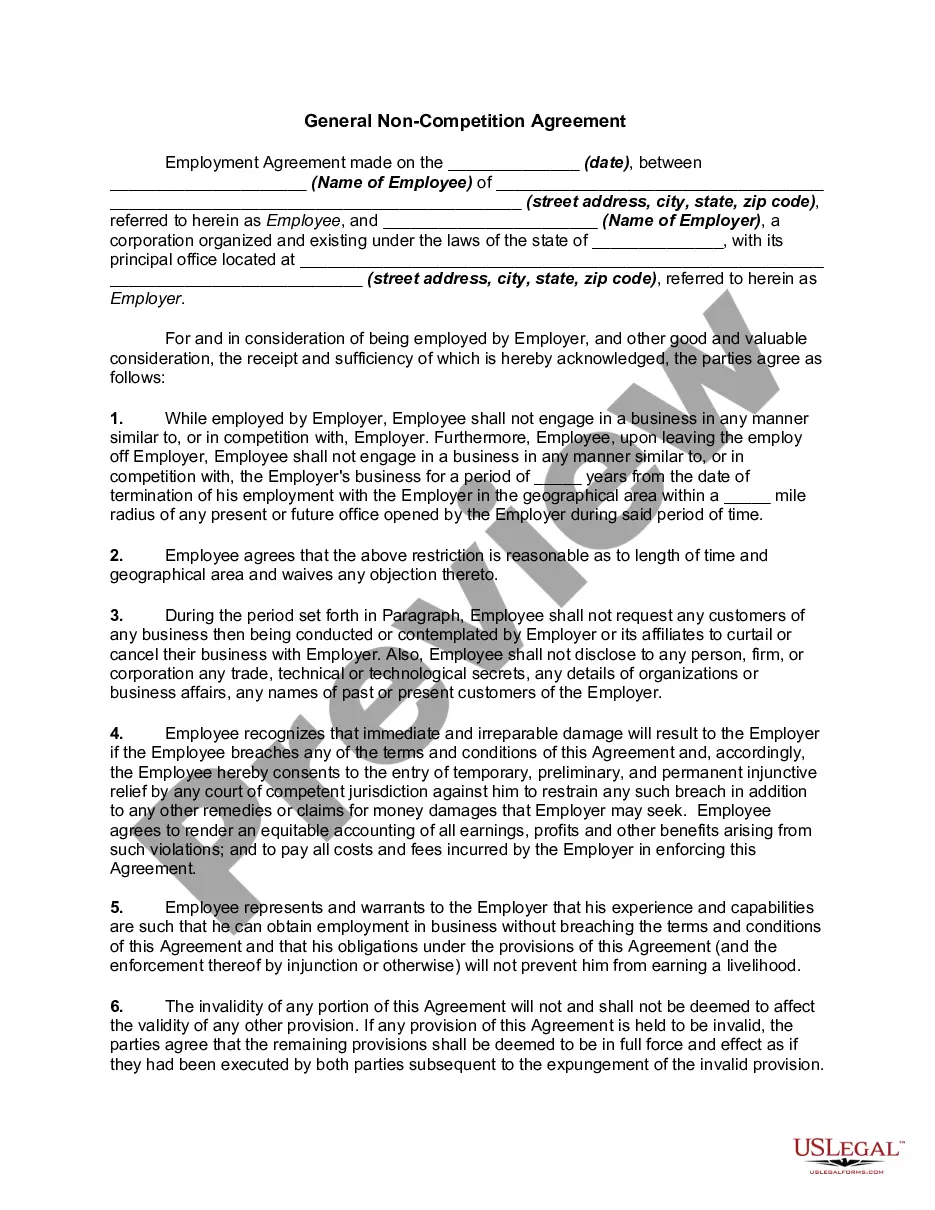
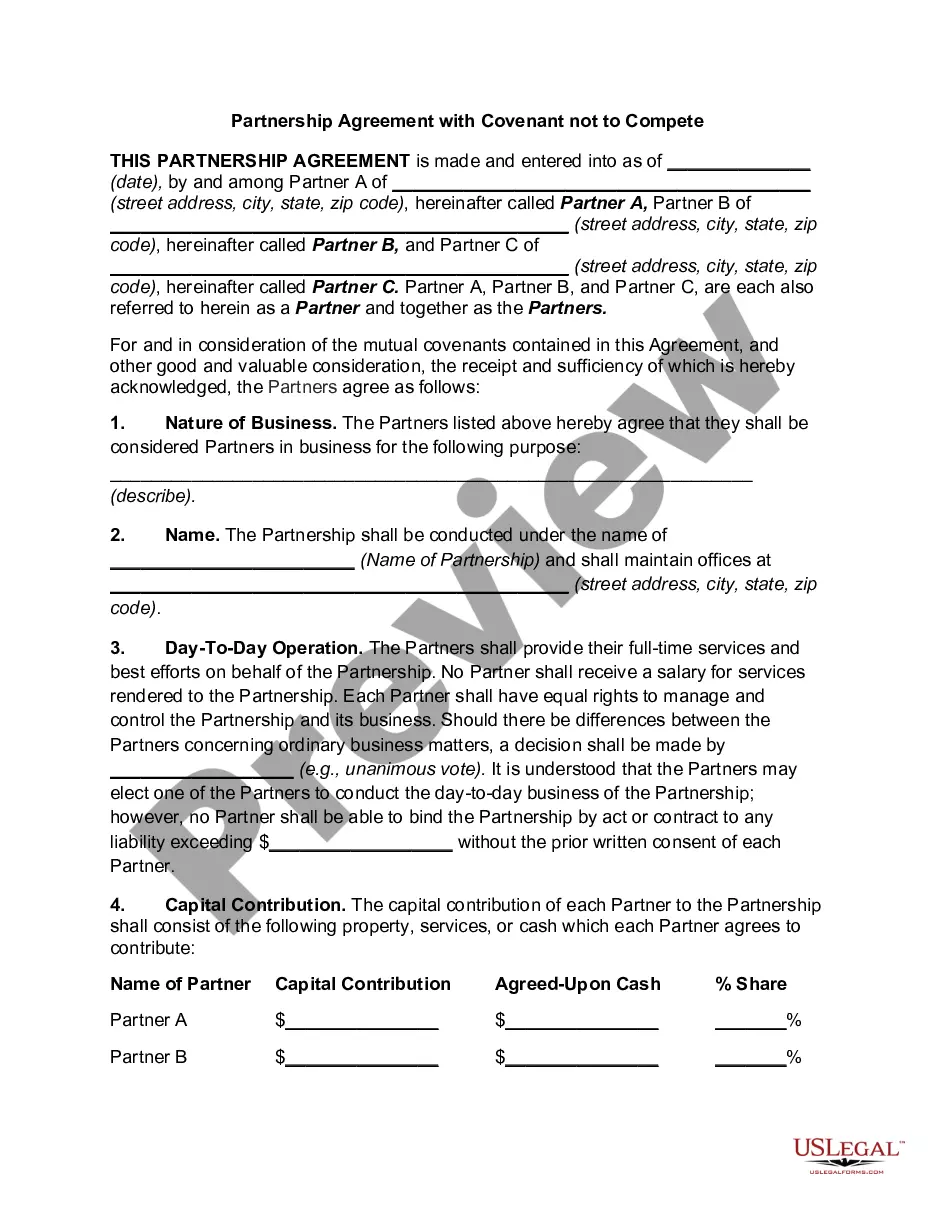
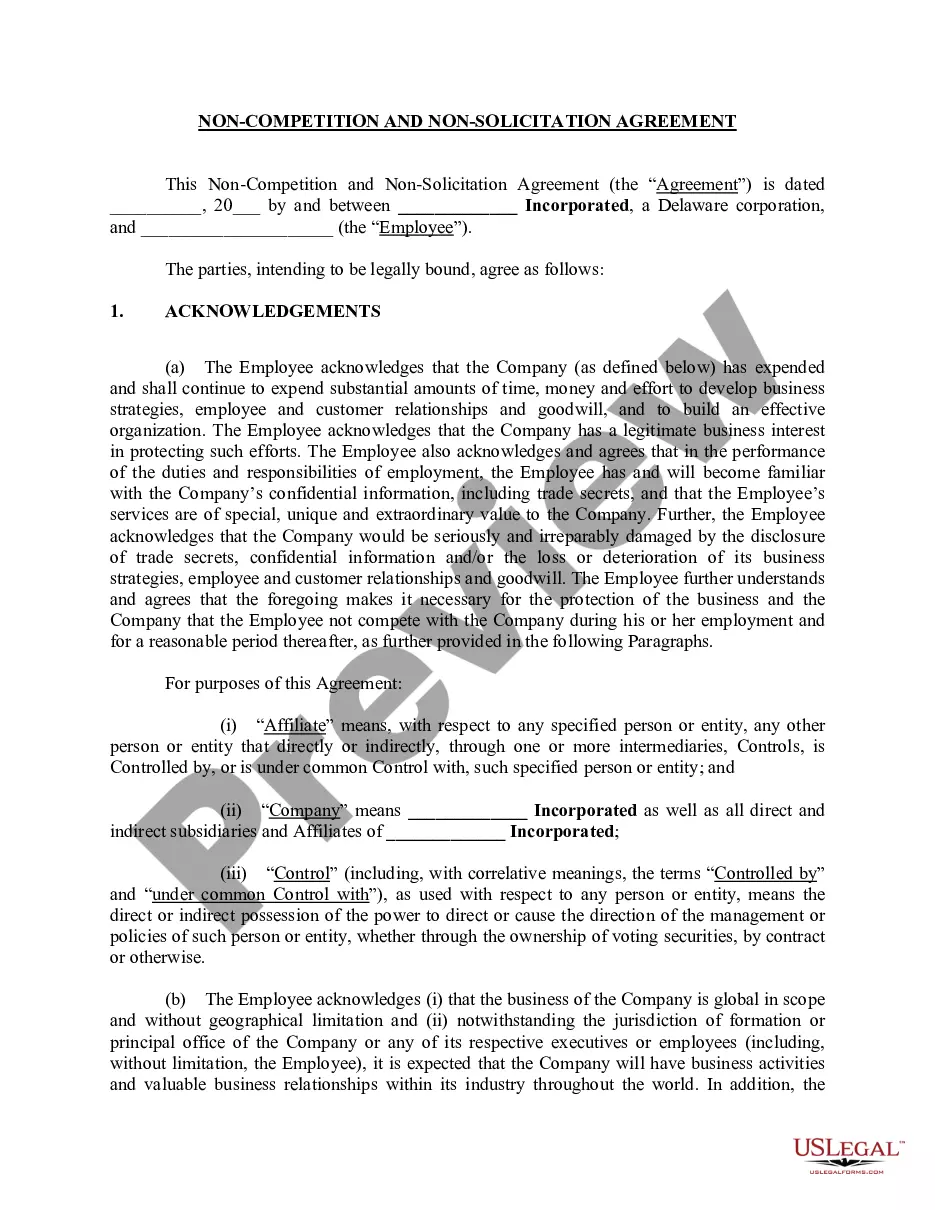
The Agreement Not to Compete During Continuation of Partnership and After Dissolution is a legal document that restricts partners from competing against each other during the partnership and for a specified time after its termination. This form helps protect the partnership's valuable information and goodwill, distinguishing it from other agreements that may focus solely on non-disclosure or confidentiality. By formalizing these terms, partners aim to ensure a fair transition and forgo opportunities that could harm the partnership's interests post-dissolution.
Key components of this form
- Identification of the partners involved and their addresses.
- Statement of the partnership's purpose and principal place of business.
- Definition of what constitutes a competing business.
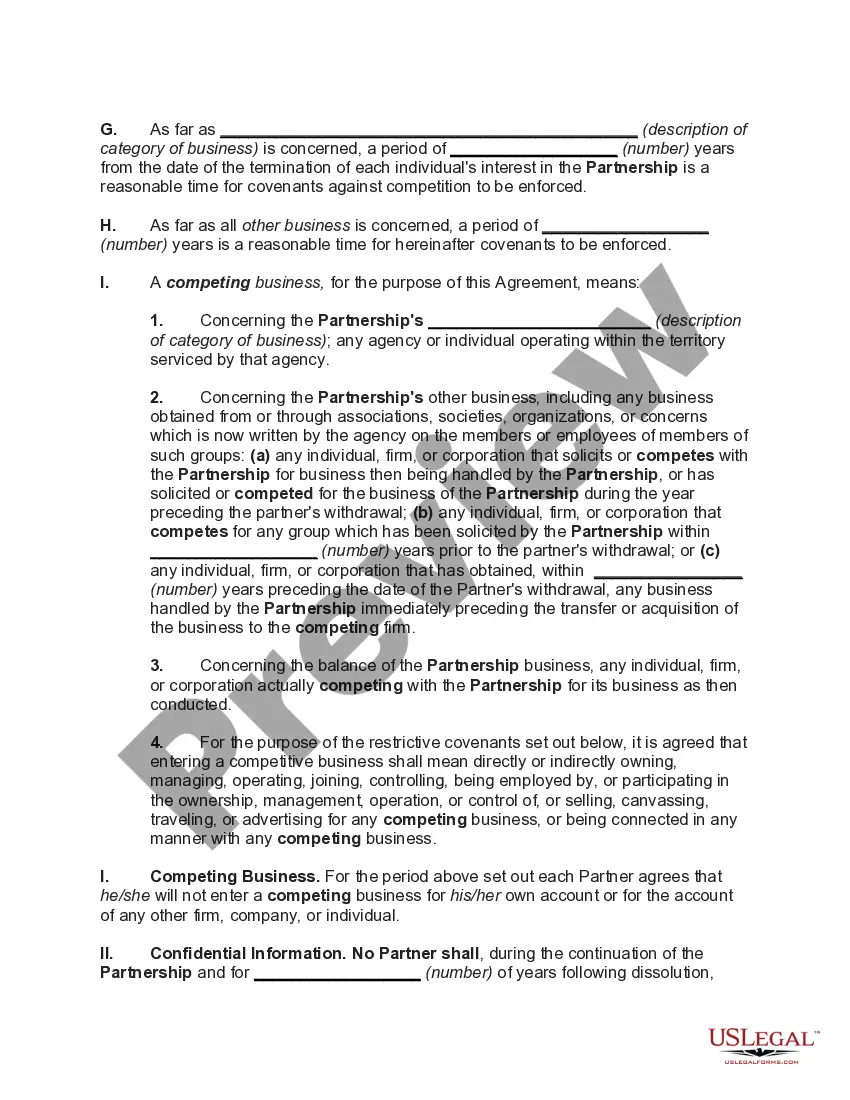
- Provisions regarding the duration of non-competition obligations.
- Confidentiality clauses to protect sensitive information post-dissolution.
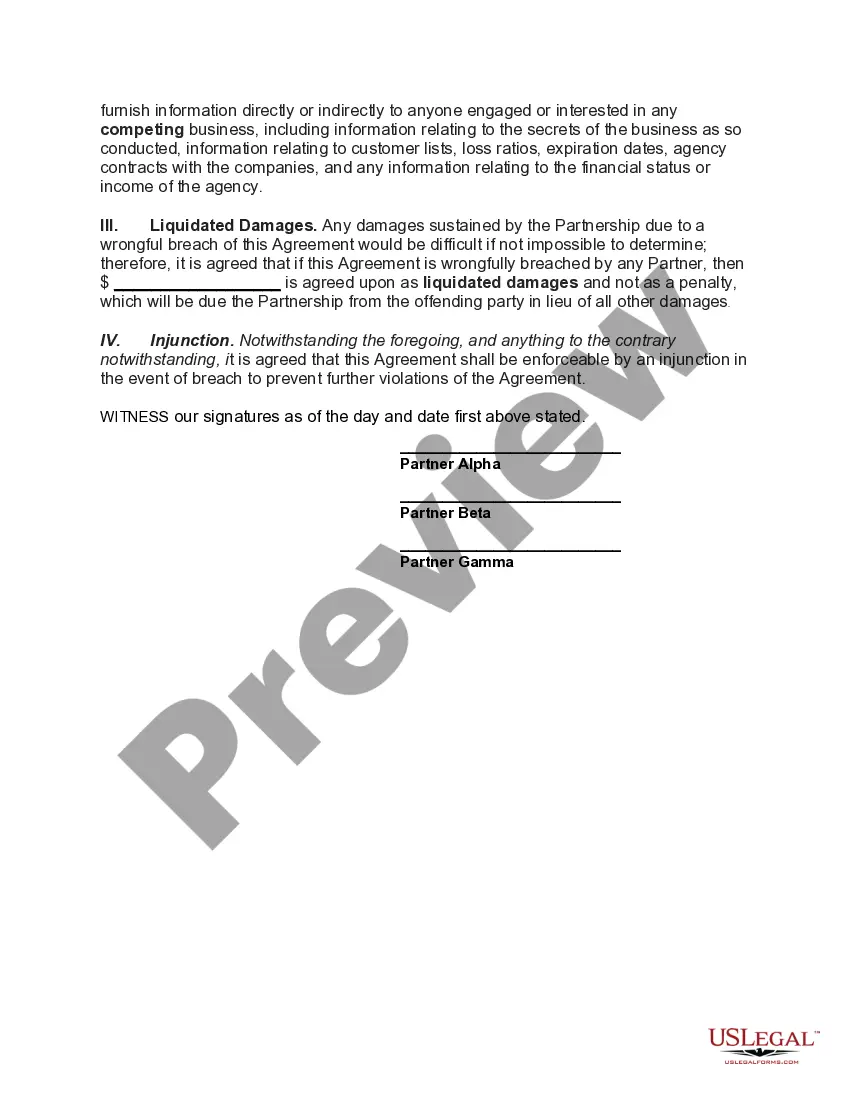
- Consequences for breach, including liquidated damages and the ability to seek an injunction.
Situations where this form applies
This form is necessary when partners in a business wish to outline restrictions on competition to protect their mutual interests. Use it when starting a partnership, as part of the partnership agreement, or when dissolving a partnership to ensure that partners will not exploit confidential information or goodwill gained during their time together. It is particularly useful in industries where client relationships and proprietary methods are critical to success.
Who needs this form
- Partners in a business partnership looking to protect their shared interests.
- Individuals planning to enter into a partnership agreement.
- Business owners considering dissolution of a partnership and wanting to secure confidentiality and non-competition provisions.
- Attorneys who require a standardized agreement for their clients forming partnerships.
Instructions for completing this form
- Identify and enter the names and addresses of all partners.
- Specify the partnership's name, purpose, and principal place of business.
- Define what constitutes a competing business relevant to your partnership's activities.
- Determine and write the duration of non-competition and confidentiality obligations.
- Include liquidated damages terms and other consequences of breach.
- Ensure all partners sign and date the agreement.
Notarization guidance
This form does not typically require notarization unless specified by local law. However, consulting with a legal professional is recommended to ensure compliance with your specific jurisdiction.
Get your form ready online
Our built-in tools help you complete, sign, share, and store your documents in one place.
Make edits, fill in missing information, and update formatting in US Legal Forms—just like you would in MS Word.
Download a copy, print it, send it by email, or mail it via USPS—whatever works best for your next step.
Sign and collect signatures with our SignNow integration. Send to multiple recipients, set reminders, and more. Go Premium to unlock E-Sign.
If this form requires notarization, complete it online through a secure video call—no need to meet a notary in person or wait for an appointment.
We protect your documents and personal data by following strict security and privacy standards.

Make edits, fill in missing information, and update formatting in US Legal Forms—just like you would in MS Word.

Download a copy, print it, send it by email, or mail it via USPS—whatever works best for your next step.

Sign and collect signatures with our SignNow integration. Send to multiple recipients, set reminders, and more. Go Premium to unlock E-Sign.

If this form requires notarization, complete it online through a secure video call—no need to meet a notary in person or wait for an appointment.

We protect your documents and personal data by following strict security and privacy standards.
Avoid these common issues
- Not defining what constitutes a competing business clearly.
- Failing to specify the duration of the non-competition clause.
- Omitting to include necessary partner signatures.
- Neglecting to review local laws on enforceability of non-compete agreements.
Benefits of completing this form online
- Convenient access to professionally drafted templates that save time.
- Easy customization to fit specific partnership needs and local regulations.
- Reliable format that can be downloaded and stored safely for future reference.
Legal use & context
- This agreement helps prevent potential disputes over competitive practices after dissolution.
- It's important for the enforceability of the agreement to align with local laws regarding restrictive covenants.
- Properly drafted agreements are generally upheld in court if they are reasonable in scope and duration.
Looking for another form?

Form popularity
FAQ
The expiration of a partnership's term. A partner serving notice of intention to leave. The court deeming the partnership as illegal. A partner's death or bankruptcy. The partnership becoming insolvent. A court-order dissolution due to incapacity or unsoundness of mind in one of the partners.
If there is no written partnership agreement, partners are not allowed to draw a salary. Instead, they share the profits and losses in the business equally. The agreement outlines the rights, responsibilities, and duties each partner has to the company and to each other.
Usually, general partnerships will dissolve if any partner withdraws, becomes deceased, or otherwise becomes unable to continue their duties as a partner. Other circumstances that may lead to partnership dissolution may include: Loss of profits or declaration of bankruptcy. Illegal activities or violations.
Protect Yourself From Your Partner's Debts In your written partnership agreement, make sure you limit the amount of debt partners can tie to your business without other partner's consent. If you do not, your partner could tie your partnership to a debt or business agreement against your will or without your knowledge.
In a General Partnership, all partners are financially obligated to any debts incurred by the partnership. When a partner leaves, the partnership dissolves and the partners equally split debts and assets.
3 attorney answers A general partnership can be dissolved when a partner withdraws or dies. However, dissolution is only the beginning of the winding up process. Assets must be divided and liabilities paid.
It has a precise legal definition, given in UPA Section 29: The dissolution of a partnership is the change in the relation of the partners caused by any partner ceasing to be associated in the carrying on as distinguished from the winding up of the business. The partnership is not necessarily terminated on
When a partnership dissolves, the individuals involved are no longer partners in a legal sense, but the partnership continues until the business's debts are settled, the legal existence of the business is terminated and the remaining assets of the company have been distributed.