Stock Option Agreement between Corporation and Officer or Key Employee
What this document covers
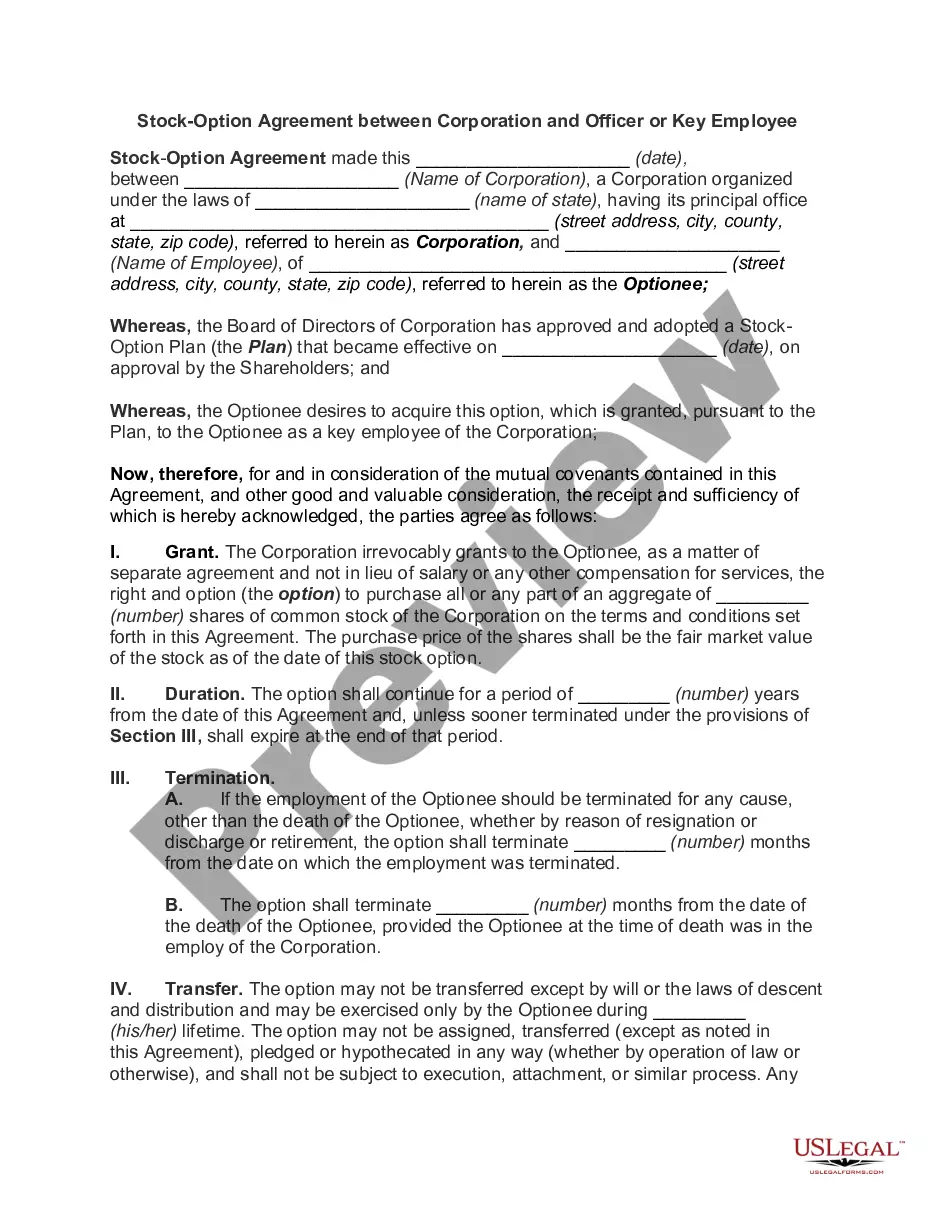
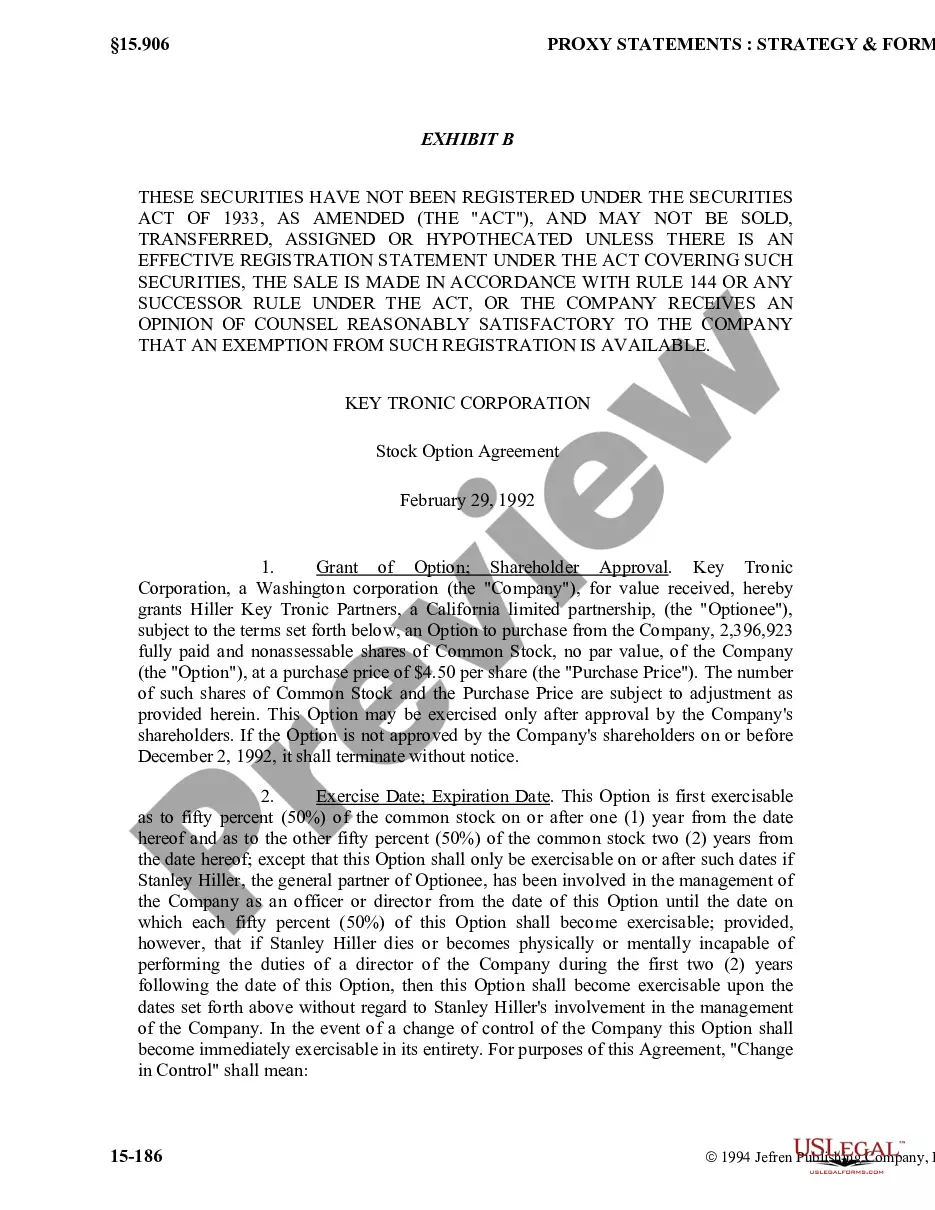
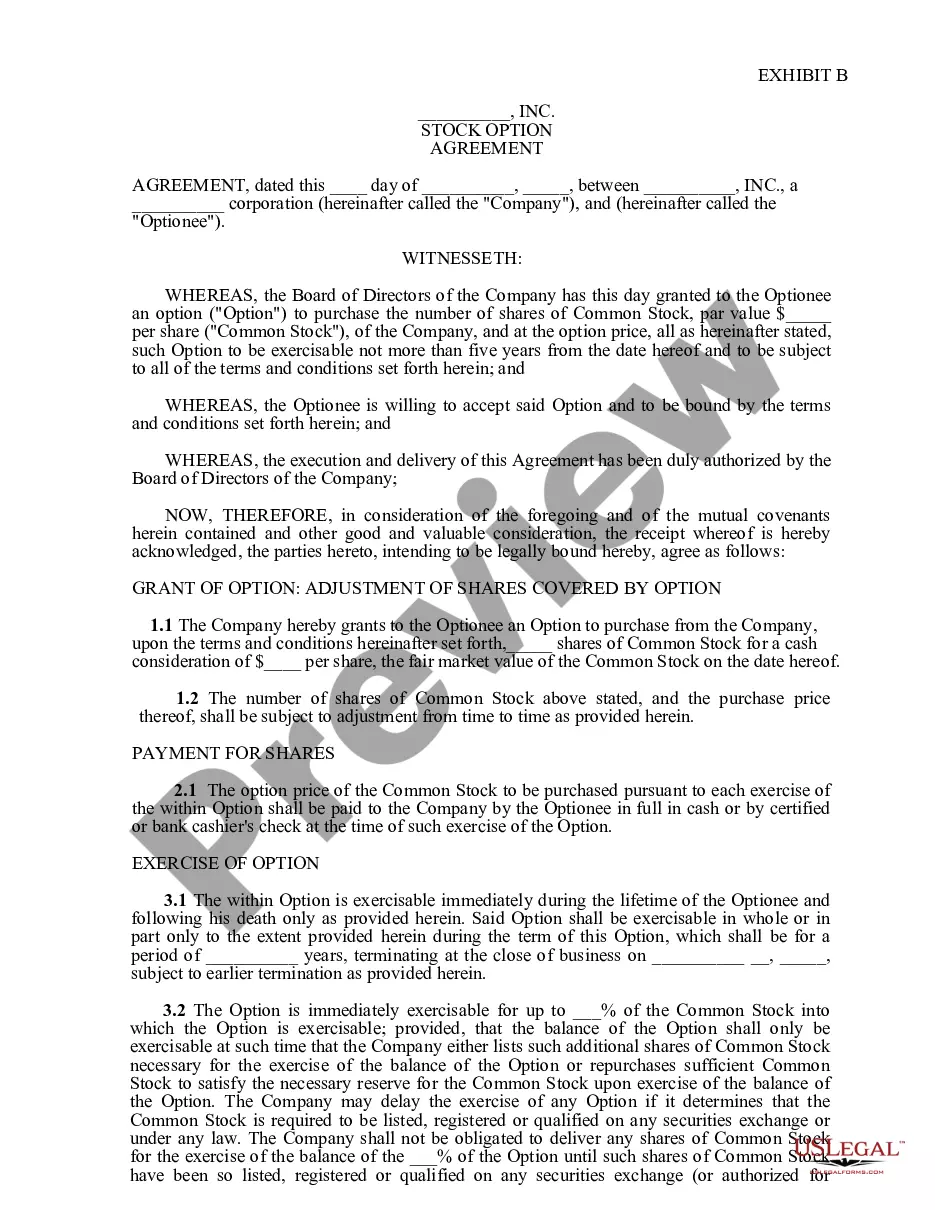
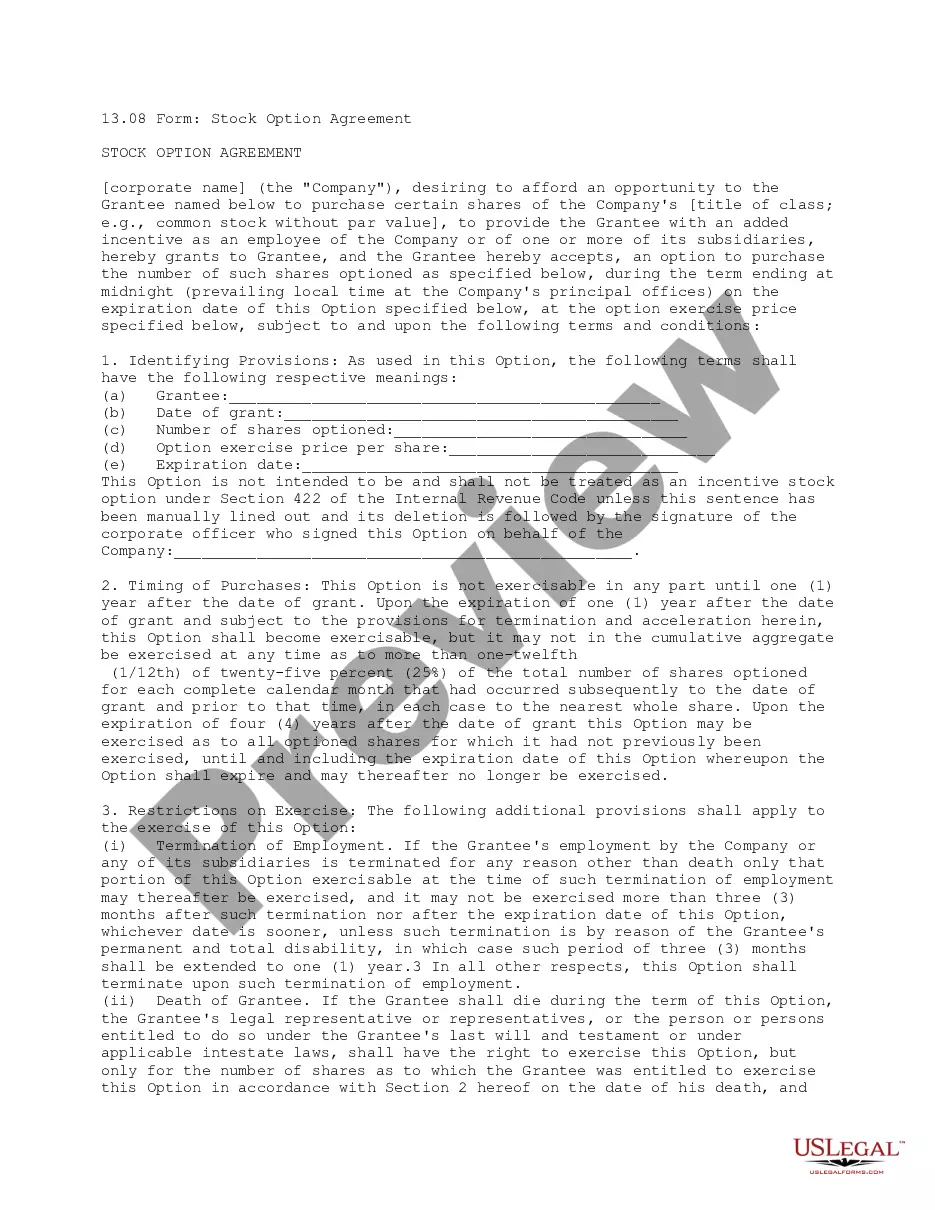
A stock option agreement between a corporation and an officer or key employee outlines the terms under which the employee can purchase stock from the company at a set price for a specified period. This legal form is essential for defining the rights and responsibilities associated with stock options, distinguishing it from other compensation agreements. Utilizing this form ensures that both parties are protected and clear on the conditions of the stock option grant.
What’s included in this form
- Grant: Details the number of shares and terms of the stock option.
- Duration: Specifies the length of time the option is valid.
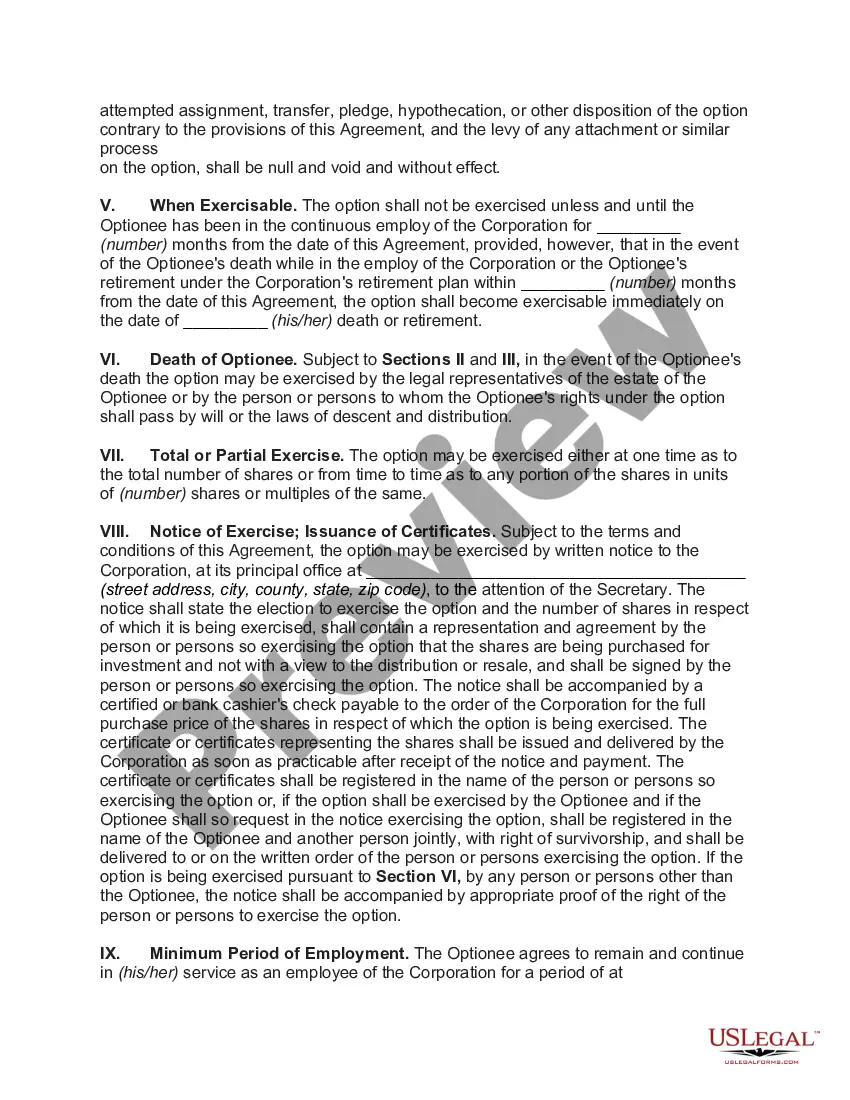
- Termination: Outlines conditions under which the option may be terminated.
- Transfer: Explains transferability restrictions of the option.
- Exercisability: States conditions for when the option can be exercised.
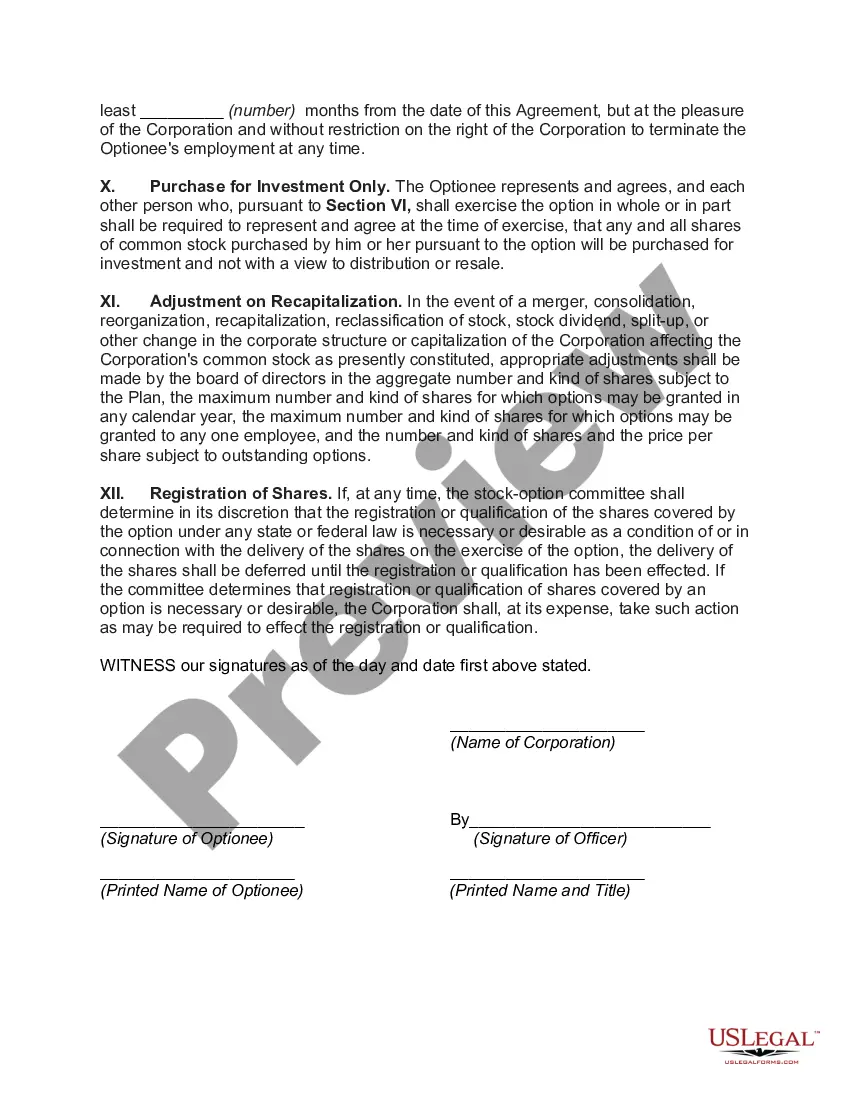
- Notice of exercise: Provides instructions for how to formally exercise the option.

When to use this form
This form should be used when a corporation wishes to offer stock options as part of the employment compensation for key employees or officers. It is particularly useful in attracting and retaining top talent by providing them with a stake in the companyâs growth. Use this form when establishing clear terms for stock options to avoid future disputes related to stock ownership and rights.
Who can use this document
- Corporations that want to incentivize key employees through stock options.
- Officers or key employees being granted stock options as part of their employment package.
- Human resource professionals involved in designing compensation plans.
- Legal advisors assisting corporations in drafting stock option agreements.
Steps to complete this form
- Identify the parties involved: the corporation and the optionee (employee).
- Enter the effective date of the agreement and the number of shares granted.
- Specify the duration of the stock option and any termination conditions.
- Include details on how the option can be exercised and any applicable notice requirements.
- Provide signatures from both the corporation representative and the optionee.
Is notarization required?
This form does not typically require notarization unless specified by local law. However, it is advisable to confirm if any state-specific regulations necessitate notarization to ensure the validity of the agreement.
Get your form ready online
Our built-in tools help you complete, sign, share, and store your documents in one place.
Make edits, fill in missing information, and update formatting in US Legal Forms—just like you would in MS Word.
Download a copy, print it, send it by email, or mail it via USPS—whatever works best for your next step.
Sign and collect signatures with our SignNow integration. Send to multiple recipients, set reminders, and more. Go Premium to unlock E-Sign.
If this form requires notarization, complete it online through a secure video call—no need to meet a notary in person or wait for an appointment.
We protect your documents and personal data by following strict security and privacy standards.

Make edits, fill in missing information, and update formatting in US Legal Forms—just like you would in MS Word.

Download a copy, print it, send it by email, or mail it via USPS—whatever works best for your next step.

Sign and collect signatures with our SignNow integration. Send to multiple recipients, set reminders, and more. Go Premium to unlock E-Sign.

If this form requires notarization, complete it online through a secure video call—no need to meet a notary in person or wait for an appointment.

We protect your documents and personal data by following strict security and privacy standards.
Mistakes to watch out for
- Failing to specify the number of shares granted.
- Not outlining clear conditions for exercising the stock options.
- Leaving out important termination clauses.
- Forgetting to have all parties sign the agreement.
Advantages of online completion
- Convenience: Access and complete the form at your own pace without the need for physical paperwork.
- Editability: Make changes easily before finalizing the agreement.
- Reliability: Ensure that the template is vetted by licensed attorneys for legal compliance.
Legal use & context
- The Stock Option Agreement is legally binding upon signature by both parties, ensuring the terms are enforceable.
- It is important to adhere to all provisions to prevent any legal disputes related to stock option exercise.
- Corporations should maintain clear records of stock option agreements for internal compliance and reporting purposes.
Main things to remember
- A Stock Option Agreement grants employees the right to purchase stock, aligning their interests with the company's performance.
- Clear terms and conditions are vital to prevent misunderstandings regarding stock options.
- This form is versatile and applies to various corporate and employment situations.
Looking for another form?

Form popularity
FAQ
What is a Stock Option? A stock option gives an investor the right, but not the obligation, to buy or sell a stock at an agreed upon price and date. There are two types of options: puts, which is a bet that a stock will fall, or calls, which is a bet that a stock will rise.
Stock options may be considered a form of compensation which gives the employee the right to buy an amount of company stock at a set price during a certain time period. Under U.S. accounting methods, stock options are expensed according to the stock options' fair value.
The simplest way to hedge your position and guarantee your outcome is to short your shares. By this we mean borrow shares of your employer's stock from your broker and then sell them in the open market. You then pay back the loan with your exercised options or your RSUs when you are ready.
Oftentimes, stock-based compensation is redeemable at the employee's or employer's option. Stock-based compensation that is redeemable at the employee's option is a considered an employer obligation, and thus a liability while awards that are redeemable at the employer's option are classified as equity.
Stock options are a form of compensation. Companies can grant them to employees, contractors, consultants and investors. These options, which are contracts, give an employee the right to buy or exercise a set number of shares of the company stock at a pre-set price, also known as the grant price.
The stock option compensation is an expense of the business and is represented by the debit to the expense account in the income statement. The other side of the entry is to the additional paid in capital account (APIC) which is part of the total equity of the business.
Stock Option Journal Entries Year 1 The stock option compensation is an expense of the business and is represented by the debit to the expense account in the income statement. The other side of the entry is to the additional paid in capital account (APIC) which is part of the total equity of the business.
Types of Employee Stock Options Companies can offer two types of stock optionsnonqualified stock options (NQSOS) and incentive stock options (ISOS).
For a long position in a stock or other asset, a trader may hedge with a vertical put spread. This strategy involves buying a put option with a higher strike price, then selling a put with a lower strike price. However, both options have the same expiry.