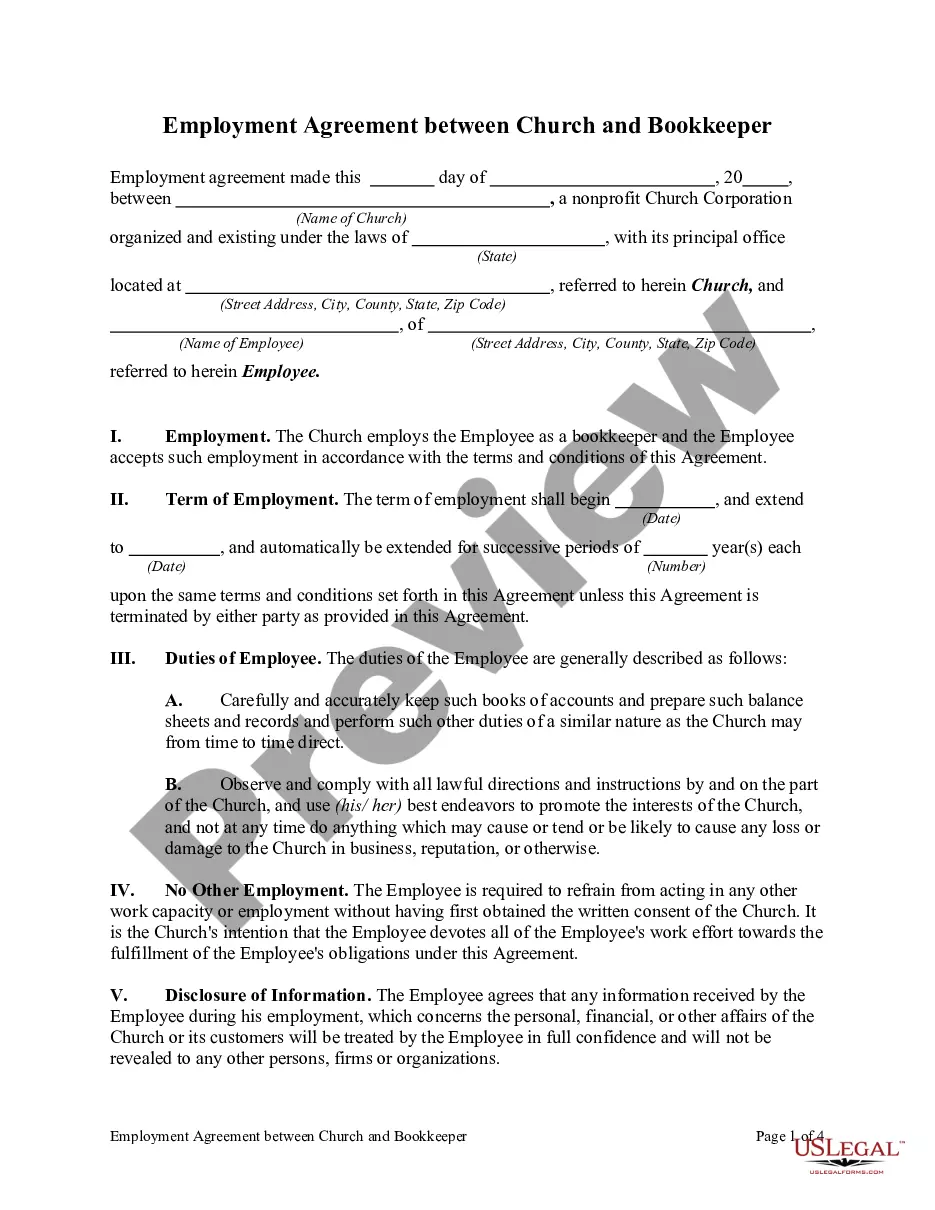
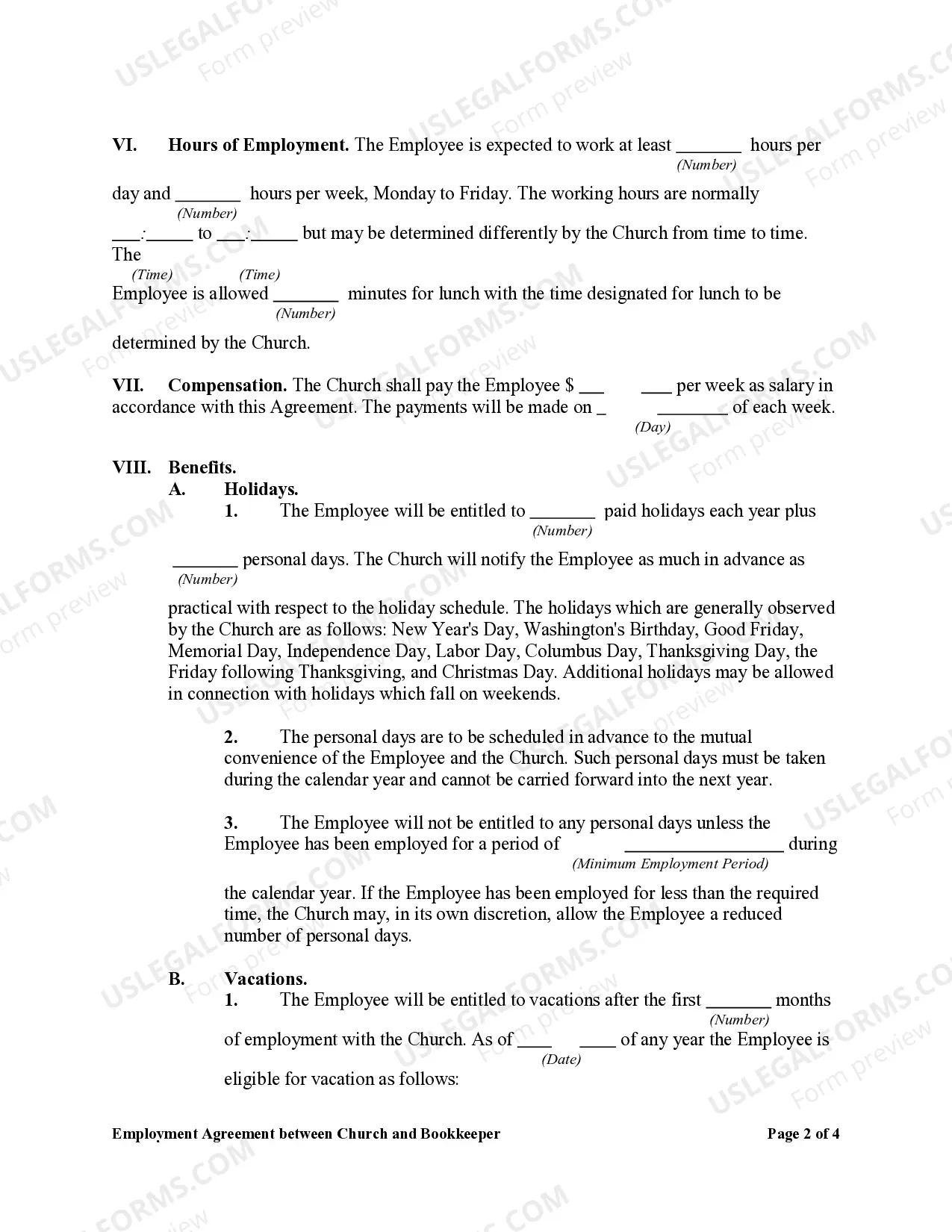
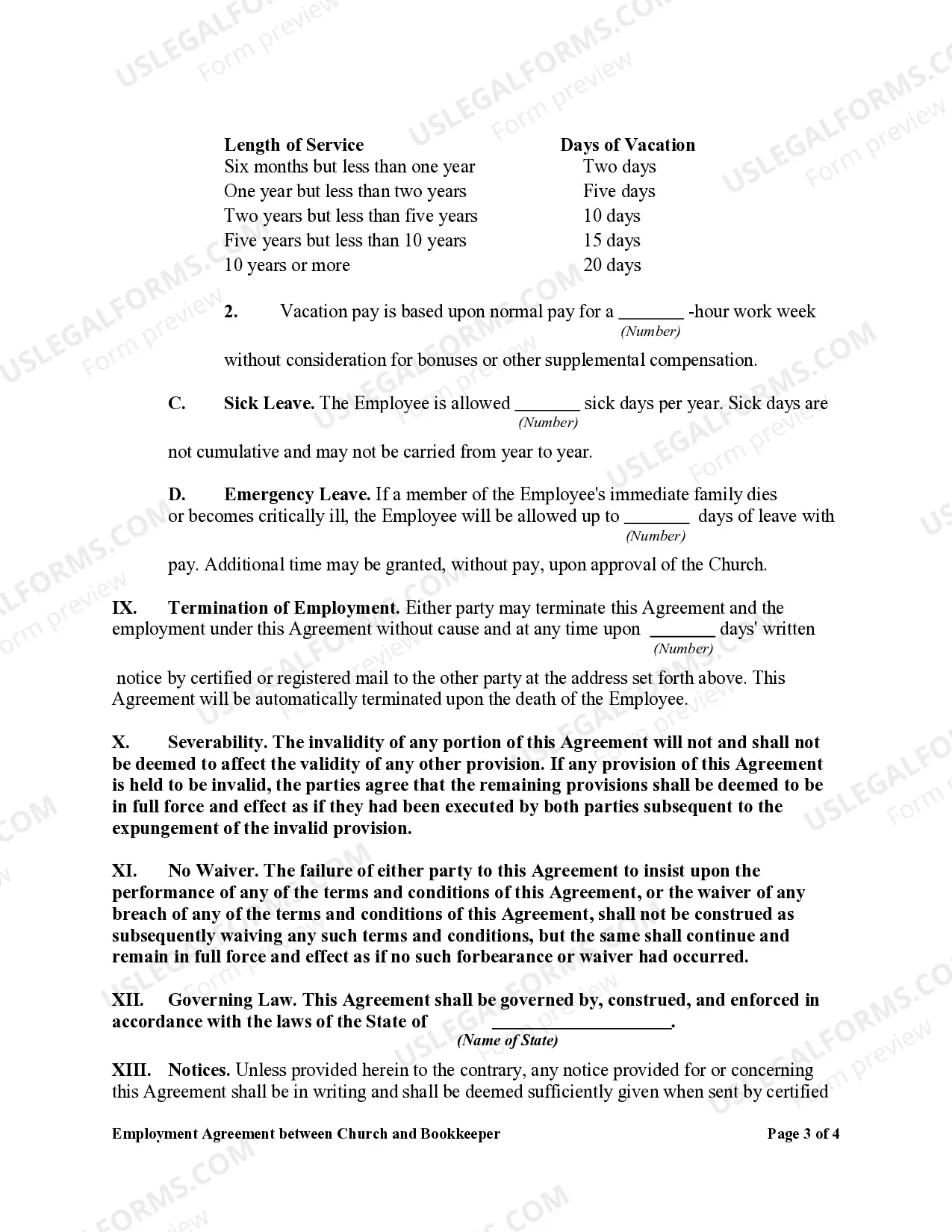
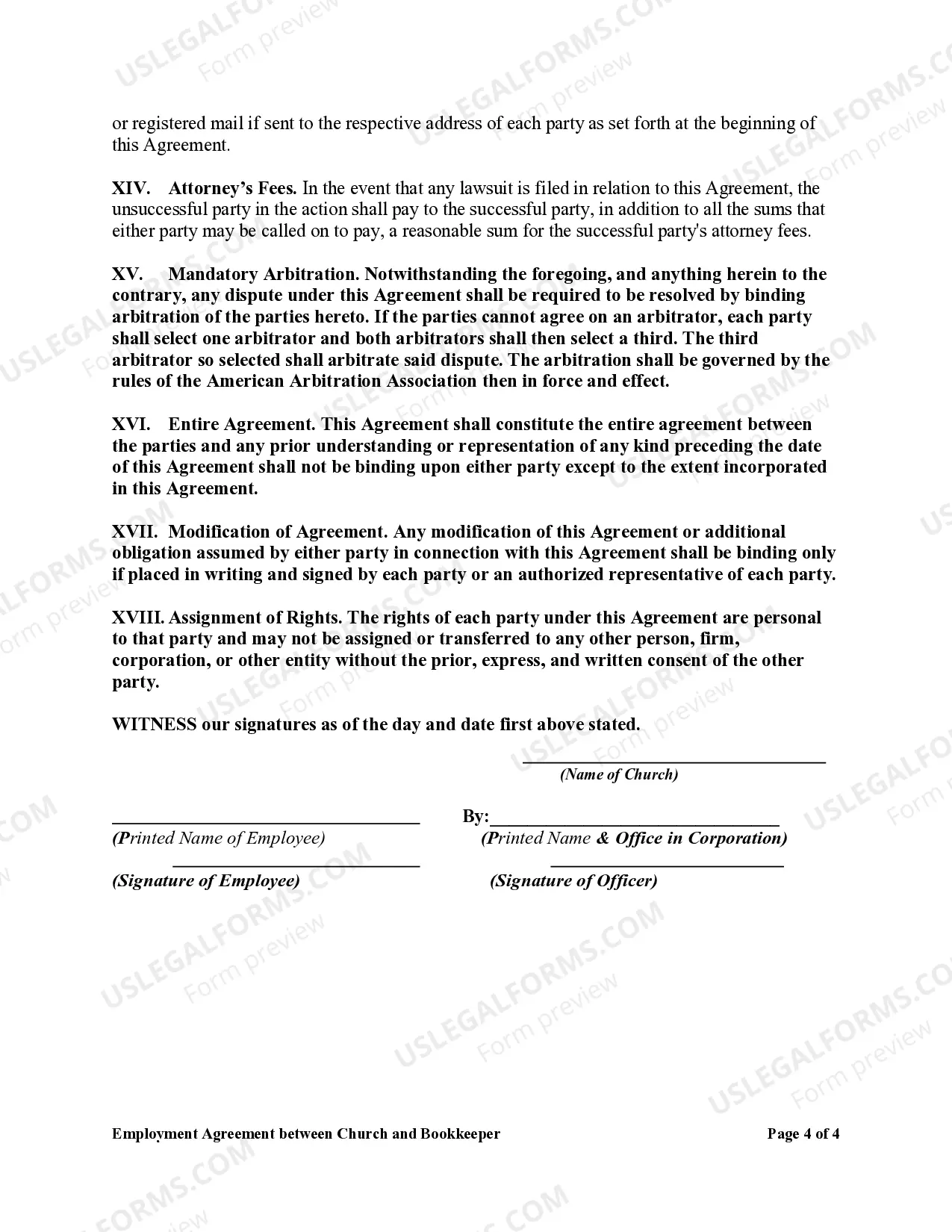
The Employment Agreement between Church and Bookkeeper is a legal document outlining the terms of employment for a bookkeeper working in a church setting. This form specifies the bookkeeper's responsibilities, including keeping accurate financial records, adhering to the church's guidelines, and maintaining confidentiality regarding the church's affairs. Unlike other employment contracts, this agreement is tailored specifically for church-related bookkeeping roles, addressing unique aspects of working within a religious organization.
This form should be used when hiring a bookkeeper for a church. It is essential when establishing clear expectations for job responsibilities, compensation, and the scope of work. It also helps protect the church's interests by setting forth confidentiality requirements and stipulations regarding outside employment.
This form does not typically require notarization unless specified by local law. Ensure to check state regulations for any additional requirements.
Our built-in tools help you complete, sign, share, and store your documents in one place.
Make edits, fill in missing information, and update formatting in US Legal Forms—just like you would in MS Word.
Download a copy, print it, send it by email, or mail it via USPS—whatever works best for your next step.
Sign and collect signatures with our SignNow integration. Send to multiple recipients, set reminders, and more. Go Premium to unlock E-Sign.
If this form requires notarization, complete it online through a secure video call—no need to meet a notary in person or wait for an appointment.
We protect your documents and personal data by following strict security and privacy standards.

Make edits, fill in missing information, and update formatting in US Legal Forms—just like you would in MS Word.

Download a copy, print it, send it by email, or mail it via USPS—whatever works best for your next step.

Sign and collect signatures with our SignNow integration. Send to multiple recipients, set reminders, and more. Go Premium to unlock E-Sign.

If this form requires notarization, complete it online through a secure video call—no need to meet a notary in person or wait for an appointment.

We protect your documents and personal data by following strict security and privacy standards.
Keeping track of daily transactions. A bookkeeper can handle the recording of day-to-day bank transactions. Sending out invoices and managing the accounts receivable ledger. Handling the accounts payable ledger. Keeping an eye on cash flow. Preparing the books for the accountant.
200bQuite often, the bookkeeper and accountant render services under conditions that are a combination of employee and independent contractor. For example, they may be an employee on one job and an independent contractor on another job.
According to IRS guidelines, a pastor is considered self-employed if a church does not have control over the pastor's employment status or activities. When a pastor is given a housing allowance or provided a parsonage, the IRS does not require this compensation to be reported as taxable income.
Organization skills. Attention to details. Integrity and Transparency. Communication skills. Problem-solving skills. Tech-savviness. Time Management Skills. A way with numbers.
Bookkeepers are responsible for providing accurate, up-to-date financial information about a business. They're always taking the pulse of a business. Most often, their reports go to business owners and managers to help them make decisions. Some bookkeepers, however, are actually involved in strategy development.
Along with the scope of work, there is also a difference between their professional status. Bookkeepers record every company transaction that involves money, accountants provide a more in-depth analysis of the financial transactions, and CPAs are state-approved accountants.
Virtual church bookkeepers can act as both accountant and treasurer, in charge of all financial aspects of the church, including: Recording tithes, offerings and any other church income.Preparing weekly, biweekly, monthly, and yearly reports of the church's financial records. Creating a yearly budget.
Like independent contractors, musicians provide their own tools. Further, freelance musicians retain some control over their work schedule, are paid on a 1099 and are highly skilled. Thus, the region found that these musicians were more like independent contractors than employees.
While I certainly got some pushback, our decision aligns with the more recent cases affirming that most musicians and performers engaged by ministries are employees, even if they only perform for the Easter or Christmas program.