Motion for Interest on an Affirmed Judgment of a Federal District Court
About this form
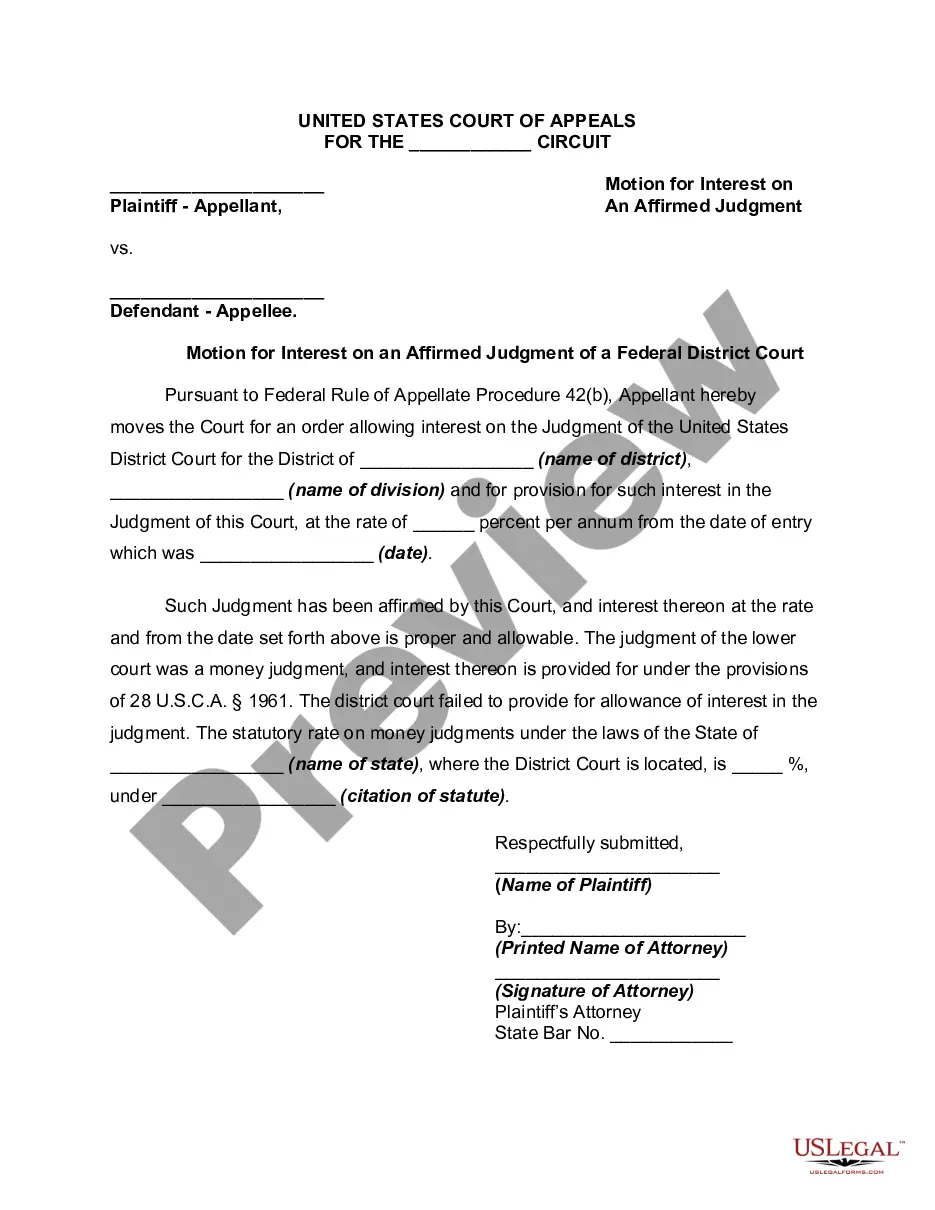
The Motion for Interest on an Affirmed Judgment of a Federal District Court is a legal document that allows a plaintiff to request interest on a monetary judgment awarded by a federal district court after the judgment is affirmed on appeal. This form is essential for ensuring the plaintiff receives compensation for the time taken during the appeal process, as interest continues to accrue under 28 U.S.C.A. § 1961. Unlike standard appeal forms, this motion specifically addresses the calculation and allowance of interest on the judgment amount during litigation.
Key components of this form
- Heading for the correct circuit and court information.
- Details of the appellant and appellee parties involved in the case.
- Statement requesting an order for interest on the judgment, including the percentage rate and relevant dates.
- Reference to the statutory rate for money judgments in the state where the district court is located.
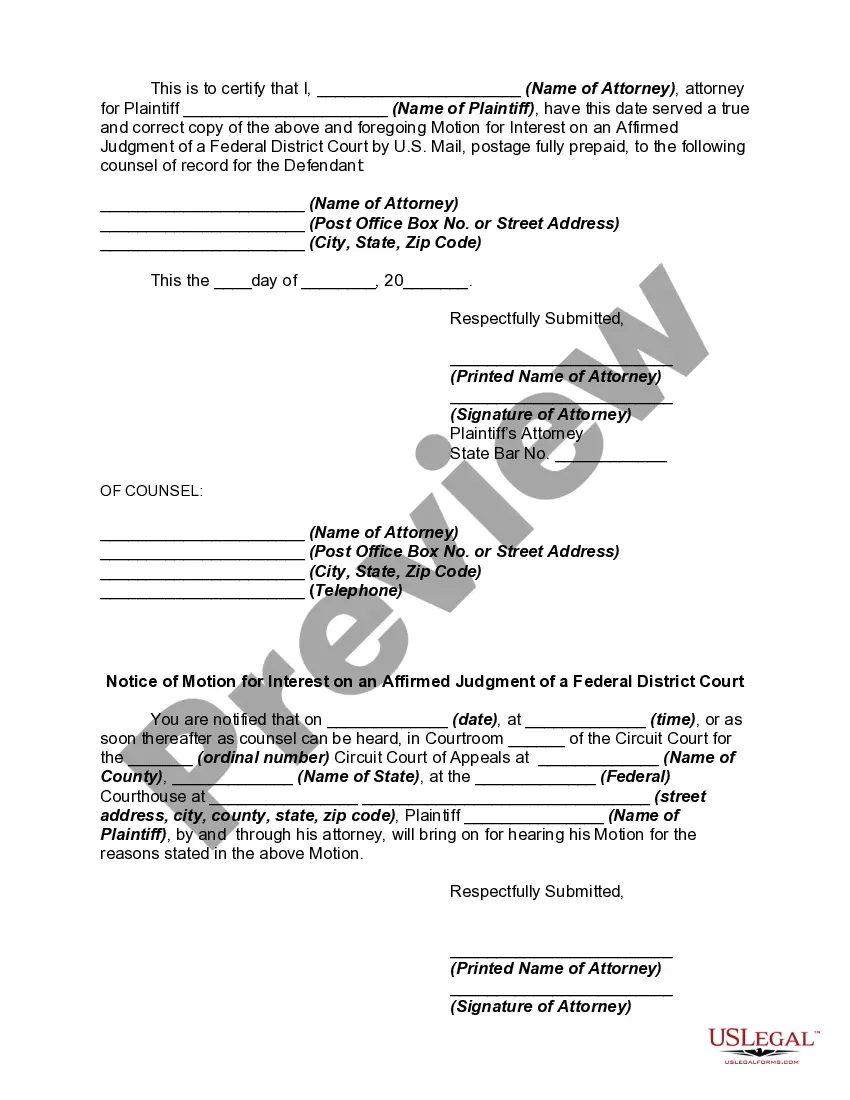
- Certificate of service, confirming delivery of the motion to the opposing counsel.
When this form is needed
This form is used when a plaintiff has successfully appealed a monetary judgment from a federal district court and seeks to claim interest on that judgment. It is applicable in situations where the original judgment did not provide for interest, or where interest is contested during the appeal process. Using this motion is imperative to ensure that rightful interest compensation is accounted for during the litigation period.
Who this form is for
This form is intended for:
- Individuals or entities who have won a monetary judgment in federal court.
- Attorneys representing plaintiffs in appellate cases.
- Parties involved in civil litigation in federal courts seeking to claim interest on affirmed judgments.
Completing this form step by step
To complete this form, follow these steps:
- Identify the correct circuit and federal district court in the heading.
- Fill in the names of the plaintiff-appellant and defendant-appellee accurately.
- Specify the interest rate and the date when the original judgment was entered.
- Cite the relevant state statute that outlines the statutory interest rate applicable to your case.
- Complete and sign the certificate of service to demonstrate proper notification to the defendantâs counsel.
Notarization requirements for this form
This form does not typically require notarization unless specified by local law. It is advisable to check with local regulations to confirm whether notarization is necessary in your jurisdiction.
Get your form ready online
Our built-in tools help you complete, sign, share, and store your documents in one place.
Make edits, fill in missing information, and update formatting in US Legal Forms—just like you would in MS Word.
Download a copy, print it, send it by email, or mail it via USPS—whatever works best for your next step.
Sign and collect signatures with our SignNow integration. Send to multiple recipients, set reminders, and more. Go Premium to unlock E-Sign.
If this form requires notarization, complete it online through a secure video call—no need to meet a notary in person or wait for an appointment.
We protect your documents and personal data by following strict security and privacy standards.

Make edits, fill in missing information, and update formatting in US Legal Forms—just like you would in MS Word.

Download a copy, print it, send it by email, or mail it via USPS—whatever works best for your next step.

Sign and collect signatures with our SignNow integration. Send to multiple recipients, set reminders, and more. Go Premium to unlock E-Sign.

If this form requires notarization, complete it online through a secure video call—no need to meet a notary in person or wait for an appointment.

We protect your documents and personal data by following strict security and privacy standards.
Common mistakes
- Failing to include the correct circuit or court information in the heading.
- Not specifying the interest rate or date clearly, leading to misunderstandings.
- Omitting to serve the motion to the opposing party as required.
- Neglecting to cite the appropriate state statute for interest calculations.
Advantages of online completion
- Convenient online access to complete the form at any time.
- Editability allows customization to specific case needs before printing.
- Reliability from legal templates drafted by licensed attorneys ensures accuracy.
- The motion serves as a request to ensure interest accumulation is legally recognized on an affirmed judgment.
- Understanding federal and state laws regarding interest on judgments is crucial for effective use of this form.
- Failure to properly file this motion may result in lost rights to collect accrued interest.
Quick recap
- The motion for interest requests accrued interest on an affirmed federal court judgment.
- Completing the form accurately is essential to secure your rights regarding interest claims.
- Consult local laws for any additional requirements in your jurisdiction concerning the motion.
- Appellant: The party who appeals a court decision.
- Appellee: The party opposing the appeal.
- Monetary judgment: A court decision that includes a financial award to a party.
- Statutory rate: The legally defined interest rate applicable to specific types of legal judgments.
Looking for another form?
Form popularity
FAQ
If your appeal is affirmed, you may file a petition to have your appeal reheard by the appellate court.The appellate court will then decide if your case will be reheard. A rehearing may result in a modification of a court decision. But in some cases, it may only be used to clarify the final order.
Common dispositions in criminal cases include (1) affirmed, meaning the appellate court upheld a lower court's action; (2) reversed, meaning the appellate court set aside, or nullified, the lower court's judgment; and (3) remanded, meaning the appellate court sent the case back to the court from which it came for
Generally, the losing party in a lawsuit may appeal their case to a higher court. The higher court then reviews the case for legal errors. If an appeal is granted, the lower court's decision may be reversed in whole or in part. If an appeal is denied, the lower court's decision stands.
1a : validate, confirm He was affirmed as a candidate. b : to state positively He affirmed his innocence. 2 : to assert (something, such as a judgment or decree) as valid or confirmed The court affirmed his conviction.
Affirmed In the practice of the court of appeals, it means that the court of appeals has concluded that the lower court decision is correct and will stand as rendered by the lower court.Appellant The party who appeals a district court's decision, usually seeking reversal of that decision.
Affirmed In the practice of the court of appeals, it means that the court of appeals has concluded that the lower court decision is correct and will stand as rendered by the lower court.Appellate About appeals; an appellate court has the power to review the judgment of a lower court (trial court) or tribunal.
Affirmed - the judgment of the lower court is correct and should stand.Reversed - changes to the contrary to opinion of the lower court/body. Reversed in Part - part of the judgment of the lower court was reversed. Vacated - sets aside the judgment of the lower court.