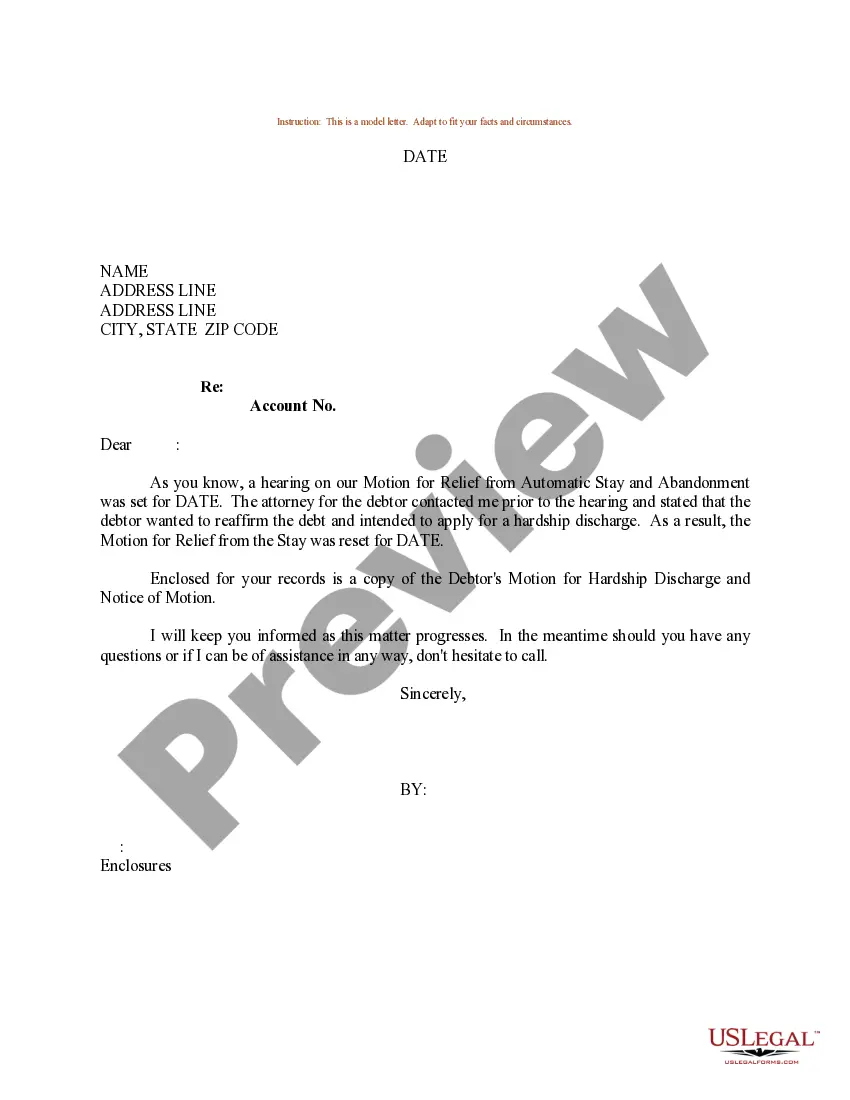
Sample Letter for Debtor's Motion for Hardship Discharge and Notice of Motion
Overview of this form
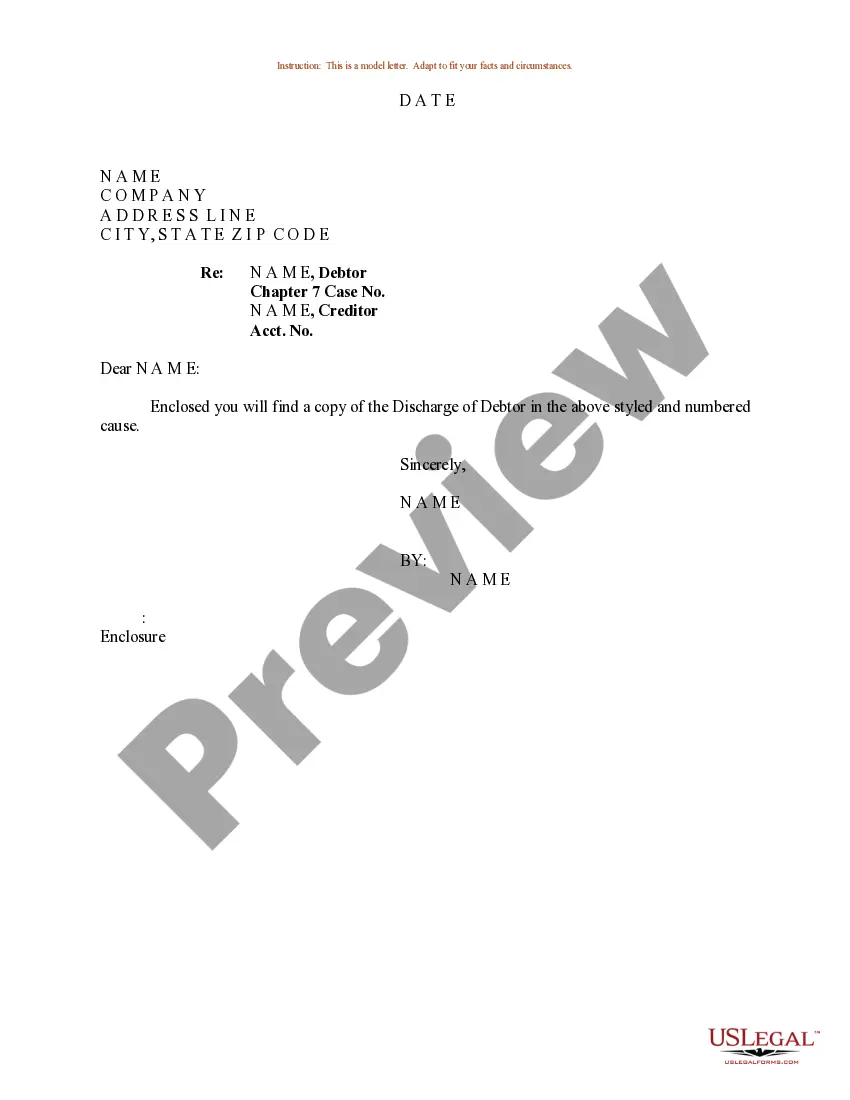
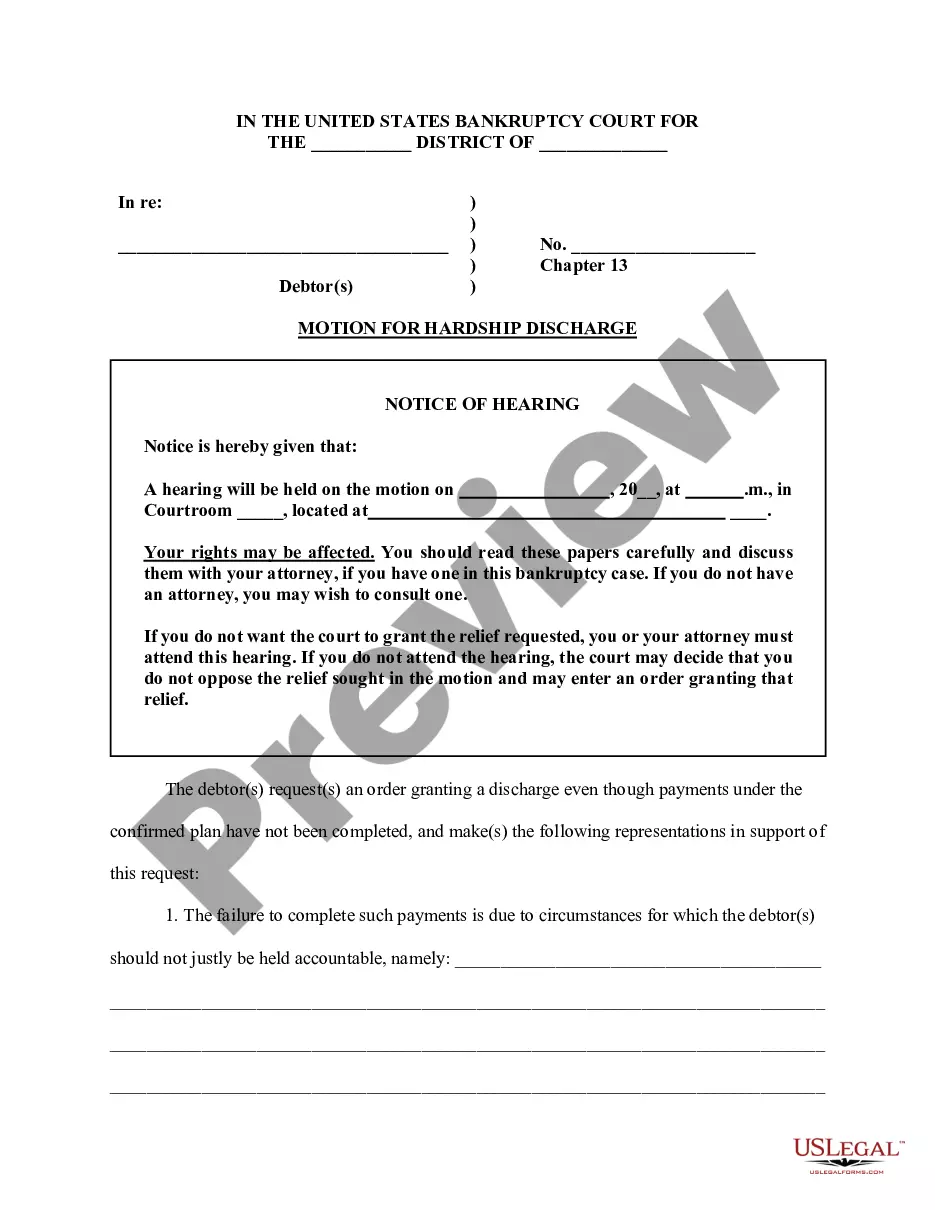
This form is a sample letter for a debtor's motion for hardship discharge and notice of motion. It serves as a template for individuals seeking relief from their debts due to financial hardship. Unlike other legal documents, this sample letter is tailored specifically for debtors needing to formally communicate their request while following legal protocols.
Key parts of this document
- Date line to specify when the letter is sent.
- Debtor's name and address for proper identification.
- Enclosure note indicating the attached motion for hardship discharge.
- Contact information for future correspondence.
- Closing remarks to maintain a professional tone.
When to use this document
Who needs this form
- Individuals facing financial difficulties who wish to file for a hardship discharge.
- Debtors seeking to formally communicate with creditors or the court regarding their financial situation.
- Those needing a structured format to ensure all required information is communicated effectively.
Steps to complete this form
- Enter the date you are sending the letter.
- Fill in your name and address in the designated fields.
- Attach a copy of your motion for hardship discharge with the letter.
- Provide your contact number for any further inquiries.
- Sign the letter in the space designated for your signature.
Does this document require notarization?
In most cases, this form does not require notarization. However, some jurisdictions or signing circumstances might. US Legal Forms offers online notarization powered by Notarize, accessible 24/7 for a quick, remote process.
Get your form ready online
Our built-in tools help you complete, sign, share, and store your documents in one place.
Make edits, fill in missing information, and update formatting in US Legal Forms—just like you would in MS Word.
Download a copy, print it, send it by email, or mail it via USPS—whatever works best for your next step.
Sign and collect signatures with our SignNow integration. Send to multiple recipients, set reminders, and more. Go Premium to unlock E-Sign.
If this form requires notarization, complete it online through a secure video call—no need to meet a notary in person or wait for an appointment.
We protect your documents and personal data by following strict security and privacy standards.

Make edits, fill in missing information, and update formatting in US Legal Forms—just like you would in MS Word.

Download a copy, print it, send it by email, or mail it via USPS—whatever works best for your next step.

Sign and collect signatures with our SignNow integration. Send to multiple recipients, set reminders, and more. Go Premium to unlock E-Sign.

If this form requires notarization, complete it online through a secure video call—no need to meet a notary in person or wait for an appointment.

We protect your documents and personal data by following strict security and privacy standards.
Avoid these common issues
- Failing to include the date and full contact information.
- Not attaching the motion for hardship discharge.
- Using informal language instead of maintaining a professional tone.
Why use this form online
- Convenient access to the form at any time for easy downloading.
- Edit the document to suit your specific situation before printing.
- Reliability in having a template drafted by licensed attorneys, ensuring legal compliance.
Looking for another form?

Form popularity
FAQ
Hardship Examples. There are a variety of situations that may qualify as a hardship. Keep it original. Be honest. Keep it concise. Don't cast blame or shirk responsibility. Don't use jargon or fancy words. Keep your objectives in mind. Provide the creditor an action plan.
Hardship Examples. There are a variety of situations that may qualify as a hardship. Keep it original. Be honest. Keep it concise. Don't cast blame or shirk responsibility. Don't use jargon or fancy words. Keep your objectives in mind. Provide the creditor an action plan.
Financial hardship is difficulty in paying the repayments on your loans and debts when they are due. There are often two main reasons for financial hardship: You could afford the loan when it was obtained but a change of circumstances has occurred after getting the loan; or.
Financial hardship typically refers to a situation in which a person cannot keep up with debt payments and bills or if the amount you need to pay each month is more than the amount you earn, due to a circumstance beyond your control.
Make the letter concise. Do not write pages explaining your hardship. State your response to the hardship. You need to describe the steps you have taken in response to the difficulty. Clearly state what you want. You can include enclosures. The conclusion.
Illness or injury. Change of employment status. Loss of income. Natural disasters. Divorce. Death. Military deployment.
Proof of income (pay stubs, offer letter, etc.) proof of other income (e.g., alimony, child support, disability benefits) an expense sheet laying out all your expenses. tax returns (two years worth of returns) profit and loss statement. current bank statements.
The IRS may agree that you have a financial hardship (economic hardship) if you can show that you cannot pay or can barely pay your basic living expenses.The IRS has standards for food, clothing and miscellaneous; housing and utilities; transportation and out-of-pocket health care expenses.
Your name, address, phone number and account number. The type of debt resolution you're seeking. Your financial situation that has caused you to fall behind in your payments. A detailed budget and your plan for making payments (if you want to keep your home)