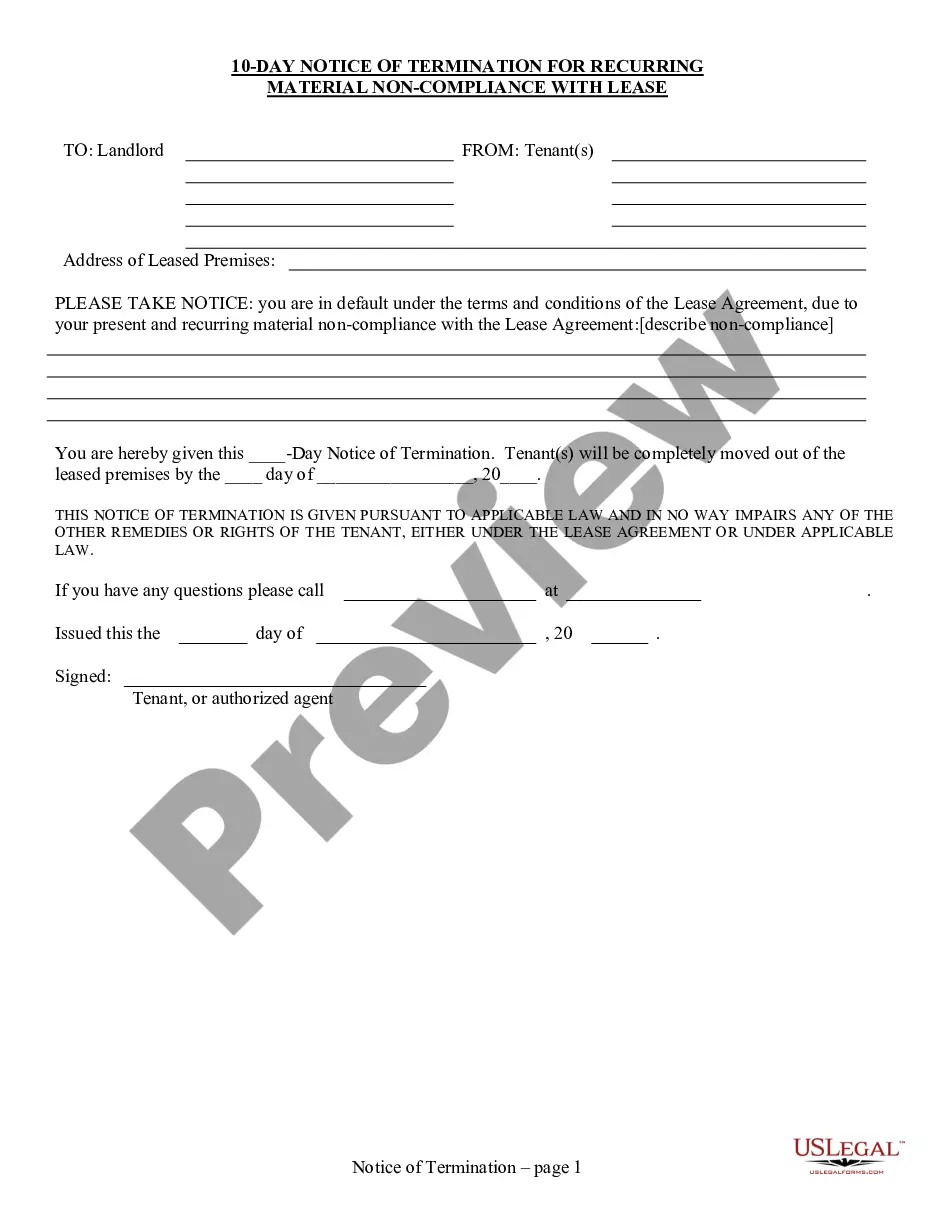
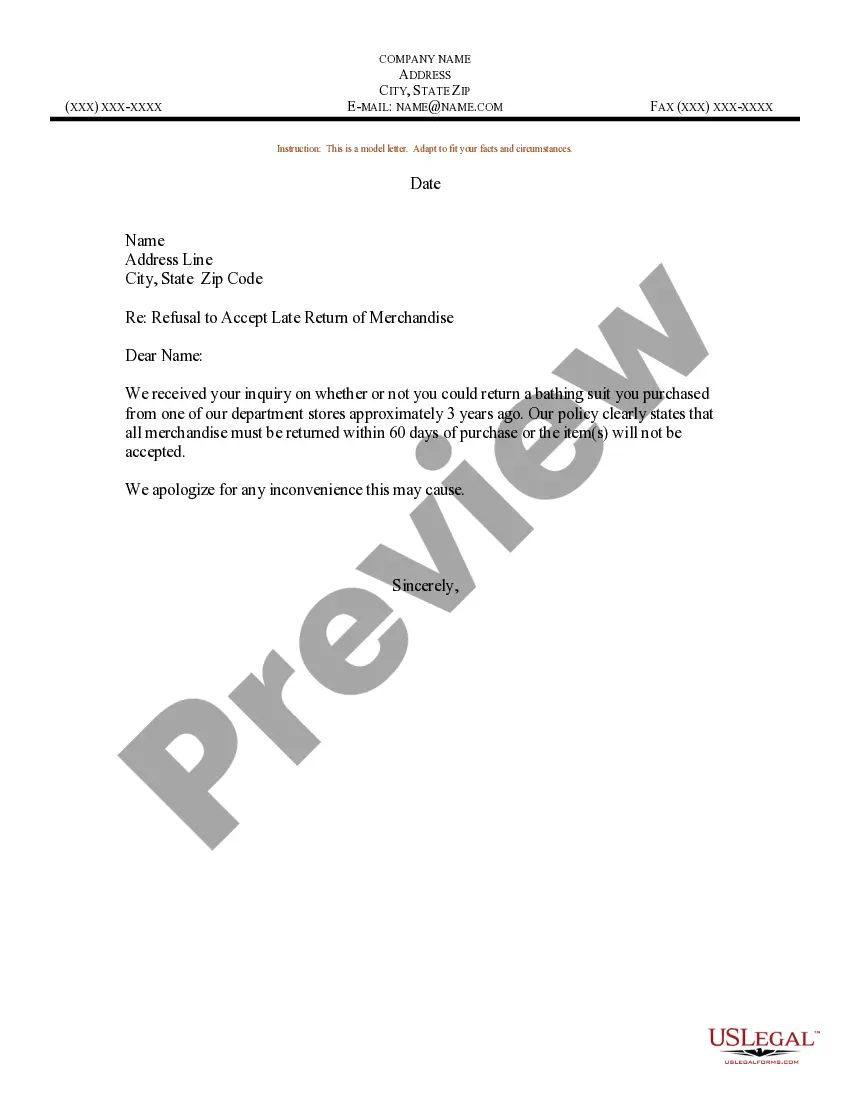
Sample Letter for Refusal to Accept Late Return of Merchandise
Overview of this form
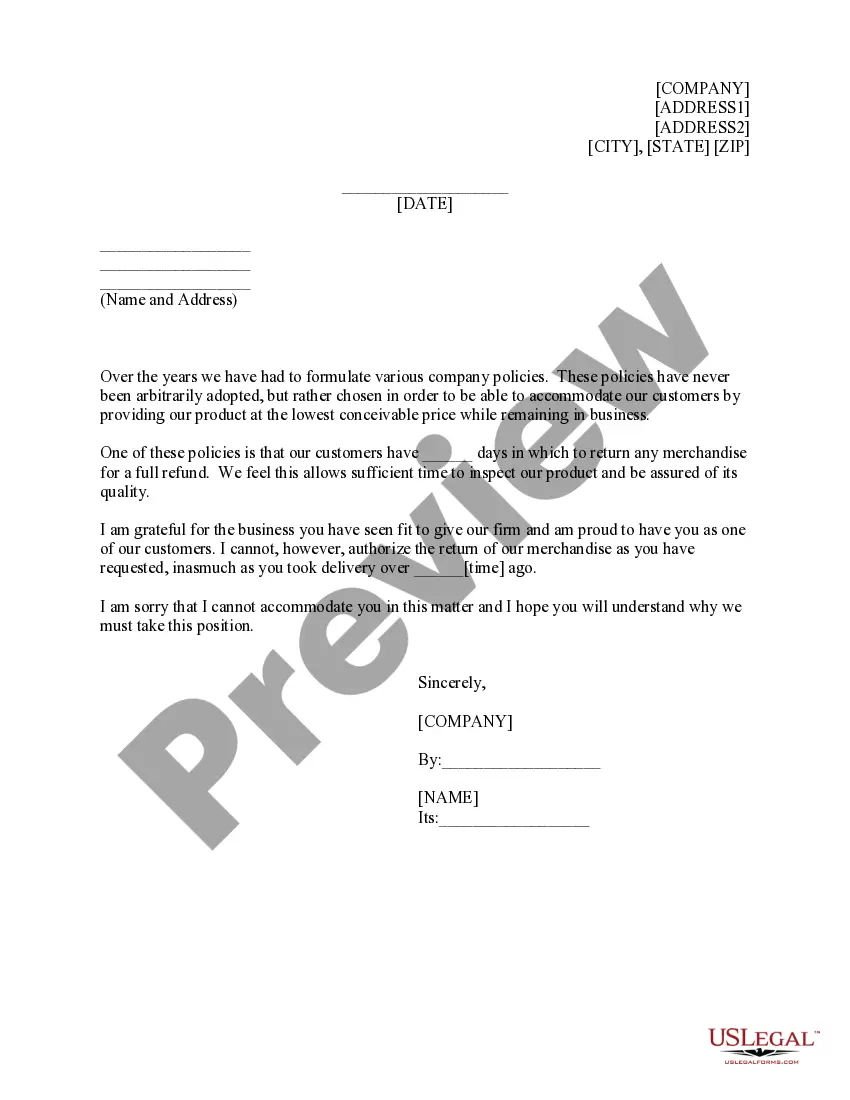
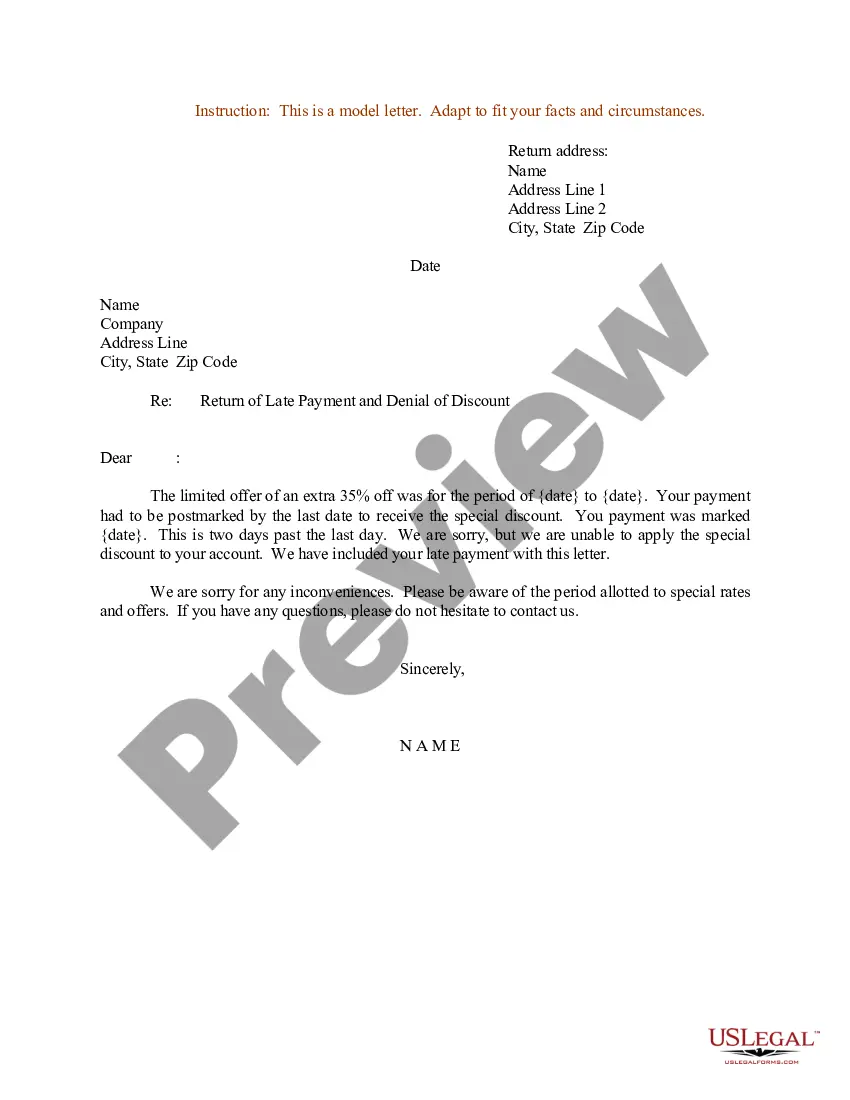
This form is a sample letter for refusal to accept a late return of merchandise. It serves as a template for businesses to communicate their return policy clearly when a customer attempts to return an item beyond the established return period. This document is distinct from other return-related forms, as it specifically addresses the refusal of late returns and outlines the company's stance on the issue.
What’s included in this form
- Date of the letter.
- Recipient's name and address.
- Subject line clearly stating the purpose of the letter.
- Body of the letter explaining the return policy.
- Apology for any inconvenience caused.
- Contact information for the company.
When to use this document
Who should use this form
This form is ideal for:
- Retail businesses with a defined return policy.
- Customer service representatives handling return inquiries.
- Managers in charge of customer communications regarding returns.
How to prepare this document
- Insert the date at the top of the letter.
- Fill in the recipient's name and address accurately.
- Clearly state the subject of the letter regarding the refusal of the return.
- Explain the company's return policy, including any time limits.
- Conclude with an appropriate company sign-off and include contact information.
Notarization requirements for this form
In most cases, this form does not require notarization. However, some jurisdictions or signing circumstances might. US Legal Forms offers online notarization powered by Notarize, accessible 24/7 for a quick, remote process.
Get your form ready online
Our built-in tools help you complete, sign, share, and store your documents in one place.
Make edits, fill in missing information, and update formatting in US Legal Forms—just like you would in MS Word.
Download a copy, print it, send it by email, or mail it via USPS—whatever works best for your next step.
Sign and collect signatures with our SignNow integration. Send to multiple recipients, set reminders, and more. Go Premium to unlock E-Sign.
If this form requires notarization, complete it online through a secure video call—no need to meet a notary in person or wait for an appointment.
We protect your documents and personal data by following strict security and privacy standards.

Make edits, fill in missing information, and update formatting in US Legal Forms—just like you would in MS Word.

Download a copy, print it, send it by email, or mail it via USPS—whatever works best for your next step.

Sign and collect signatures with our SignNow integration. Send to multiple recipients, set reminders, and more. Go Premium to unlock E-Sign.

If this form requires notarization, complete it online through a secure video call—no need to meet a notary in person or wait for an appointment.

We protect your documents and personal data by following strict security and privacy standards.
Typical mistakes to avoid
- Not specifying the return policy details, which can cause further confusion.
- Failing to include the customer's information, making it difficult to identify the inquiry.
- Using unclear language that does not clearly communicate the refusal.
Why use this form online
- Convenience of instant access and downloading the letter template.
- Editability to fit specific circumstances or company policies.
- Reliability of using legally vetted templates prepared by licensed attorneys.
Legal use & context
- The letter serves as documentation for the refusal of merchandise returns.
- Establishes clarity on return policies which can help mitigate future disputes.
- Ensures compliance with consumer rights laws concerning returns.
Looking for another form?

Form popularity
FAQ
State the type of penalty you want removed. Include an explanation of the events and specific facts and circumstances of your situation, and explain how these events were outside of your control. Attach documents that will prove your case.
For the failure to file or pay penalty, taxpayers can request that the IRS abate the penalties. Abatement is simply removing the penalties after they are assessed to the taxpayer.Rather, taxpayers can request an exclusion from the penalty when filing their tax return (individuals use Form 2210).
Reduce the tax. The first thing that you or an experienced tax professional should do is figure out why you owe the tax. Reduce the penalties. When you get penalties reduced or removed, you also reduce the interest that goes along with them. Set up a monthly payment plan.
The second most common reason is for reasonable cause. Reasonable cause is the IRS term for having a good excuse as to why you could not comply. Recklessness and willful blindness reasons need not apply. You must have made an attempt to comply but could not do so because of unforeseen circumstances or hardship.
Use Form 843 to claim a refund or request an abatement of certain taxes, interest, penalties, fees, and additions to tax.
In this case, you should argue for reasonable cause. Some basic elements of claiming reasonable cause for late filing or payment: Show that you attempted to meet your federal tax obligations. Explain and prove that external forces prevented you from filing/paying on time.
The IRS doesn't abate interest for reasonable cause or as first-time relief. Interest is charged by law and will continue until your account is fully paid. If any of your penalties are reduced, we will automatically reduce the related interest.
Request penalty abatement by phone A tax practitioner may call the IRS Practitioner Priority Service (PPS) line at 866.860. 4259 to request FTA if his or her client's case isn't being handled by a specific compliance unit (examination, collection, etc.).