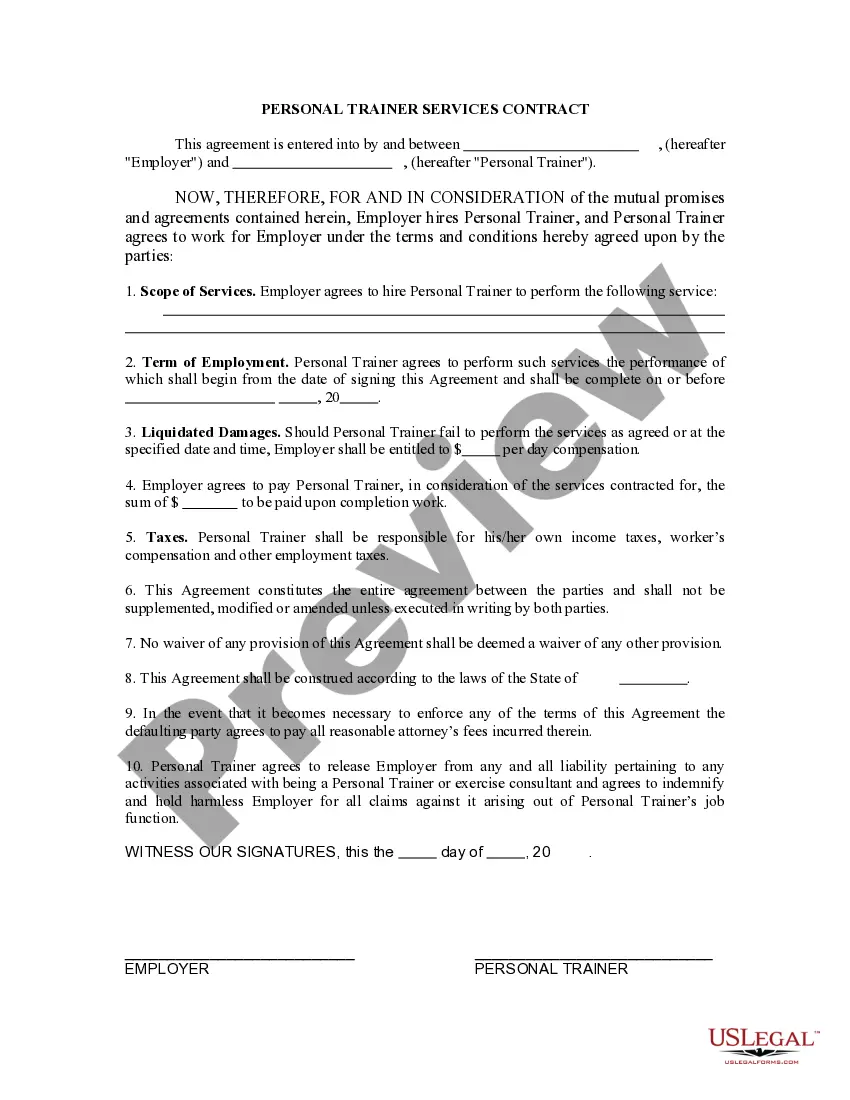
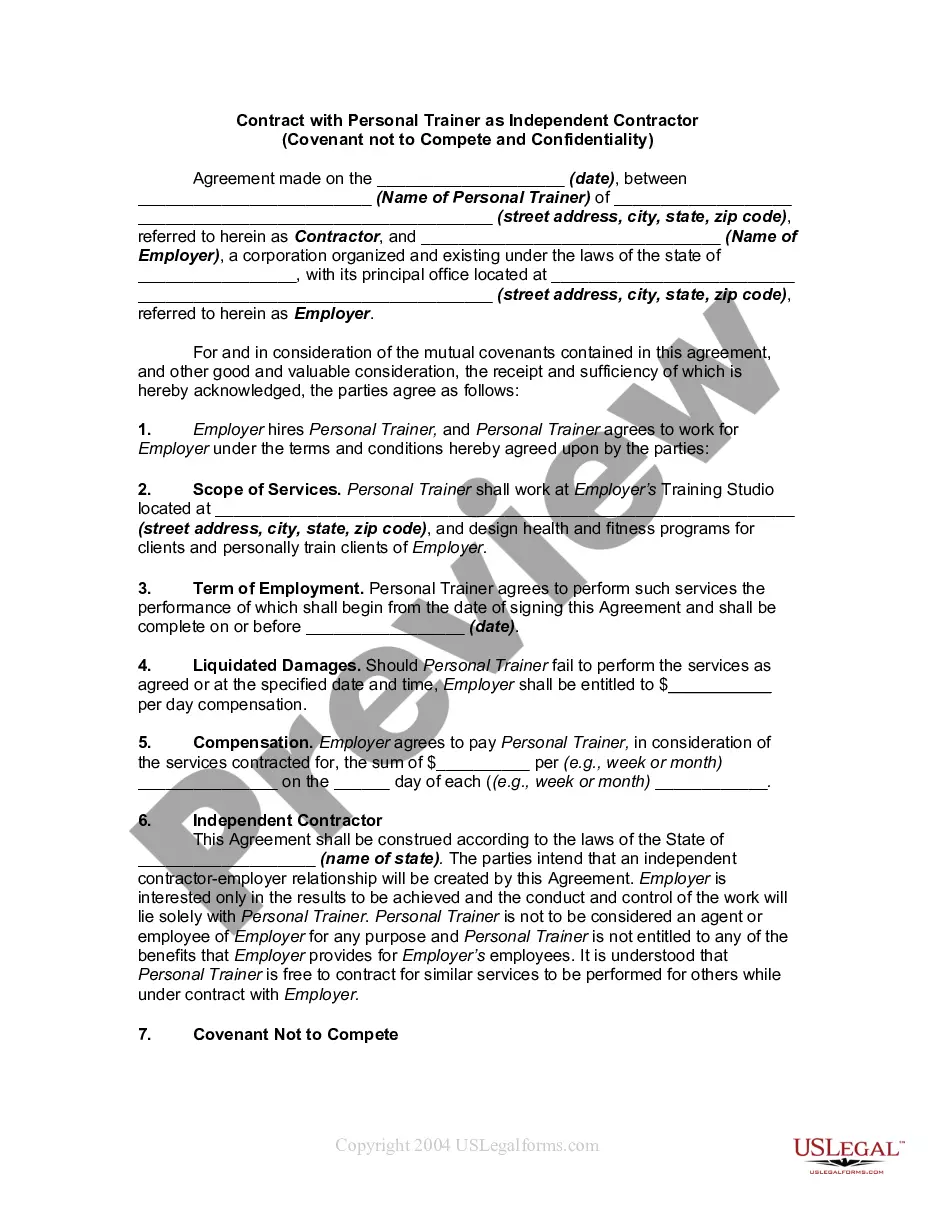
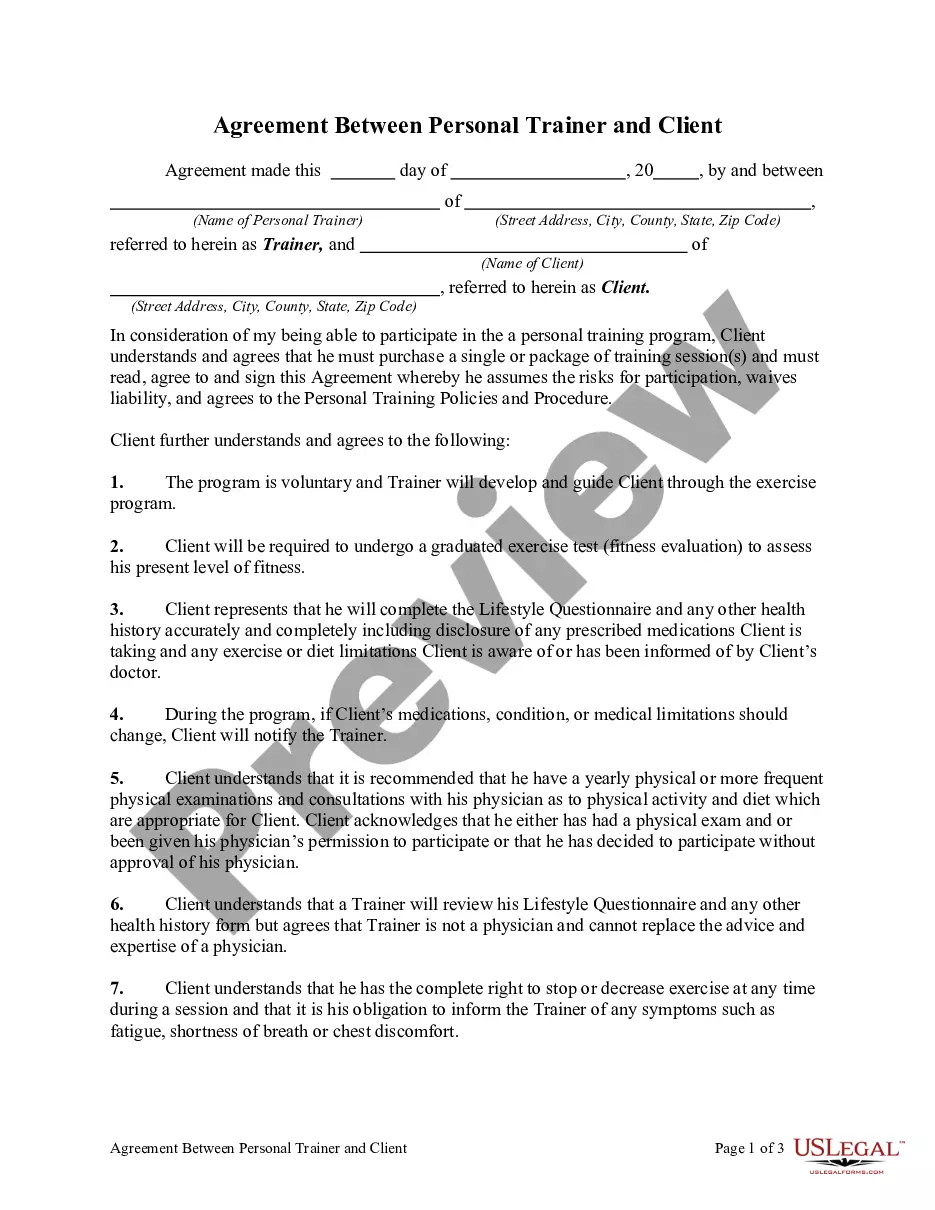
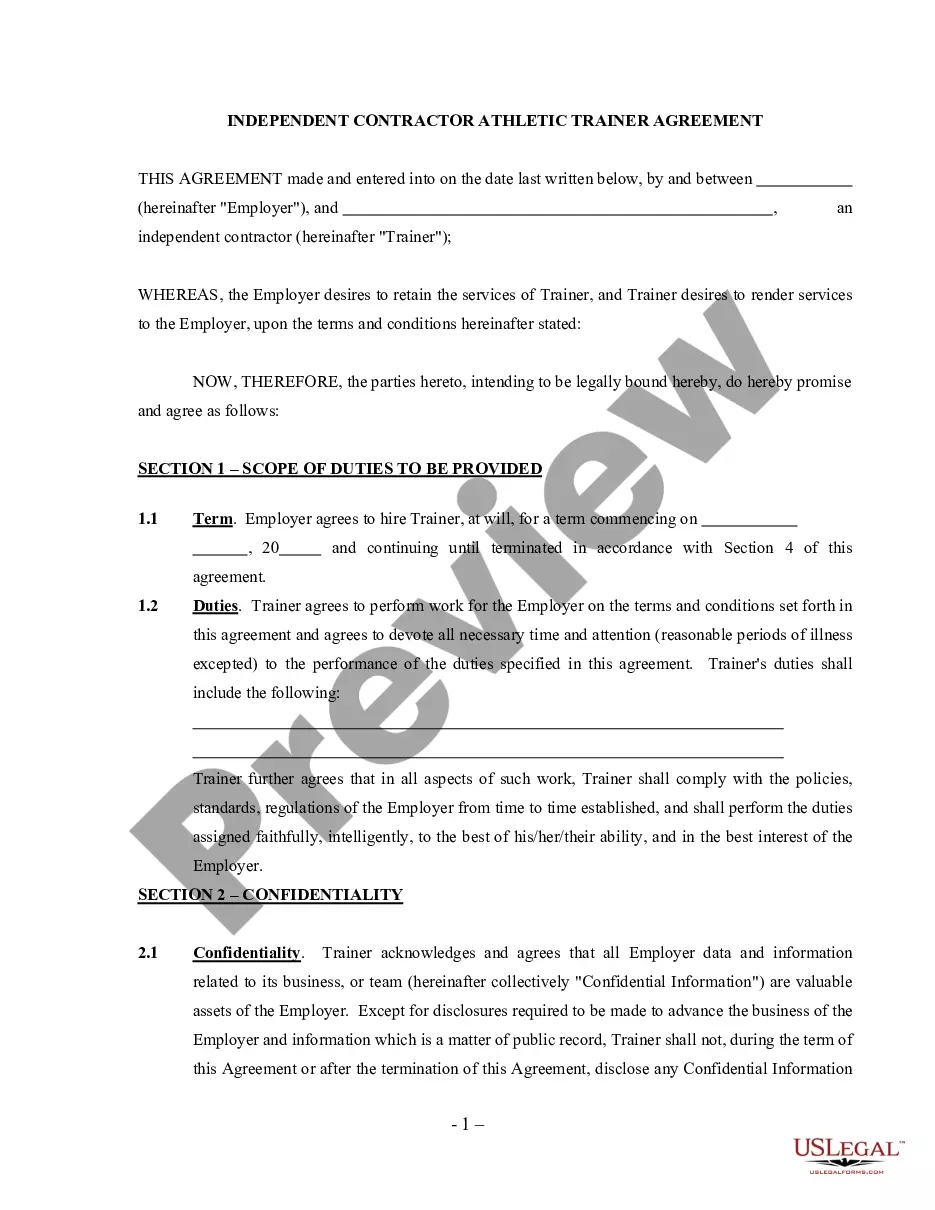
This is a contract whereby a personal trainer is hired by an employer to train clients or customers in a workout facility or gym. This contract also includes a release from liability releasing the owner from liability to clients.
Texas Self-Employed Personal Trainer or Training Services Contract
State:
Multi-State
Control #:
US-INDC-49
Format:
Word;
Rich Text
Instant download
Description
Get your form ready online
Our built-in tools help you complete, sign, share, and store your documents in one place.
Built-in online Word editor
Make edits, fill in missing information, and update formatting in US Legal Forms—just like you would in MS Word.
Export easily
Download a copy, print it, send it by email, or mail it via USPS—whatever works best for your next step.
E-sign your document
Sign and collect signatures with our SignNow integration. Send to multiple recipients, set reminders, and more. Go Premium to unlock E-Sign.
Notarize online 24/7
If this form requires notarization, complete it online through a secure video call—no need to meet a notary in person or wait for an appointment.
Store your document securely
We protect your documents and personal data by following strict security and privacy standards.

Make edits, fill in missing information, and update formatting in US Legal Forms—just like you would in MS Word.

Download a copy, print it, send it by email, or mail it via USPS—whatever works best for your next step.

Sign and collect signatures with our SignNow integration. Send to multiple recipients, set reminders, and more. Go Premium to unlock E-Sign.

If this form requires notarization, complete it online through a secure video call—no need to meet a notary in person or wait for an appointment.

We protect your documents and personal data by following strict security and privacy standards.
Looking for another form?


How to fill out Self-Employed Personal Trainer Or Training Services Contract?
You might spend considerable time online looking for the appropriate legal format that meets the state and federal requirements you need. US Legal Forms provides a vast selection of legal documents that have been evaluated by experts.
You can download or print the Texas Self-Employed Personal Trainer or Training Services Contract from our platform. If you already have a US Legal Forms account, you can Log In and click the Download button. Then, you can fill out, modify, print, or sign the Texas Self-Employed Personal Trainer or Training Services Contract. Every legal document you acquire is yours indefinitely.
To obtain another copy of a purchased document, navigate to the My documents section and select the appropriate option. If you are using the US Legal Forms website for the first time, follow the simple instructions below: First, make sure you have chosen the correct format for the area/city you select. Review the form description to confirm you have picked the right document. If available, utilize the Preview feature to inspect the format as well.
Utilize professional and state-specific templates to address your business or personal requirements.
- If you want to find another version of the document, use the Search field to locate the format that fits your needs and specifications.
- Once you have found the format you desire, click Purchase now to continue.
- Choose the pricing plan you prefer, enter your details, and create an account on US Legal Forms.
- Complete the transaction. You can use your credit card or PayPal account to pay for the legal document.
- Select the format of the file and download it to your device.
- Make changes to your document if necessary. You can fill out, modify, and sign and print the Texas Self-Employed Personal Trainer or Training Services Contract.
- Download and print a multitude of document templates using the US Legal Forms website, which offers the largest collection of legal forms.
Form popularity
FAQ
Whether $300 a month is a lot for a personal trainer depends on several factors, including your location and the services offered. In Texas, this amount may be reasonable for personal training sessions, especially if they include personalized programs and additional support. It's important to evaluate the value you receive from your trainer, as well as how it aligns with your fitness goals. A well-structured Texas Self-Employed Personal Trainer or Training Services Contract can help clarify what to expect for that investment.
Creating a contract as a Texas Self-Employed Personal Trainer involves outlining the terms of your services, including payment, session duration, and cancellation policies. Start by drafting a document that clearly states these details, ensuring both you and your client understand the agreement. You can enhance your contract by including liability waivers and confidentiality clauses. For a comprehensive and legally sound contract, consider utilizing templates available on platforms like US Legal Forms.
As a Texas Self-Employed Personal Trainer, you will file taxes using a Schedule C form along with your personal income tax return. Keep track of all income and expenses related to your training services, as this will help you maximize deductions. Consider working with a tax professional to ensure compliance and to take advantage of all available tax benefits. Using tools and resources from US Legal Forms can also assist you in managing your financial records effectively.
To register as a Texas Self-Employed Personal Trainer, start by choosing a business structure, such as a sole proprietorship or LLC. Then, obtain any necessary licenses or permits specific to your location. It's also essential to get an Employer Identification Number (EIN) from the IRS for tax purposes. Finally, consider using platforms like US Legal Forms to streamline the process and access essential documents.
Absolutely, you can be a self-employed personal trainer in Texas. This path allows you to create your own business, define your services, and work with clients directly. As a Texas Self-Employed Personal Trainer, you have the potential to build a rewarding career while enjoying the independence of running your own business. Using a Training Services Contract can help you establish clear terms with your clients.
Texas does not require personal trainers to have a specific license to operate. However, obtaining certification from a recognized organization is highly recommended for credibility. As a Texas Self-Employed Personal Trainer, certification can enhance your skills and attract clients. Complementing your qualifications with a Training Services Contract adds a professional touch to your business.
Showing proof of income as a Texas Self-Employed Personal Trainer can be done through various methods. You can provide bank statements, invoices, or a summary of your earnings from training sessions. Additionally, maintaining well-organized records of your Training Services Contracts can substantiate your income claims. This documentation can be beneficial when applying for loans or renting property.
Yes, many personal trainers successfully operate as self-employed professionals. As a Texas Self-Employed Personal Trainer, you have the freedom to set your schedule, choose your clients, and define your services. This flexibility allows you to tailor your business to your strengths and interests. To formalize your agreements, consider using a Training Services Contract.
In Texas, you can call yourself a personal trainer without certification, but it may impact your credibility and client trust. Clients often look for certified trainers due to the expertise and professionalism they bring. If you aim to stand out as a Texas Self-Employed Personal Trainer, obtaining certification is a wise investment. A Training Services Contract can also help outline your qualifications to potential clients.
Setting up an LLC can provide you with liability protection, which is crucial for a Texas Self-Employed Personal Trainer. An LLC separates your personal assets from your business, safeguarding you in case of legal issues. Furthermore, it can offer tax advantages and establish your professional credibility. Using a Training Services Contract can also enhance your business structure.