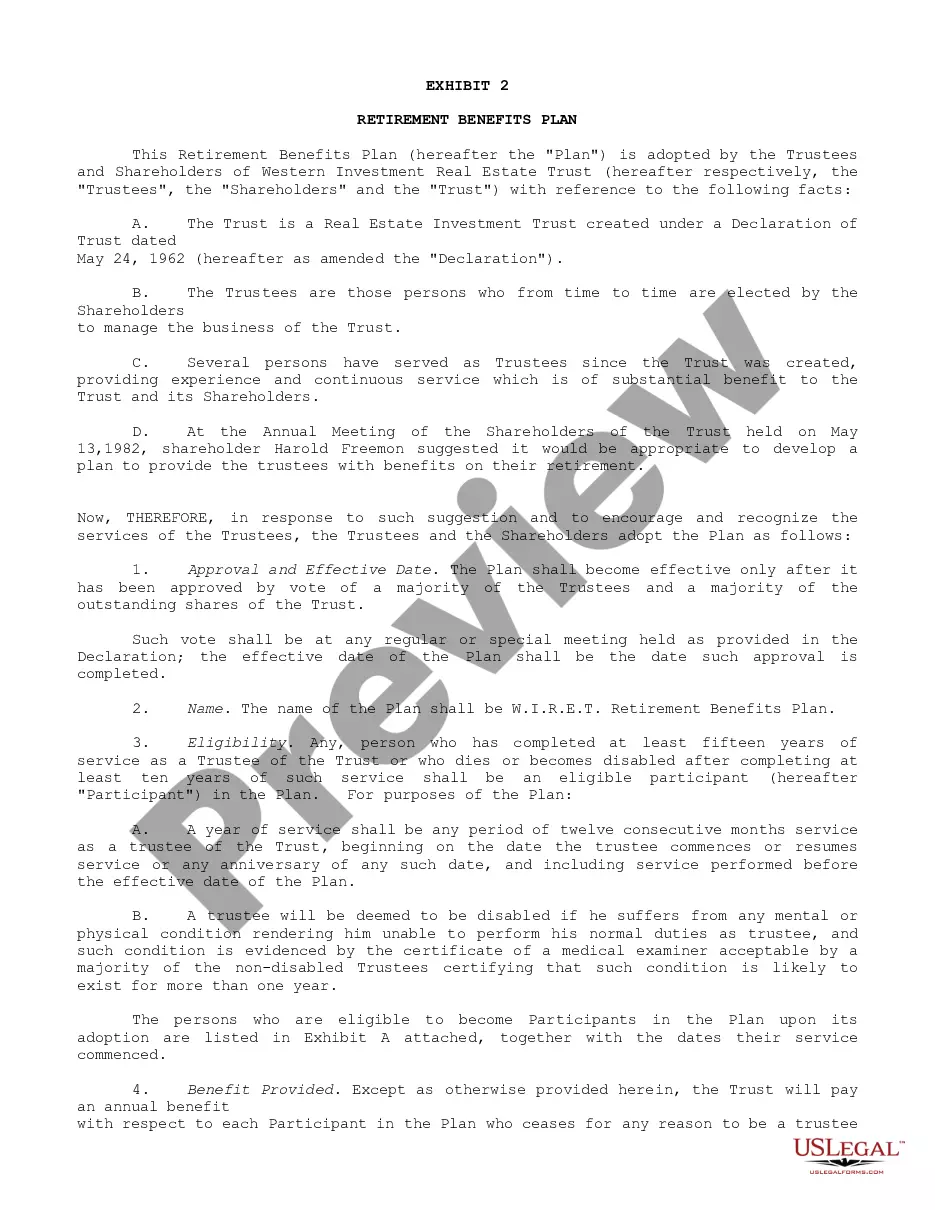
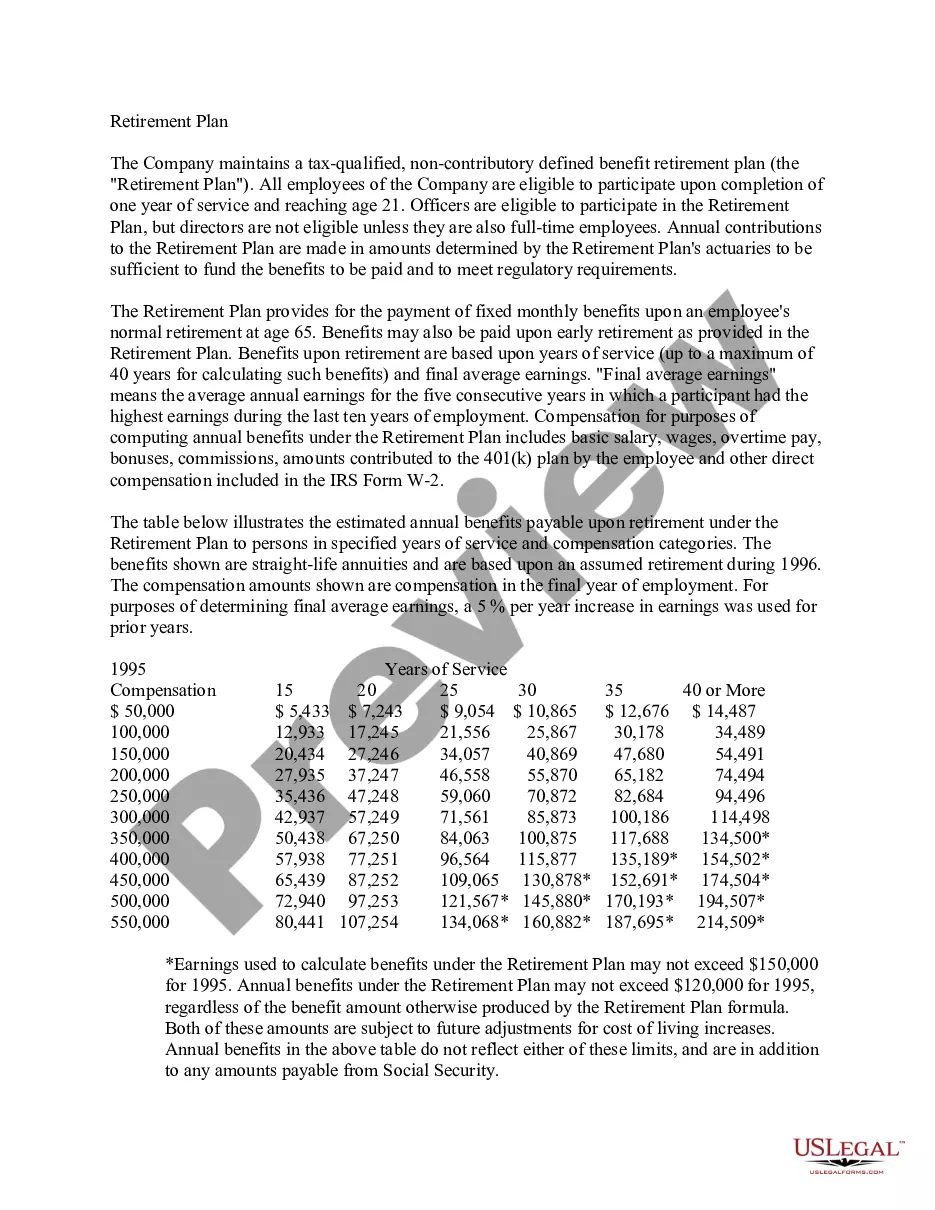
21-104 21-104 . . . Supplemental Executive Retirement Plan which permits eligible management and highly-compensated employees to receive benefits that will compensate them for limitations imposed by Sections 401(a)(17), 401(k), 401(m) and 402(g) of Internal Revenue Code on salary deferrals and matching contributions under 401(k) plan
Texas Supplemental Retirement Plan
Category:
State:
Multi-State
Control #:
US-CC-21-104
Format:
Word;
Rich Text
Instant download
Description
Free preview




Get your form ready online
Our built-in tools help you complete, sign, share, and store your documents in one place.
Built-in online Word editor
Make edits, fill in missing information, and update formatting in US Legal Forms—just like you would in MS Word.
Export easily
Download a copy, print it, send it by email, or mail it via USPS—whatever works best for your next step.
E-sign your document
Sign and collect signatures with our SignNow integration. Send to multiple recipients, set reminders, and more. Go Premium to unlock E-Sign.
Notarize online 24/7
If this form requires notarization, complete it online through a secure video call—no need to meet a notary in person or wait for an appointment.
Store your document securely
We protect your documents and personal data by following strict security and privacy standards.

Make edits, fill in missing information, and update formatting in US Legal Forms—just like you would in MS Word.

Download a copy, print it, send it by email, or mail it via USPS—whatever works best for your next step.

Sign and collect signatures with our SignNow integration. Send to multiple recipients, set reminders, and more. Go Premium to unlock E-Sign.

If this form requires notarization, complete it online through a secure video call—no need to meet a notary in person or wait for an appointment.

We protect your documents and personal data by following strict security and privacy standards.
Looking for another form?





How to fill out Supplemental Retirement Plan?
It is possible to spend time on the Internet trying to find the legal file format that suits the state and federal specifications you need. US Legal Forms offers a large number of legal types which are reviewed by pros. It is possible to acquire or print the Texas Supplemental Retirement Plan from my service.
If you have a US Legal Forms profile, it is possible to log in and then click the Down load switch. Afterward, it is possible to total, edit, print, or sign the Texas Supplemental Retirement Plan. Each legal file format you purchase is yours forever. To get another backup of any obtained develop, visit the My Forms tab and then click the corresponding switch.
If you work with the US Legal Forms internet site for the first time, follow the easy directions below:
- Initially, make certain you have chosen the best file format for that region/town that you pick. Look at the develop description to ensure you have picked out the appropriate develop. If accessible, make use of the Preview switch to look with the file format also.
- In order to discover another version of the develop, make use of the Research industry to get the format that fits your needs and specifications.
- Once you have identified the format you need, just click Get now to continue.
- Select the prices program you need, type your references, and register for a free account on US Legal Forms.
- Total the transaction. You should use your charge card or PayPal profile to purchase the legal develop.
- Select the formatting of the file and acquire it to the system.
- Make modifications to the file if necessary. It is possible to total, edit and sign and print Texas Supplemental Retirement Plan.
Down load and print a large number of file layouts while using US Legal Forms Internet site, which provides the most important selection of legal types. Use specialist and state-certain layouts to handle your company or personal demands.
Form popularity
FAQ
Advantages of a SERP As they are non-qualified, they require no IRS approval and minimal reporting. The company controls the plan and is able to book an annual expense equal to the present value of the stream of future benefit payments. When the benefits are paid, the company is able to deduct them as an expense.
SERP withdrawals are taxed as regular income, but taxes on that income are deferred until you start making withdrawals. Much like other tax-deferred retirement plans, SERP funds grow tax-free until retirement. If you withdraw your SERP funds in a lump sum, you'll pay the taxes at all once.
Although SERPs could be paid out of cash flows or investment funds, most are funded through a cash value life insurance plan. The employer buys the insurance policy, pays the premiums, and has access to its cash value. The employee receives supplemental retirement income paid for through the insurance policy.
A Supplemental Executive Retirement Plan (SERP) is a deferred compensation agreement between the company and the key executive whereby the company agrees to provide supplemental retirement income to the executive and his family if certain pre-agreed eligibility and vesting conditions are met by the executive.
A supplemental retirement plan gives your top employees a chance to save more once they've maxed out their contribution to a qualified plan, which can increase engagement and retention.
It's a lump-sum cash award, designed to offset the effects of your reduced pension contributions due to your service-related disability.
The employee's total elective deferrals to all of these plans combined cannot exceed the annual deferral limit ($22,500 in 2023; $20,500 in 2022; $19,500 in 2020 and 2021). See How Much Salary Can You Defer if You're Eligible for More Than One Retirement Plan.
The employer buys the insurance policy, pays the premiums, and has access to its cash value. The employee receives supplemental retirement income paid for through the insurance policy. Once the employee receives income in retirement, that benefit is taxable. At that point, the employer receives a tax deduction.