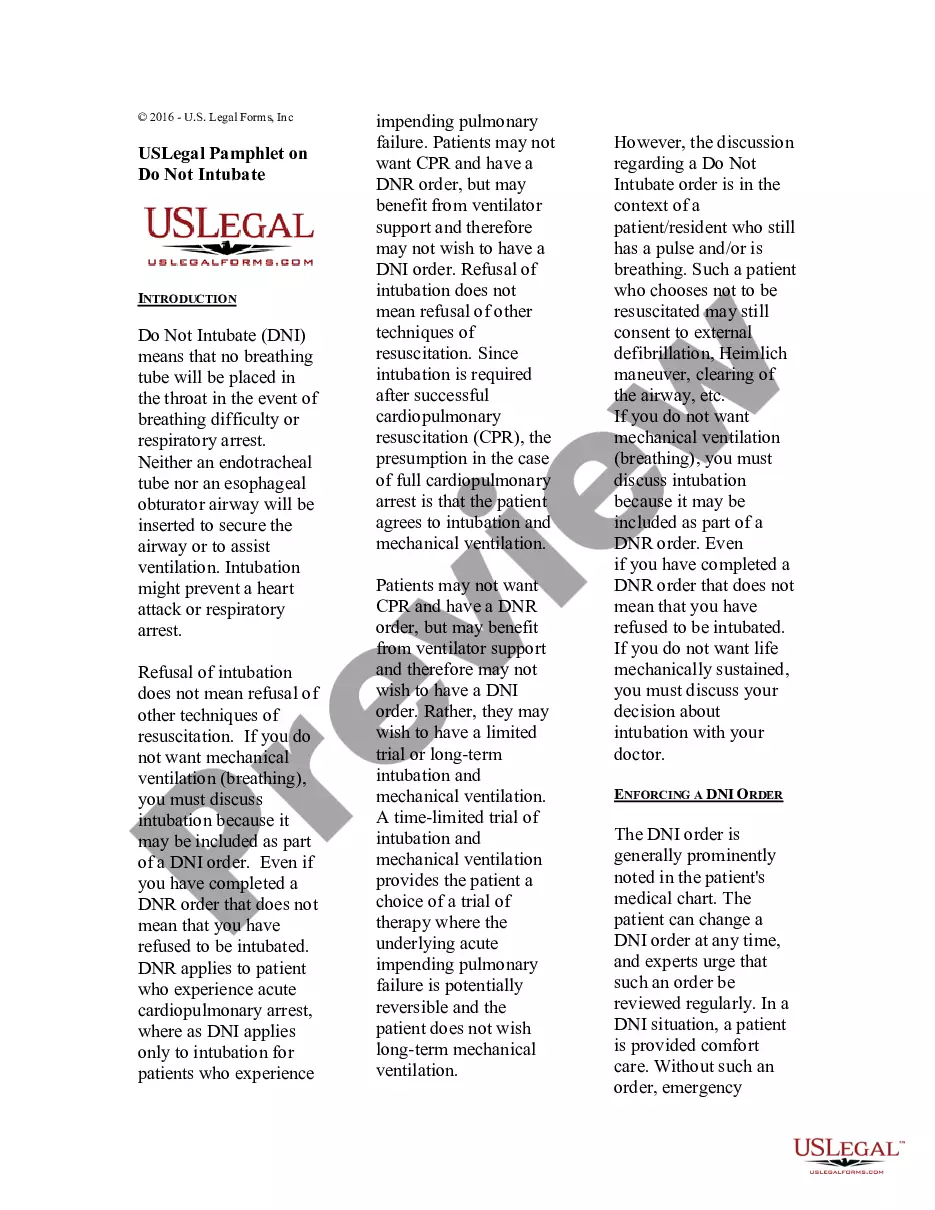
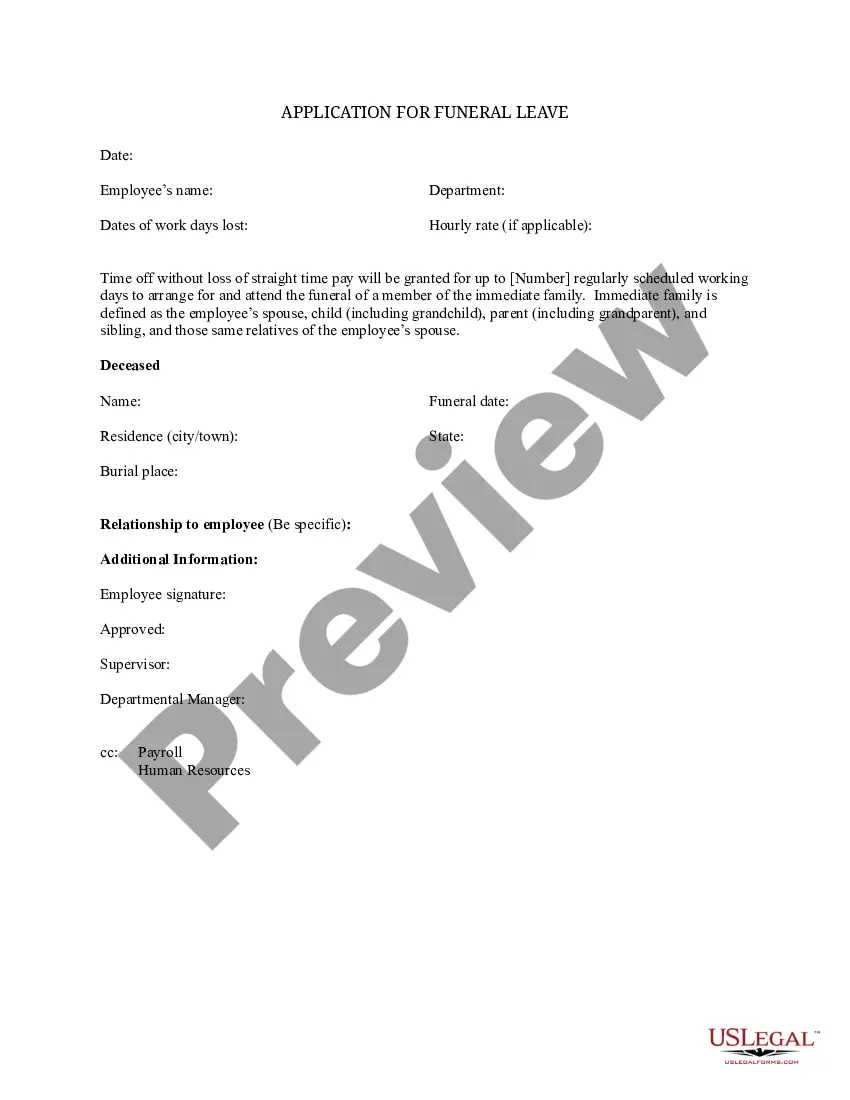
Texas Application for Funeral Leave
Description
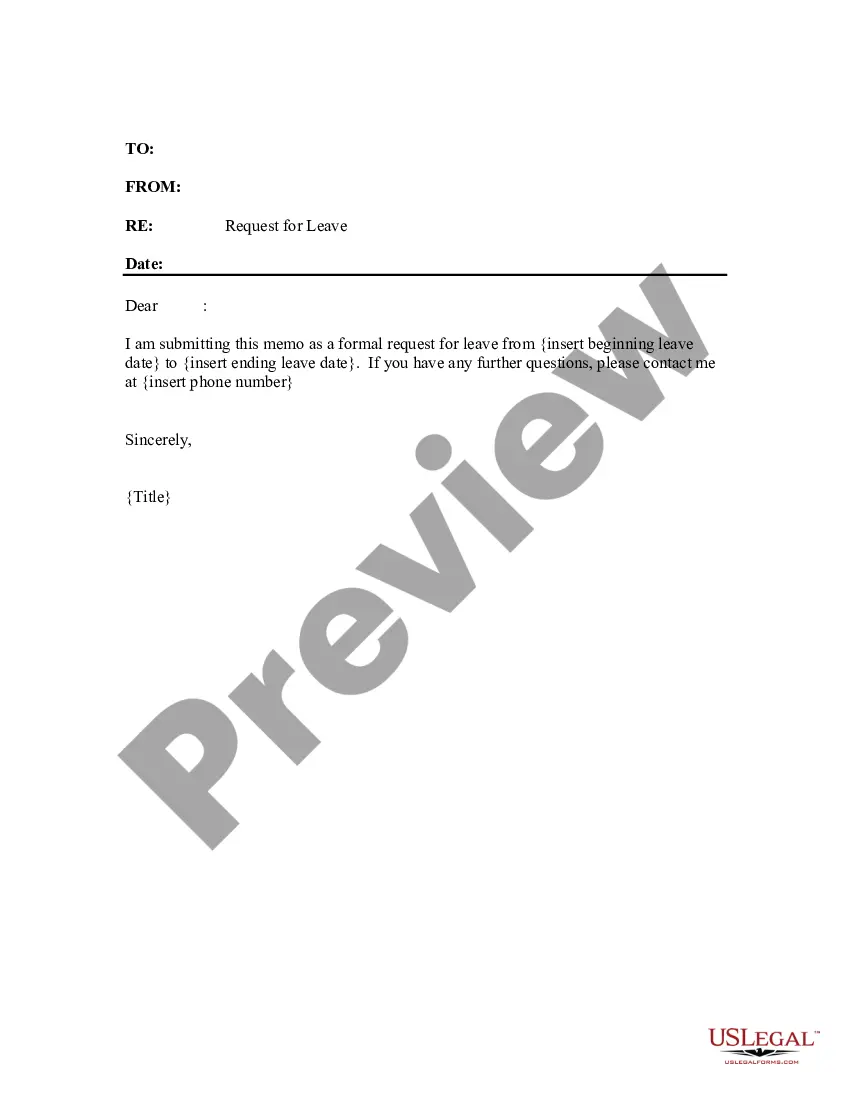
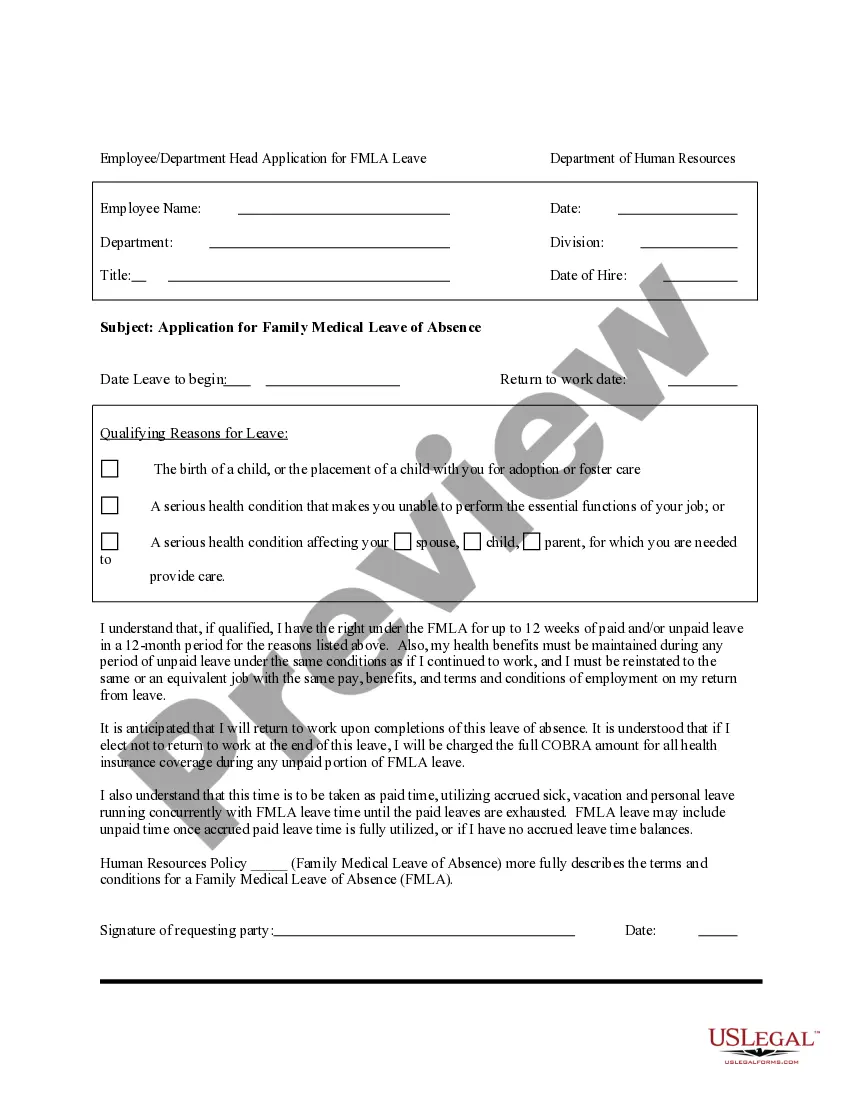
Get your form ready online
Our built-in tools help you complete, sign, share, and store your documents in one place.
Make edits, fill in missing information, and update formatting in US Legal Forms—just like you would in MS Word.
Download a copy, print it, send it by email, or mail it via USPS—whatever works best for your next step.
Sign and collect signatures with our SignNow integration. Send to multiple recipients, set reminders, and more. Go Premium to unlock E-Sign.
If this form requires notarization, complete it online through a secure video call—no need to meet a notary in person or wait for an appointment.
We protect your documents and personal data by following strict security and privacy standards.

Make edits, fill in missing information, and update formatting in US Legal Forms—just like you would in MS Word.

Download a copy, print it, send it by email, or mail it via USPS—whatever works best for your next step.

Sign and collect signatures with our SignNow integration. Send to multiple recipients, set reminders, and more. Go Premium to unlock E-Sign.

If this form requires notarization, complete it online through a secure video call—no need to meet a notary in person or wait for an appointment.

We protect your documents and personal data by following strict security and privacy standards.
Looking for another form?


How to fill out Application For Funeral Leave?
You can spend hours online searching for the legal form template that satisfies the federal and state requirements you need.
US Legal Forms offers a vast selection of legal documents that have been reviewed by experts.
You can download or print the Texas Application for Funeral Leave from our service.
In order to obtain another version of your form, use the Search field to find the template that meets your needs and requirements.
- If you already have a US Legal Forms account, you can sign in and hit the Download button.
- Then, you can complete, modify, print, or sign the Texas Application for Funeral Leave.
- Every legal document template you acquire is yours indefinitely.
- To obtain an additional copy of any purchased form, go to the My documents section and click on the relevant button.
- If you are using the US Legal Forms website for the first time, follow the simple instructions below.
- First, ensure you have selected the correct form template for the county/city of your choice.
- Check the form description to confirm you have selected the right document.
Form popularity
FAQ
Immediate family members typically include your spouse, children, parents, and siblings under Texas guidelines. Some employers may also recognize other relatives like in-laws and grandparents. When applying for leave, use the Texas Application for Funeral Leave to specify your connection to the deceased.
Texas law does not require employers to provide employee bereavement leave. Bereavement leave is leave that is taken by an employee due to the death of another individual, usually a close relative.
Texas law does not require employers to provide employee bereavement leave. Bereavement leave is leave that is taken by an employee due to the death of another individual, usually a close relative.
Emergency leave is permitted for the death of a family member (spouse, parent, grandparent, child, grandchild, sibling or the equivalent of a spouse's relations) without a reduction in pay.
Employees can take leave for the death of a spouse, child, parent, sibling, grandparent, grandchild, or domestic partner. Their guaranteed ten days off can be used at any time in any combination in the three months following the death.
Leave Application due to My Father Passed Away With deep sorrow I have to inform you of the sudden death of my Father due to a brain hemorrhage on the night of 20262026202620262026 (date). As I am required to attend the last rites of father at my home town, I request you to kindly grant me leave for seven days with priority basic.
Bereavement leave isn't mandatory in Texas. Federal and state laws don't regulate the leave process. And in most states laws that protect workers' rights don't cover bereavement leave. » MORE: Easy as 1-2-3, make an online will in minutes.
Immediate Family Defined for Bereavement Leave: Immediate family members are defined as an employee's spouse, child, stepchild, parent, stepparent, sister, brother, grandparent, grandchild, niece, nephew, father-in-law, mother-in-law, brother-in-law, sister-in-law, son-in-law or daughter-in-law.
I regret to inform you that my father passed away today, tragically and unexpectedly. In light of these circumstances, I respectfully request that you grant me 5 days of paid leave and 3 days of unpaid leave beginning today.
Immediate family members are one of the following relatives related to the employee either by blood or current marriage: spouse, 2022 parent, 2022 child, 2022 brother or sister, 2022 grandparent, 2022 grandchild, 2022 step-child, 2022 step-brother or step-sister, 2022 step-parent, and 2022 step-grandparent.