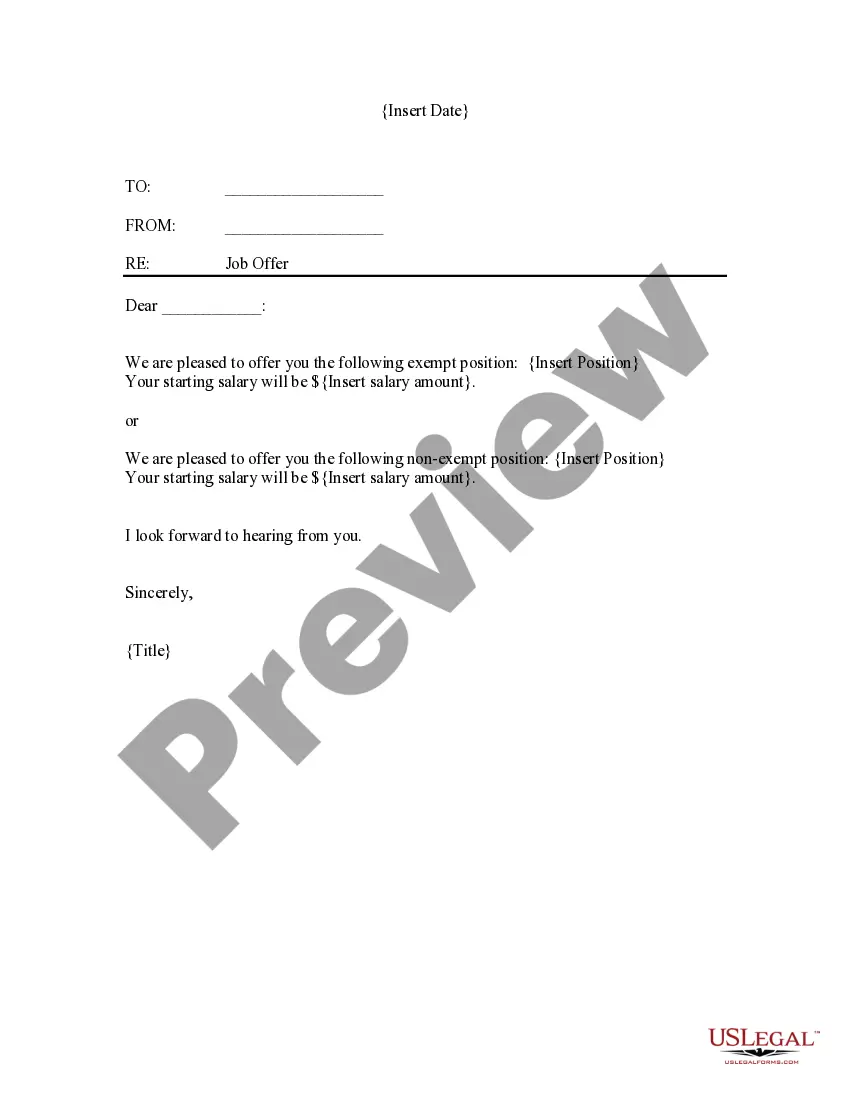
Texas Job Offer Letter for Lawyer
Description
Get your form ready online
Our built-in tools help you complete, sign, share, and store your documents in one place.
Make edits, fill in missing information, and update formatting in US Legal Forms—just like you would in MS Word.
Download a copy, print it, send it by email, or mail it via USPS—whatever works best for your next step.
Sign and collect signatures with our SignNow integration. Send to multiple recipients, set reminders, and more. Go Premium to unlock E-Sign.
If this form requires notarization, complete it online through a secure video call—no need to meet a notary in person or wait for an appointment.
We protect your documents and personal data by following strict security and privacy standards.

Make edits, fill in missing information, and update formatting in US Legal Forms—just like you would in MS Word.

Download a copy, print it, send it by email, or mail it via USPS—whatever works best for your next step.

Sign and collect signatures with our SignNow integration. Send to multiple recipients, set reminders, and more. Go Premium to unlock E-Sign.

If this form requires notarization, complete it online through a secure video call—no need to meet a notary in person or wait for an appointment.

We protect your documents and personal data by following strict security and privacy standards.
Looking for another form?

How to fill out Job Offer Letter For Lawyer?
You can spend multiple hours online searching for the legal document template that meets the federal and state regulations you need.
US Legal Forms offers a vast collection of legal forms that can be reviewed by professionals.
You can easily download or print the Texas Job Offer Letter for Lawyer from their services.
If available, use the Preview option to view the document template simultaneously.
- If you possess a US Legal Forms account, you may Log In and select the Acquire option.
- After that, you can complete, alter, print, or sign the Texas Job Offer Letter for Lawyer.
- Each legal document template you purchase is yours indefinitely.
- To obtain another copy of the acquired form, visit the My documents tab and click the relevant option.
- If you are using the US Legal Forms site for the first time, follow the simple instructions below.
- First, ensure that you have selected the correct document template for the state/city of your preference.
- Review the form outline to make sure you have chosen the right form.
Form popularity
FAQ
To detect a legitimate Texas job offer letter for lawyer, look for official letterhead and contact information from the law firm. Additionally, check for clear details about the position, salary, and benefits. Be cautious of vague information or requests for payment, as these can indicate a scam.
In general, offer letters are less formal than employment contracts, which typically set terms and conditions of employment that are legally binding. It's also vital for employers to understand that they aren't required by federal law to send an offer letter to new hires.
Generally, this means that when an employer makes an offer of at-will employment, the employer is free to rescind that job offer, for any reason or no reason at all, at any time, including the period after the potential employee has accepted the offer but before he or she begins work, without legal consequence.
Once the offer is accepted you have a binding contract, as long as the terms on offer are clear.
It doesn't currently work like that under Texas law. So typically, the promises in the offer letter are only enforceable if you've already performed what is required.
In general, offer letters are less formal than employment contracts, which typically set terms and conditions of employment that are legally binding. It's also vital for employers to understand that they aren't required by federal law to send an offer letter to new hires.
Some important details about an offer letter are: It is NOT a legally binding contract. It does NOT include promises of future employment or wages. It includes an employment at-will statement.
A job offer can be made in writing or verbally and once made it is legally binding. A job offer can be conditional or unconditional.
Contrary to what most people think, a signed offer letter, except in very rare instances, is not a legally binding implied contract. Candidates often think that because they have signed and accepted an offer letter, they have some sort of legal right to the job.
Unfortunately, your boss is correct. An written offer of employment does not constitue a legal contrat unless it guaranteed your employment in some way (i.e. your compensation, etc.) for a specified period of time.