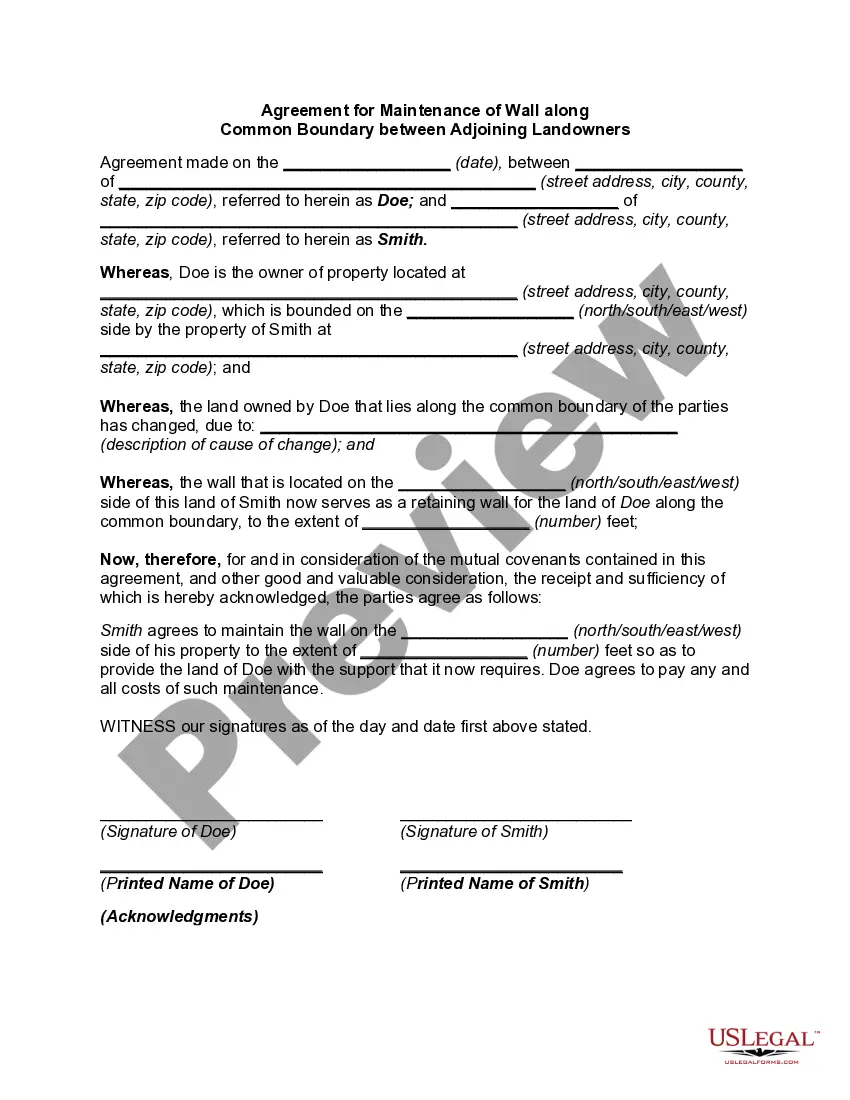
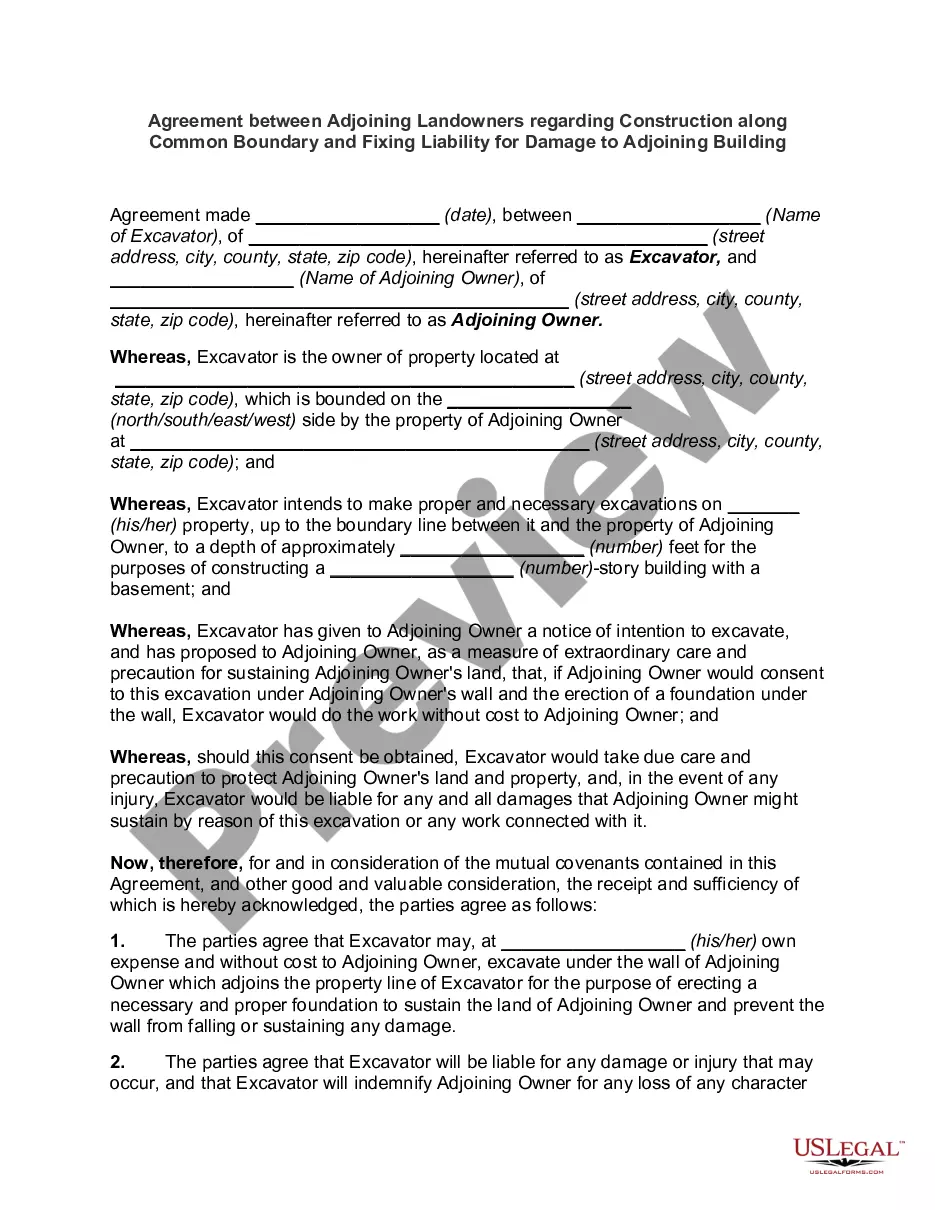
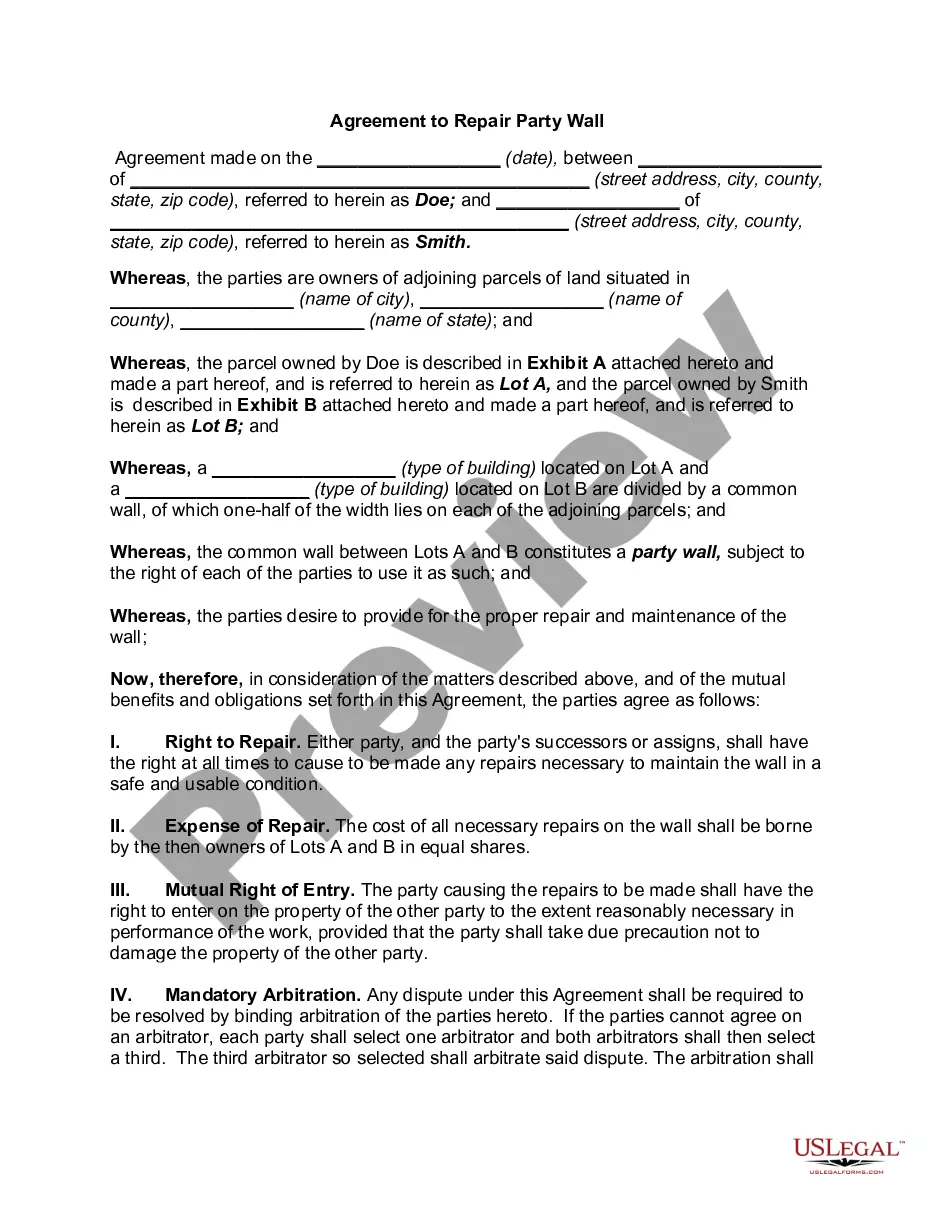
Texas Agreement for Maintenance of Wall Along Common Boundary Between Adjoining Landowners
Description
Get your form ready online
Our built-in tools help you complete, sign, share, and store your documents in one place.
Make edits, fill in missing information, and update formatting in US Legal Forms—just like you would in MS Word.
Download a copy, print it, send it by email, or mail it via USPS—whatever works best for your next step.
Sign and collect signatures with our SignNow integration. Send to multiple recipients, set reminders, and more. Go Premium to unlock E-Sign.
If this form requires notarization, complete it online through a secure video call—no need to meet a notary in person or wait for an appointment.
We protect your documents and personal data by following strict security and privacy standards.

Make edits, fill in missing information, and update formatting in US Legal Forms—just like you would in MS Word.

Download a copy, print it, send it by email, or mail it via USPS—whatever works best for your next step.

Sign and collect signatures with our SignNow integration. Send to multiple recipients, set reminders, and more. Go Premium to unlock E-Sign.

If this form requires notarization, complete it online through a secure video call—no need to meet a notary in person or wait for an appointment.

We protect your documents and personal data by following strict security and privacy standards.
Looking for another form?
How to fill out Agreement For Maintenance Of Wall Along Common Boundary Between Adjoining Landowners?
Are you in a situation where you need to access documents for both business or personal reasons almost every workday? There are numerous legal document templates available online, but finding forms you can trust is not easy.
US Legal Forms provides thousands of document templates, such as the Texas Agreement for Maintenance of Wall Along Common Boundary Between Adjoining Landowners, that are designed to meet both federal and state requirements.
If you are already familiar with the US Legal Forms site and have an account, simply Log In. Afterwards, you can download the Texas Agreement for Maintenance of Wall Along Common Boundary Between Adjoining Landowners template.
- Locate the form you need and confirm it is for your specific city/state.
- Utilize the Preview button to review the form.
- Check the description to make sure you have selected the right form.
- If the form is not what you are looking for, use the Search field to find the form that meets your needs and criteria.
- Once you find the proper form, click on Purchase now.
- Choose the pricing plan you prefer, provide the necessary details to create your account, and complete the transaction using your PayPal or credit card.
- Select a convenient document format and download your copy.
Form popularity
FAQ
You do not want to be caught by surprise. Under this statute, a person may not remove a fence that is a separating or dividing fence in which the person is a joint owner or that is attached to a fence owned or controlled by another person, absent mutual agreement between the parties.
Texas does not have a specific state law that addresses boundary line fences.
Unless the deeds specify for the boundary to be maintained, there is no legal requirement for the owner to maintain the wall or fence or to keep hedges tidy. The owner could be liable if the fence or wall causes damage or injury because it has been neglected.
The best way to determine whether a fence is yours or not is by examining where it falls on the property line. If the fence is placed on your side of the property line between your house and your neighbor's, the fence is yours.
Boundaries can also be changed by a boundary agreement between previous owners. If the boundary line cannot be agreed on the basis of what you can see in the deeds, you and your neighbour may want to consider agreeing to jointly appoint a chartered land surveyor.
If only one neighbor pays for the fence, it is not a common fence but rather the exclusive property of the builder. If neighbors agree to maintain a portion of the fence, this agreement is legally binding and enforceable.
Under the Texas Agricultural Code, a person may not remove a fence in which the person is a joint owner or a fence that is attached to a fence controlled by another person, without giving a 6-month notice of the intent to remove the fence in writing.
The answer: Fence ownership is determined by where your fence lays on the property line. If your fence is right on the property line between your neighbor's property and your property, neither you nor your neighbor owns a side; it's a shared fence responsibility.
How to Amend Property LinesTalk to your neighbor to see if she will allow you to purchase enough additional property to move the boundary line to the desired location.Enter into a boundary line agreement.File a court action to establish the property boundaries.More items...
There is no general rule about whether you own the fence on the left-hand or right-hand side of your property. So forget any 'rules' you've heard previously that state otherwise not everyone will own the left-hand side of their fence.