Texas Visitor Nondisclosure Agreement
Description
Get your form ready online
Our built-in tools help you complete, sign, share, and store your documents in one place.
Make edits, fill in missing information, and update formatting in US Legal Forms—just like you would in MS Word.
Download a copy, print it, send it by email, or mail it via USPS—whatever works best for your next step.
Sign and collect signatures with our SignNow integration. Send to multiple recipients, set reminders, and more. Go Premium to unlock E-Sign.
If this form requires notarization, complete it online through a secure video call—no need to meet a notary in person or wait for an appointment.
We protect your documents and personal data by following strict security and privacy standards.

Make edits, fill in missing information, and update formatting in US Legal Forms—just like you would in MS Word.

Download a copy, print it, send it by email, or mail it via USPS—whatever works best for your next step.

Sign and collect signatures with our SignNow integration. Send to multiple recipients, set reminders, and more. Go Premium to unlock E-Sign.

If this form requires notarization, complete it online through a secure video call—no need to meet a notary in person or wait for an appointment.

We protect your documents and personal data by following strict security and privacy standards.
Looking for another form?

How to fill out Visitor Nondisclosure Agreement?
Selecting the correct valid document template can be challenging.
Indeed, there are numerous templates available online, but how can you find the legitimate format you need.
Utilize the US Legal Forms website. This service offers thousands of templates, including the Texas Visitor Nondisclosure Agreement, suitable for both business and personal purposes.
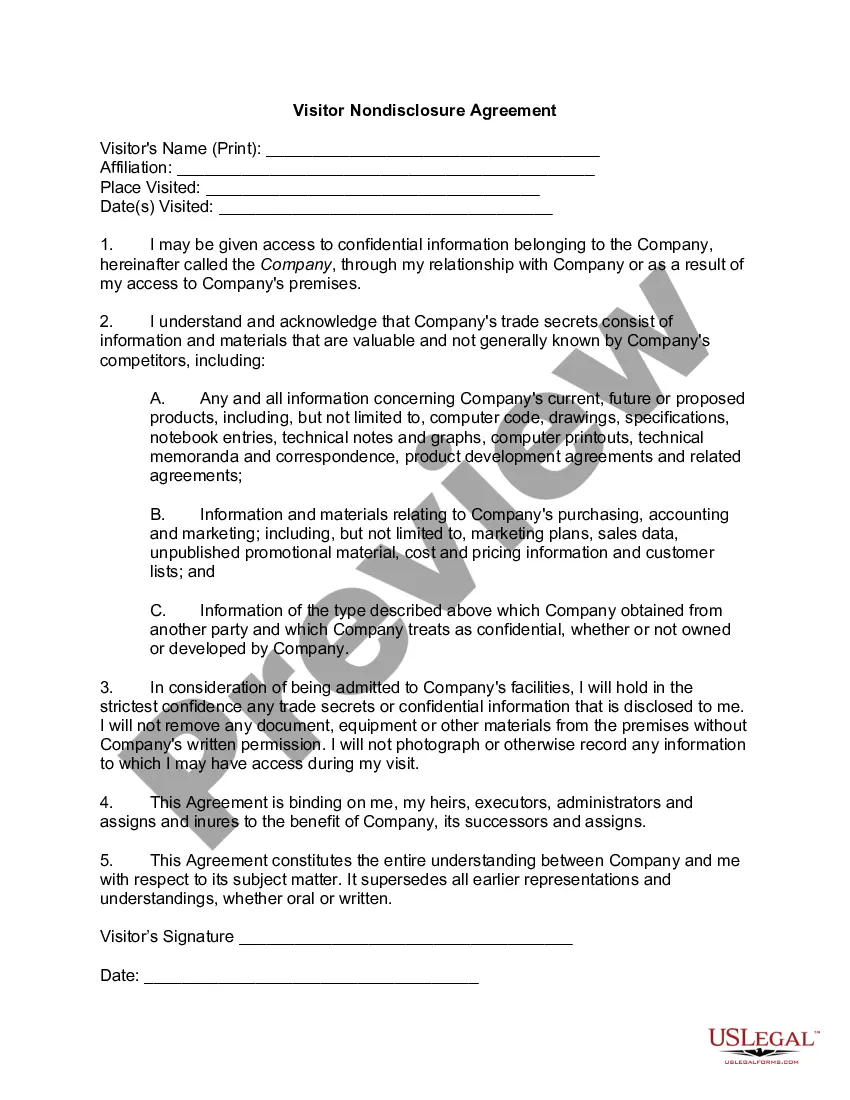
You can preview the form using the Review option and read the form details to confirm it is indeed the right one for you.
- All templates are reviewed by professionals and comply with state and federal regulations.
- If you are already registered, Log In to your account and click the Download button to obtain the Texas Visitor Nondisclosure Agreement.
- Use your account to browse through the legal forms you have previously acquired.
- Visit the My documents section of your account to download another copy of the document you require.
- If you are a new user of US Legal Forms, here are simple steps to follow.
- First, ensure that you have selected the correct form for your city/county.
Form popularity
FAQ
Yes, NDAs are enforceable in Texas, provided they meet legal requirements outlined in Texas law. A Texas Visitor Nondisclosure Agreement will be upheld by courts if it protects legitimate interests and is reasonable in its restrictions. Always ensure that the terms are clear and not overly broad, as this can affect enforceability. Consulting with legal professionals can further enhance your NDA’s strength.
To file a non-disclosure in Texas, you typically do not need to submit it to a court. Instead, ensure that all parties involved in the Texas Visitor Nondisclosure Agreement maintain signed copies. Keeping proper records and disseminating the agreement to relevant stakeholders is essential. If you face any challenges, platforms like US Legal Forms can provide you with templates and guidance on drafting a compliant NDA.
Yes, NDAs work effectively in Texas, including the Texas Visitor Nondisclosure Agreement, to protect confidential information. When executed properly, these agreements can deter breaches and provide legal recourse if violations occur. Businesses frequently use NDAs to safeguard trade secrets and sensitive information. Make sure your NDA is tailored to your specific needs to maximize its effectiveness.
In Texas, the duration of a nondisclosure agreement can vary, but it typically lasts for a specified period stated in the Texas Visitor Nondisclosure Agreement. Many businesses set confidentiality periods ranging from two to five years, depending on the nature of the information and industry standards. Make sure to specify the duration in your agreement for clarity. To stay compliant, consider future updates to the NDA if needed.
NDAs, including the Texas Visitor Nondisclosure Agreement, generally hold up well in court if they are properly drafted and reasonable in scope. Courts will enforce NDAs as long as they protect legitimate business interests without being overly broad. You should ensure that your agreement complies with Texas law to enhance its enforceability. Always consider seeking legal advice to strengthen your NDA.
To fill out a Texas Visitor Nondisclosure Agreement, start by clearly identifying the parties involved. Next, specify the confidential information you wish to protect, ensuring it is well-defined. Include the purpose of the agreement and the duration of confidentiality. Finally, both parties should sign and date the agreement to make it legally binding.
In the context of Texas Visitor Nondisclosure Agreements, MNDA stands for Mutual Nondisclosure Agreement. This type of agreement signifies that both parties are sharing confidential information and agree to safeguard each other's trade secrets. It's crucial to understand this distinction to ensure that your business interests are effectively protected.
In the framework of a Texas Visitor Nondisclosure Agreement, there are three primary types: unilateral, bilateral, and multilateral. A unilateral NDA involves one disclosing party and one receiving party, a bilateral NDA includes two parties sharing information, and a multilateral NDA can include multiple parties in the agreement. Selecting the right type helps ensure the confidentiality of your sensitive information.
The difference between an NDA and an MNDA is quite clear in the context of Texas Visitor Nondisclosure Agreements. An NDA is a one-sided agreement that protects the confidential information of one party, whereas an MNDA is mutual and allows both parties to share and protect each other's sensitive information. This understanding can significantly impact your decision-making process when entering into agreements.
The Texas Visitor Nondisclosure Agreement (NDA) and an MDNA, which stands for Mutual Disclosure Nondisclosure Agreement, fulfill different roles in confidentiality. An NDA typically protects one party's proprietary information, whereas an MDNA allows for the reciprocal exchange of sensitive information between two parties. Understanding these differences can help you choose the right agreement for your specific needs.