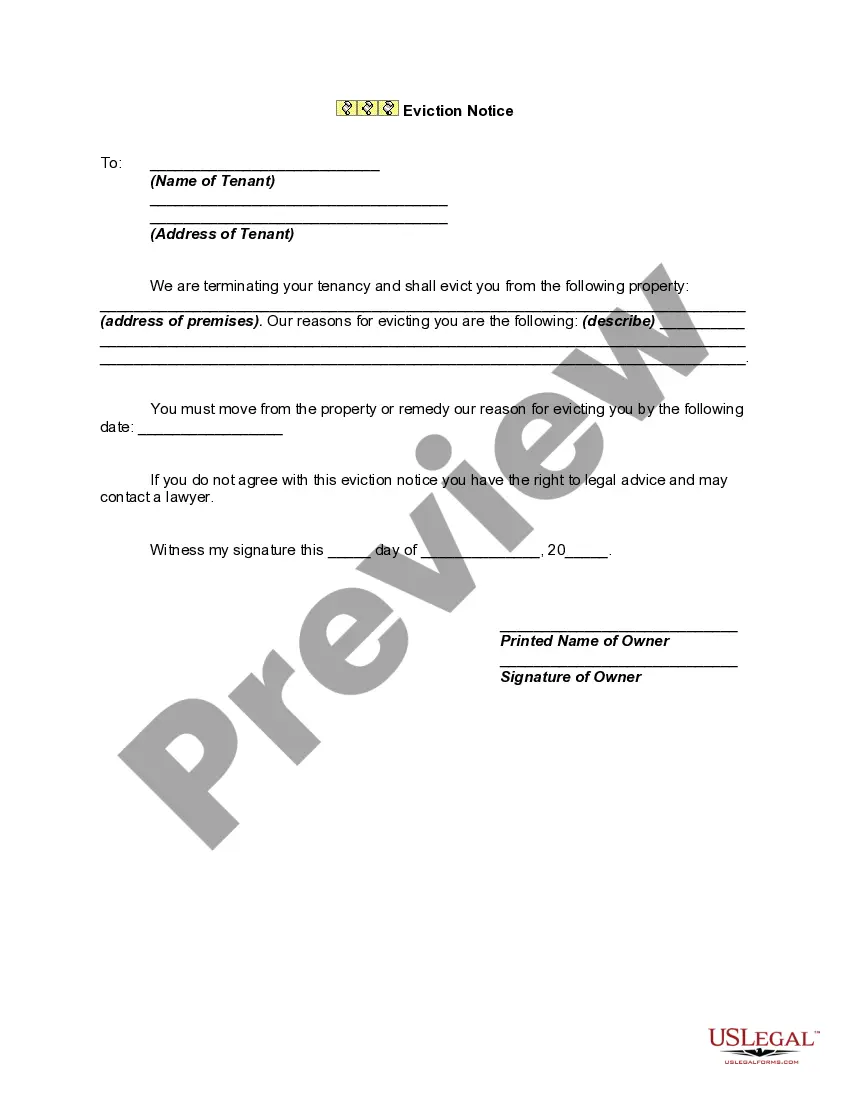
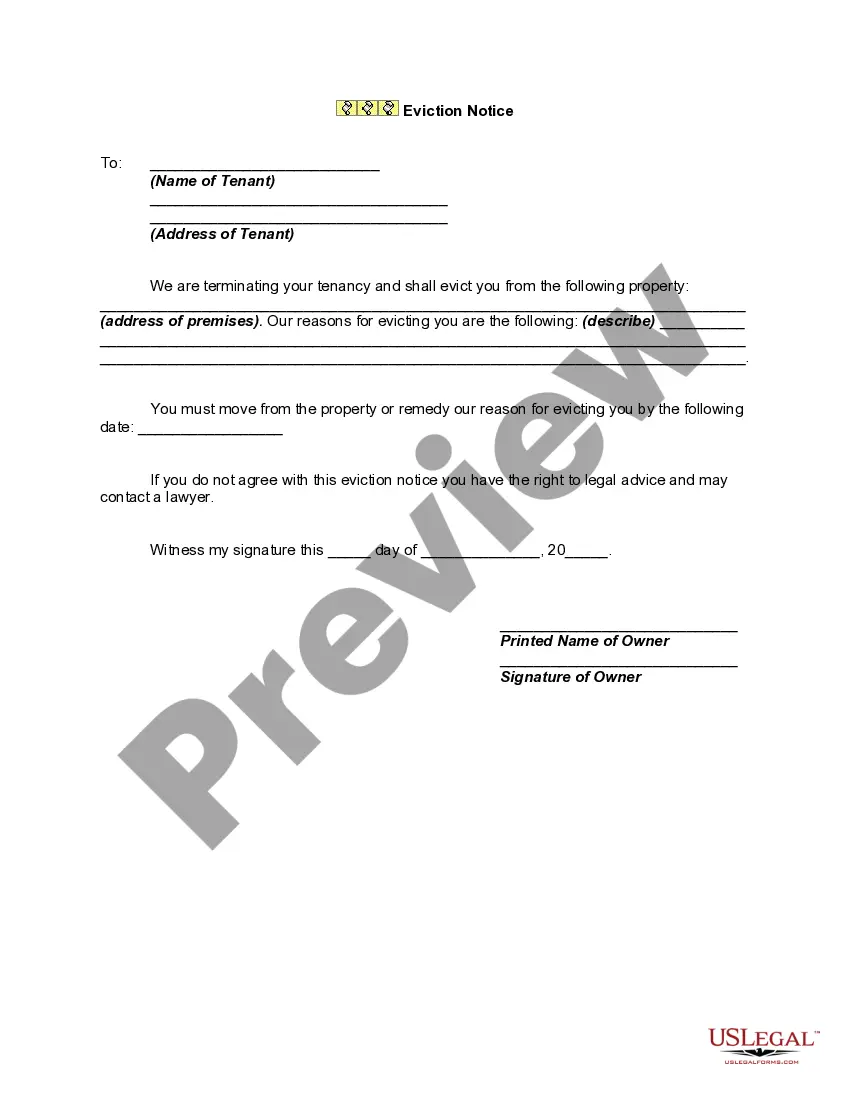
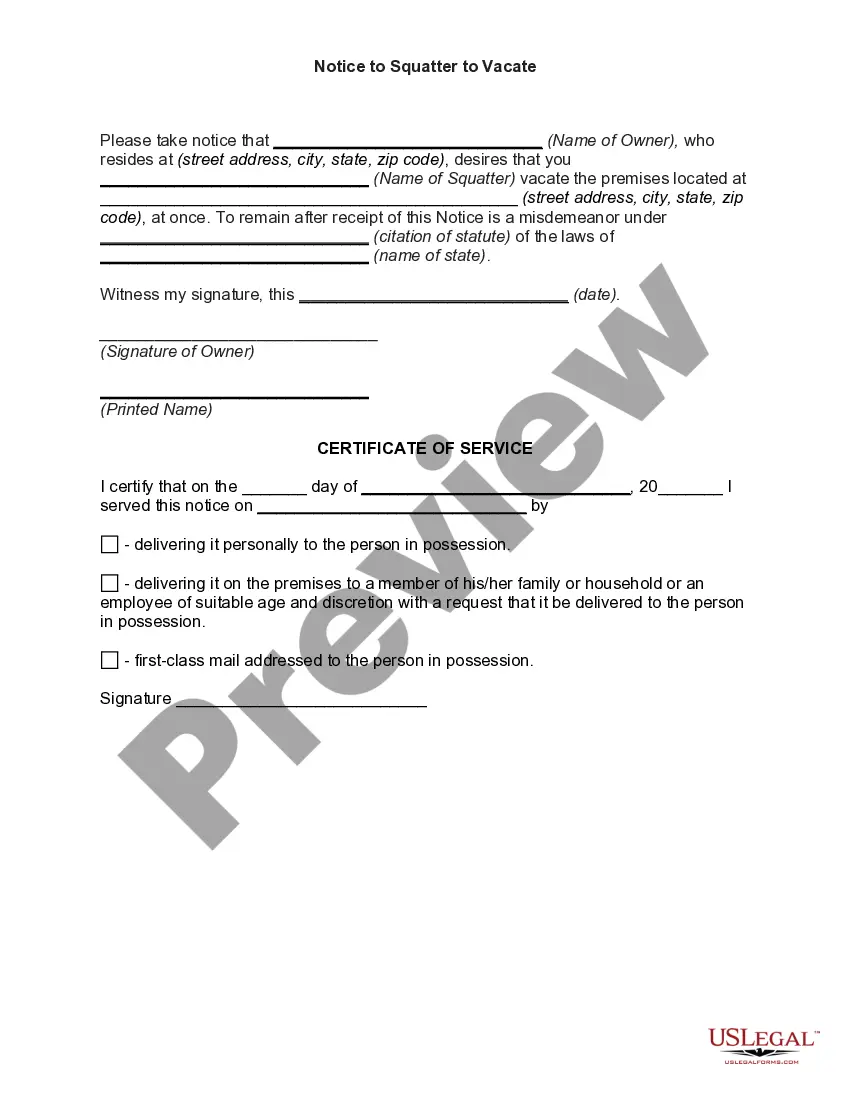
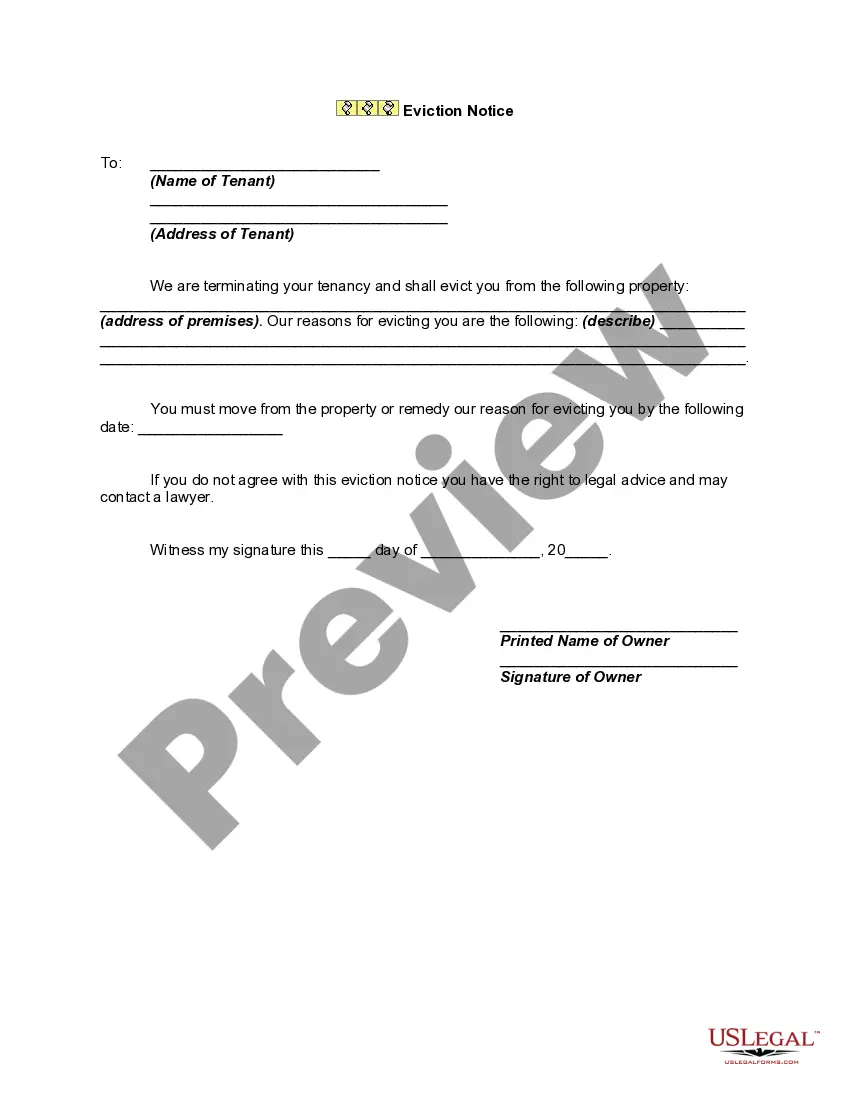
Texas Eviction Notice for Spouse
Description

Get your form ready online
Our built-in tools help you complete, sign, share, and store your documents in one place.
Make edits, fill in missing information, and update formatting in US Legal Forms—just like you would in MS Word.
Download a copy, print it, send it by email, or mail it via USPS—whatever works best for your next step.
Sign and collect signatures with our SignNow integration. Send to multiple recipients, set reminders, and more. Go Premium to unlock E-Sign.
If this form requires notarization, complete it online through a secure video call—no need to meet a notary in person or wait for an appointment.
We protect your documents and personal data by following strict security and privacy standards.

Make edits, fill in missing information, and update formatting in US Legal Forms—just like you would in MS Word.

Download a copy, print it, send it by email, or mail it via USPS—whatever works best for your next step.

Sign and collect signatures with our SignNow integration. Send to multiple recipients, set reminders, and more. Go Premium to unlock E-Sign.

If this form requires notarization, complete it online through a secure video call—no need to meet a notary in person or wait for an appointment.

We protect your documents and personal data by following strict security and privacy standards.
Looking for another form?










How to fill out Eviction Notice For Spouse?
If you wish to finalize, acquire, or print legal document templates, utilize US Legal Forms, the largest assortment of legal forms available online.
Make use of the site’s straightforward and convenient search feature to find the documents you require.
A diverse range of templates for business and personal purposes are organized by categories and states, or keywords.
Step 4. Once you have found the form you need, click the Buy now button. Choose your preferred pricing plan and enter your credentials to register for the account.
Step 5. Process the transaction. You can use your credit card or PayPal account to complete the purchase.
- Utilize US Legal Forms to locate the Texas Eviction Notice for Spouse with just a few clicks.
- If you are already a US Legal Forms user, Log In to your account and click the Download button to obtain the Texas Eviction Notice for Spouse.
- You can also access forms you have previously purchased in the My documents section of your account.
- If you are using US Legal Forms for the first time, follow the instructions below.
- Step 1. Ensure you have chosen the form for your specific city/state.
- Step 2. Use the Preview option to review the form’s content. Don’t forget to check the details.
- Step 3. If you are not satisfied with the form, use the Search field at the top of the screen to find alternative versions of the legal form template.
Form popularity
FAQ
Judges in Texas have no patience or tolerance for parties who are intent on hiding assets during divorce. Texas is a community property state, which means all property and assets acquired from the date of marriage through the date of divorce are subject to just and equitable division upon divorce.
Even if you buy the house and you only put it in one person's name, it is still considered community property in Texas and your spouse cannot kick you out of the house. Additionally if you're living in the house, your spouse cannot kick you out. You have a right to be there.
California is a ?community property state,? which means property a couple acquires during their marriage belongs to both parties. In many cases, this includes their home, which means one spouse cannot force the other to move out simply because they are in the process of divorcing.
You cannot force your partner to move out unless there is a court order granting you exclusive use of the home. This typically occurs during a temporary orders hearing in a divorce process. If you and your partner cannot agree on living arrangements, the judge will make the decision for you.
You might urgently need to stop them coming back so you can be safe in your home. You should apply for a: 'non-molestation order' to protect you or your children from being harmed by your ex-partner. 'occupation order' to give you the right to stay in your home and stop your ex-partner coming back.
If you have a valid agreement in place that addresses who will stay in the house and who will move out, you have leverage through that agreement for keeping your spouse out. Without such an agreement you may have to get a court order from the judge to keep them out if they insist on moving back in.
You can move back into the marital residence so long as no court order precludes you from doing so, but you must be cautioned about any potential confrontation which may result.
Both parties have a right to stay in the home. No one can force you to leave your residence without a court order unless there is domestic violence. A temporary orders hearing must be held to get such a court order in a divorce.