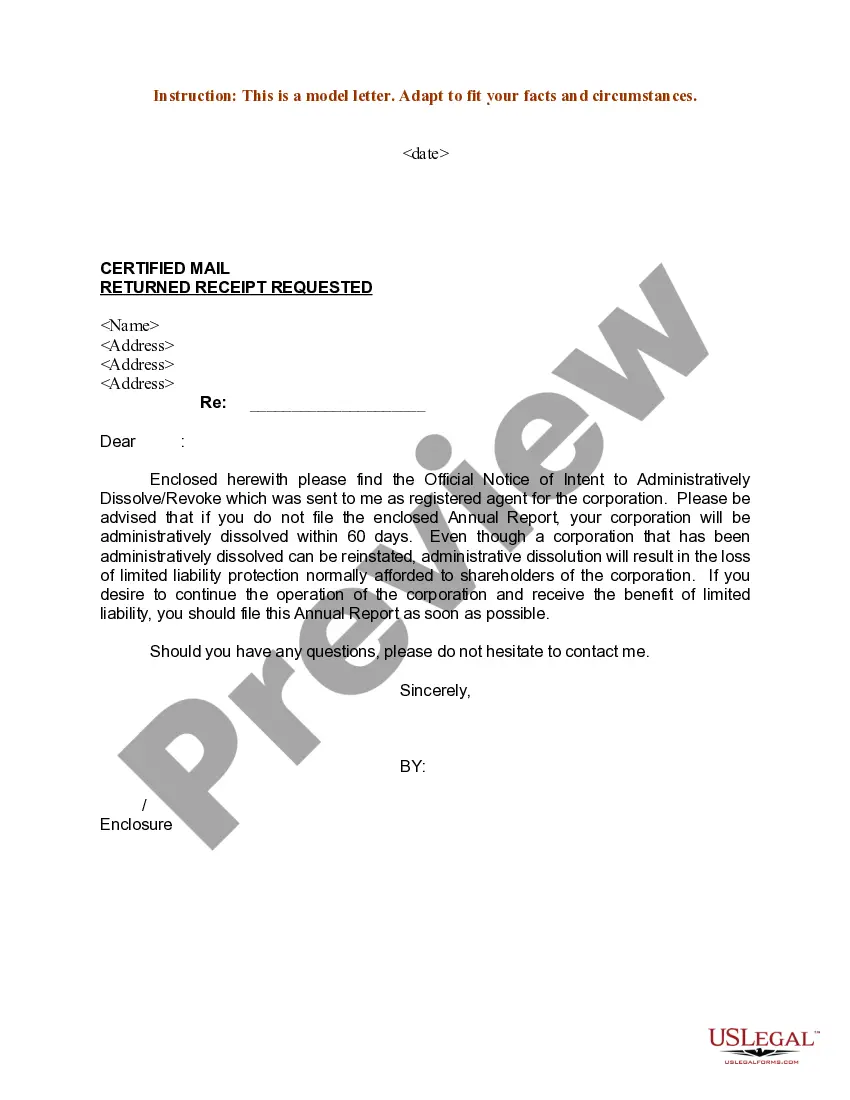
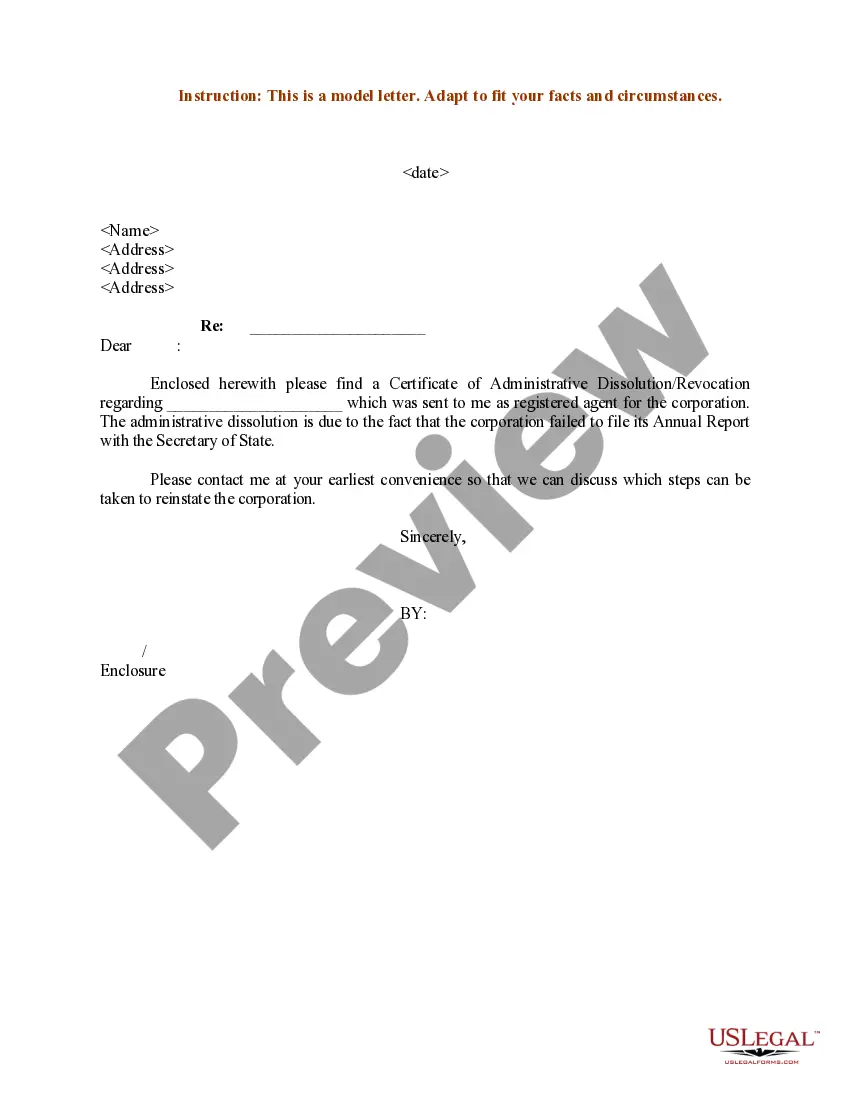
Texas Sample Letter regarding Notification of Official Notice of Intent to Administratively Dissolve or Revoke Corporation
Description
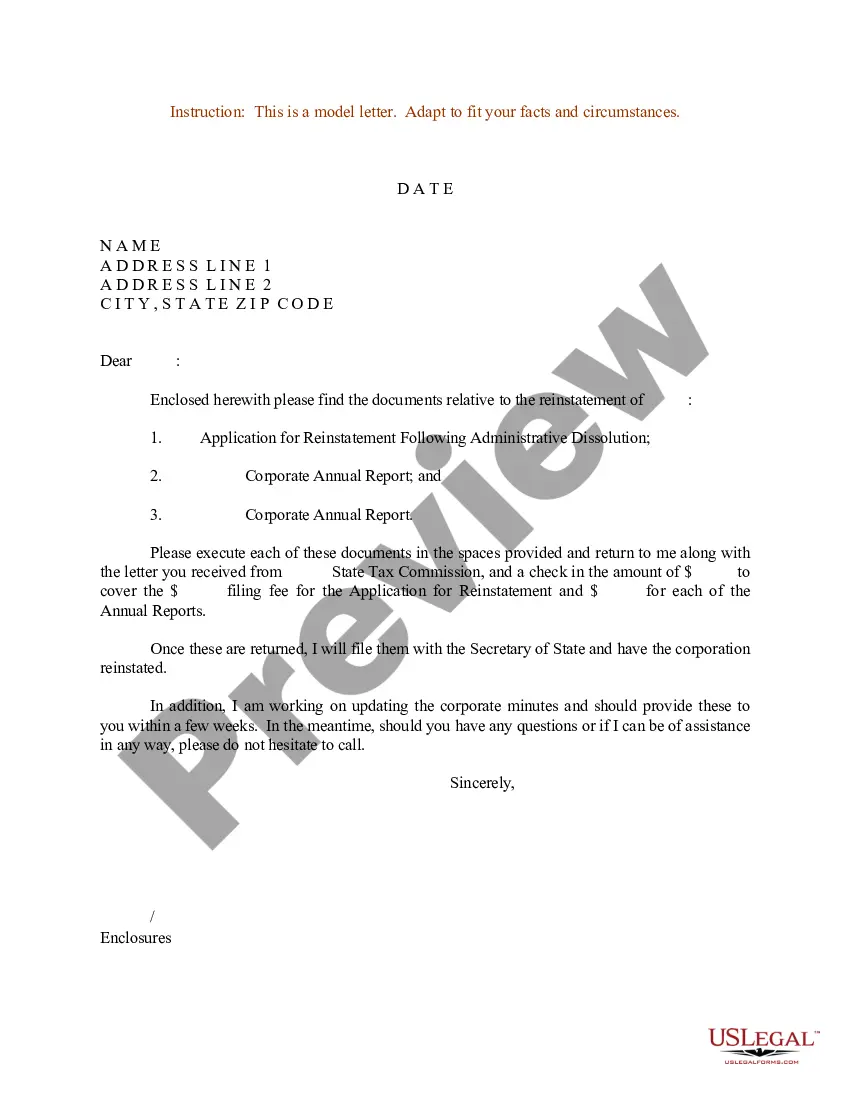
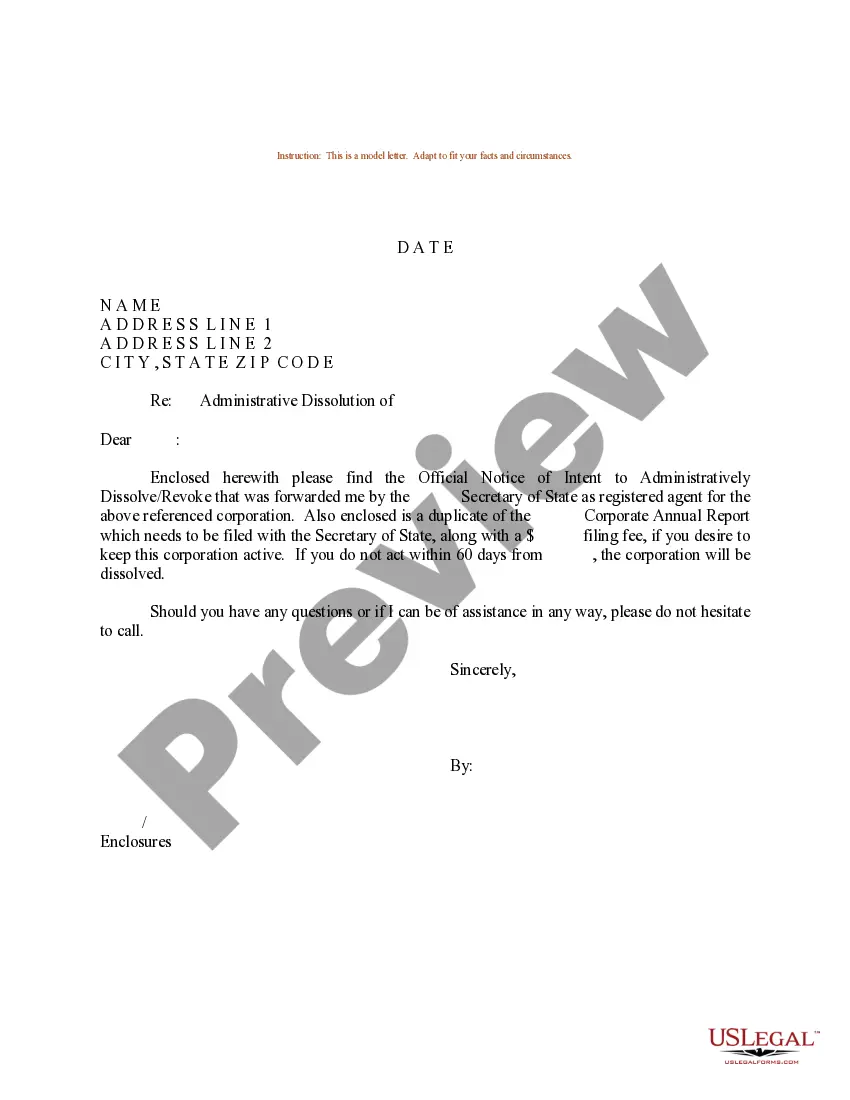
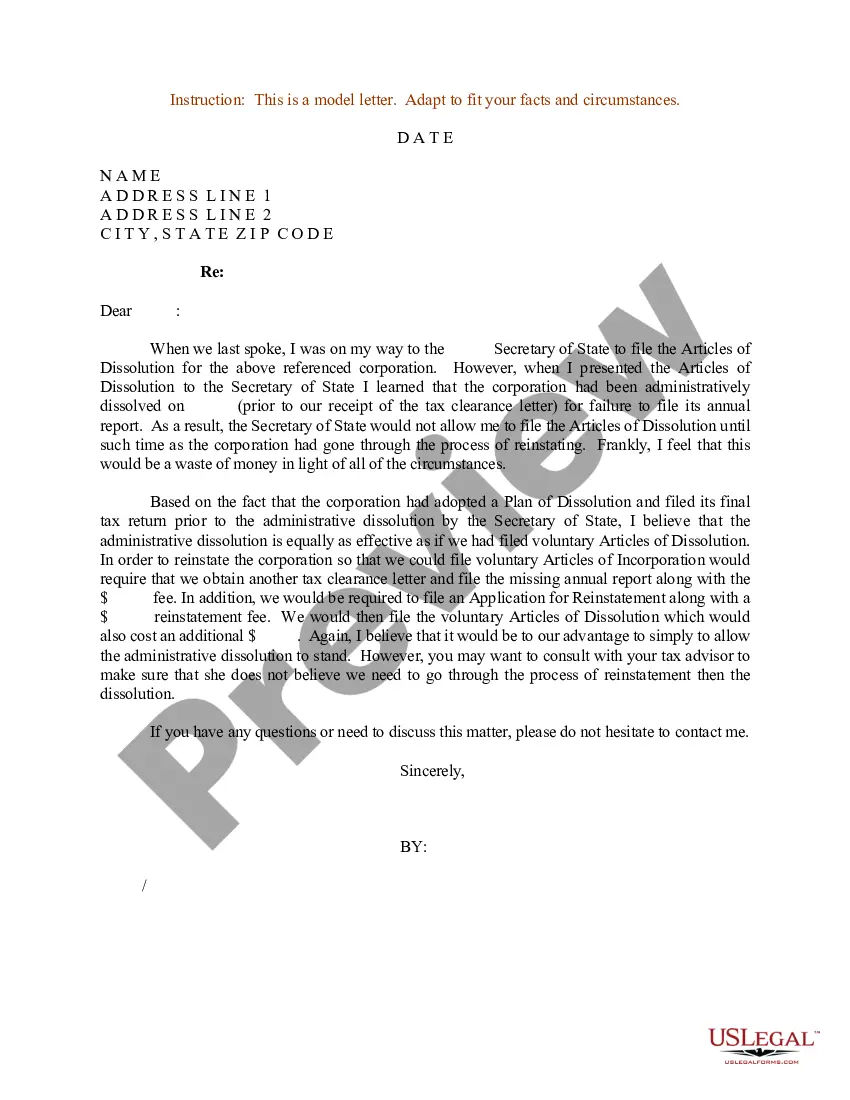
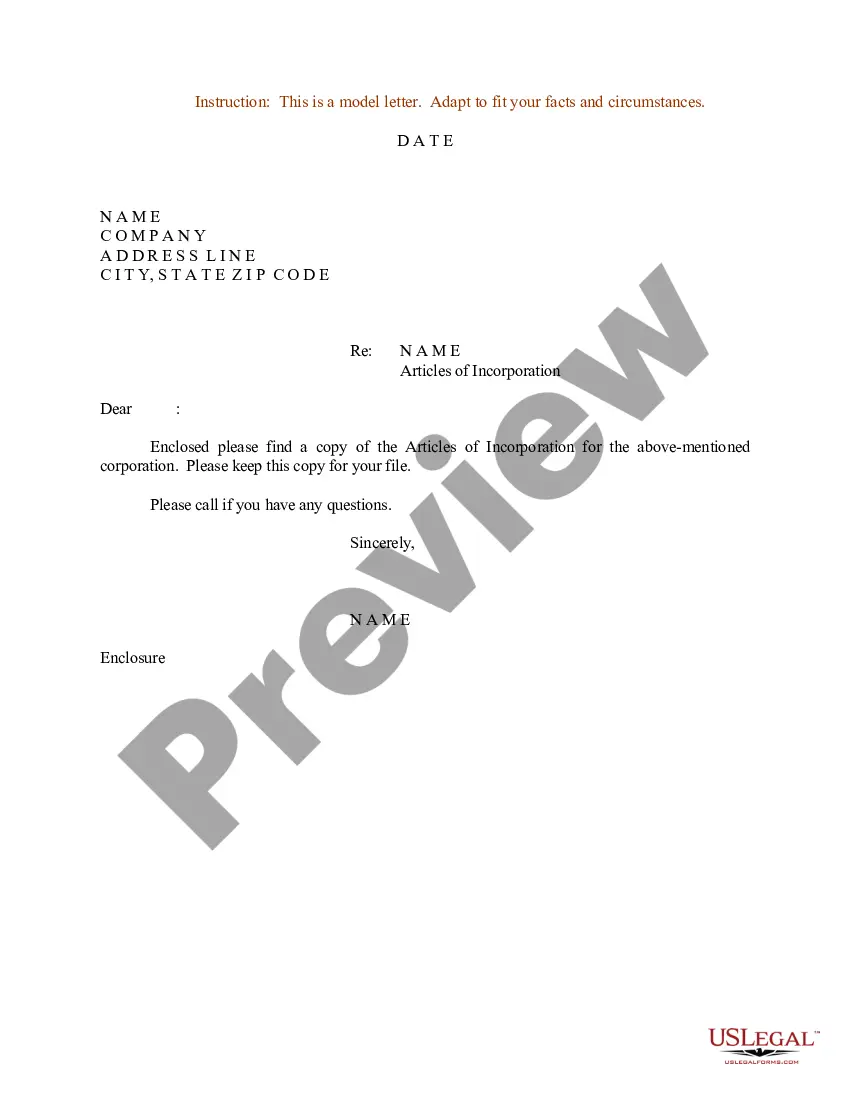
Get your form ready online
Our built-in tools help you complete, sign, share, and store your documents in one place.
Make edits, fill in missing information, and update formatting in US Legal Forms—just like you would in MS Word.
Download a copy, print it, send it by email, or mail it via USPS—whatever works best for your next step.
Sign and collect signatures with our SignNow integration. Send to multiple recipients, set reminders, and more. Go Premium to unlock E-Sign.
If this form requires notarization, complete it online through a secure video call—no need to meet a notary in person or wait for an appointment.
We protect your documents and personal data by following strict security and privacy standards.

Make edits, fill in missing information, and update formatting in US Legal Forms—just like you would in MS Word.

Download a copy, print it, send it by email, or mail it via USPS—whatever works best for your next step.

Sign and collect signatures with our SignNow integration. Send to multiple recipients, set reminders, and more. Go Premium to unlock E-Sign.

If this form requires notarization, complete it online through a secure video call—no need to meet a notary in person or wait for an appointment.

We protect your documents and personal data by following strict security and privacy standards.
Looking for another form?
How to fill out Sample Letter Regarding Notification Of Official Notice Of Intent To Administratively Dissolve Or Revoke Corporation?
If you wish to complete, download, or print legal document templates, utilize US Legal Forms, the most extensive variety of legal types available online. Take advantage of the site's simple and efficient search to find the documents you need. A wide range of templates for business and personal purposes are categorized by types and keywords. Use US Legal Forms to obtain the Texas Sample Letter concerning Notification of Official Notice of Intent to Administratively Dissolve or Revoke Corporation in just a few clicks.
If you are already a US Legal Forms client, Log In to your account and then click the Acquire button to get the Texas Sample Letter regarding Notification of Official Notice of Intent to Administratively Dissolve or Revoke Corporation. You can also access forms you previously downloaded in the My documents section of your account.
If you are using US Legal Forms for the first time, follow the steps outlined below: Step 1. Make sure you have selected the form for the correct city/state. Step 2. Use the Preview option to review the form's content. Remember to read the description. Step 3. If you are not satisfied with the form, utilize the Search field at the top of the page to find alternative versions of the legal form template. Step 4. Once you have found the form you desire, click the Acquire now button. Choose the payment plan you prefer and enter your details to register for an account. Step 5. Complete the transaction. You can use your Visa or Mastercard or PayPal account to finalize the payment. Step 6. Choose the format of the legal form and download it to your device. Step 7. Complete, edit, and print or sign the Texas Sample Letter regarding Notification of Official Notice of Intent to Administratively Dissolve or Revoke Corporation.
Avoid altering or deleting any HTML tags. Only synonymize plain text outside of the HTML tags.
- Every legal document template you obtain is yours indefinitely.
- You have access to every form you downloaded in your account.
- Navigate to the My documents section and select a form to print or download again.
- Compete and download, and print the Texas Sample Letter regarding Notification of Official Notice of Intent to Administratively Dissolve or Revoke Corporation with US Legal Forms.
- There are numerous professional and state-specific templates available for your business or personal requirements.
Form popularity
FAQ
When the revocation of dissolution is effective, it relates back to and takes effect as of the effective date of the dissolution and the corporation resumes carrying on its business as if dissolution had never occurred.
How do you dissolve a Texas corporation? To dissolve your Texas corporation, you file Form 651 Certificate of Termination of Domestic Entity and accompany that with a tax clearance certificate from the Texas Comptroller of Public Accounts indicating that all taxes have been paid by the entity.
People who continue to operate a business that has been dissolved, are taking a serious risk. That's because once the company dissolves, the corporate protections no longer exist. That means that someone who operates the dissolved business, can be sued personally for anything the (dissolved) company does.
Administrative dissolution is the taking away of the rights, powers, and authority of a domestic corporation, LLC, or other statutory business entity by the state administrator overseeing business entities, due to the entity's failure to comply with certain obligations of the business entity statute.
An entity forfeited under the Tax Code can reinstate at any time (so long as the entity would otherwise continue to exist) by (1) filing the required franchise tax report, (2) paying all franchise taxes, penalties, and interest, and (3) filing an application for reinstatement (Form 801 Word 178kb, PDF 87kb), ...
Once a company is dissolved, it no longer exists as a legal entity and cannot conduct business or enter into contracts. Dissolution may also trigger a number of certain legal obligations, such as the distribution of remaining assets to creditors or shareholders. It also might involve the filing of final tax returns.
Administrative dissolution is an involuntary dissolution action taken by the Secretary of State, or whatever they call it in your state, that results in the loss of the business entity's rights to do business in that particular location.
After dissolution, a corporation is generally expected to pay all its existing debts and then liquidate its remaining assets to its shareholders. This sometimes becomes difficult, however, where there are unknown claims that may exist against the corporation.