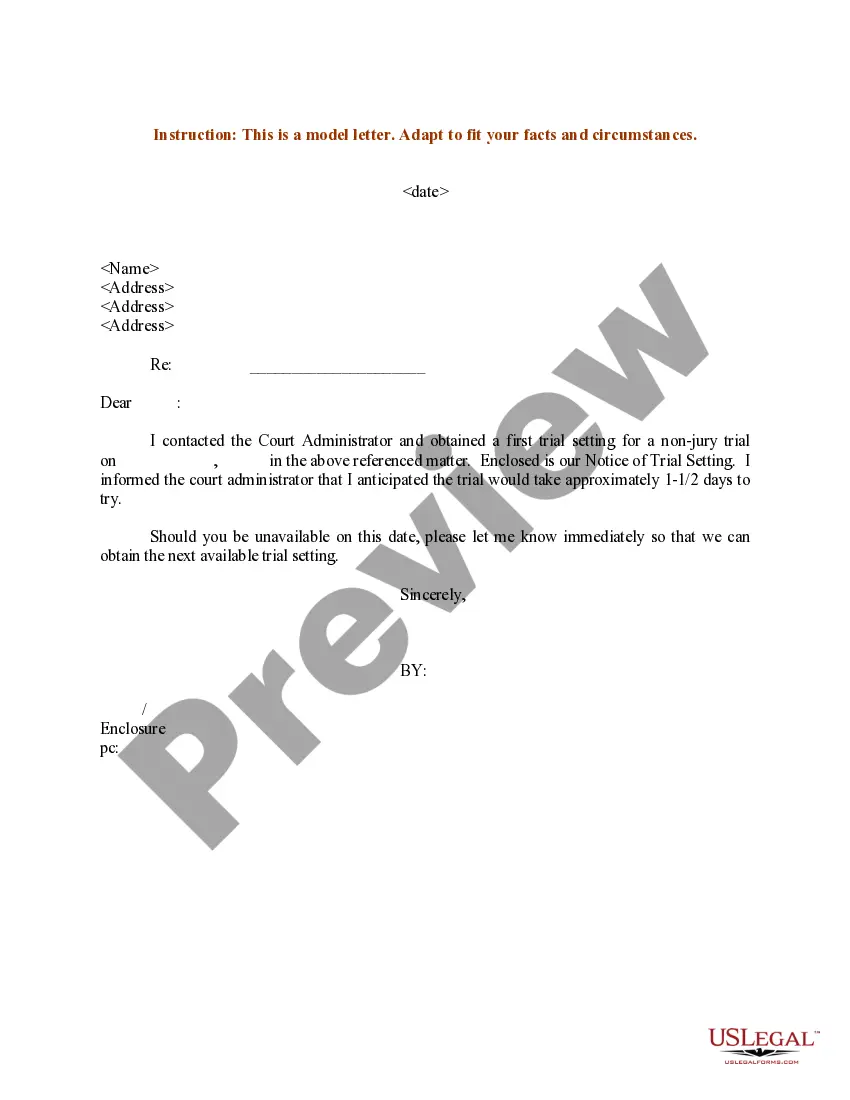
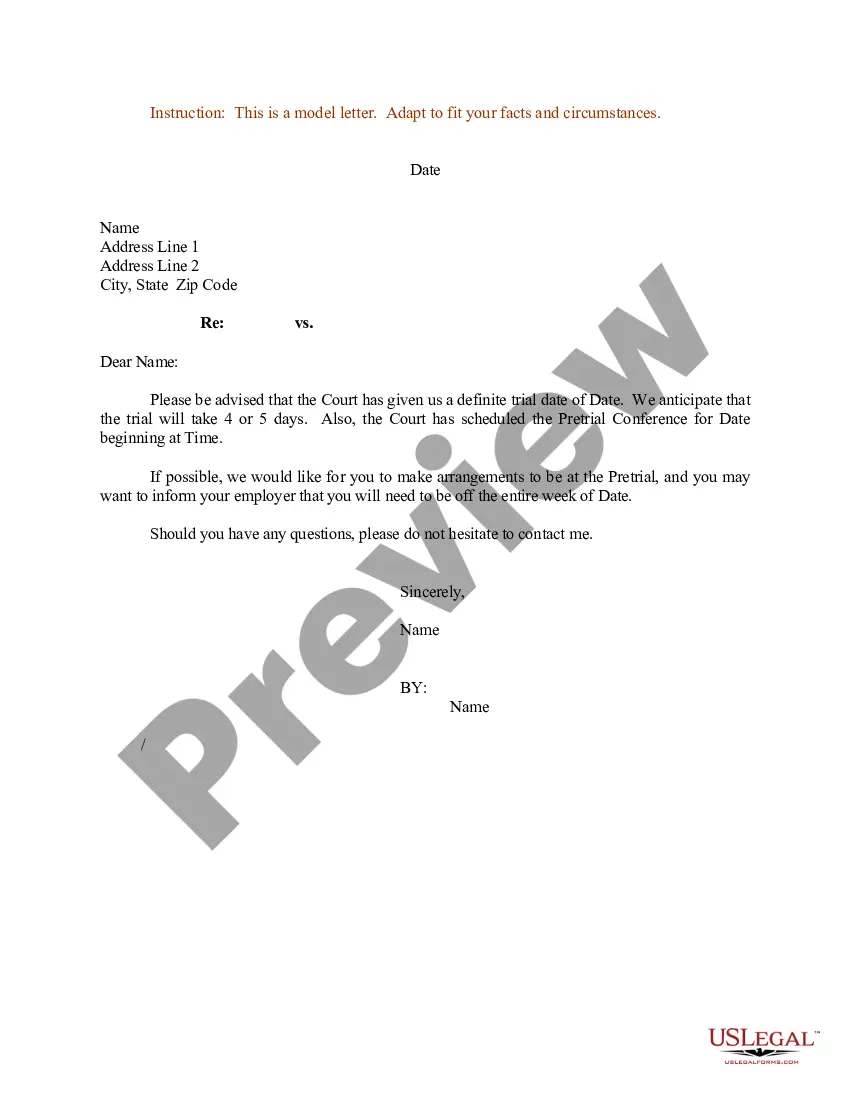
Texas Sample Letter for Trial Setting for Non-Jury Trial
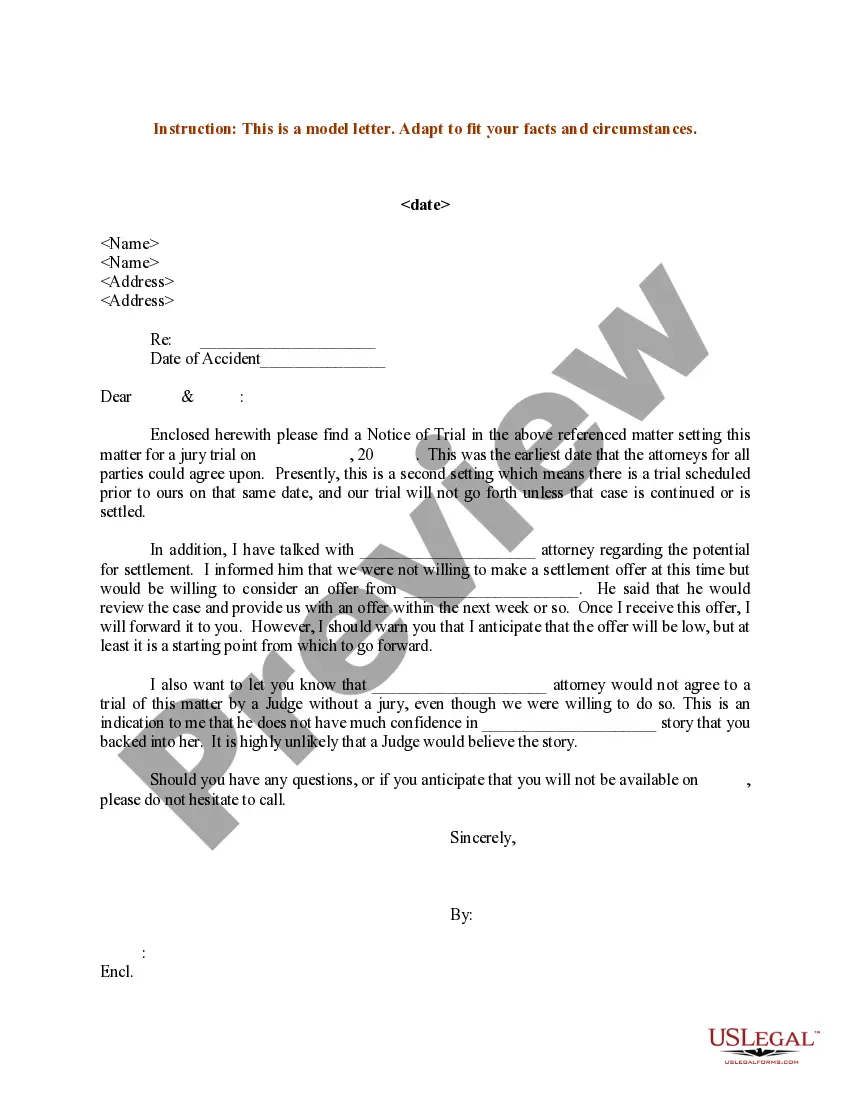
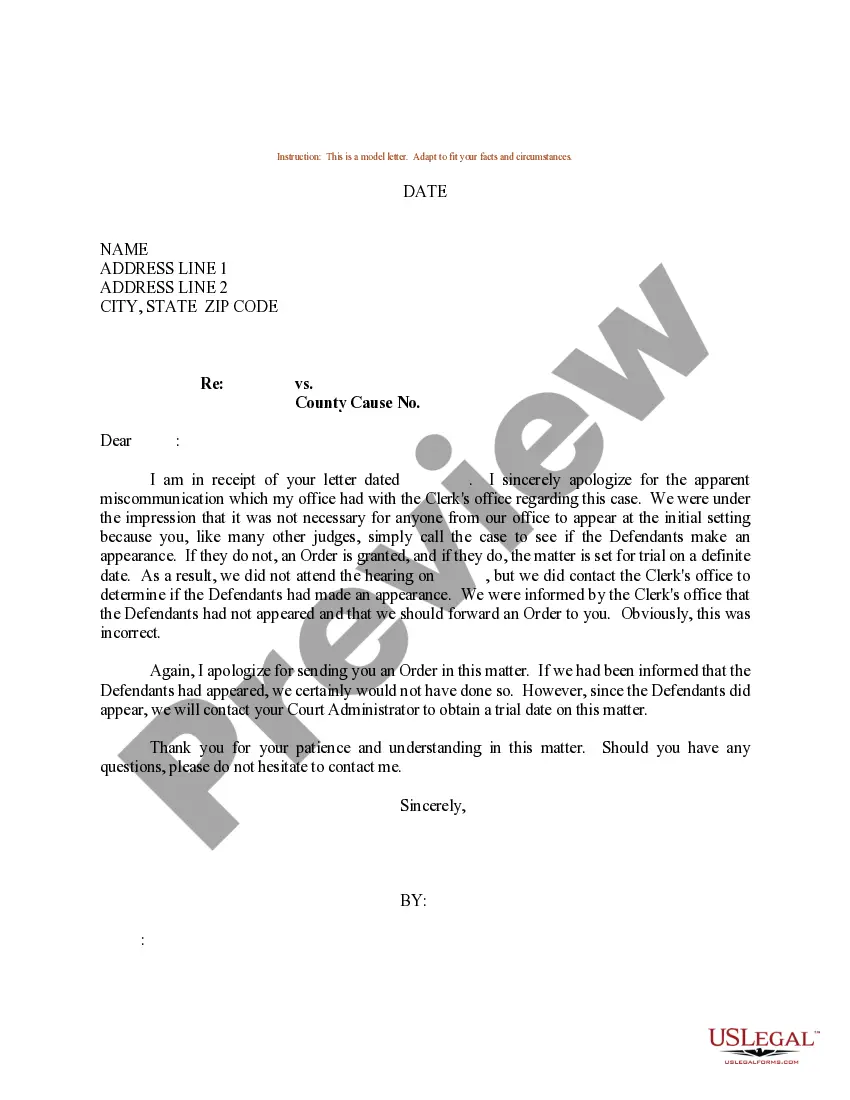
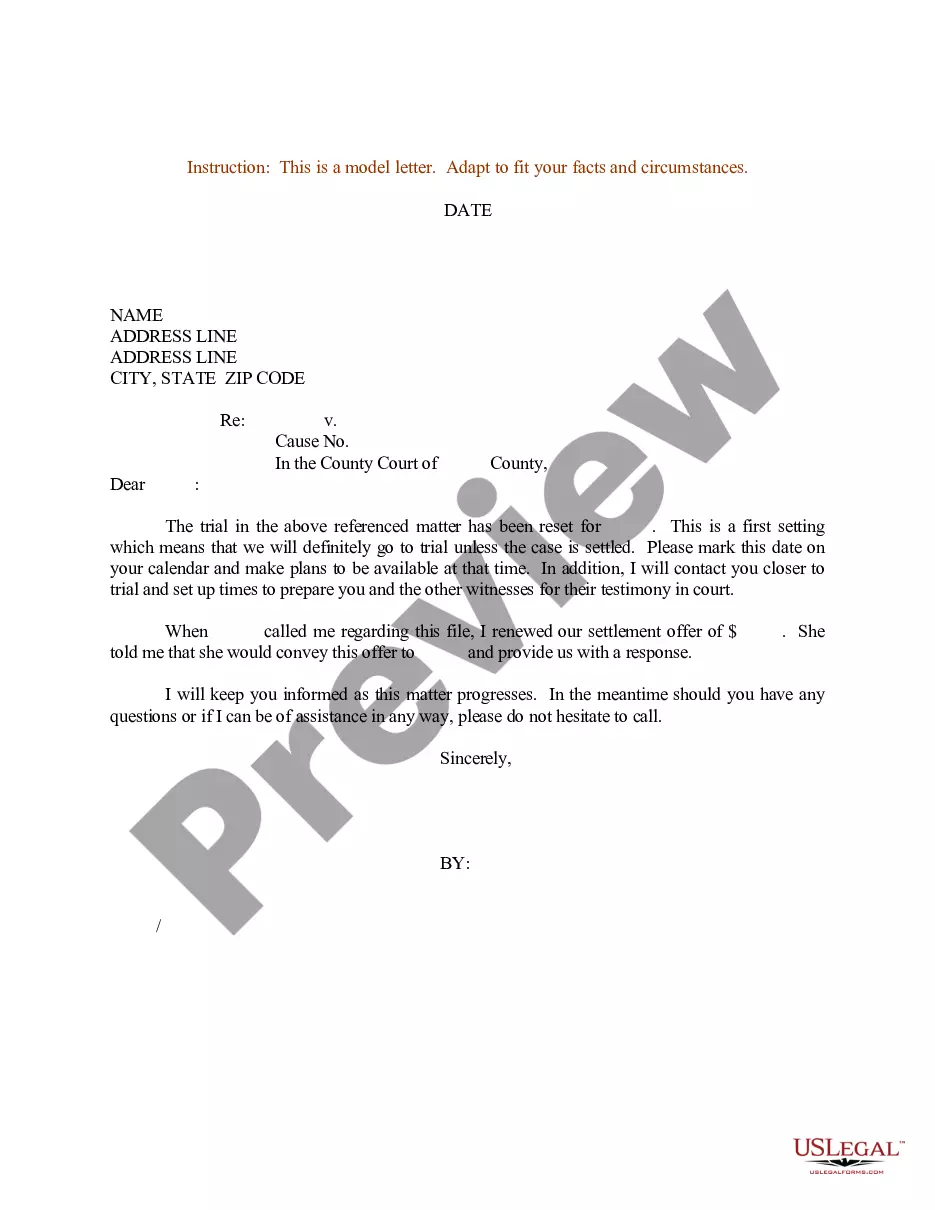
Description
Get your form ready online
Our built-in tools help you complete, sign, share, and store your documents in one place.
Make edits, fill in missing information, and update formatting in US Legal Forms—just like you would in MS Word.
Download a copy, print it, send it by email, or mail it via USPS—whatever works best for your next step.
Sign and collect signatures with our SignNow integration. Send to multiple recipients, set reminders, and more. Go Premium to unlock E-Sign.
If this form requires notarization, complete it online through a secure video call—no need to meet a notary in person or wait for an appointment.
We protect your documents and personal data by following strict security and privacy standards.

Make edits, fill in missing information, and update formatting in US Legal Forms—just like you would in MS Word.

Download a copy, print it, send it by email, or mail it via USPS—whatever works best for your next step.

Sign and collect signatures with our SignNow integration. Send to multiple recipients, set reminders, and more. Go Premium to unlock E-Sign.

If this form requires notarization, complete it online through a secure video call—no need to meet a notary in person or wait for an appointment.

We protect your documents and personal data by following strict security and privacy standards.
Looking for another form?

How to fill out Sample Letter For Trial Setting For Non-Jury Trial?
Are you currently in a circumstance where you need documents for either business or personal purposes every day.
There are numerous legal document templates available online, but locating reliable ones can be challenging.
US Legal Forms offers a vast array of form templates, including the Texas Sample Letter for Trial Setting for Non-Jury Trial, which are designed to comply with state and federal requirements.
Utilize US Legal Forms, the most extensive collection of legal documents, to save time and avoid errors.
The service offers professionally crafted legal document templates that you can use for various purposes. Create an account on US Legal Forms and start making your life a bit easier.
- If you are already familiar with the US Legal Forms site and have an account, simply Log In.
- Then, you can download the Texas Sample Letter for Trial Setting for Non-Jury Trial template.
- If you do not have an account and wish to start using US Legal Forms, follow these steps.
- Obtain the form you need and ensure it is for the correct city/region.
- Use the Review button to examine the form.
- Check the description to confirm you have selected the right form.
- If the form is not what you're looking for, utilize the Search field to find the form that meets your needs and specifications.
- Once you find the correct form, click Acquire now.
- Select the pricing plan you prefer, fill in the necessary information to create your account, and pay for the transaction using your PayPal or credit card.
- Choose a convenient file format and download your copy.
- Find all the document templates you have purchased in the My documents list. You can download an additional copy of the Texas Sample Letter for Trial Setting for Non-Jury Trial at any time if needed. Just select the required form to download or print the document template.
Form popularity
FAQ
Amendment Seven to the Constitution was ratified on December 15, 1791. It protects the right for citizens to have a jury trial in federal courts with civil cases where the claim exceeds a certain dollar value. It also prohibits judges in these trials from overruling facts revealed by the jury.
You have the right to a jury trial. You may waive a jury trial and have a trial before the judge, commonly called a ?bench trial?. If you elect to represent yourself, no person other than an attorney can assist you during your trial.
Any party is entitled to a trial by jury. A written demand for a jury must be filed no later than 14 days before the date a case is set for trial. If the demand is not timely, the right to a jury is waived unless the late filing is excused by the judge for good cause.
Both the defendant and the County Attorney (representing the State of Texas) have the right to a trial by a jury. Sometimes, both sides agree to let a Judge listen to the evidence and decide the case without a jury; this is called a "bench trial".
In civil trials, either the defendant or plaintiff may request a jury trial. However, if neither party makes such a request in writing, the suit will be decided by the judge. Juries decide family law disputes too, such as divorce cases and child custody matters.
Rule 216 - Request and Fee for Jury Trial a. Request. No jury trial shall be had in any civil suit, unless a written request for a jury trial is filed with the clerk of the court a reasonable time before the date set for trial of the cause on the non-jury docket, but not less than thirty days in advance.
Retainer fees for a jury trial range from $25,000 to $75,000. Depending on how long the case will take and where you are at in the process, the case could easily cost more.
What Is a Bench Trial? A bench trial is also often referred to as a trial by judge. This means there is no jury to decide on the case, and the judge will determine if you're guilty. Before you choose which is suitable for you, you should learn the advantages of trial by judge.