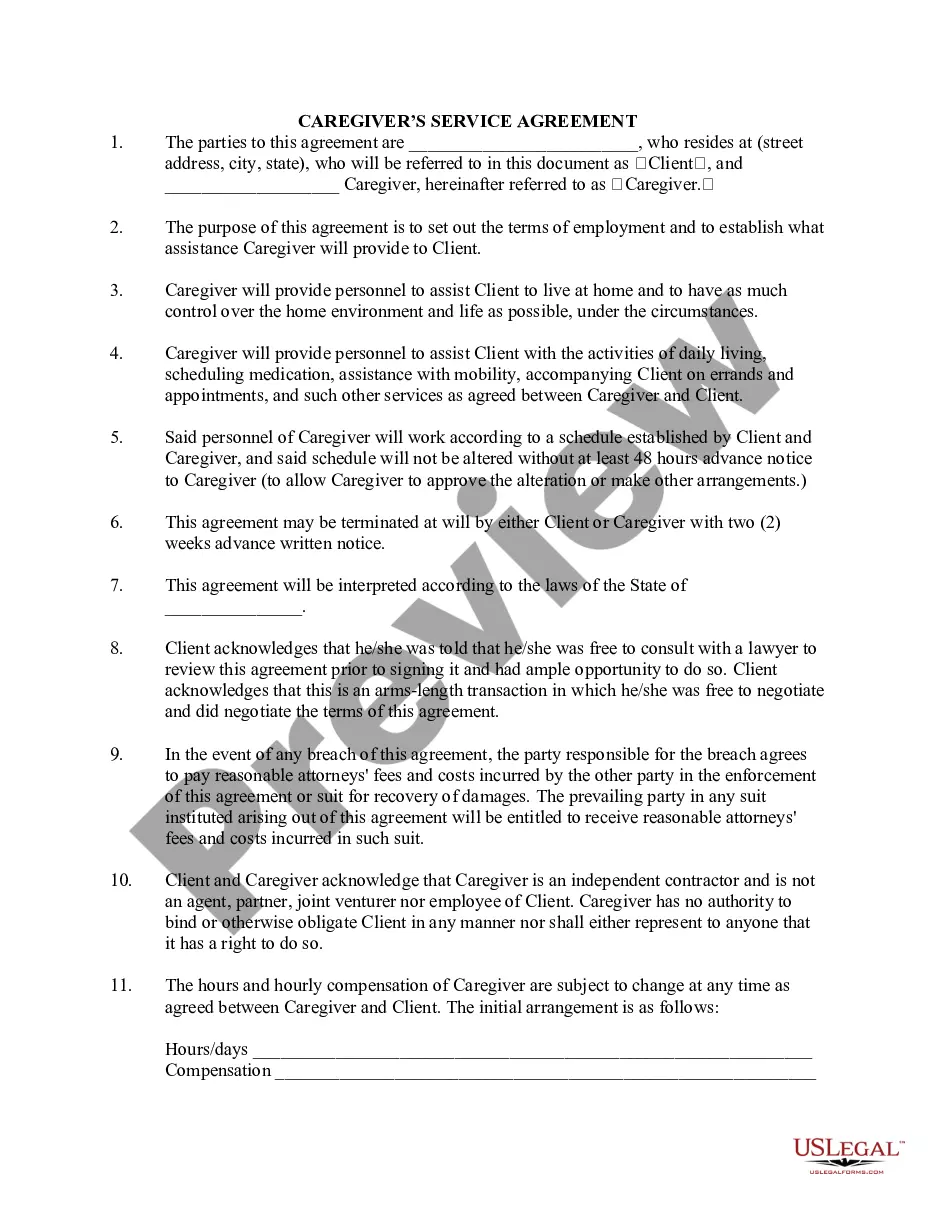
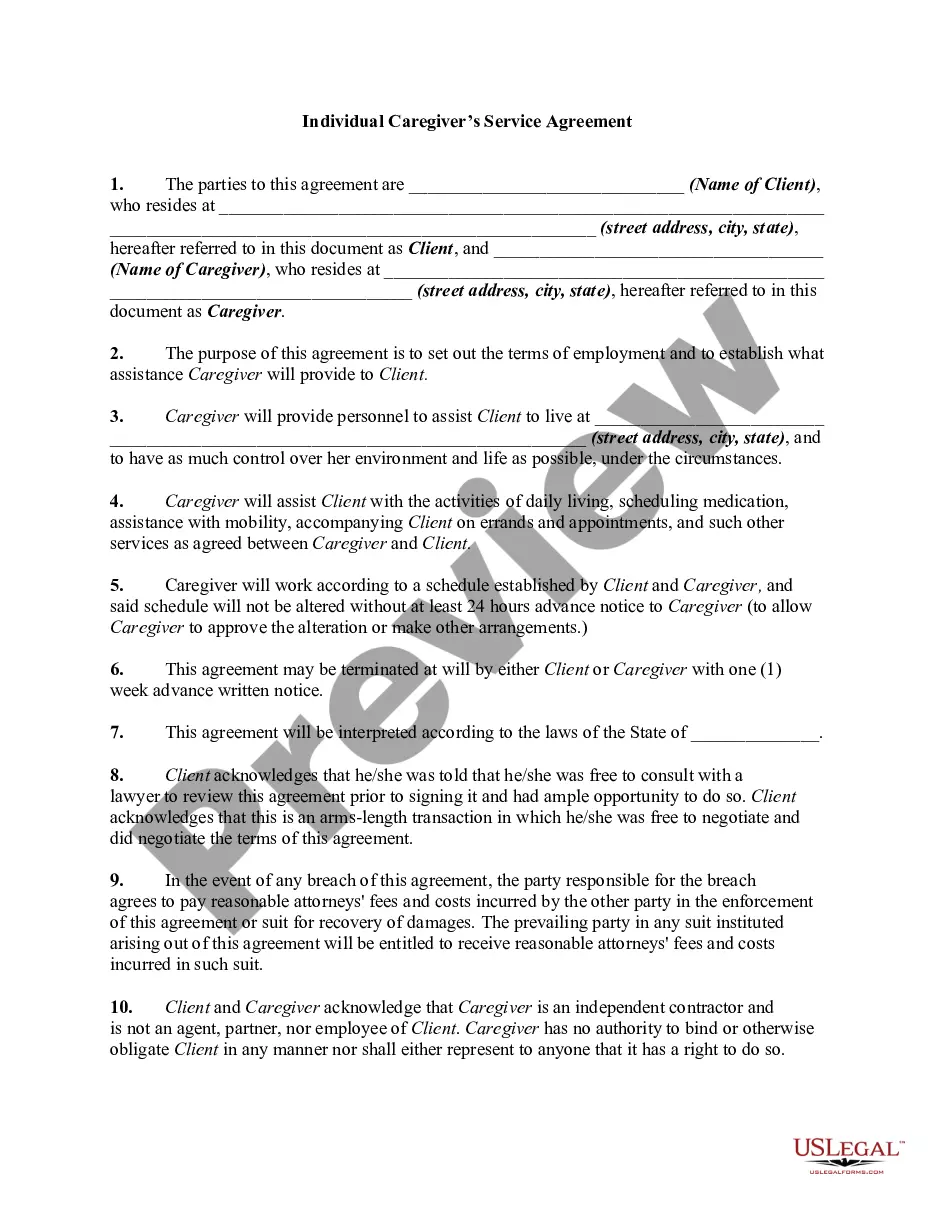
This form is a sample of an agreement between an elderly or disabled client and a Caregiver who operates as an independent contractor and provides personnel to assist Client to live at home and to have as much control over the home environment and life as possible under the circumstances. Caregiver's personnel also assist Client with the activities of daily living, scheduling medication, assistance with mobility, accompanying Client on errands and appointments, and such other services as agreed between Client and Caregiver.
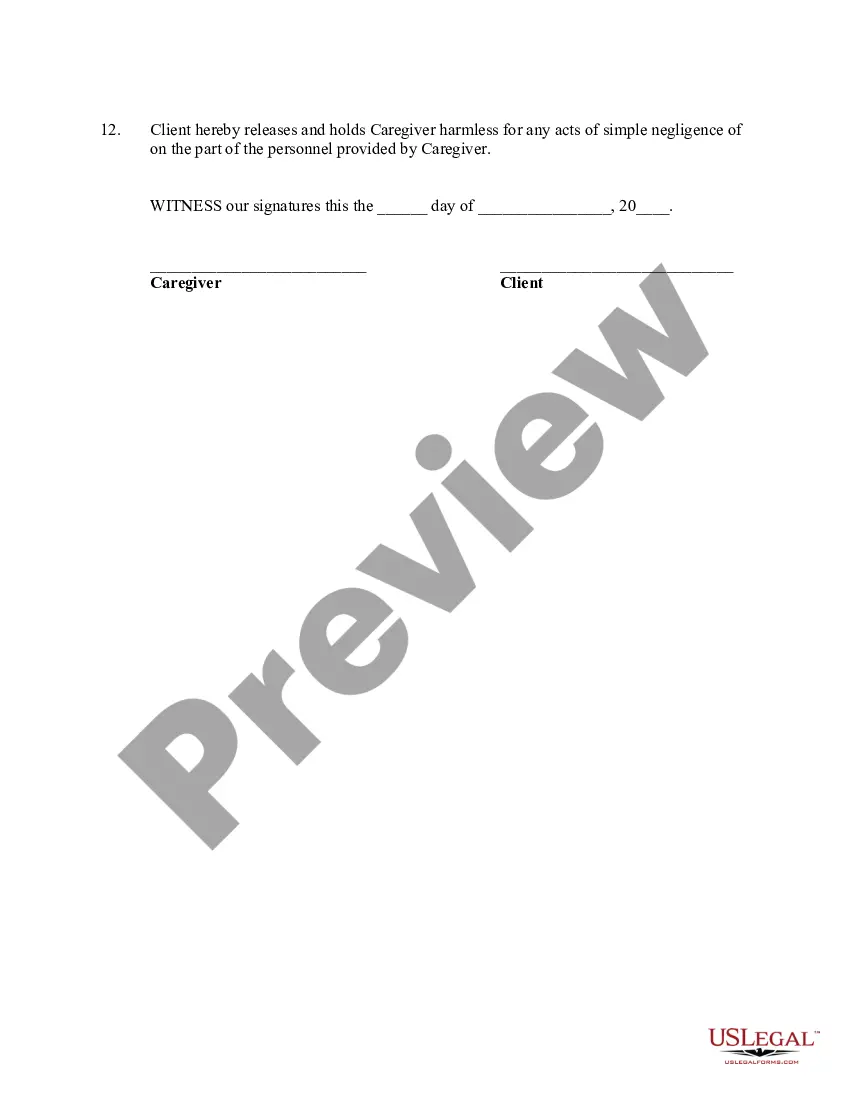
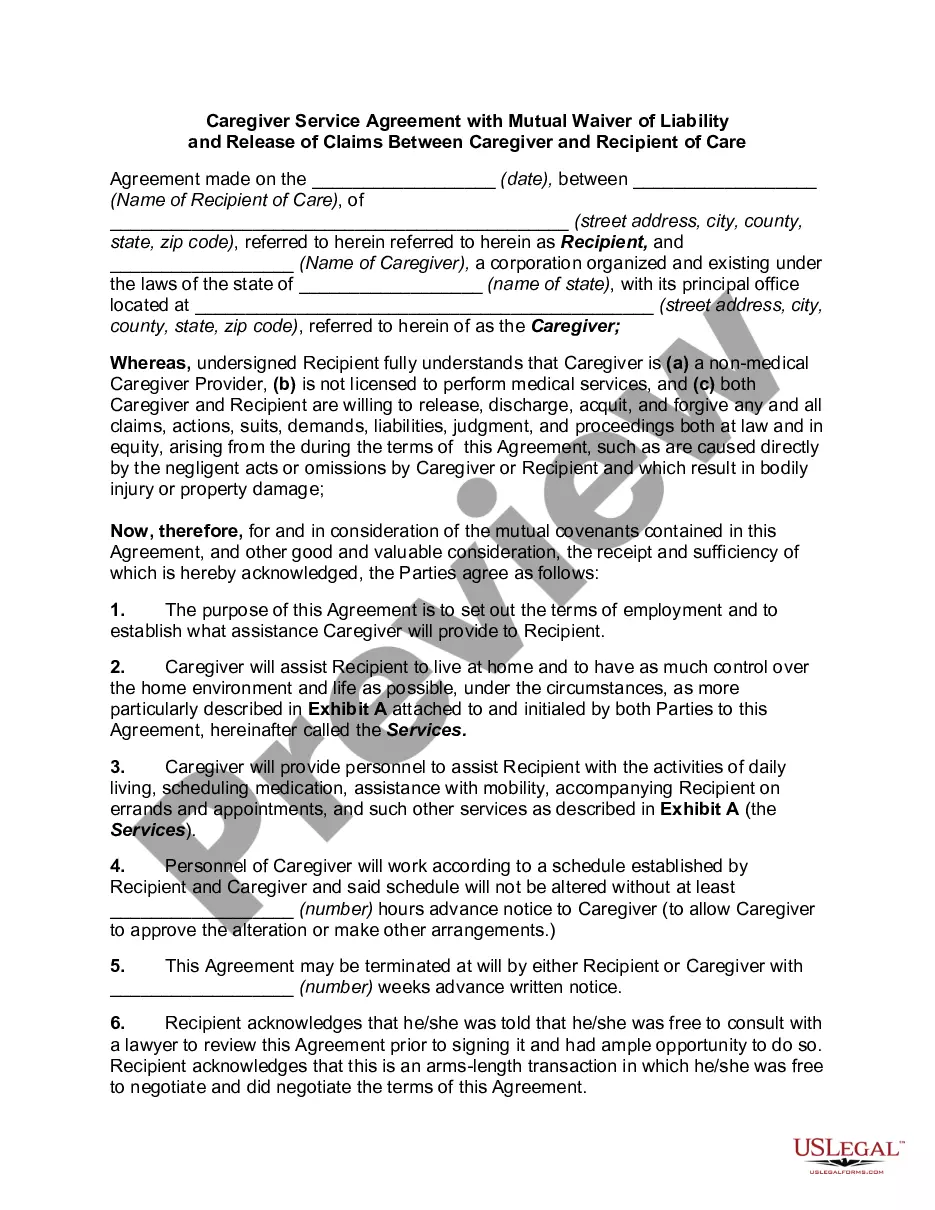
In this agreement, Client waives damages for simple negligence of Caregiver, but not gross negligence or misconduct that is intentional or criminal in nature. Courts generally will not enforce waivers of this type of misconduct since such a waiver would be deemed to be against public policy because it would encourage dangerous and illegal behavior.
Texas Personal Care Service Agreement - Caregiver for Elderly or Disabled - Consent
262 downloads
Description
Free preview
Get your form ready online
Our built-in tools help you complete, sign, share, and store your documents in one place.
Built-in online Word editor
Make edits, fill in missing information, and update formatting in US Legal Forms—just like you would in MS Word.
Export easily
Download a copy, print it, send it by email, or mail it via USPS—whatever works best for your next step.
E-sign your document
Sign and collect signatures with our SignNow integration. Send to multiple recipients, set reminders, and more. Go Premium to unlock E-Sign.
Notarize online 24/7
If this form requires notarization, complete it online through a secure video call—no need to meet a notary in person or wait for an appointment.
Store your document securely
We protect your documents and personal data by following strict security and privacy standards.

Make edits, fill in missing information, and update formatting in US Legal Forms—just like you would in MS Word.

Download a copy, print it, send it by email, or mail it via USPS—whatever works best for your next step.

Sign and collect signatures with our SignNow integration. Send to multiple recipients, set reminders, and more. Go Premium to unlock E-Sign.

If this form requires notarization, complete it online through a secure video call—no need to meet a notary in person or wait for an appointment.

We protect your documents and personal data by following strict security and privacy standards.
Looking for another form?
How to fill out Personal Care Service Agreement - Caregiver For Elderly Or Disabled - Consent?
You might spend multiple hours online trying to discover the appropriate legal document format that meets the state and federal requirements you require.
US Legal Forms provides an extensive collection of legal forms that are reviewed by experts.
You can conveniently download or print the Texas Personal Care Service Agreement - Caregiver for Elderly or Disabled - Consent from our platform.
If available, utilize the Review button to browse through the document format as well.
- If you possess a US Legal Forms account, you can Log In and click on the Acquire button.
- Subsequently, you can complete, modify, print, or sign the Texas Personal Care Service Agreement - Caregiver for Elderly or Disabled - Consent.
- Each legal document format you purchase is yours indefinitely.
- To obtain an additional copy of a purchased document, head to the My documents section and click the appropriate button.
- If you are visiting the US Legal Forms website for the first time, follow the simple instructions provided below.
- First, ensure you have selected the correct document format for your area/region of choice.
- Review the document outline to confirm you have chosen the right document.
Form popularity
FAQ
A caregiver cannot make decisions that require consent without proper authorization, such as accessing a client’s finances or making legal decisions. Caregivers must also refrain from administering prescription medications unless they are qualified to do so. Knowing what caregivers cannot do helps safeguard the individual’s rights and ensures compliance with the Texas Personal Care Service Agreement - Caregiver for Elderly or Disabled - Consent.
Caregivers must adhere to specific boundaries, which include not providing medical treatments unless licensed to do so and not neglecting the needs of the individual they care for. Additionally, caregivers cannot engage in any activities that may harm or manipulate those under their care. Understanding these limitations ensures that caregivers operate within legal and ethical standards, in accordance with the Texas Personal Care Service Agreement - Caregiver for Elderly or Disabled - Consent.
The caregiver law in Texas outlines the legal responsibilities and rights of caregivers, providing a framework for their work. It requires caregivers to act in the best interest of their clients, following the guidelines set in the Texas Personal Care Service Agreement - Caregiver for Elderly or Disabled - Consent. Familiarizing yourself with this law is vital for caregivers, as it protects both them and their clients while delivering quality care.
The community caretaking law in Texas allows law enforcement to intervene in situations where an individual may be in danger or unable to care for themselves. This law supports caregivers by ensuring that emergency services can be accessed when necessary, promoting the safety and well-being of the elderly or disabled. Understanding this law is essential for caregivers as it underlines the importance of their role in safeguarding those they care for under the Texas Personal Care Service Agreement - Caregiver for Elderly or Disabled - Consent.
Caregiver consent refers to the agreement given by a caregiver to provide services as outlined in the Texas Personal Care Service Agreement - Caregiver for Elderly or Disabled - Consent. This consent ensures that caregivers understand their responsibilities and the needs of the individuals they assist. It emphasizes the importance of clear communication and trust between caregivers and clients, which helps foster a positive caregiving environment.
A written agreement, like the Texas Personal Care Service Agreement - Caregiver for Elderly or Disabled - Consent, does not have to be notarized for it to be valid. However, notarization can add an additional measure of legitimacy, especially in case of disputes. It provides assurance to both the caregiver and the client that the terms are recognized and can be upheld when necessary.
The agreement between a caregiver and a client establishes clear expectations regarding care. In a Texas Personal Care Service Agreement - Caregiver for Elderly or Disabled - Consent, both parties agree on the services provided, the schedule, payment structure, and communication guidelines. This mutual understanding not only enhances the caregiving experience but also ensures that the client's needs are met effectively.
In Texas, a caregiver agreement does not necessarily need to be notarized to be legally binding. However, having the Texas Personal Care Service Agreement - Caregiver for Elderly or Disabled - Consent notarized can provide an extra layer of security and credibility for both parties involved. It serves as an official acknowledgment and may simplify potential legal matters in the future.
A legal document for a caregiver outlines the responsibilities of the caregiver and the rights of the client, typically the elderly or disabled individual receiving care. This Texas Personal Care Service Agreement - Caregiver for Elderly or Disabled - Consent ensures both parties understand their roles, including services to be provided, payment terms, and confidentiality matters. Having this document helps avoid misunderstandings and fosters a professional relationship.
While notarization is not always a requirement for a personal care agreement, it is often advisable to provide an additional layer of validation and security. A Texas Personal Care Service Agreement - Caregiver for Elderly or Disabled - Consent can be more effective when properly executed. This process helps clarify the responsibilities and expectations of all involved parties, thereby reducing potential disputes. Platforms like uslegalforms can guide you in creating a legally sound agreement tailored to your specific needs.